
Dutch inventor Boyan Slat said he still believed his $360 million plan could work.

The Ocean Cleanup device floating in a lagoon in Alameda, California, in August 2018.The Ocean Cleanup via EPA
Jan. 4, 2019 / 4:24 AM EST
By James Rainey
An ambitious project to clean up a vast tide of ocean pollution has been sidelined. The project’s 2,000-foot-long screen — which was already failing to capture plastic while stationed more than 1,000 miles off the coast of California — broke apart just before New Year’s under the constant wind and waves of the Pacific Ocean.
The young Dutch inventor who conceived the Ocean Cleanup project, and hopes to one day deploy 60 of the devices to skim plastic debris off the surface of the ocean, said Thursday that he would not be deterred by the setback.
Boyan Slat said in a phone interview from his office in Rotterdam, Netherlands, that the screen would be towed about 800 miles to Hawaii. Once there, it will either be repaired or loaded onto a barge to return to its home port of Alameda, California.
“Of course there is slight disappointment, because we hoped to stay out there a bit longer to do more experiments and to….solve the [plastic] retention issue,” Slat said. “But there is no talk whatsoever about discouragement.
“This is an entirely new category of machine that is out there in extremely challenging conditions,” Slat added. “We always took into account that we might have to take it back and forth a few times. So it’s really not a significant departure from the original plan.”


June 12, 201802:09
But a critic who has followed Slat’s project since he unveiled it more than five years ago said the failure was predictable and that systems deployed closer to shore stand a greater chance of slowing the deluge of plastics spilling into the world’s oceans.
“I certainly hope they will be able to get it to work, but this is a very difficult environment where equipment breaks, which is why you normally do things closer to shore, where things are easier to repair,” said Miriam Goldstein, director of ocean policy at the Center for American Progress, a liberal think tank.
Oceanographers and environmentalists have been concerned with plastics pollution for years, but the issue gained broader public attention in 2018, with many jurisdictions banning plastic drinking straws, eating utensils and bags. The World Economic Forum has projected that the total of plastic debris in the oceans will outweigh all the world’s fish by 2050, if plastics disposal continues unabated.
Slat first came up with his audacious plan to clean the waste from the oceans as a teenager. Now, at 24, he has raised more than $40 million from tech entrepreneurs and thousands of donors. He oversees a staff of more than 80 engineers, oceanographers and others.
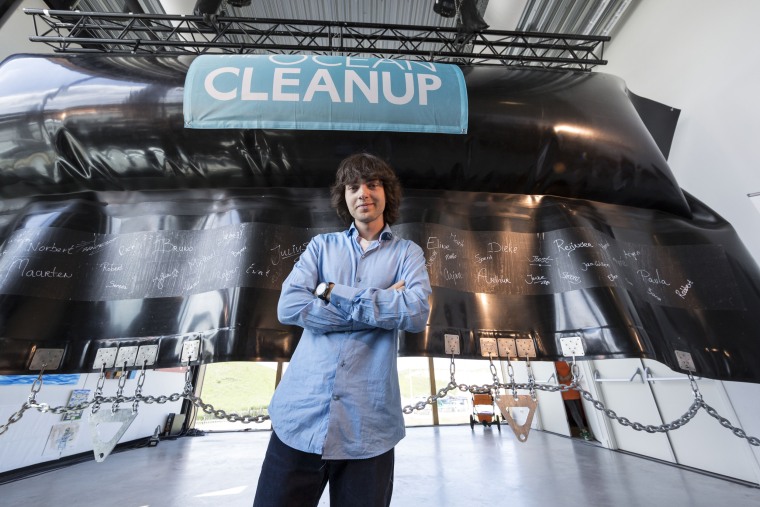 Boyan Slat poses during the unveiling of an Ocean Cleanup prototype in June 2016 in The Hague, Netherlands.Michel Porro / Getty Images file
The crew has designed a pipe-shaped plastic barrier that floats atop the ocean, with a 10-foot-tall screen of impermeable synthetic textile hanging beneath the surface. The device is designed to move with the wind and waves, fast enough that the U-shaped “array” will hold plastic — which can periodically be picked up and shipped away to recycling centers.
With an estimated cost of nearly $6 million per screen, a total of $360 million would be needed to operate 60 of the strainers for three years in the Pacific, the Ocean Cleanup project says.
But for now, Slat and his team need to get their prototype working.
Read the full story here
HT/Neo
via Watts Up With That?
January 6, 2019 at 12:08AM

