Month: March 2019

What’s the worst case? Emissions/concentration scenarios

by Judith Curry

Is the RCP8.5 scenario plausible?

This post is Part II in the possibility series (for an explanation of the possibilistic approach, see previous post link).  This paper also follows up on a recent series of posts about RCP8.5 [link].

3. Scenarios of emissions/concentration

Most worst-case climate outcomes are associated with climate model simulations that are driven by the RCP8.5 representative concentration pathway (or equivalent scenarios in terms of radiative forcing). No attempt has been made to assign probabilities or likelihoods to the various emissions/concentration pathways (e.g. van Vuuren et al. 2011), based on the argument that the pathways are related to future policy decisions and technological possibilities that are considered to be currently unknown.

The RCP8.5 scenario was designed to be a baseline scenario that assumes no greenhouse gas mitigation and no impacts of climate change on society. This scenario family targets a radiative forcing of 8.5 W m-2 from anthropogenic drivers by 2100, which is nominally associated with an atmospheric CO2 concentration of 936 pm (Riahi et al. 2007). Since the scenario outcome is already specified (8.5 W m-2); the salient issue is whether plausible storylines can be formulated to produce the specified outcome associated with RCP8.5.

A number of different pathways can be formulated to reach RCP8.5, using different combinations of economic, technological, demographic, policy, and institutional futures. These scenarios generally include very high population growth, very high energy intensity of the economy, low technology development, and a very high level of coal in the energy mix. Van Vuuren et al. (2011) report that RCP8.5 leads to a forcing level near the 90th percentile for the baseline scenarios, but a literature review at that time was still able to identify around 40 storylines with a similar forcing level.

Storylines for the RCP8.5 scenario and its equivalents have been revised with time as our background knowledge changes. To account for lower estimates of future world population growth and much lower outlooks for emissions of non-CO2 gases, more CO2 must be released to the atmosphere to reach 8.5 W m-2 by 2100 (Riahi et al., 2017). For the forthcoming IPCC AR6, the comparable SSP5-8.5 scenario is associated with an atmospheric CO2 concentration of almost 1100 ppm by 2100 (O’Neill et al. 2016), which is a substantial increase relative to the 936 ppm reported by Riahi et al. (2007).

As summarized by O’Neill et al. (2016) and Kriegler et al. (2017), the SSP5-8.5 baseline scenarios exhibit rapid re-carbonization, with very high levels of fossil fuel use (particularly coal). The plausibility of the RCP8.5-SSP5 family of scenarios is increasingly being questioned. Ritchie and Dowlatabadi (2018) challenge the bullish expectations for coal in the SSP5-8.5 scenarios, which are counter to recent global energy outlooks. They argue that the ‘return to coal’ scenarios exceed today’s knowledge of conventional reserves. Wang et al. (2017) has also argued against the plausibility of the existence of extensive reserves of coal and other easily-recoverable fossil fuels to support such a scenario.

Most importantly, Riahi et al. (2017) found only one single baseline scenario of the full set (SSP5) reaches radiative forcing levels as high as the one from RCP8.5 (compared with 40 cited by van Vuuren et al. 2011). This finding suggests that 8.5 W/m2 can only emerge under a very narrow range of circumstances. Ritchie and Dowlatabadi (2018) notes that further research is needed to determine if plausible high emission reference cases consistent with RCP8.5 could be developed with storylines that do not lead to re-carbonization.

Given the socio-economic nature of most of the assumptions entering into the SSP-RCP storylines, it is difficult to argue that the SSP5-RCP8.5 scenarios are impossible. However, numerous issues have been raised about the plausibility of this scenario family. Given the implausibility of re-carbonization scenarios, current fertility (e.g. Samir and Lutz, 2014) and technology trends, as well as constraints on conventional coal reserves, a categorization of RCP8.5 as ‘borderline impossible’ is justified based on our current background knowledge.

Based on this evidence, Ritchie and Dowlatabadi (2017) conclude that RCP8.5 should not be used as a benchmark for future scientific research or policy studies. Nevertheless, the RCP8.5 family of scenarios continues to be widely used, and features prominently in climate change assessments (e.g. CSSR, 2017).

JC note:  next installment is climate sensitivity

via Climate Etc.

https://ift.tt/2uyagFB

March 28, 2019 at 11:41AM

Get a Second Opinion Before Climate Surgery


Myron Ebell writes March 28, 2019 in the Sacramento Bee PRO: Climate Science Needs a Critical Review by Skeptical Experts Excerpts in italics with my bolds.

Is global warming a looming catastrophe? President Donald Trump has often said he doesn’t think so even while his administration continues to release official reports warning that it is.

The president will soon find out who is right by convening a high-level commission to do a critical review of the fourth National Climate Assessment issued last November and other government reports.

Surprisingly, most of the climate science funded by the federal government has never been subjected to the kind of rigorous and exhaustive review that is common practice for other important scientific issues and major engineering projects.

For example, when NASA was putting men on the moon, every piece of equipment and every calculation were scrutinized from every possible angle simply because if anything went wrong the mission would fail.

Serious problems and shortcomings with official climate science have been raised repeatedly in the past by highly qualified scientists such as Princeton’s brilliant physics professor William Happer only to be ignored or dismissed by the federal agencies in charge of producing the reports.

Yet the conclusions and predictions made in these official climate science reports are the basis for proposed energy policies that could cost trillions of dollars in less than a decade and tens of trillions of dollars over several decades.

Given the magnitude of the potential costs involved, taking on trust the bureaucratic processes that have led to official consensus is simply foolish. Thus the review to be undertaken by the proposed President’s Commission on Climate Security is long overdue.

To mention only three major issues among many that need to be scrutinized:

First, the computer models used have predicted far more warming than has occurred over the past 40 years. Why have such models failed and why are they still used are important questions.

Second, predictions of the various negative impacts of warming, such as sea level rise, are derived from highly unrealistic scenarios; and positive impacts, such as less ferocious winter storms, are minimized or ignored. What would a more honest accounting of all the possible impacts of climate change look like?

Third, surface temperature data sets appear to have been manipulated to show more warming in the past century than has occurred. The new commission should insist that the debate be based on scrupulously reliable data.

Since news of the proposed review leaked out in February, a furious campaign to stop it has been mounted by the federal climate bureaucracy and their allies in the climate industrial complex.

On the surface, this seems puzzling. If the alarmists are confident that the science contained in the official reports is spot on, they should welcome a review that would finally put to rest the doubts that have been raised.

On the other hand, their opposition suggests that the science behind the climate consensus is highly suspect and cannot withstand critical review. In other words, they’ve been peddling junk and are about to be found out.

A press release from one alarmist pressure group was headlined: “58 Senior Military and National Security Leaders Denounce NSC Climate Panel.”

Denouncing an expert review seems a most inappropriate response, and especially to one that is designed to be open and subject to further review by other experts, such as the National Academies of Science.

I wonder if environmental pressure groups have ever denounced doing another environmental review of projects – for example, the Keystone XL pipeline – they are trying to stop.

Two prominent promoters of global warming alarmism recently published an op-ed in which they accused the Trump administration of using “Stalinist tactics” to try to discredit the climate science consensus.

Let’s hope that they’re not as ignorant about science as they are about history. It’s the enforcers of climate orthodoxy and opponents of open debate who are using Stalinist tactics.

via Science Matters

https://ift.tt/2OtJqHN

March 28, 2019 at 11:28AM

Scientists: The CO2 Greenhouse Effect Was Cancelled Out By Clouds During 1992-2014

The Greenhouse Effect On Hiatus

An unheralded but significant 2016 scientific paper – “A Hiatus of the Greenhouse Effect” – is now publicly available.

Scientists have found the greenhouse effect’s (GHE) influence on planetary temperatures went on “hiatus” during 1992-2014.

The estimated GHE radiative influence for these 22 years was a slightly negative -0.04 Wm-2 per year.

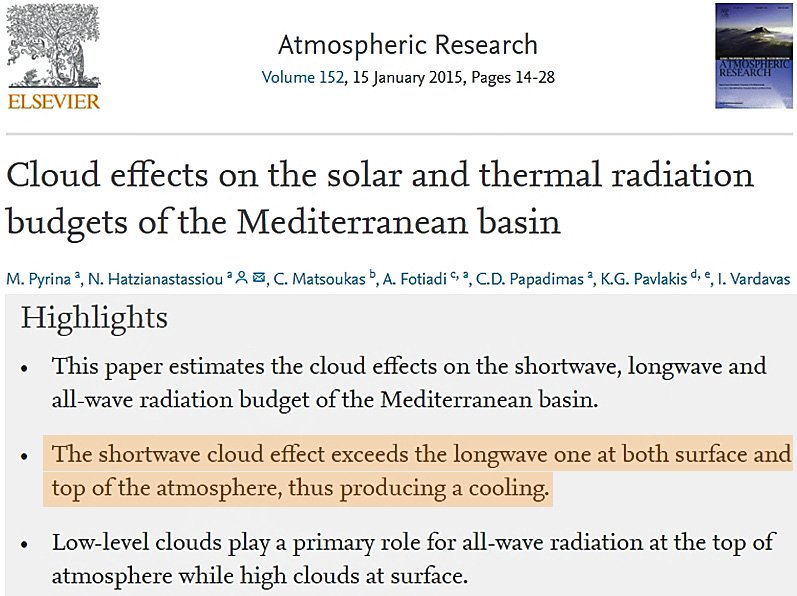
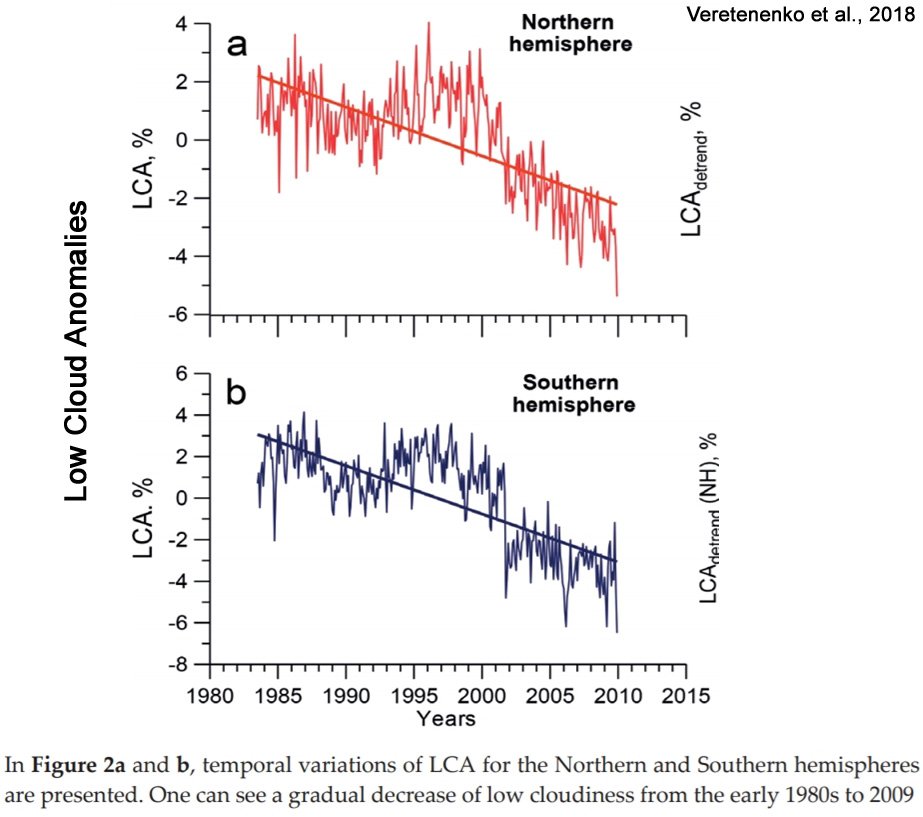
The reason why the GHE influence went on hiatus in recent decades is that (a) decadal-scale changes in cloud cover exert dominant radiative control in longwave forcing (GHE) efficacy, and (b) the shortwave effects of cloud cover changes override the radiative longwave effects, meaning that a decrease in cloud cover will allow more direct shortwave radiation to be absorbed by the Earth system, eliciting a net positive imbalance in the energy budget.

Image Source(s): Wielicki et al., 2002, Ramanathan et al., 1989, Longman et al., 2014

As a consequence, a decadal-scale reduction in cloud cover, which has been observed via satellite since the 1990s, effectively “offsets” or cancels out the GHE influence from gases such as water vapor and CO2.

“Overall, the downward tendency of clouds is the dominant contributor to the greenhouse effect hiatus.” (Song et al., 2016)

The implications for this analysis are profound.

During 1992-2014, the global CO2 concentration rose from 356 ppm to 398 ppm, an increase of 42 ppm.

If this level of CO2 enhancement within the GHE can be so easily “offset” by a decadal-scale decrease in cloud cover, then the climate’s sensitivity to CO2 concentration changes should be regarded as significantly less influential than climate models currently profess.

Indeed, if the climate’s sensitivity to CO2 is so expungeable that a small change in cloud cover can effectively wipe out the potential influence of over 100 gigatons of CO2 emissions, then modern efforts to mitigate CO2 emissions by transitioning to solar and wind power may therefore be not only ineffectual, but rather pointless.


Image Source: Song et al., 2016

Image Source: Khilyuk and Chilingar, 2006

via NoTricksZone

https://ift.tt/2FxVXG6

March 28, 2019 at 11:05AM

Day3 – Peter Ridd versus James Cook University -Uni and State-sponsored Media Stuck in Denial

Dr. Jennifer Marohasy writes: Professor Peter Ridd’s trial in the Brisbane Federal Circuit Court has just wrapped-up after three days. With Judge Salvadore Vasta presiding, Stuart Wood QC acting for Peter Ridd (the applicant) argued the case with great skill. However, on the most critical of issues the university (the defendant), and important media, refused…

via Watts Up With That?

https://ift.tt/2FHkNEI

March 28, 2019 at 11:03AM