
Abstract
Most Earth system models agree that land will continue to store carbon due to the physiological effects of rising CO2 concentration and climatic changes favoring plant growth in temperature-limited regions. But they largely disagree on the amount of carbon uptake. The historical CO2 increase has resulted in enhanced photosynthetic carbon fixation (Gross Primary Production, GPP), as can be evidenced from atmospheric CO2 concentration and satellite leaf area index measurements. Here, we use leaf area sensitivity to ambient CO2 from the past 36 years of satellite measurements to obtain an Emergent Constraint (EC) estimate of GPP enhancement in the northern high latitudes at two-times the pre-industrial CO2 concentration (3.4 ± 0.2 Pg C yr−1). We derive three independent comparable estimates from CO2 measurements and atmospheric inversions. Our EC estimate is 60% larger than the conventionally used multi-model average (44% higher at the global scale). This suggests that most models largely underestimate photosynthetic carbon fixation and therefore likely overestimate future atmospheric CO2 abundance and ensuing climate change, though not proportionately.
Introduction
Predicting climate change requires knowing how much of the emitted CO2 (currently ~40 Pg CO2 yr−1) will remain in the atmosphere (~46%) and how much will be stored in the oceans (~24%) and lands (~30%)1. Earth system models (ESM) show a large spread in projected increase of terrestrial photosynthetic carbon fixation (GPP)2,3,4,5,6 and are thought to overestimate current estimates5,7, although the latter is also subject of debate5,8,9,10,11. Historical increase of atmospheric CO2 concentration, from 280 to current 400 ppm, has resulted in enhanced GPP due to its radiative12 and physiological13,14 effects, which is indirectly evident in amplified seasonal swings of atmospheric CO2 concentration15,16,17 and large scale increase in summer time green leaf area18,19,20. Thus, these observables, expressed as sensitivities to ambient CO2 concentration, might serve as predictors of changes in GPP21,22,23,24 and help to reduce uncertainty in multi-model projections of terrestrial carbon cycle entities.
This study is focused on the northern high latitudes (NHL, north of 60°N) where significant and linked changes in climate25 and vegetation15 have been observed in the past 3–4 decades: 52% of the vegetated lands show statistically significant greening trends over the 36-year record of satellite observations26 (1981–2016, Methods), while only 12% show browning trends, mostly in the North American boreal forests due to disturbances27 (Fig. 1). We therefore hypothesize that the greening sensitivity (i.e., leaf area index, LAI, changes in response to changes in the driver variables) inferred from the historical period of CO2 increase can be used to obtain a constrained estimate23 of future GPP enhancement from both the radiative and physiological effects (Supplementary Fig. 1).
Fig. 1
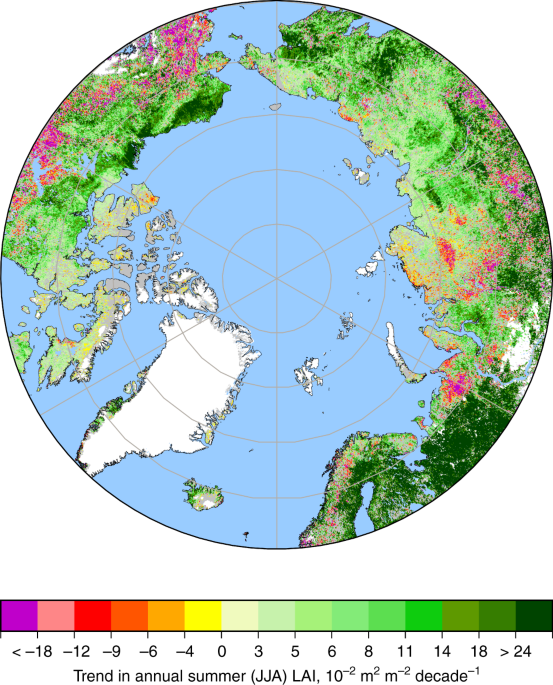
Greening (LAI increase) and browning trends during 1981–2016 in the northern high latitudes. Statistically significant (Mann–Kendall test, p < 0.1) trends in summer (June–August) average LAI are color coded. Non-significant changes are shown in gray. White areas depict ice sheets or barren land. Details of the LAI data set are provided in Methods. The figure was created using the cartographic python library Cartopy (Release: 0.16.0)
State-of-the-art fully coupled carbon-climate ESMs vary in their representation of many key processes, e.g., vegetation dynamics, carbon–nitrogen interactions, physiological effects of CO2 increase, climate sensitivity, etc. This results in divergent trajectories of evolution of the 21st century carbon cycle4,5,6. To capture this variation, we use two sets of simulations28 available from seven ESMs23 from the Coupled Model Intercomparison Project Phase 5 (CMIP5)—one with historical forcings including anthropogenic CO2 emissions for the period 1850–2005 and the second with idealized forcing (1% CO2 increase per year, compounded annually, starting from a pre-industrial value of 284 ppm until quadrupling). In our analyses, the magnitude of the physiological effect is represented by the CO2 concentration and the radiative effect by growing degree days (GDD0, > 0 °C, Methods) as plant growth in NHL is principally limited by the growing season temperature12. Leaf area changes can be represented either by changes in annual maximum LAI (LAImax)29 or growing season average LAI—we use the former because of its ease and unambiguity, as the latter requires quantifying the start- and end-dates of the growing season, something that is difficult to do accurately in NHL30 with the low-resolution model data.
Here, we apply the concept of Emergent Constraints (EC) to reduce uncertainty in multi-model projections of GPP using historical simulations and satellite observations of LAI focusing on NHL. We find that the EC estimate is 60% larger than the commonly accepted multi-model mean value, in line with a recent study that assessed the impact of physiological effects of higher CO2 concentration on GPP of northern hemispheric extra-tropical vegetation23. Detailed independent analyses of in-situ CO2 measurements and atmospheric inversions imbue confidence in our conclusions. Our central finding is, the effect of ambient CO2 concentration on terrestrial photosynthesis is larger than previously thought, and thus, has important implications for future carbon cycle and climate.
via Watts Up With That?
June 18, 2019 at 01:04PM
 Iowa Climate Science Education
Reblogged this on Climate- Science.
LikeLike