
Guest Ayeuhhh???? by David Middleton
Meanwhile, oil, gas, and coal companies are killing many of the 22,000 remaining polar bears by melting the ice and destroying habitat, yet get away with it.
Man charged in Alaska for killing a polar bear and burning body after letting it rot 5 monthshttps://t.co/48bxn1EsHl
— Mark Z. Jacobson (@mzjacobson) July 12, 2019
Let’s identify the non sequitur first… The man who killed the polar bear, leaving it to rot for five months and then burning the carcass, did not work in the “climate wrecking” industry.
Man charged in Alaska for killing a polar bear and burning the body after letting it rot for 5 months
By Allen Kim, CNN
Updated 2:27 PM ET, Fri July 12, 2019(CNN)A man in an Alaska village has been charged with federal crimes for allegedly killing a polar bear and leaving it to rot for five months.
Christopher Gordon of Kaktovik is accused of violating the Marine Mammal Protection Act after he allegedly shot and killed a polar bear around December 20, 2018.
[…]
Katkovik, with about 250 residents, is some 640 miles north of Anchorage.
Officials say Gordon improperly stored whale meat in his front yard, which attracted the polar bear. Gordon allegedly shot and killed the polar bear for trying to eat the whale meat, not to defend himself or someone else.
Investigators say the carcass sat in Gordon’s yard from late December until May, when a snow removal vehicle hit the bear’s body and tore off one of its legs.
[…]
The funny thing is that he wouldn’t have broken the law if he ate the bear.
Katkovik is in the “no drill” zone…
So… The “climate wrecking” industry had nothing to do with the demise of this particular polar bear.
Kaktovik has apparently become a tourist attraction because polar bears are ignoring the climate models. Instead of drowning for wildlife photographers, they just move onto land when the sea ice melts.
Kaktovik is a small Inupiaq village on the northern coast of Barter Island in the Arctic National Wildlife Refuge. Last year, the Associated Press reported that the village was seeing a tourism boom as polar bears have been spending more time on land than on diminishing sea ice.
Even funnier thing… Christopher Gordon is a Democrat. While I can’t be 100% certain he doesn’t work in the oil & gas industry (no LinkedIn page), he lives in the Alaska National Wildlife Refuge, votes Democrat and apparently likes to eat whale meat… The again, maybe he’s a Cajun. (Note: I will not tell you when I’m being sarcastic.)
Now that we’ve solved the case of the Kaktovik polar bear, let’s get to the “meat” of Dr. Jacobson’s Twit Tweet…
Meanwhile, oil, gas, and coal companies are killing many of the 22,000 remaining polar bears by melting the ice and destroying habitat, yet get away with it.
Mark Z. Jacobson
Really?
November 14, 2018
First tally of U.S.-Russia polar bears finds a healthy population
Hannah Hickey
UW NewsNot all polar bears are in the same dire situation due to retreating sea ice, at least not right now. Off the western coast of Alaska, the Chukchi Sea is rich in marine life, but the number of polar bears in the area had never been counted. The first formal study of this population suggests that it’s been healthy and relatively abundant in recent years, numbering about 3,000 animals.
The study by researchers at the University of Washington and federal agencies is published Nov. 14 in Scientific Reports, an open-access journal from the Nature Publishing Group.
“This work represents a decade of research that gives us a first estimate of the abundance and status of the Chukchi Sea subpopulation,” said first author Eric Regehr, a researcher with the UW’s Polar Science Center who started the project as a biologist in Alaska with the U.S. Fish and Wildlife Service. “Despite having about one month less time on preferred sea ice habitats to hunt compared with 25 years ago, we found that the Chukchi Sea subpopulation was doing well from 2008 to 2016.
[…]
Of the world’s 19 subpopulations of polar bears, the U.S. shares two with neighboring countries. The other U.S. subpopulation — the southern Beaufort Sea polar bears, whose territory overlaps with Canada — is showing signs of stress.
“The southern Beaufort Sea subpopulation is well-studied, and a growing body of evidence suggests it’s doing poorly due to sea-ice loss,” Regehr said.
[…]
Recent ecological observations had suggested that Chukchi Sea bears are doing well. A study led by co-author Karyn Rode, at the U.S. Geological Survey, showed the top predators have similar amounts of body fat as 25 years ago, a good indicator of their overall health.
The current study is the first assessment of the subpopulation size using modern methods. It estimates just under 3,000 animals, with generally good reproductive rates and cub survival.
[…]
For the first time, the model also considered local and traditional ecological knowledgecollected by the North Slope Borough of Alaska from Native hunters and community members who have generations of experience with polar bears.
“It was important to bring our science together with the observations and expertise of people who live in polar bear country year-round and understand the animals in different ways,” Regehr said.
[…]
If the loss of sea ice due to global warming is stressing out the Beaufort Sea polar bears, why are they doing so well in the Chukchi Sea?
The Chukchi Sea is more ice-free than the Beaufort Sea…
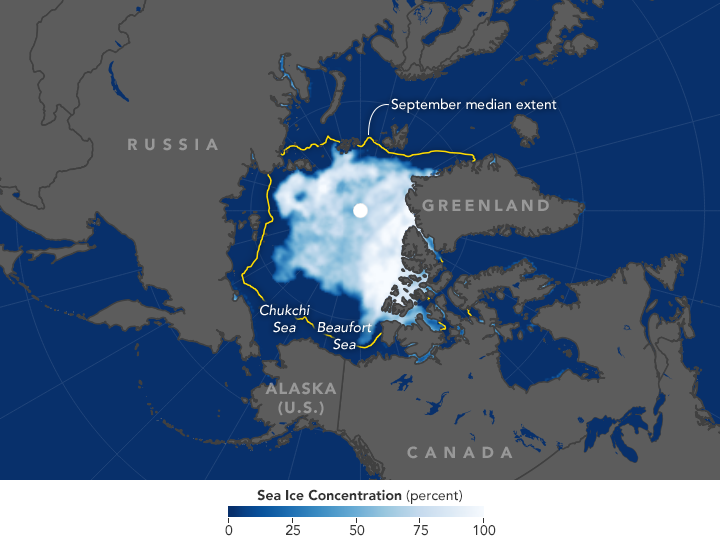
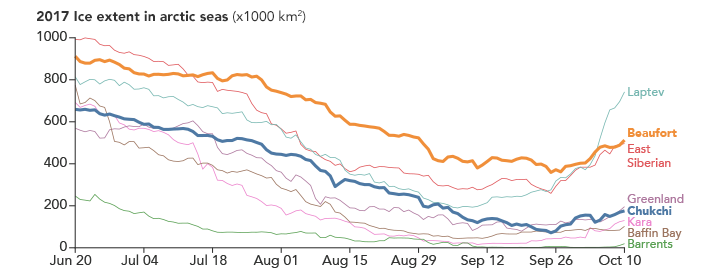
The “core study area” was the between Lisburne and Seward Peninsulas…

The “core study area” has been especially hard-hit by sea ice loss…


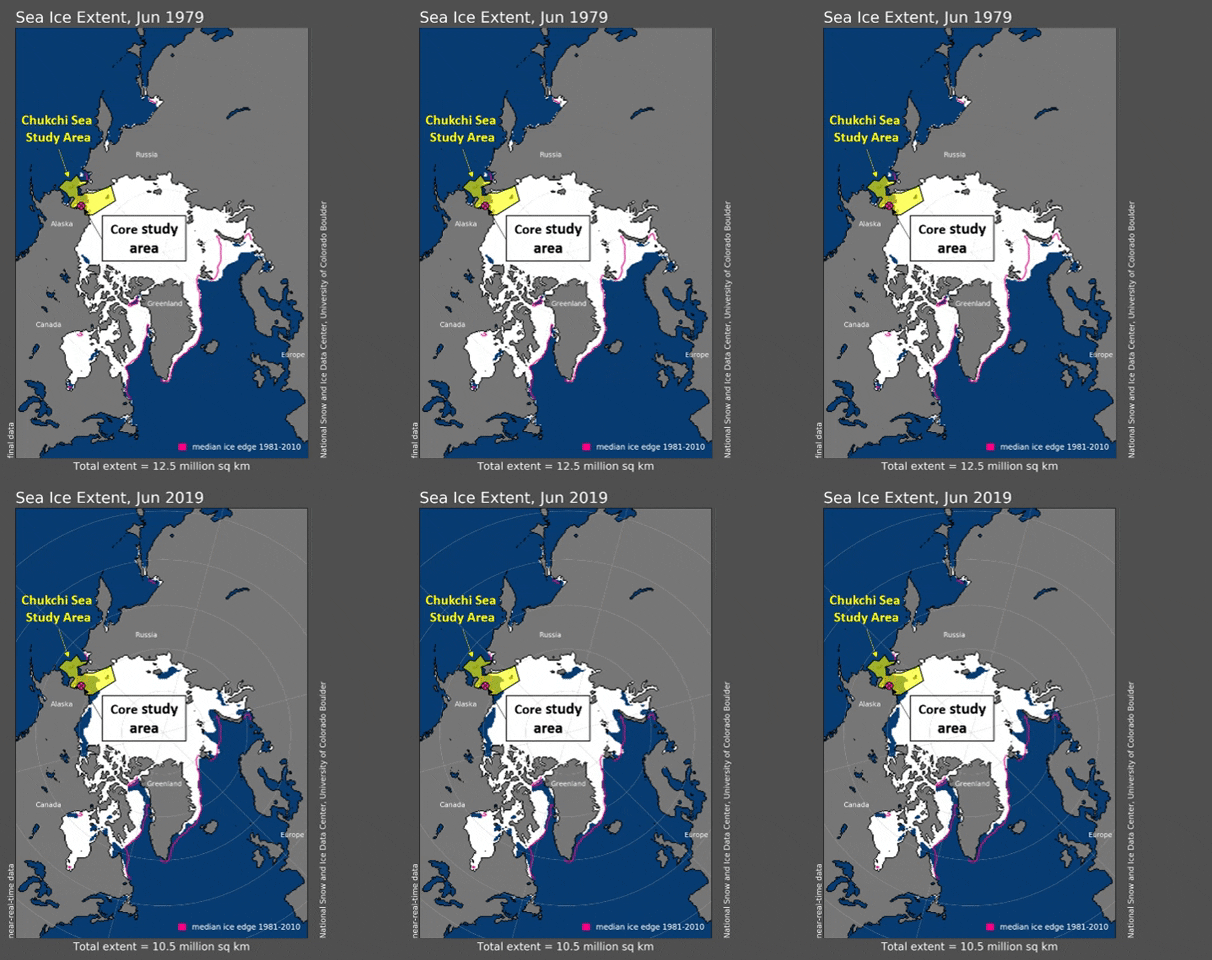
Setting aside the fact that overall polar bear populations don’t seem to be declining, he’s got us red-handed…


Humble Oil was founded in Humble, Texas in 1911. In 1919, Standard Oil of New Jersey acquired a 50% stake in Humble Oil. They acquired the other 50% in 1959. Eventually all of the affiliates were merged int Exxon Corporation in 1973 and ultimately merged with Mobil Oil Corporation, a descendant of Standard Oil Company of New York, in 1999 to become ExxonMobil (Texas State Historical Association).
via Watts Up With That?
July 14, 2019 at 12:35AM
 Iowa Climate Science Education
Reblogged this on Climate- Science.
LikeLike