

Guest nostalgia-izing by David Middleton
A common theme in Warmunist vs Skeptic “debates” is the notion of a scientific consensus regarding global cooling in the 1970’s. My recollection is that there was no scientific consensus, because there weren’t enough climatologists around back then to hold a decent debate, much less form a consensus. However, there was indeed a global cooling “crisis.”
A Little 70’s Background
I have been a professional geologist/geophysicist in the oil & gas industry since May 1981… From September 1976 through May 1980, I was a college student at Southern Connecticut State University (“That fine oil school”) in New Haven, Connecticut. Winters were fracking cold back then. The Northeastern United States blizzard of 1978 (AKA “Storm Larry”) shut the State of Connecticut down for almost a full week. Classes were cancelled, we were snowed into our dormitories… And all we could do for an entire week was to drink beer, play Risk and engage in huge snowball fights… Then the crisis hit… Every package store within walking distance of campus ran out of beer and all other alcoholic beverages. We were forced to dig our cars out of the snow and become the first climate refugees. (If at any time you think I might be being sarcastic, you’re not thinking hard enough.)
Despite all of these extracurricular activities, I found time for classes and even kept most of my old textbooks. If there was a climate change consensus, it should have been in at least one of them.
Historical Geology
Suggestion that changing carbon dioxide content of the atmosphere could be a major factor in climate change dates from 1861, when it was proposed by British physicist John Tyndall.
[…]
Unfortunately we cannot estimate accurately changes of past CO2 content of either atmosphere or oceans, nor is there any firm quantitative basis for estimating the the magnitude of drop in carbon dioxide content necessary to trigger glaciation. Moreover the entire concept of an atmospheric greenhouse effect is controversial, for the rate of ocean-atmosphere equalization is uncertain.
Dott, Robert H. & Roger L. Batten. Evolution of the Earth. McGraw-Hill, Inc. Second Edition 1976. p. 441.
Meteorology
FORECASTING THE FUTURE. We can now try to decide if we are now in an interglacial stage, with other glacials to follow, or if the world has finally emerged from the Cenozoic Ice Age. According to the Milankovitch theory, fluctuations of radiation of the type shown in Fig. 16-18 must continue and therefore future glacial stages will continue. According to the theory just described, as long as the North and South Poles retain their present thermally isolated locations, the polar latitudes will be frigid; and as the Arctic Ocean keeps oscillating between ice-free and ice-covered states, glacial-interglacial climates will continue.
Finally, regardless of which theory one subscribes to, as long as we see no fundamental change in the late Cenozoic climate trend, and the presence of ice on Greenland and Antarctica indicates that no change has occurred, we can expect that the fluctuations of the past million years will continue.
Donn, William L. Meteorology. 4th Edition. McGraw-Hill 1975. pp 463-464
Physical Geography
The atmosphere’s blanketing effect over the earth’s surface has been compared to the functioning of a greenhouse. Short-wave sunlight passes as easily through the glass of the greenhouse as through the atmosphere. Because glass is opaque to the long-wave radiation from the warm interior of the greenhouse, it hinders the escape of energy.
As a planet, the earth is not warming or cooling appreciably on the average, because it loses as much radiant energy as it gains.
Kolenkow, Robert J., Reid A. Bryson, Douglas B. Carter, R. Keith Julian, Robert A. Muller, Theodore M. Oberlander, Robert P. Sharp & M. Gordon Wolman. Physical geography today : a portrait of a planet. Del Mar, Calif. : CRM Books, [1974]. p. 64.
Yes… That Reid Bryson.
A Century of Climate Crises
Dan Gainor and Warren Anderson compiled a great summary of “weather vane” climate crises back in 2006…
Fire and Ice
It was five years before the turn of the century and major media were warning of disastrous climate change. Page six of The New York Times was headlined with the serious concerns of “geologists.” Only the president at the time wasn’t Bill Clinton; it was Grover Cleveland. And the Times wasn’t warning about global warming – it was telling readers the looming dangers of a new ice age.
The year was 1895, and it was just one of four different time periods in the last 100 years when major print media predicted an impending climate crisis. Each prediction carried its own elements of doom, saying Canada could be “wiped out” or lower crop yields would mean “billions will die.”
[…]
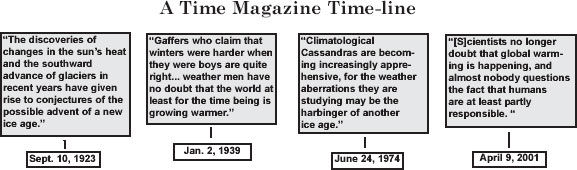
Fire and Ice is a great read with some fantastic graphics:

And some classic music…
The ice age is coming, the sun’s zooming in
Engines stop running, the wheat is growing thin
A nuclear era, but I have no fear
’Cause London is drowning, and I live by the river— The Clash “London Calling,” released in 1979
I would have worked in this Bob Dylan song…
You don’t need a weather man
To know which way the wind blowsBob Dylan, Subterranean Homesick Blues, 1965
Since weather isn’t climate, it appears that you do need a weather man to know which way the climate blows! (/Sarc)
While it would be fun to have a look at all of these fake crises, I’m going to focus on That 70’s Climate Crisis Show because I was in the live audience.
That 70’s Climate Crisis Show
In Search of… The Coming Ice Age
After the cancellation of the greatest TV show ever made, Leonard Nimoy found the next best entertainment niche to Mr. Spock…
In Search of…. The Coming Ice Age
30min | Documentary, Sci-Fi | Episode aired May 1978Storyline
An inquiry into whether the dramatic weather changes in America’s northern states mean that a new ice age is approaching.Pat Bushnell
Dr. James Hayes
Dr. Chester Langway
Dr. Gifford Miller
Dr. Stephen Schneider
The segment with Dr. Stephen Schneider is particularly worth watching. He was asked about geoengineering schemes to avert “The Coming Ice Age.”
Can we do these things? Yes. But will they make things better? I’m not sure. We can’t predict with any certainty what happens to our own climatic future. How can we come along and [garbled] that in our ignorance? We could melt the icecaps. What would that do to the coastal cities? The cure could be worse than the disease. Would that be better or worse than the risk of an ice age?
Some things never change… The cure is still worse than the disease and all of the proposed “solutions” to climate change are far worse than the risk of a slightly warmer world in the 22nd Century.
“Another Ice Age?” Time Magazine Monday June 24, 1974

Science: Another Ice Age?
In Africa, drought continues for the sixth consecutive year, adding terribly to the toll of famine victims. During 1972 record rains in parts of the U.S., Pakistan and Japan caused some of the worst flooding in centuries. In Canada’s wheat belt, a particularly chilly and rainy spring has delayed planting and may well bring a disappointingly small harvest.Rainy Britain, on the other hand, has suffered from uncharacteristic dry spells the past few springs. A series of unusually cold winters has gripped the American Far West, while New England and northern Europe have recently experienced the mildest winters within anyone’s recollection.
As they review the bizarre and unpredictable weather pattern of the past several years, a growing number of scientists are beginning to suspect that many seemingly contradictory meteorological fluctuations are actually part of a global climatic upheaval. However widely the weather varies from place to place and time to time, when meteorologists take an average of temperatures around the globe they find that the atmosphere has been growing gradually cooler for the past three decades. The trend shows no indication of reversing. Climatological Cassandras are becoming increasingly apprehensive, for the weather aberrations they are studying may be the harbinger of another ice age.
Telltale signs are everywhere —from the unexpected persistence and thickness of pack ice in the waters around Iceland to the southward migration of a warmth-loving creature like the armadillo from the Midwest. Since the 1940s the mean global temperature has dropped about 2.7° F. Although that figure is at best an estimate, it is supported by other convincing data. When Climatologist George J. Kukla of Columbia University’s Lamont-Doherty Geological Observatory and his wife Helena analyzed satellite weather data for the Northern Hemisphere, they found that the area of the ice and snow cover had suddenly increased by 12% in 1971 and the increase has persisted ever since. Areas of Baffin Island in the Canadian Arctic, for example, were once totally free of any snow in summer; now they are covered year round.
[…]
Whatever the cause of the cooling trend, its effects could be extremely serious, if not catastrophic. Scientists figure that only a 1% decrease in the amount of sunlight hitting the earth’s surface could tip the climatic balance, and cool the planet enough to send it sliding down the road to another ice age within only a few hundred years.
The earth’s current climate is something of an anomaly; in the past 700,000 years, there have been at least seven major episodes of glaciers spreading over much of the planet. Temperatures have been as high as they are now only about 5% of the time. But there is a peril more immediate than the prospect of another ice age. Even if temperature and rainfall patterns change only slightly in the near future in one or more of the three major grain-exporting countries—the U.S., Canada and Australia — global food stores would be sharply reduced. University of Toronto Climatologist Kenneth Hare, a former president of the Royal Meteorological Society, believes that the continuing drought and the recent failure of the Russian harvest gave the world a grim premonition of what might happen. Warns Hare: “I don’t believe that the world’s present population is sustainable if there are more than three years like 1972 in a row.”
Time Magazine Monday June 24, 1974 Full text.
The Cooling World, Newsweek, April 28, 1975

The Cooling World
Newsweek, April 28, 1975There are ominous signs that the Earth’s weather patterns have begun to change dramatically and that these changes may portend a drastic decline in food production – with serious political implications for just about every nation on Earth. The drop in food output could begin quite soon, perhaps only 10 years from now. The regions destined to feel its impact are the great wheat-producing lands of Canada and the U.S.S.R. in the North, along with a number of marginally self-sufficient tropical areas – parts of India, Pakistan, Bangladesh, Indochina and Indonesia – where the growing season is dependent upon the rains brought by the monsoon.
The evidence in support of these predictions has now begun to accumulate so massively that meteorologists are hard-pressed to keep up with it.
[…]
To scientists, these seemingly disparate incidents represent the advance signs of fundamental changes in the world’s weather. The central fact is that after three quarters of a century of extraordinarily mild conditions, the earth’s climate seems to be cooling down.
[…]
Climatologists are pessimistic that political leaders will take any positive action to compensate for the climatic change, or even to allay its effects. They concede that some of the more spectacular solutions proposed, such as melting the Arctic ice cap by covering it with black soot or diverting arctic rivers, might create problems far greater than those they solve. But the scientists see few signs that government leaders anywhere are even prepared to take the simple measures of stockpiling food or of introducing the variables of climatic uncertainty into economic projections of future food supplies. The longer the planners delay, the more difficult will they find it to cope with climatic change once the results become grim reality.
—PETER GWYNNE with bureau reportsNewsweek, April 28, 1975 Full text.
Way back in 1975… “Climatologists are pessimistic that political leaders will take any positive action to compensate for the climatic change, or even to allay its effects.” Some things never change…

Scientists Ask Why World Climate Is Changing, The New York Times May 21, 1975
This is actually a very good article…
Scientists Ask Why World Climate Is Changing
By WALTER SULLIVAN MAY 21, 1975The world’s climate is changing. Of that scientists are firmly convinced. But in what direction and why are subjects of deepening debate.
There are specialists who say that a new ice age is on the way—the inevitable consequence of a natural cyclic process, or as a result of man‐made pollution of the atmosphere. And there are those who say that such pollution may actually head off an ice age.Sooner or later a major cooling of the climate is widely considered inevitable. Hints that it may already have begun are evident. The drop in mean temperatures since 1950 in the Northern Hemisphere has been sufficient, for example, to shorten Britain’s growing season for crops by two weeks.
As noted in a recent report of the National Academy of Sciences, “The global patterns of food production and population that have evolved are implicitly dependent on the climate of the present century.”
Vulnerability to climate change, it says, is “all the more serious when we recognize that our present climate is in fact highly abnormal, and that we may already be. producing climatic changes, as a result of our own activities.”
The first half of this century has apparently been the warmest period since the “hot spell” between 5,000 and 7,000 years ago immediately following the last ice age. That the climate, at least in the Northern Hemisphere, has been getting cooler since about 1950, is well established—if one ignores the last two winters.
[…]
Man‐Made Influence
There is general agreement that introducing large amounts of smoke particles or carbon dioxide into the atmosphere can alter climate. The same would be true of generating industrial heat comparable to a substantial fraction of solar energy falling on the earth. The debate centers on the precise roles of these effects and the levels of pollution that would cause serious changes.Carbon dioxide in the air acts like glass in a greenhouse. It permits solar energy to reach the earth as visible light, but it impedes the escape of that energy into space in the form of heat radiation (at infrared wave lengths).
Dr. Mitchell has pointed out that a variety of factors determine the role of carbon dioxide on earth. For example, the extent to which that gas, introduced into the atmosphere by smokestacks and exhaust pipes, is absorbed by the oceans depends on the temperature of surface waters.
This, in turn, is affected by climate, leading to so called feedback effects. Plants consume carbon dioxide at rates that depend on temperature and the abundance of that gas in the air, complicating predictions of their role.The observatory atop Mauna Loa, the great Hawaiian volcano, has recorded a steady rise in the annual mean level of carbon dioxide in the atmosphere, amounting to 4 per cent between 1958 and 1972. That, however, was a period of global cooling—not the reverse, as one would expect from a greenhouse effect.
The Mauna Loa observatory has also recorded a steady rise in atmospheric turbidity —the extent to which particles overhead dim the brightness of the sun. The academy study finds that human activity over the last 120 years has contributed more to this atmospheric dust than have volcanic eruptions.
However, it says, the present atmospheric load of man‐made dust is perhaps only one fifth what was thrown into the stratosphere by the volcanic explosion of Krakatoa in 1883. The role of of atmospheric dust is complex, for it cuts off sunlight from the earth, but is itself heated by that light, warming levels of atmosphere in which it resides.
Until recently the idea that ice ages are initiated by intense volcanic activity was unpopular for lack of evidence for such activity. The hypothesis has gained more credence from the analysis of sediment cores extracted from the ocean floors by the drill ship Glomar Challenger.
According to University of Rhode Island scientists, ash was far more common in layers laid down in the last two million years than in the previous 18 million years.
If worldwide energy consumption continues to increase at its present rates, catastrophic climate changes have been projected by M. I. Budyko, a leading Soviet specialist. He says that the critical level will probably be reached within a century.
This, he has written, will lead to “a complete destruction of polar ice covers.” Not only would sea levels rise but, with the Arctic Ocean free of ice, the entire weather system of the Northern Hemisphere would be altered.
However, Dr. Mitchell has suggested, warming of the climate due to pollution might be enough to head off an ice age “quite inadvertently.”
CAN THE TRUTH BE LEARNED?
More precise knowledge of the past is certain to aid in choosing between various explanations for long‐term climate changes. The Greenland Ice Sheet Program, with American, Danish and Swiss participants, is drilling a series of holes into the crest of the Greenland ice in the hope, ultimately, of reconstructing a year‐by‐year re cord of climate for the last 100,000 years.
So far the ice has been penetrated 1,325 feet, extending the record back 1,420 years. The yearly layers can be counted, like tree rings, in terms of summer and winter variation in the relative abundance of two forms of oxygen (oxygen 16 and oxygen 18). Their ratio indicates temperature at the time when the snow fell to form that layer of the ice sheet.
[…]
The New York Times May 21, 1975 Full text.
The “science” clearly was in its infancy back then… But some things never change…
If worldwide energy consumption continues to increase at its present rates, catastrophic climate changes have been projected by M. I. Budyko, a leading Soviet specialist. He says that the critical level will probably be reached within a century.
This, he has written, will lead to “a complete destruction of polar ice covers.” Not only would sea levels rise but, with the Arctic Ocean free of ice, the entire weather system of the Northern Hemisphere would be altered.
At least their predictions were less falsifiable back then… The ice caps will be toast by 2075. Does anyone have a reference for Budyko’s prediction? Was he also referring to Antarctica and Greenland? Or just sea ice? The fact that the current Arctic sea ice cover is well above the Holocene average leads me to an Alfred E. Neuman moment.
“The Ice Age Cometh?”, Science News March 1, 1975

No words necessary and this brings us to the pièce de résistance…
How the Current Fake Climate Crisis Saved Us From… That 70’s Climate Crisis

According to the sacred climate models, if not for The Climate Wrecking Industry, the planet would be colder than “The Ice Age Cometh”…
This proud member of the Climate Wrecking Industry says, “You’re welcome.”
Post Script
I don’t care what Thomas C. Peterson, William M. Connolley, and John Fleck said in their 2008 BAMS article. That article didn’t exist in the 1970’s… But this did…
The ice age is coming, the sun’s zooming in
Engines stop running, the wheat is growing thin
A nuclear era, but I have no fear
’Cause London is drowning, and I live by the river— The Clash “London Calling,” released in 1979
via Watts Up With That?
July 24, 2019 at 04:57PM



Reblogged this on Climate- Science.
LikeLike