
Guest slam-dunk by David Middleton
How Science Got Trampled in the Rush to Drill in the Arctic
By ADAM FEDERMAN with photographs by NATHANIEL WILDER and video by PETER ELSTNER | 07/26/2019
Every year, hundreds of petroleum industry executives gather in Anchorage for the annual conference of the Alaska Oil and Gas Association, where they discuss policy and celebrate their achievements with the state’s political establishment. In May 2018, they again filed into the Dena’ina Civic and Convention Center, but they had a new reason to celebrate. Under the Trump administration, oil and gas development was poised to dramatically expand into a remote corner of Alaska where it had been prohibited for nearly 40 years.
Tucked into the Tax Cuts and Jobs Act, a bill signed by President Donald Trump five months earlier, was a brief two-page section that had little to do with tax reform. Drafted by Alaska Senator Lisa Murkowski, the provision opened up approximately 1.6 million acres of the vast Arctic National Wildlife Refuge to oil and gas leasing, a reversal of the federal policy that has long protected one of the most ecologically important landscapes in the Arctic.
[Blah, blah, blah… caribou… polar bears… Orange man bad]
The article drones on with a bunch of Obama maladministration bureaucrats and holdovers whining about polar bears, the Porcupine caribou herd and features this “gotcha” map.

Firstly, there are no “untapped reserves of oil” anywhere. Reserves, by definition, have been tapped. ANWR Area 1002 contains enormous resource potential according to the USGS. Resources have the potential to become reserves, they can also become dry holes. We won’t have any idea what ANWR’s ultimate oil & gas reserves will be until quite a few wells have been drilled and some production history established… And the drilling probably won’t commence before modern 3d seismic data over ANWR Area 1002 become available.
The thesis of the Politico article is that the acquisition of 3d seismic data in ANWR will devastate the “main calving grounds for the Porcupine caribou herd” and some how wipe out all of polar bears who weren’t shot by Democrats.
Caribou, not just the title of a 1974 Elton John album
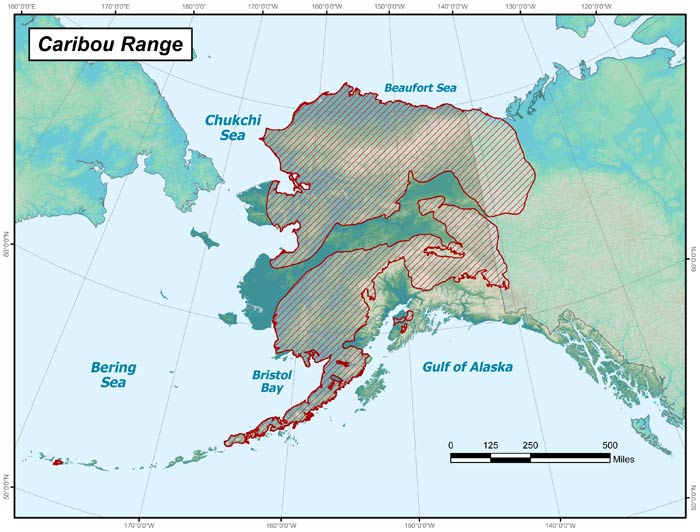
In Europe, caribou are called reindeer, but in Alaska and Canada only the semi-domesticated form is called reindeer. All caribou and reindeer throughout the world are considered to be the same species, but there are 7 subspecies: barrenground (Rangifer tarandus granti), Svalbard (R.t platyrhynchus), European (R.t. tarandus), Finnish forest reindeer (R.t. fennicus), Greenland (R.t. groenlandicus), woodland (R.t. caribou) and Peary (R.t. pearyi). Alaska has predominantly the barren-ground subspecies and one small herd of woodland caribou, the Chisana herd, which moves into Canada in the Wrangell-St. Elias area of Southcentral Alaska. Canada has three subspecies, the Peary, woodland and barren-ground.
Caribou in Alaska are distributed in 32 herds or populations. A herd uses a distinct calving area that is separate from the calving area of other herds, but different herds may mix on winter ranges.
The Porcupine herd is one of the largest caribou herds in the world and they do calve on the ANWR coastal plain in SUMMER.
However, exploration season is not in summer
Busiest exploration season in decades planned for this winter
By:
Alex DeMarban
Anchorage Daily News
Post date:
Tue, 01/29/2019The number of exploration and production rigs working on the oil-rich North Slope should reach its highest level in 20 years this winter, state officials say.
Oil field employment is higher than last year, modestly, but a first in more than four years.
And the state just had one of its strongest North Slope lease sales in recent history.
Those factors and others show the recent plunge in oil prices has not dampened industry’s expectations for the region, amid newfound interest in a little-tapped geological formation, the Nanushuk, state officials indicated in a meeting with the Senate Finance committee last week.
But with long development windows for Alaska projects, much of the new oil production is still years away.
[…]
Alaska Journal of Commerce
Winter is also the season for seismic surveys…
PUBLIC NOTICE
Greater Prudhoe Bay 2019 3D Seismic ProgramThe Alaska Department of Natural Resources (ADNR), Division of Oil and Gas (Division), has received a Geophysical Exploration Permit Application from BP Exploration (Alaska), Inc. (BPXA) for the Greater Prudhoe Bay 2019 3D Seismic Program. The Division is providing notice to all upland land owners that could be affected by the project.
[…]
BPXA plans to conduct a three-dimensional (3D) seismic program on state lands and waters in the Prudhoe Bay area of the North Slope during the 2019 winter season. The survey will be conducted between January 1 and May 31, 2019. The survey area lies mainly within the Prudhoe Bay Unit with a western boundary near the Kuparuk Operations Center continuing east to the Sagavanirktok River. Additional program details are outlined in the Application.
[…]
The proposed ANWR 3d survey was supposed to have begun in the winter of 2019 and finished in the winter of 2020, if not completed in one season.
SEISMIC EXPLORATIONON THE COASTAL PLAIN
Purpose and Need
SAExploration has requested to conduct 3 Dimensional (3D) Winter Seismic Exploration Surveys on the Coastal Plain of the USFWS Arctic National Wildlife Refuge in Alaska. The proposed seismic exploration would begin in winter 2018/2019 and, if not finished in one year,
would continue through winter 2019/2020. Seismic exploration generates acoustic waves that are picked up by sensors as the waves bounce off subsurface formations. From this information, images can be created that show subsurface topography and formations including those areas of potential hydrocarbons.The purpose of the proposed seismic activity is to acquire quality, high resolution seismic data, using vibroseis techniques to identify potential oil and gas reserves. Approval of the proposed action would authorize SAE to conduct 3D seismic surveys beginning when frost and snow
cover are at sufficient depths to protect tundra and would continue through the winter seasons until tundra travel has been closed.Analysis of this project will include access to the program area from Deadhorse, storage of fuel, and the use of up to two mobile camps, each capable of housing up to 160 people. The total proposed project area would encompass the entire Coastal Plain, approximately 2,600 sq. miles
(1,664,000 acres) (program area).[…]
The start date in SAE’s application has been delayed to December 2019. SAE will acquire the 3d seismic data with Vibroseis sources.
Land Acquisition
SourcesLand acquisition for reflection seismology uses an array of sources and receivers. The choices of which sources and receivers to use depend on the goals of the survey along with cost and environmental conditions.
Explosive Sources
Dynamite is a commonly used impulse source for exploration. Dynamite is preferred when the survey area is in harsh terrain that Vibroseis cannot traverse such as marshes, mountains, or environmentally sensitive areas. The dynamite must be buried prior to detonation to increase the amount of energy transmitted into the subsurface and for safety. Since the energy is produced instantly from the detonation, dynamite sources produce a wavelet that is roughly minimum phase. However, dynamite does have its drawbacks. Inconsistencies in the blasts along with variations in the burial depth and the local ground conditions will cause variations in the produced signal. Another impulse source used is modified shotguns called Betsy Guns. Betsy Guns are used for shallower and smaller surveys.Vibratory Sources
Another commonly used source type for petroleum exploration are vibratory sources. Vibroseis trucks, as shown in figure 1, are used to transmit energy into the earth using a specified range of frequencies over a specified time. The trucks feature a heavy mass that vibrates vertically on a base plate to transfer energy into the subsurface. The range of frequencies (i.e. how fast the mass vibrates) and the length of time that the vibration occurs are unique for each survey. Since the signal inputted into the subsurface is known, it can be mathematically removed in processing to help remove noise and create a trace that resembles the true reflectivity of the survey area. In an effort to improve the post-correlation signal to noise ratio, an array of vibroseis trucks may be used, as the post-correlation signal to noise ratio is S:R = F(LN)^1/2, where F = the weight of the truck(force applied), L = the length of the sweep and N = the number of sweeps[1]. Using an array of trucks will increase the force applied, therefore enhancing the Signal to noise Ratio (SNR). Generally, Vibroseis trucks generally only produce P-waves as they are designed to vibrate the mass vertically. Vibroseis trucks that produce S-waves exist, but they are rare and infrequently used. Vibroseis trucks are typically used when the acquisition region features no extreme topography, densely populated areas, and a relatively dry climate. Vibroseis trucks do not do well in wet climates, as they are very heavy and tend to get stuck and leave high amounts of property damage in wet terrain.Weight Drops
Weight drops are another type of source. These are impulse sources which are generally used for shallow subsurface due to being much lower energy than dynamite or vibroseis. Examples of weight drops are sledgehammers hitting a metal plate on the ground and weights dropped heights of at least two meters. Accelerated weight drops (AWD) also fall in this category. AWD work by using a hydraulic system to lift a heavy steel hammer up, and a gas-charged piston forces the piston down. These have been proven as viable sources for VSP’s and tool-orientation for micro-seismic surveys. [2]

This sort of activity will be taking place while the Porcupine caribou herd are at their maximum migratory distance away from the ANWR coastal plain.
The only potential environmental impact of this seismic survey is the possibility of tire and/or tread tracks in the tundra. By the time the Porcupine caribou herd returns to the ANWR coastal plain in summer, the seismic crews will be long-gone.
Happy Seismic Trails to you

Seismic exploration, authorized by the U.S. Congress, was conducted on the coastal plain of the Arctic Refuge during the winters of 1984 and 1985. Exploration during winter causes less damage to tundra vegetation and soils than in summer, but damage does occur. Snow cover on the Refuge coastal plain is normally shallow, usually less than one foot deep. Strong winds blow the snow into depressions, leaving higher areas with thinner snow cover, making them more susceptible to impacts from vehicles.
As a result of the 1984-85 seismic exploration, known as 2-D (two-dimensional) seismic, 1250 miles of trails – made by drill, vibrator and recording vehicles – crossed the coastal plain tundra (see map above). Additional trails were created by D-7 Caterpillar tractors that pulled ski-mounted trailer-trains between work camps.
Refuge staff have monitored recovery of the seismic trail damage on the Refuge by periodically collecting vegetation data at 100 permanent plots. To determine how much trail is still disturbed they rate another 200 points for disturbance level. While 90% of all trails recovered well during the first 10 years after exploration, 5% of trails had still not recovered by 2009, 25 years after the disturbance.
[…]
Effects of 1984-1985 Seismic Trails on Porcupine caribou herd
Porcupine Caribou Herd reaches record high population
Shady Grove Oliver, The Arctic Sounder
January 8, 2018
The Porcupine caribou herd has a record high number of animals. That’s according to a photocensus compiled last summer by the Alaska Department of Fish and Game.
The herd has been growing at a rate of about 3 to 4 percent annually since 2010, Northeast Alaska Assistant Area Biologist Jason Caikoski said last week. As of this year, the herd reached an estimated 218,000 animals.
[…]
That’s nearly 40,000 more caribou than were present during the herd’s last population peak in 1989.
However, recent advances in photocensus technology have also made estimating the herd’s numbers more accurate over the years.
[…]
Since the herd’s peak in the late 1980s, the population declined to a low of 123,000 in 2001, Fish and Game noted. Since then, the herd has been steadily growing, based on census counts.
[…]
The Porcupine caribou herd population was growing while those “evil” seismic trails were being cut. The important question is this:
Why did the Porcupine caribou population decline from 1989-2001?
I’m sure Yale Environment 360 can answer this question.
A Troubling Decline in the Caribou Herds of the Arctic
Across the Far North, populations of caribou — an indispensable source of food and clothing for indigenous people — are in steep decline.
Scientists point to rising temperatures and a resource-development boom as the prime culprits.
BY ED STRUZIK • SEPTEMBER 23, 2010
[…]
According to scientists, the causes of the global caribou decline are straightforward: rapidly rising Arctic temperatures are throwing caribou out of sync with the environment in which they evolved; oil and gas development, mining, logging, and hydropower projects in the Far North are impinging on the caribou’s range; and, though not a major factor, hunting is further depleting already beleaguered caribou populations.
[…]
Anne Gunn, a former biologist with the government of the Northwest Territories and now a scientific consultant, is concerned that the whittling away of caribou habitat is occurring just as the animals are feeling the effects of global warming. Unlike some scientists, Gunn, who has more than 30 years of field experience, believes caribou can adapt to the climate changes occurring now. She is most concerned that very little is being done to protect critical caribou habitat, especially the critical calving grounds and migration corridors. Of 24 large caribou herds being tracked by CARMA — the Circumpolar Rangifer Monitoring and Assessment Network — only the calving grounds of the Porcupine and Bluenose West herds are fully or largely protected.
“For caribou it is all about ‘space’ — their perceptions of what space they need, including the space needed to distance themselves from us,” said Gunn. “Climate change and overhunting are very serious factors that need to be addressed. But unless we give caribou the space they need, I’m afraid we’re going to see these declines continue.”
So… Global warming and “oil and gas development, mining, logging, and hydropower projects” caused the decline… Except there were no “oil and gas development, mining, logging, and hydropower projects” upon which the Porcupine population decline could be blamed… And the global warming that shrank the population was supposedly still ongoing while the Porcupine caribou herd reached a “record high population” in 2017.
Why can’t environmentalists just be honest? All they have to say is, “We have no idea why the Porcupine caribou herd population did what it did… We just hate anything related to capitalism.”
“For caribou it is all about ‘space’ — their perceptions of what space they need, including the space needed to distance themselves from us” …
Porcupine caribou herd will still have plenty of “the space needed to distance themselves from us” because most of the exploration activities will occur when they are as far away from ANWR Area 1002 as they can get. It would be geographically impossible for them to have any more space. Any oil discoveries made, will be developed from small pad sites, which will be the focus of very little human activity during calving season.
Today’s drilling leaves a small footprint
Nov 24, 2014When Prudhoe Bay was developed in the 1970’s, about 2 % of the surface area over the field, or 5,000 acres, was covered by gravel for roads and drilling and production facility sites. If Prudhoe Bay were developed today, using lessons learned since the 1960’s, gravel would cover less than 2,000 acres, a 60 % reduction.
Extended-reach Drilling
Advances in directional, or extended-reach, drilling now allow producing companies to reach a reservoir three miles from the surface location. Soon “extended reach” wells out to four miles will be possible on the North Slope. When Prudhoe Bay was first developed, wells could reach out only one and a half miles.Well Spacing
In the 1970’s, production wells on drill pads in Prudhoe Bay were spaced 100 feet or more apart. New directional drilling techniques and drill equipment allow wells to be spaced 25 to 15 feet apart, and in some cases 10 feet apart. A drill pad that would have been 65 acres in 1977 can be less than nine acres today. The same number of wells that required a 65-acre pad in the 1970’s can be drilled on less than a nine-acre pad today.Drilling Mud Disposal
New technology allows producing companies to do away with reserve pits for drilling fluid (“mud”) and cuttings. Mud and cuttings are now injected the below-ground through disposal wells.Ice Roads and Drilling Pads
Instead of building a gravel pad for exploration drilling, companies are now building temporary pads of ice, which disappear after the exploration well has been drilled. Temporary ice roads have long been used to support winter exploration drilling on the North Slope.

Speaking of “it’s about space”…
About the author
David Middleton has been a geophysicist/geologist in the oil & gas industry since 1981. He has worked the Gulf of Mexico since 1988, and East Texas from 1981-1988. He has visited many seismic survey crews, a couple of Vibroseis crews in North Central Texas in 1981, quite a few dynamite crews in East Texas from 1981-1988 and has never seen a caribou or any other hoofed animal injured during seismic survey operations… Although it is really cool when a shot hole blows out.
via Watts Up With That?
July 29, 2019 at 04:53PM
 Iowa Climate Science Education
Reblogged this on Climate- Science.
LikeLike