
H/T Climate Change Dispatch
In which a scientific project gets dropped, or ignored, when it fails to produce the expected or hoped-for incriminating ‘climate change’ related data.
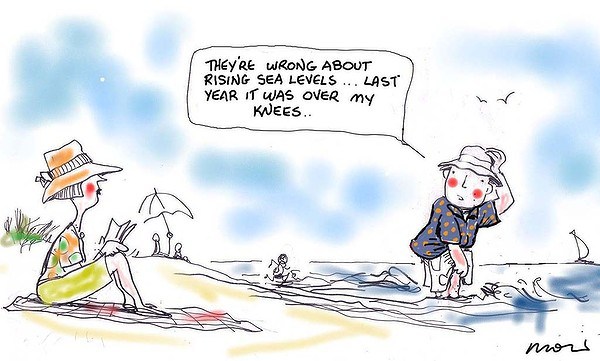
There is a striking disparity between sea-level datasets favored by climate catastrophists and actual observations, which mostly exists in their imaginations, writes Jack Weatherall for Quadrant Online.
The splendiferous east coast of Tasmania never ceases to please with all its myriad landscapes.
So it was a little discombobulating to recently pass a sign planted hard against the flow of traffic following the serpentine track that threads the coastal communities, proclaiming ‘Climate Change Is Killing the Planet’.
As it was only about eight degrees at the time, I was reasonably confident I would make my destination before something akin to the fate of the death star transpired and, thankfully, I was right.
It did, however, get me to thinking of how corrupt the science of the carbon cycle has truly become in the hyperbolic atmosphere of climate politics.
You would likely need a temperature increase in excess of 100 degrees in order to extinguish all life, including prokaryotes, from the biosphere — and even then creatures at depth, both aquatic and terrestrial, would probably find safe harbor.
Not to disappoint my sign-erecting fellow Taswegian, but his or her prophecy can’t possibly be achieved through carbon emissions alone.
Furthermore, the complete death of the planet, depending on how you might define that, may require extinguishing all its iron and siliceous substrate into stardust, a mighty feat even for that arch-villain, CO2.
Wishing to stay open-minded about what 400 parts per million of carbon dioxide had inflicted on the planet, I was intrigued when it was announced recently that what has been a great example of citizen science orchestrated under the banner of the Antarctic Climate & Ecosystems Cooperative Research Centre (ACE CRC) was to be more or less abandoned, possibly due to being unhelpful to the narrative that accompanies climate change dogma.
Known as the TASMARC Project (Tasmanian Shoreline Monitoring & Archiving Project), this admirable public access project, with dedicated volunteers at the dune face of data collection, commenced tracking the gradient of 16 beaches around the Apple Isle in 2005, the object is to measure ‘the shoreline and the way it is responding to storm events and sea-level rise.
Utilizing standard surveying equipment (as depicted above) employed by engineers in civil construction projects and the like, over the course of the project the number of sites measured and profiled expanded to thirty.
Without putting too fine a point on it, there is no possible way the resultant data can be manipulated to demonstrate anything other than “nothing to see here” in regard to supporting the notion of CO2-mediated sea level rise.
Read more here.
– – –
Talkshop footnote
The post says TASMARC is an ‘admirable public access project’. On the project website (https://www.lgat.tas.gov.au/page.aspx?u=654) it says ‘For more information about the TASMARC Project from the ACE CRC click here’, which leads to this message:
Forbidden
You don’t have permission to access /~johunter/tasmarc.pdf on this server.
via Tallbloke’s Talkshop
August 7, 2019 at 09:09AM
 Iowa Climate Science Education
Reblogged this on Climate- Science.
LikeLike