
Guest Douglas Adams’ing by David Middleton
This morning I made the mistake of reading this article on Real Clear Science…
“Green Growth” Is Supposed to Fix Climate Change. It Won’t Work
By Christine Corlet Walker August 12, 2019You may have missed it, but a recent report declared that the main strategy of world leaders for tackling climate change won’t work. It’s called green growth, and it’s favoured by some of the largest and most influential organisations in the world, including the United Nations and the World Bank.
[…]
Fixing the climate crisis without having to compromise on economic growth sounds appealing.
[…]
Proposals for green growth that rely solely on technology to solve the climate crisis are based on a flawed idea.
[…]
Our goal in the 21st century should be creating economies that allow people to flourish, even when they don’t grow.
Christine Corlet Walker, PhD Candidate in Ecological Economics, University of Surrey
I made an even bigger mistake by downloading the report.

I even started to read it…
Date of publication: July 2019
Authors of the report:
Timothée Parrique, Centre for Studies and Research in International Development (CERDI), University of Clermont Auvergne, France; Stockholm Resilience Centre (SRC), Stockholm University, Sweden
Jonathan Barth, ZOE.Institute for Future-Fit Economies, Bonn, Germany
François Briens, Independent, Informal Research Centre for Human Emancipation (IRCHE).
Christian Kerschner, Department of Sustainability, Governance, and Methods, MODUL University Vienna, Austria; Department of Environmental Studies, Masaryk University, Czech Republic
Alejo Kraus-Polk, University of California, Davis, USA
Anna Kuokkanen, Lappeenranta-Lahti University of Technology, Lahti Finland
Joachim H. Spangenberg, Sustainable Europe Research Institute (SERI Germany), Cologne, Germany
Page 3
I looked up the lead author on LinkedIn:
Timothée Parrique: PHD Researcher at Stockholm Resilience Centre,
Education
Universitat Autònoma de Barcelona
Degree Name: Degrowth Summer School Field Of Study: Monetary and Banking Reforms
Dates attended or expected graduation 2014 – 2014Uppsala University
Degree Name: Masters of Science, Sustainable Development Field Of Study: Specialisation in Economics Education
Dates attended or expected graduation 2011 – 2013Université de Versailles Saint-Quentin-en-Yvelines
Degree Name: Masters of Sciences of the Environment, Territory and the Economy Field Of Study: Sustainability Science, Tools and Techniques
Dates attended or expected graduation 2010 – 2011Uppsala University
Degree Name: Erasmus Exchange Field Of Study: International Economics
Dates attended or expected graduation 2009 – 2010Université de Versailles Saint-Quentin-en-Yvelines
Degree Name: Degree in Economics Field Of Study: International Economics
Dates attended or expected graduation 2007 – 2010
There doesn’t appear to be anything resembling a real job in his résumé… But he was in college for 7 years…
Figuring that the coauthors’ would be even less qualified to run the global economy, I didn’t bother to look them up. But, I did read on…
This report highlights the need for a new conceptual toolbox to inform and support the design and evaluation of environmental policies. Policy-makers have to acknowledge the fact that addressing environmental breakdown may require a direct downscaling of economic production and consumption in the wealthiest countries.
Page 6
As if that wasn’t stupid enough…
Introduction
Is economic growth compatible with ecological sustainability? Almost half a century after the publication of the Meadows report “Limits to growth” and Sicco Mansholt’s letter to the President of the European Commission in 1972 in defence of a shift away from the pursuit of economic growth, the relation between Gross Domestic Product (GDP) and environmental pressures remains a matter of fierce political debate.
The debate has two main sides. Proponents of what has been named “green growth” argue that technological progress and structural change will enable a decoupling of natural resources consumption and environmental impacts from economic growth. On the other hand, advocates of “degrowth” or “post-growth” argue that, because an infinite expansion of the economy is fundamentally at odds with a finite biosphere, the reduction of environmental pressures requires a downscaling of production and consumption in wealthiest countries,
which is likely to result in a decrease in GDP compared to current levels. On one side, green growth advocates expect efficiency to enable more goods and services at a lower environmental cost; on the other, degrowth proponents appeal to sufficiency, arguing that less goods and services is the surest road to ecological sustainability.Today, the green growth narrative dominates most political circles.
[…]
Page 10
That’s as far as I could get before triggering a Billy Madison.
Points of ridicule
- WTF are Ecological Economics?
- Climate change would only need fixing if it stopped changing.
- There is no climate “crisis”.
- “Our goal in the 21st century should be creating economies that allow people to flourish, even when they don’t grow,” is perhaps the most self-ridiculing sentence ever written in the English language.
- Their “debate has two main sides”… Dumb and dumber.
“The debate has two main sides”
And the report got them both wrong. The two sides of the debate are Malthusians and reality. Malthusians have a 100% perfect track record of being wrong and reality is what it is.
It’s a fossil fueled world

There is no climate crisis


To the extent there might be a climate annoyance… natural gas, nuclear power, carbon sequestration & utilization and a little bit of green schist will make it manageable.
“Golgafrinchan Ark Fleet Ship B”
Just in case some readers are unfamiliar with the classic works of Douglas Adams…

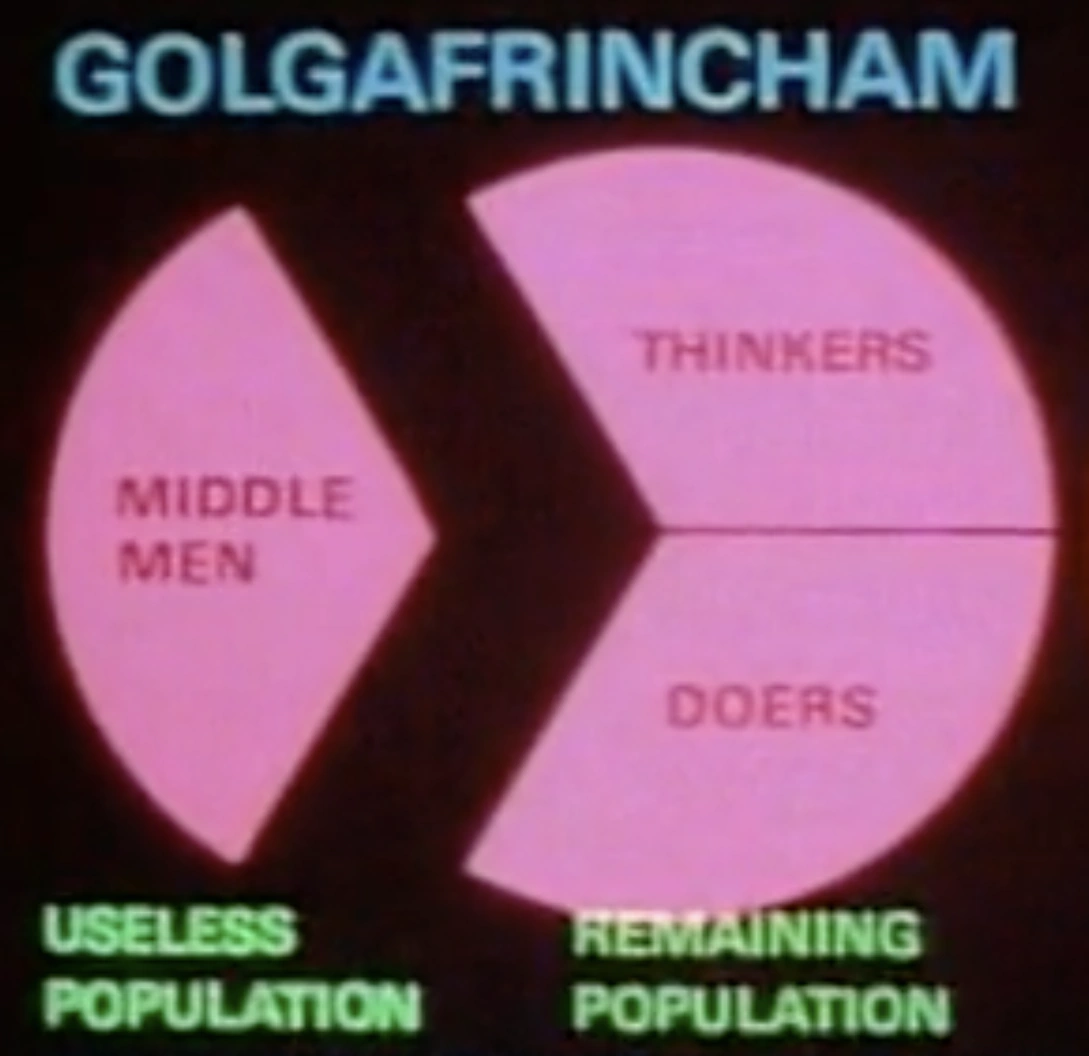
The Golgafrinchans realised that were three types of beings on the planet of Golgafrincham: the leaders (or thinkers), the workers (or doers), and the middlemen.
The leaders contained the artists and “achievers”. The workers were the people who “did all the actual work”, and who made and did things. The middle management was comprised of hairdressers, lawyers, telephone sanitisers, and other such “worthless jobs.”[1]The three classes of Golgafrinchans, as seen in Episode 6 of the TV series.
The group of leaders built a ship and convinced the middlemen to leave Golgafrincham by telling them several different reasons, including: that the planet was going to crash into the sun (or perhaps the moon was going to crash into the planet), that the planet was being invaded by a gigantic swarm of twelve foot piranha bees, and that “the entire planet was in imminent danger of being eaten by an enormous mutant star goat.”[1]The middlemen were sent off, told that the other Golgafrinchans would follow soon, however they remained on the planet with no intention of leaving. The middlemen stayed in space for a long period of time, with many on board in suspended animation for the majority of the journey, with the exception of the Captain and his Number One and Number Two. This third class eventually crashed onto Earth, while the other two-thirds of their society on Golgafrincham lived full, rich and happy lived until they were all suddenly killed off by a raging disease contracted from a dirty telephone.
Eventually, while sustaining major losses, and settling down in a cave-dwelling lifestyle, becoming ‘cavemen’, the Golgafrinchan middlemen wiped out the hut-dwelling original humans of Earth, and became the ancestors of present day humanity, “mucking up the program to determine the Ultimate Question.”[1]
It’s time to build a B Ark, pack it with ecological economists, climastrologers and other people who’ve never had real jobs, then launch it toward the nearest Earth-like exoplanet… making sure the flight trajectory takes them through the thickest parts of the Van Allen radiation belts. The bright side is that we won’t have to worry about being “wiped out by a virulent disease contracted from a dirty telephone”… because telephone sanitiser would have been a real job and public telephones are largely a thing of the past.
References
Adams, Douglas. 1979. The hitchhiker’s guide to the galaxy. New York: Harmony Books.
Parrique T., Barth J., Briens F., C. Kerschner, Kraus-Polk A., Kuokkanen A., Spangenberg J.H., 2019. “Decoupling debunked: Evidence and arguments against green growth as a sole strategy for sustainability”. European Environmental Bureau.
via Watts Up With That?
August 12, 2019 at 08:57PM
 Iowa Climate Science Education
Reblogged this on Climate- Science.press.
LikeLike