
“With the very unique situation of CO2 (a global externality of positives and negatives), government mitigation is doomed to fail. Sooner or later, you will have to admit that politics failed, that fossil fuels were just too good given the alternatives of non-use, renewables, nuclear.” (Bradley to Dessler #1, August 3, 2019)
“We have not only market failure but also analytical failure (imperfect you, me, others) and government failure, which is magnified by 190 or so governments.” (Bradley to Dessler #2, August 3, 2019)
I have been critical of Texas A&M climatologist and Green New Dealer Andrew Dessler for some time now. He is far too certain about climate doom (“climate dystopia,” to use his term) and refuses to see the risks in climate policy, not only physical climate change. Most of all, he seems blind to human ingenuity in regards to adapting to weather extremes and climate change from any source, natural or anthropogenic.
Forwarding Professor Dessler a post from Marion Tupy of the Cato Institute, “The Cost of Air-Conditioning Fell by 97 Percent Since 1952,” I made a case for fossil fuels being the answer whether or not fossil fuels were the problem. My communication was inspired by the fact that he was revising his Introduction to Modern Climate Change primer for Cambridge University Press, very timely given a need to rectify a number of important omissions (I listed 11 here and that will be more specifically dealt with in tomorrow’s post).
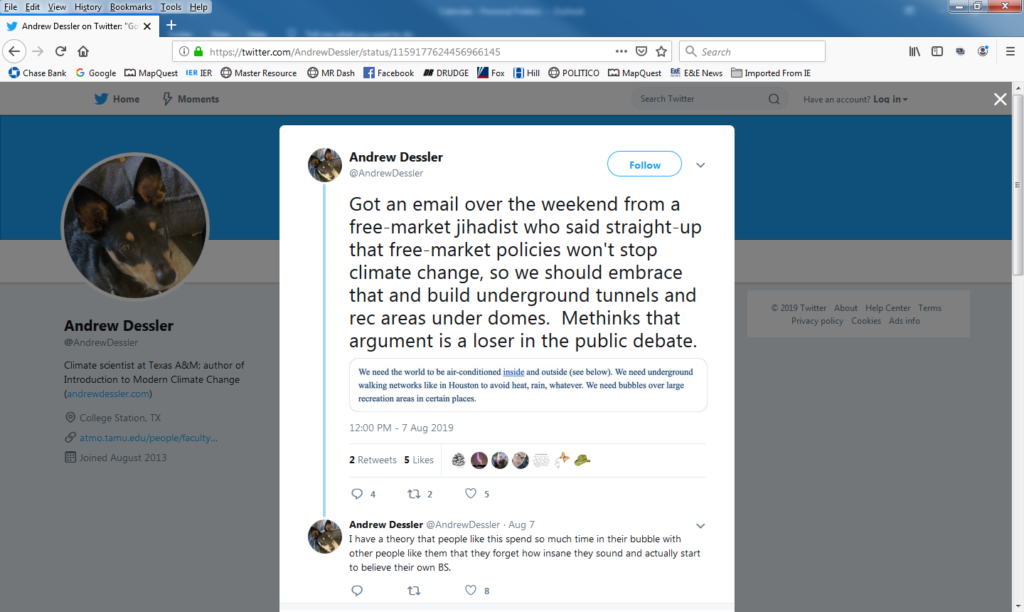
Seeing Dessler’s Tweet (below) referring to me as a “free-market jihadist,” I am inspired to share my entire exchange with him and let the reader decide who is on the right track and realistically imagining how free, enabled humans can survive and thrive in a warming world (again, natural or human-caused).
Dessler Tweet (August 7th)
Exchange: Bradley to Dessler (August 2, 2019)
Professor Dessler: You mentioned in a tweet that you are revising your
science textbook, which hitherto has included a political economy section.
One point to inform your supporters and engage your critics. The debate over adaptation versus mitigation will only grow in importance because of the saturation effect of CO2 atmospheric concentrations on the one hand and the ongoing internalization of the costs of extreme weather (from whatever source) on the other (‘as if lead by an invisible hand’).
The weakness in your political economy argument is the
affordability and thus practicality of Adaptation in free societies governed by
private property, voluntary exchange, and the rule of law. It should be a
reason that you favor free markets even more than if the climate issue did not
exist. We need free trade (not protectionism, including CO2 tariffs) to
increase wealth. We need free migration where people vulnerable to weather can
vote with their feet (but not overrun a welfare state).
We need the world to be air-conditioned inside and
outside (see below). We need underground walking networks like in Houston to
avoid heat, rain, whatever. We need bubbles over large recreation areas in
certain places.
This is where the future is headed as our wealth
increases to shape our world the way we like it.
More CO2 emissions from all this? More negative climate
change? Remember the positives from the CO2 fertilization effect and from
climate change—and note that the wealth from dense, reliable, carbon-based
energy solves the ‘problem’ of climate change (or just extreme weather). And it
has for a long time.
Perhaps the most important statistic for the climate debate is the large reduction in climate-related deaths since measurements began. See Bjorn Lomborg here. If you dispute the statistics or have a different interpretation, do so in your books. (Don’t duck!)
Some wealth-is-health quotations:
“Climate is no longer a major cause of deaths, thanks in large part to fossil fuels.… Not only are we ignoring the big picture by making the fight against climate danger the fixation of our culture, we are ‘fighting’ climate change by opposing the weapon that has made it dozens of times less dangerous. The popular climate discussion has the issue backward. It looks at man as a destructive force for climate livability, one who makes the climate dangerous because we use fossil fuels. In fact, the truth is the exact opposite; we don’t take a safe climate and make it dangerous; we take a dangerous climate and make it safe. High-energy civilization, not climate, is the driver of climate livability.” (Alex Epstein, The Moral Case for Fossil Fuels, pp. 126-127.)
“If good and evil are measured by the standard of human well-being and human progress, we must conclude that the fossil fuel industry is not a necessary evil to be restricted but a superior good to be liberated.”
“We don’t need green energy–we need humanitarian energy.” (Alex Epstein, “At CERAWeek Fossil Fuel Leaders Should Make A Moral Case For Their Industry,” Forbes.com., February 18, 2016.)
Your books need to sharpen the discussion of energy
density as a backdrop to the above debate (you do deal with intermittency).
Vaclav Smil is the person you need to understand (he is Bill Gates’s favorite
energy analyst).
I hope this will inspire more analysis of the issues. And please let me know of your counter-arguments if you feel I am missing some important analysis. I’m all ears and eyes.
Dessler’s Response (August 2, 2019)
“So your argument is that doing nothing about climate change and letting everyone take of themselves is better than the collective response of avoiding even the worst-case climate change scenario?”
Bradley to Dessler #2 (August 3, 2019)
Your
formulation, which I know was a quickie, is not the way to characterize my
position.
You
stated:
So your argument is that doing nothing about climate change and letting everyone take of themselves is better than the collective response of avoiding even the worst-case climate change scenario?
“Doing nothing” is a misrepresentation. I want to do a lot—but not use the power of government to override consumers/taxpayers by pricing CO2 emissions, etc. to artificially hurt fossil fuels in the energy mix.
- I want climate scientists to keep getting us to a better understanding of what might be in the future (your 2.7C plus/minus is important in this regard). But a warning: false certainty in the high direction will oversell air conditioning, domes, spillways, etc. (Unintended consequence?)
- Given realistic science (above), it becomes open knowledge to prepare and adapt to the future. Fossil fuels (see below) and wealth-is-health public policies are crucial in this regard. There is less margin for error than otherwise, right?
- I want reform. I want to redirect public resources, private philanthropy, and individual effort away from wealth-compromising, potentially debilitating climate politics (Green New Deal) to climate/weather realism and resilience. I want public policy changes to empower self-help and societal improvement, which would include free migration, open trade, etc. The climate “problem” requires less government, not more.
So I want climate policy reform. And yes, there will be incremental CO2 emissions from an adaptation, free market approach.
In
theory, “collective response” and “worst-case scenario” are unfair if you are
assuming an effective “collective response” and a realistic “worst-case
scenario”. In the real world, we cannot abstract from the ‘knowledge problem’
(Hayek) and perfect government (Public Choice economics vs. Nordhaus’s
‘environmental Pope’). We have not only market failure but also analytical
failure (imperfect you, me, others) and government failure, which is
magnified by 190 or so governments.
“Letting everyone take care of themselves” is not
only the permission and incentive for individuals to ‘do the right thing’ and
‘do the best they can.’ It is also activating the very powerful third force of
society beyond the individual and government—civil society. I think it
would be far better climate policy to have the Rockefeller Brothers Fund and
all the other activist climate organizations to spend their dollars on a
variety of actions to help individuals and groups anticipate and adapt to
change, not play the ‘alligator shoes’ game (Hansen) of climate politics.
Here
is how I would rephrase your statement as my position:
So your argument is that government mitigation of anthropogenic GHG emissions wastes scarce resources and works against natural incentives to anticipate and adapt to a changing climate under a variety of modeled scenarios?
To which I would say “Yes,” and add:
But more than this, to the extent that there is a real physical change toward extreme temperature changes and other problematic weather events, we need to move the US and the world away from statism, collectivism, and cronyism to private ownership, voluntary exchange, and the rule of law—and toward liberalized immigration policy, free trade, balanced budgets, etc.
Here are other ways to understand my point:
- The worse the climate problem, the more fossil fuels must be part of the preparation and response. The fundamental principle of energy density and intermittency, and the plain fact that electricity cannot lubricate, make plastics, and do many other things versus petroleum, is a physical reality at present.
- The increasing wealth of a free society (and future generations given economic freedom!) can be expected to turn physically worse weather in the future into, practically speaking, more benign weather. (If just having a TV and the weather channel, for a simple example.)
This also explains why climate deaths have radically
declined in the capitalist, fuel-fuel era. Wealth is health, to repeat
myself.
By the way, I would have used the above argument a decade
or two or three ago. And today, I would say, it is more compelling given the
reality of energy (fossil-fuel boom) and politics (government waste, inaction,
greenwashing). In other words, as we naturally adapt and the saturation effect
increasingly kicks in, the case against mitigation and for
wealth-is-health adaptation becomes more powerful.
This is my position. Just want you to personally
understand it and, hopefully, professionally consider it. It is somewhat subtle
but has a number of rich academic traditions behind it. I have actually read
your books cover-to-cover, and skimmed your earlier editions to try to identify
revisions. I am not afraid of ‘being wrong’ at this late stage of the game and
welcome your critical feedback.
Dessler to Bradley #2 (August 3, 2019)
I hope you don’t mind me following up, but your response sounds like a lot of what I hear from the do-nothing crowd (“we need innovation!” “we need to make people richer!” “people need to prepare for climate change”) as a general principle, I agree with those goals.
But these are just goals — you need policies to achieve them. So when you say something like “I want reform. I want to redirect public resources, private philanthropy, and individual effort away from wealth-compromising, potentially debilitating climate politics”, how do you achieve that goal? What policies do you advocate for?
My hypothesis is that what you wrote is a lot of fancy window dressing that ultimately boils down to a policy of doing nothing, but I am ready to be proven wrong by a response from you containing a list of concrete policies that you’d like to see implemented.
Bradley to Dessler #3
Say the question was “what do we need to do to
address poverty” … whether it was the goal in the US in the 1930s or a
developing country today–and anything between.
Would you want to list specific welfare programs? Government this or that to tell citizens what
to do? This is exactly wrong in my view.
To a classical liberal, this is called central planning or
in theoretical terms, ‘scientism’ and ‘the fatal conceit’ — and it gets to the
idea that government (190 nations in regard to CO2) has the knowledge to plan
the right thing and that politics can implement the right thing…. And that
private-sector entrepreneurs and hard working individuals cannot bring
prosperity to themselves and to civil society to defeat poverty.
A classical liberal (there is a whole worldview here)
believes in ‘simple rules for a complex world’ where you have the right
institutions and incentives from private property rights, mutually beneficial
(voluntary) exchange, the rule of law. Government does not plan but is neutral.
Civil society is huge because government is small.
Entrepreneurship is all about anticipating and responding
to change–business thrives on change for extraordinary profit (and loss). An
accumulation of little things like what McIlhenny Company did with its 20-foot
levee around its Tabasco plant on Avery Island off the Louisiana coast to
insure against flooding.
So climate policy would be specifically to get the best science out there and let individuals, groups, philanthropies, and local government plan around it. NO mitigation of GHG’s as part of a “first do no harm, no regrets,” policy here.
Regarding “we need innovation,” you and others
are right to conclude that this does not apply to wind, solar, and carbon
capture and storage as far as being affordable and scalable. (Nuclear? Still
quite uneconomic and risky and very subsidized by government.)
Innovation that is realistic is on the adaptation side,
and we have countless examples of success is escaping bad weather or
uncomfortable temperatures and the rest of it.
The most concrete climate policy, perhaps, is for the
government to stop subsidizing beach living and the sort. Micro policies that
work against self-help and adaptation. Also, immigration policies to allow
folks to leave areas of ‘bad’ climate change for areas of ‘good’ climate
change. Developing countries have another reason to reform toward free
economies.
So, ZERO activist government mitigation policies that are
a failure to date (you might agree) with little hope for reversal. The train
has left the station and is gaining speed. (That is added to your books’
conclusion, right?)
With greater wealth from cheap, abundant mineral
energies, adapt, adapt, adapt. (But don’t you scientists exaggerate the
problem!). But even here, no central plan for adaptation. Let a million flowers
bloom.
And for all the major capitalist-created foundations that
are bankrolling climate alarmism and policy activism, redirect that money to
real human needs rather than having to get philanthropists on the other side to
hire people like me to try to cancel out the Joe Romms of the world. (Political solutions are wasteful all
around.)
I wonder if the next editions of your books will increasingly focus on adaptation and the strategy of wealth-is-health as the only affordable climate policy in an energy-rich world.
Dessler to Bradley #3 (August 3, 2019)
The only policy action in your response was (maybe) getting rid of national flood insurance and (unspecified) immigration policies.
Otherwise, it still sounds to me like your preferred policy is to do nothing about climate change. If you think you have a set of coherent policy proposals, I just don’t see them. Perhaps you know that your policy is to do nothing, but you feel you can’t say it because you also know that’s a loser in a public debate — on that, we can agree.
Bradley to Dessler #4 (August 3, 2019)
Backing up, I advocate a public policy for CO2 that is
about human betterment. Better quality of life and longer lives–and more
people if that is what naturally emerges.
If your standard is not human betterment, we cannot
agree. A deep ecologist has different premises and ends.
This said, I have a public policy with a clear rationale.
You cannot accept my policy because it does not involve government, the one
institution with a monopoly on force in a particular geographical area. I
believe that under a wide range of scenarios, government forcing in the name of
mitigating climate change fails under a human betterment standard. Lots of
arguments in theory and, in practice, it is turning out just this way for
understandable reasons (as you cover in your books).
Defining climate-conscious adaptation as “do
nothing” policy because it is not macro-governmental (centrally planned)
is a disservice to the debate. It is very robust–so much so that the other
side really does not want to debate it. Present pain for distant benefits is a
political loser, and it is a tough sell in a public debate too.
With the very unique situation of CO2 (a global
externality of positives and negatives), government mitigation is doomed to
fail. Sooner or later, you will have to
admit that politics failed, that fossil fuels were just too good given the
alternatives of non-use, renewables, nuclear.
I have provided many arguments for my position that you have jumped over. If I may return to an essential fact: fossil fuels must be the answer, whether or not they are the problem. I don’t see how you can deny this. The world reconfirms this every second 85 percent of the time, energy-wise. And humanity, by virtually all objective standards, is getting better despite statism at home and abroad.
Dessler to Bradley #4 (August 3, 2019)
OK, I think I understand your point. You think THE GOVERNMENT should do nothing to address climate change. As you probably suspect, I don’t view government action as the evil you do, and I think well-designed government regulations will lead to a more beneficial solution than free-market-only solutions. But thank you for detailing your points. I will of course consider this (and all other viewpoints) when I make decisions about what will and will not go into the 3ed of my textbook. Best wishes.
Bradley to Dessler #5
Yes, only decentralized government adaptation in the sense of planning infrastructure that it owns or manages.
What this exchange did for me is to formulate the term
‘climate-conscious adaptation’ in place of just adaptation. And what I sort of
like about it is that it creates the right incentive for climate scientists to
not exaggerate the problem because that would artificially spur CO2 emissions.
The post Adaptation: Think about It (a ‘free-market jihadist’?) appeared first on Master Resource.
via Master Resource
August 20, 2019 at 01:22AM


Dear ICSE, If I read you between the lines properly, you want to build enough tunnels (read caves) for the rich to live in, since no one else will be able to afford the cost of living in a cave. On top of that you want to sell oxygen, at a market-bearing price of course, to those cave dwellers, so that all those riches get transferred to the coffers of the owners of the tunnels and the providers of the oxygen. How are you going to grow your food, which will need sunlight to grow (or will you survive on fungi and vitamin pills?)? What kind of economy will you propose after you have condemned the wage-slaves to living outside in high carbon dioxide conditions and no electricity to run their tools or air conditioners? And I guess all the rich peple will be drinking and dancing and otherwise carrying on 24/7/365 since they will have nothing else to do. Meanwhile they will suffer depression from lack of Vitamin D because of never seeing the sun.
I really don’t know why I bother, I’m just a layman, watching my life disappear needlessly. I hope you have fun in your tunnels, you and your fossil fuel buddies. You are so out of touch with most of humanity and other living beings you’d rather condemn life to death than open your eyes to the real future you are trying to create.
LikeLike
Reblogged this on Climate- Science.press.
LikeLike