
In recent decades, North American glaciers have advanced by many kilometers and buried forests in ice in the same regions where glaciers have receded and uncovered Medieval-era forests.
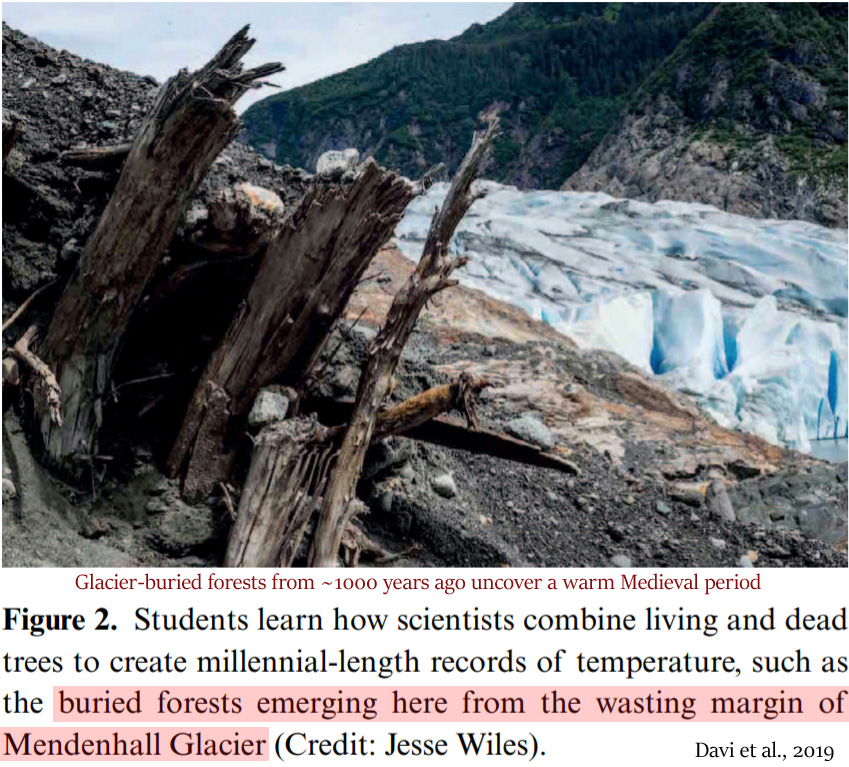
Image Source: Davi et al., 2019
Ancient forests buried beneath ice for the last ~1,000 years began “popping out from under southern Alaska’s Mendenhall Glacier” and garnishing headlines a few years ago (LiveScience, 2013).
Much of the attention centered around the glacier’s retreat and an apparent link to climate change. However, the revelation that intact and upright trees could be exposed from beneath a glacier suggests the Medieval climate was warm enough to sustain forests prior to the Little Ice Age glaciation.
In close proximity to Juneau’s wasting-away Mendenhall Glacier, the Taku Glacier has advanced 7 km since 1890 (Vore et al., 2019), encasing modern cottonwood tree forests in ice throughout the process.
There are claims that Juneau residents are concerned about the ice melt contribution to sea level rise due to the recession of the Mendenhall Glacier (LiveScience, 2013). This is ironic considering local relative sea level has been falling at a rate of over -13 mm/yr since the 1930s.
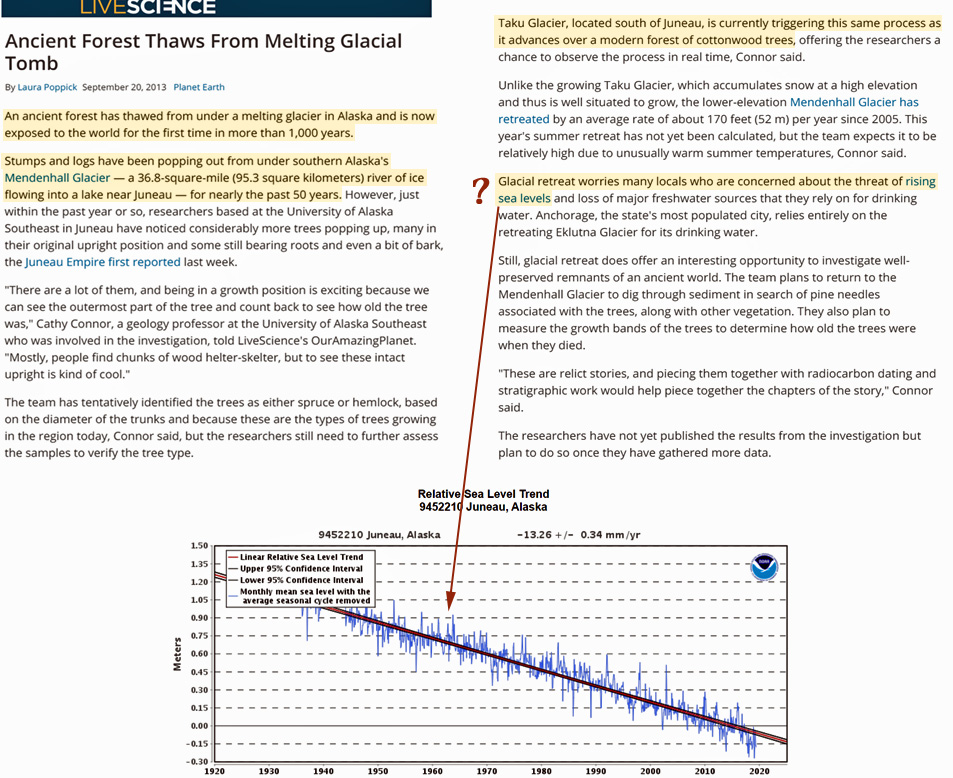
Image Source: LiveScience (2013) and NOAA
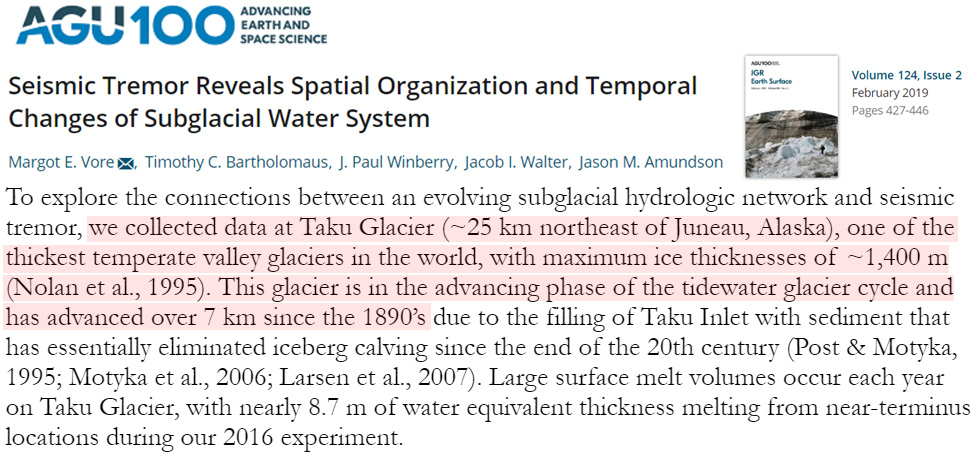
Image Source: Vore et al., 2019
In Arctic Canada, the Good Friday Glacier (GF) has been continuously advancing ever since it was first spotted in 1948. While the advance has slowed in recent years (upon reaching tidewater and calving in the late 2000s), the uninterrupted advance has amounted to 9.3 km in the last 70 years (Medrzycka et al., 2019).
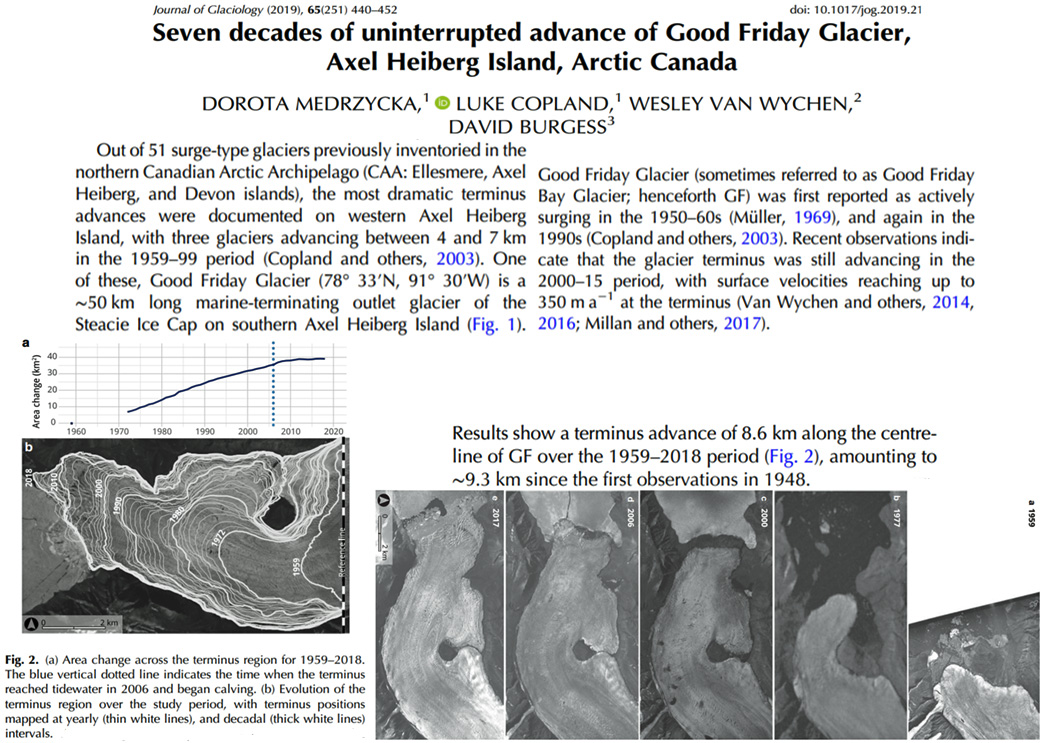
Image Source: Medryzcka et al., 2019
Another North American glacier system on the slopes of Mount Rainer (Washington, USA) has undergone both retreat and advance since the 1970s (Moore et al., 2019), further emphasizing non-linear glacier responses to recent climate changes.
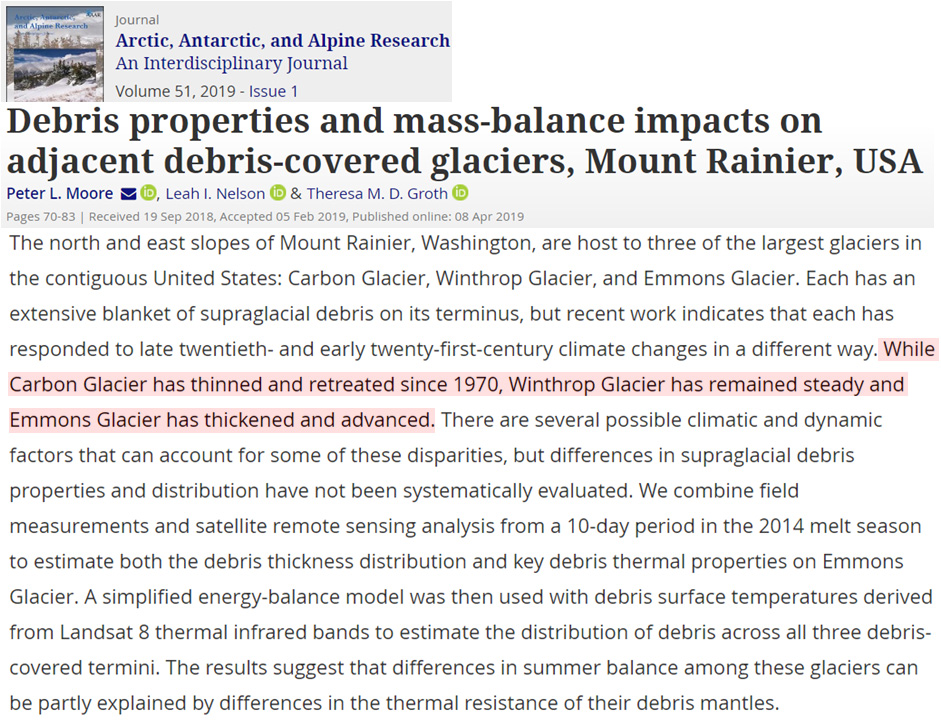
Image Source: Moore et al., 2019
via NoTricksZone
August 26, 2019 at 09:21AM
 Iowa Climate Science Education
Reblogged this on Climate- Science.press.
LikeLike