
By Rong-Gong Lin II Staff Writer
Oct. 17, 2019 1:45 PM
A major California fault capable of producing a magnitude 8 earthquake has begun moving for the first time on record, a result of this year’s Ridgecrest earthquake sequence destabilizing nearby faults, Caltech scientists say in a new study released in the journal Science on Thursday.
In the modern historical record, the 160-mile-long Garlock fault on the northern edge of the Mojave Desert has never been observed to produce either a strong earthquake or even to creep.
But new satellite radar images now show that the fault has started to move, causing a bulging of land that can be viewed from space.
“This is surprising, because we’ve never seen the Garlock fault do anything. Here, all of a sudden, it changed its behavior,” said the lead author of the study, Zachary Ross, assistant professor of geophysics at Caltech. “We don’t know what it means.”
The creeping illustrates how the Ridgecrest quakes — the largest in Southern California in two decades — have destabilized this remote desert region of California between the state’s greatest mountain range, the Sierra Nevada, and its lowest point, Death Valley.
It also punctures a persistent myth that circulates in California and beyond — that quakes like the Ridgecrest temblors are somehow a good thing that makes future quakes less likely. In fact, earthquakes make future earthquakes more likely. Most of the time, the follow-up quakes are smaller. But occasionally, they’re bigger.
Not only has the Garlock fault begun to creep in one section, but there’s also been a substantial swarm of small earthquakes in another section of the fault, and two additional clusters of earthquakes elsewhere — one south of Owens Lake and the other in the Panamint Valley just west of Death Valley.
Whether the destabilization will result in a major quake soon cannot be predicted. In September, the U.S. Geological Survey said the most likely scenario is that the Ridgecrest quakes probably won’t trigger a larger earthquake. Nevertheless, the USGS said that the July quakes have raised the chances of an earthquake of magnitude 7.5 or more on the nearby Garlock, Owens Valley, Blackwater and Panamint Valley faults over the next year.
A large quake on the Garlock fault has the potential to send strong shaking to the San Fernando Valley, Santa Clarita, Lancaster, Palmdale, Ventura, Oxnard, Bakersfield and Kern County, one of the nation’s most productive regions for agriculture and oil.
Important military installations could also get strong shaking, such as Edwards Air Force Base, Naval Air Weapons Station China Lake and Fort Irwin National Training Center. The fault is crossed by two of Southern California’s most important supplies of imported water — the California and Los Angeles aqueducts — and critical roads like Interstate 5, state routes 14 and 58 and U.S. 395.
A major quake on the Garlock fault could then, in turn, destabilize the San Andreas. A powerful earthquake on a stretch of the roughly 300-mile-long southern San Andreas fault could cause the worst shaking the Southern California region has felt since 1857, and send destructive tremors through Los Angeles and beyond.
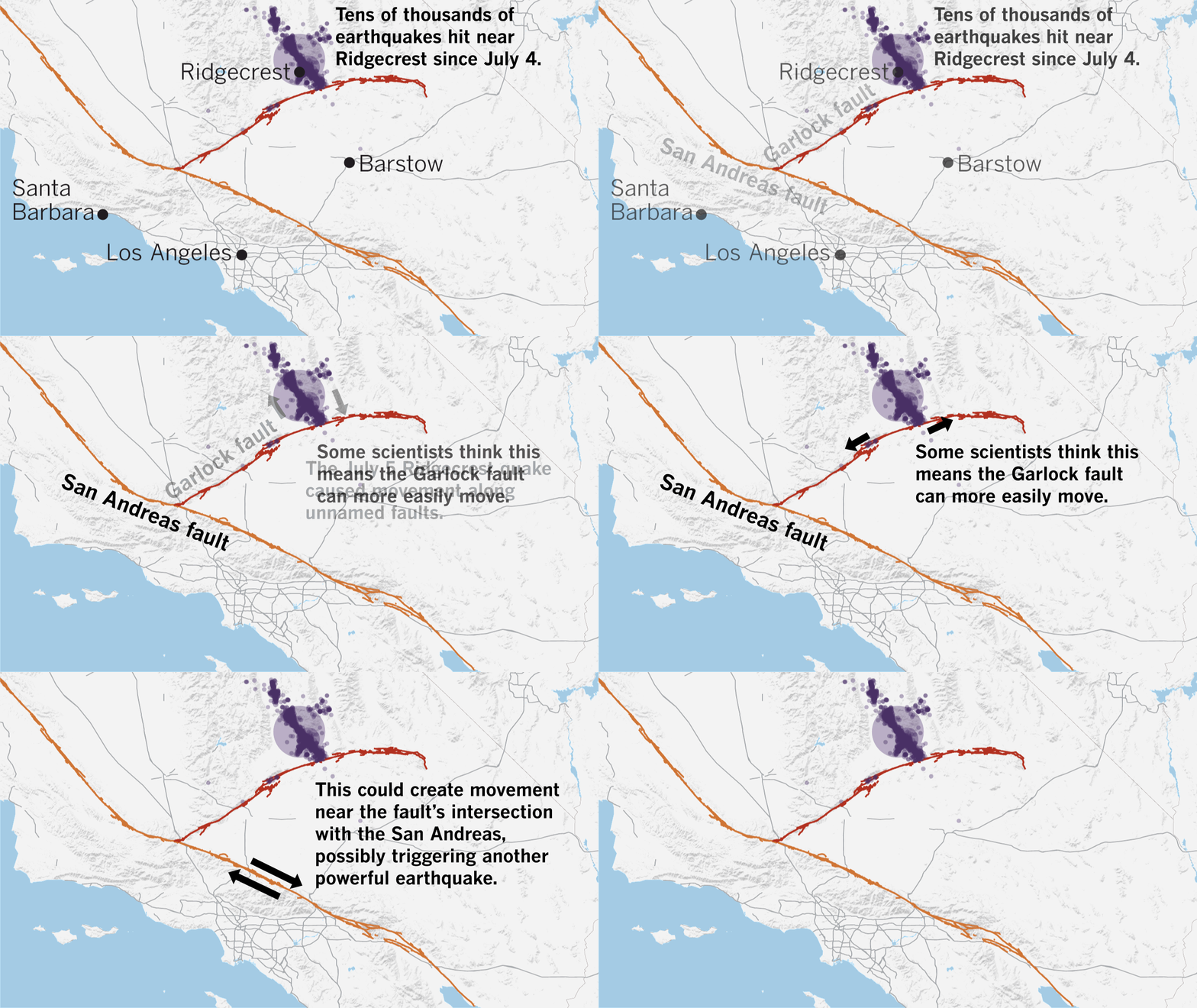
One plausible scenario involves the Ridgecrest quakes triggering a large temblor on the Garlock fault, which then triggers a seismic event on the San Andreas. The chances of such an event happening are small. Another plausible scenario, not mapped, involves a rupture of faults southeast of the Ridgecrest quakes.
(Jon Schleuss / Los Angeles Times)
HT/ozspeaksup
via Watts Up With That?
October 22, 2019 at 12:46PM
 Iowa Climate Science Education
Reblogged this on Climate- Science.press.
LikeLike