
Guest “that was easy” by David Middleton
Like most Bloomberg energy articles, this is very stupidly written… Starting off with the headline that implies that “Warren’s fracking ban” is something more than a fantasy…
Politics
Exxon, Chevron Begin Pushing Back Against Warren’s Fracking Ban
By Kevin Crowley
November 1, 2019America’s two biggest oil companies are starting to push back against the fracking ban touted by the leading candidates for the Democratic presidential nomination, which may become one of the most consequential flashpoints for energy markets during the election campaign.
Exxon Mobil Corp. and Chevron Corp. executives spoke out publicly against the proposals for the first time on Friday, saying they would shift profits from crude production from the U.S. to other countries, and may increase prices for consumers while doing nothing to reduce oil demand or greenhouse-gas emissions.
[…]
To be sure, whoever gets elected next year will find it difficult to end fracking. Presidential powers to enact a ban only extend to federal lands, something that would be certain to face immediate legal challenges. A wider restriction would need to go through Congress.
“Any efforts to ban fracking or restrict supply will not remove demand for the resource,” Neil Hansen, Exxon’s vice president of investor relations, said on a conference call with analysts. “If anything it will shift the economic benefit away from the U.S. to another country, and a potentially impact the price of that commodity here and globally.”
[…]
“It’s really unlocked an economic huge economic benefit for the country, as well as for the companies involved,” Jay Johnson, the boss of Chevron’s upstream business, said during the company’s earnings conference call.
[…]
Here’s Liawatha’s Tweet and one of the funnier replies…
Well on a positive note that should make OPEC Happy that they will be back in The Oil business big time.
What a Joke. Get off the Stage..— Redlion’s Den (@eddiern24) September 8, 2019
Setting aside the fact that the President has no authority to ban frac’ing anywhere other than Federal lands, and might not even have the authority to do it there. Leasing on federal lands and the Outer Continental Shelf (OCS) is governed by laws. Presidents are charged with faithfully executing the laws, not faithlessly disregarding them.
Obama’s unlawful drilling moratorium and subsequent permit-orium were repeatedly slapped down by Federal judges. Obama’s defiance of these rulings did more damage to Gulf of Mexico crude oil production than any hurricane has.
Day 9: Obama repeatedly defied federal court with Gulf oil policies
by Conn Carroll
September 26, 2013[…]
After reviewing the facts and science in the case, the U.S. District Court for the Eastern District of Louisiana found that Obama’s drilling ban was an “arbitrary and capricious” abuse of executive authority, and ordered the ban overturned.
But instead of following the law and allowing Gulf drilling to resume, Obama doubled down, issuing a new moratorium featuring minor technical changes from the first.
The second Obama drilling moratorium applied for the exact same length of time as the first moratorium, through Nov. 30, 2010.
But after intense bipartisan political pressure from Louisiana Sens. David Vitter, a Republican, and Mary Landrieu, a Democrat, Obama nominally lifted the moratorium on Oct. 12, 2010.
By that time about 36 rigs in the Gulf of Mexico had been put out of work, five rigs were being transferred to Egypt and other parts of Africa, and 12,000 jobs had been lost.
Energy industry experts predicted that if new oil leases were not issued, the long-term and indirect economic losses would include more than 175,000 jobs in the region.
But even though the Obama the moratorium had been nominally lifted, a functional ban remained because the Interior Department refused to issue any new drilling permits.
So oil companies again took Obama to federal court, this time seeking an order holding the chief executive in contempt of court and asking that the government pay all of their legal fees.
Again, the U.S. District Court for the Eastern District of Louisiana ruled against Obama, finding him in contempt of court for “a flagrant and continuous disregard of the Court’s Order.”
Finally, on Feb. 28, 2011, almost a month after he had been found in contempt, Obama granted the first oil lease in the Gulf of Mexico.
But while the Interior Department has since stepped up the pace of issuing leasing permits, Gulf oil production is still far below pre-Deepwater Horizon levels. The month before the blowout, according to the Energy Information Administration, oil companies were pumping 1.6 million barrels of oil a day out of the Gulf.Today they are pumping just 1.07 million barrels a day, a 33 percent drop in production.
All told, according to a 2012 American Petroleum Institute study, Obama’s Gulf oil drilling moratorium cost the United States more than $24 billion in lost energy investments and about 90,000 jobs.
Those losses make the $440,596.68 in legal fees the Eastern District forced Obama to pay the oil companies for defying its court order seem like a drop in the bucket.
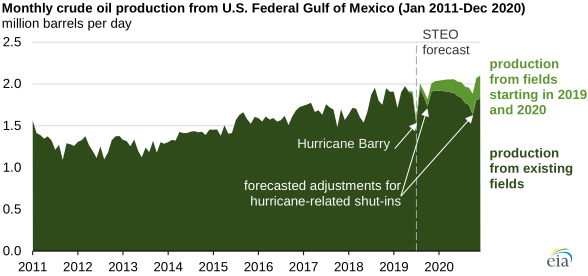
Hurricanes in 2005 (Katrina & Rita) and 2008 (Ike) inflicted extensive damage on Gulf of Mexico oil & gas infrastructure, depressing production by about 250,000 bbl/d from 2006-2008. The Obama maladministration’s unlawful drilling moratorium and “permitorium” in response to the Deepwater Horizon blowout and oil spill depressed production by about 500,000 bbl/d from 2011-2013.

Since then, Gulf of Mexico oil production has surged to record levels and is expected to top 2 million barrels per day in 2020 as a dozen recent deepwater discoveries are brought online.
While a President Fauxcahontas could inflict similar damage, barring new legislation from Congress, the courts would probably slap her down even harder than they slapped Obama down.
What if a Marxist POTUS was able to ban frac’ing and offshore drilling?
POTUS = President Of These United States
JULY 8, 2019
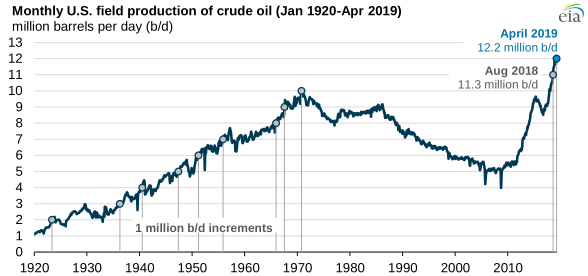
U.S. crude oil production surpassed 12 million barrels per day in AprilU.S. crude oil production and lease condensate reached another milestone in April 2019, totaling 12.2 million barrels per day (b/d), according to EIA’s latest Petroleum Supply Monthly. April 2019 marks the first time that monthly U.S. crude oil production levels surpassed 12 million b/d, and this milestone comes less than a year after U.S. crude oil production surpassed 11 million b/d in August 2018.
Texas and the Federal Offshore Gulf of Mexico (GOM), the two largest crude oil production areas in the United States, both reached record levels of production in April at 4.97 million b/d and 1.98 million b/d, respectively. Oklahoma also reached a record production level of 617,000 b/d.
The U.S. onshore crude oil production increase is driven mainly by developing low permeability (tight) formations using horizontal drilling and hydraulic fracturing. EIA estimates that crude oil production from tight formations in April 2019 reached 7.4 million b/d, or 61% of the U.S. total.
[…]
About 9.2 million barrels per day of current US oil production comes from tight formations and the Gulf of Mexico.
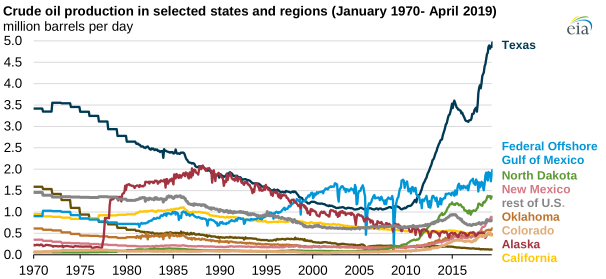
Frac’ing and offshore drilling account for over 75% of current US crude oil production and almost all of the future growth potential for US production and reserves growth.
While an Enviromarxist ban on frac’ing and offshore drilling wouldn’t drop our production to zero-point-zero immediately, the decline would be quick and particularly sharp in the tight formations. There is a very significant relationship between “rig count” and production.

Obama’s unlawful Gulf of Mexico moratorium, very quickly dropped production by about 500,000 bbl/d and the 2014-2016 crash in oil prices caused a similar decline in the Permian Basin. A ban on frac’ing would be catastrophic in the Permian Basin.
Permian Basin oil production with frac’ing…

What would have happened if frac’ing was banned in 2010…

It would be even worse for natural gas.
About 70% of current US natural gas production and all of the future growth potential is from “shale” and other tight formations requiring frac’ing.

The biggest slice of the “shale” gas pie is the Marcellus formation…

Natural gas production from the Appalachia region is mostly from the Marcellus and Utica formations.
Appalachia region natural gas production with frac’ing…

What would have happened if frac’ing was banned in 2010…

Conclusion
Anyone calling for frac’ing ban is mentally ill. Any POTUS who tried to enact a frac’ing ban would be committing Treason. A frac’ing ban wouldn’t change this:

A frac’ing ban would just drive up oil & natural gas prices, force us to import more crude oil and convert LNG export terminals into import terminals. To paraphrase Jeff Goldblum as Dr. Ian Malcolm in The Lost Word, Jurassic Park…
A frac’ing ban would be “the worst idea in the long, sad history of bad ideas.”
Notes about nomenclature
Fracking vs. frac’ing
Frac’ing is a common well completion procedure that has been safely employed in oil & gas production for more than 70 years. There is no evidence whatsoever that frac’ing has ever polluted groundwater or triggered palpable earthquakes. Wastewater injection wells aren’t frac’ing. Frac’ing is a hyphenated abbreviation of “hydraulic fracturing”. Fracking is a cleaned up version of the “F” word.
What is frac’ing? And, is it the same as hydraulic fracturing?
In short, yes. The term “fracking,” which is (supposedly) shorthand for the well completion process of hydraulic fracturing, is actually correctly spelled “frac’ing.” Fracking has become the most used word to describe natural gas from shale deposits, such as the Barnett Shale.Google “fracking” and you get 10,200,000 links.
Unfortunately, the word fracking appears to be widely misunderstood and misused. In fact, it is being used in ways that have nothing to do with the process of frac’ing. For example, the Fort Worth Star-Telegram used the words “pipelines used for fracking” in a recent article’s title, which is incorrect, since pipelines are not used in frac’ing. It’s a good example of how fracking has become an epithet, not a proper description term.
I asked a few people about the word usage recently. “It’s a co-opted word and a co-opted spelling used to make it look as offensive as people can try to make it look,” said Michael Kehs, vice president for Strategic Affairs at Chesapeake Energy, the nation’s second-largest natural gas producer. To the surviving humans of the sci-fi TV series “Battlestar Galactica,” it has nothing to do with oil and gas. It is used as a substitute for the very down-to-earth curse word.So, to set the record straight, here is a quick primer on frac’ing:
First, frac’ing is a well completion or well stimulation technique actually called hydraulic fracturing. It is not a drilling technique, as is commonly written. The fracturing process consists of pumping a combination of 99.5% water and sand, and .5% chemical additives, into the wellbore under high pressure, creating tiny fractures in the shale to release the natural gas. Frac’ing is done after the drilling rig has been removed.
Second, frac’ing is done after the drilling rig has completed the wellbore and has been removed. The actual process of frac’ing a Barnett Shale natural gas well takes less than a week to complete. At that point, the natural gas produced from the well that was hydraulically fractured is no different than any other natural gas well, regardless of how the well was completed.
Finally, and most importantly, the abundant quantities of natural gas contained in shale deposits have been unlocked by combining hydraulic fracturing with horizontal drilling. While the combination of these technologies has been used for decades, it was perfected for shales about 10 years ago. The result is a complete change in the energy outlook for the United States, and many countries in the world for that matter.
[…]
Shale vs. “shale”
I try to put quotation marks around the word shale when I use it in reference to “shale” plays. Most “shale” plays aren’t actually shale.
Is it Shale or not Shale? That is the Question.
In a previous blog on unconventionals, ”Conventional vs. Unconventional Shale: What is my Reservoir?,” Richard Day wrote about the nontrivial problem of classifying reservoirs as conventional or unconventional formations. I would like to continue this topic, as, in Europe, this issue has made it into the headlines of local newspapers. People in small villages have become “experts” in the field of geology, and believe they can determine whether exploration is for conventional or unconventional hydrocarbons, and whether it threatens their tranquillity. If they deem it so, from England to Poland, they voice their concerns.
Personally, if I had a choice, I would prefer to have unconventional drilling in my backyard rather than conventional. The high environmental standards and restrictive regulations give more guarantees that unconventional drilling is more secure and environmentally friendly than conventional drilling. But, sometimes, local people are afraid of whatever we call “shale.” Here, I would like to show examples of rocks that do not meet the definition of shale, but are still perceived as shale. Definitions can be misleading, and the nature of shale is more complex than people believe.
[…]
Recently, I was forced to change my presentation because I used the word “shale” for a rock containing over 45% clay minerals (as was reported in an X-ray diffraction (XRD) test and consistent with my petrophysical analysis), but the operator was wary of naming this rock as a “shale.” Shale can be defined as: ”Shale is laminated, indurated (consolidated) rock with > 67% clay-sized materials.” Jackson, J.A. (1997). Glossary of Geology, 4th Ed., American Geological Institute.
While it is always good to have reliable sources of knowledge, please take a look at the mineral composition of known shale gas plays in the U.S., as presented in Fig. 1 – which shows that almost none of the U.S. shale gas plays meet the criteria of the definition given above. According to this definition, there are no shale gas plays in the U.S. “Houston, we have a problem…”
[…]

Notes on comments
If you’re going to complain about my style and use of words like:
- Liawatha
- Fauxcahontas
- Marxist
- Enviromarxist
Don’t bother to comment. At best, I will ignore you. At worst, I will ridicule the living schist out of you.
via Watts Up With That?
November 7, 2019 at 08:34AM
 Iowa Climate Science Education
Reblogged this on Climate- Science.press.
LikeLike