
By Paul Homewood
You will recall that climate scientist Piers Forster was heavily featured in Matt McGrath’s “global warming causing floods” piece the other day.
In particular, Forster had claimed:
"As temperatures are warmer we get more intense rain, which by itself bring more floods, even if the number of storms hitting our shores don’t change.
When coupled to warmer, wetter winters generally, as expected from climate change, the ground becomes more saturated so any rainfall will give a greater chance of flooding."
Forster linked that BBC report on his Twitter page:

https://twitter.com/piersforster/status/1195329139634507776
Forster was then challenged about his claims, but failed to provide any data to back them up, merely quoting unreliable and theoretical attribution studies:

As we know, the rainfall on Nov 7th in South Yorkshire was exceptionally heavy by any standard. But it was not unprecedented. Nor is there any real world evidence that daily rainfall in England has become more extreme.
But the key to understanding the floods lies in these two maps:


https://www.metoffice.gov.uk/research/climate/maps-and-data/uk-actual-and-anomaly-maps
In the two months prior to the recent floods, rainfall has been well above average in South Yorkshire and East Midlands. Most of the country, however, has not been so badly affected.
This has nothing to do with global warming, it is merely a reflection of the weather patterns that have been in play.
We can get a better idea from the actual figures:


https://www.metoffice.gov.uk/pub/data/weather/uk/climate/stationdata/sheffielddata.txt
Neither September or October were unusually wet in Sheffield, but taken together, the two months were the 6th wettest, though still well down on 1960 and 1903.
There is no evidence of any significant trends in either month either.
For England as a whole, however, the two months are only the 12th wettest since 1910, hardly exceptional. Again there is no noticeable trend.

https://www.metoffice.gov.uk/research/climate/maps-and-data/uk-and-regional-series
.
In my earlier analysis, I anecdotally commented that the dams around Sheffield have been full for sometime, that the river levels were relatively high, and that some of the fields around Fishlake were also flooded in the week prior to the big floods.
None of this is surprising, given the above charts. Indeed the EA’s own river flow summaries for the week before the flood confirmed the same thing, that the Don and Trent were already notably high:

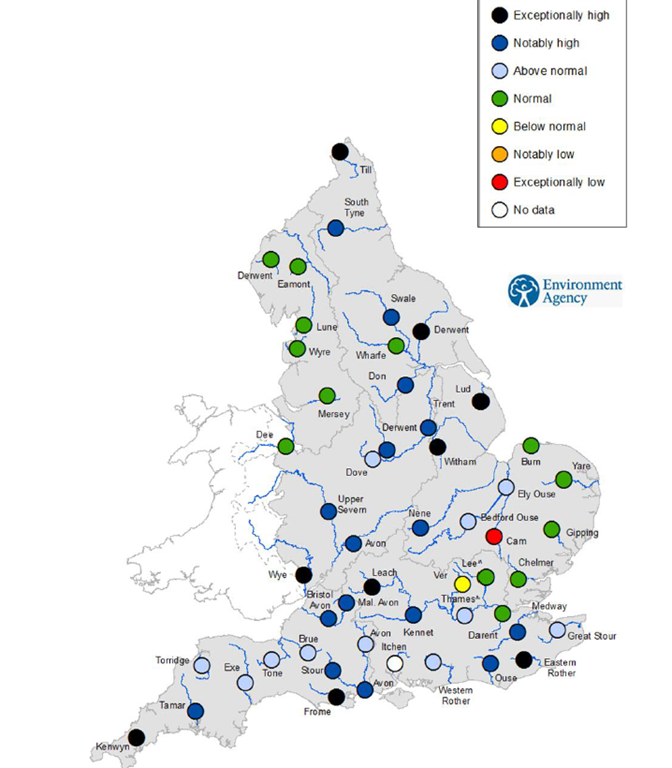
https://www.gov.uk/government/publications/weekly-rainfall-and-river-flow-reports-for-england
In short, everything we have seen is fully explained by normal, natural weather patterns. It is a pity that Piers Forster has to resort to assertions which the data does not support.
His claim, of course, is that as temperatures are warmer we get more intense rain. In fact, temperatures in the last month or so have been well normal:

via NOT A LOT OF PEOPLE KNOW THAT
November 19, 2019 at 05:39AM
 Iowa Climate Science Education
Reblogged this on Climate- Science.press.
LikeLike