
By Paul Homewood
An important and, as usual, forensic contribution from Roy Spencer:

Summary Points
1) Global wildfire activity has decreased in recent decades, making any localized increase (or decrease) in wildfire activity difficult to attribute to ‘global climate change’.
2) Like California, Australia is prone to bushfires every year during the dry season. Ample fuel and dry weather exists for devastating fires each year, even without excessive heat or drought, as illustrated by the record number of hectares burned (over 100 million) during 1974-75 when above-average precipitation and below-average temperatures existed.
3) Australian average temperatures in 2019 were well above what global warming theory can explain, illustrating the importance of natural year-to-year variability in weather patterns (e.g. drought and excessively high temperatures).
4) Australia precipitation was at a record low in 2019, but climate models predict no long-term trend in Australia precipitation, while the observed trend has been upward, not downward. This again highlights the importance of natural climate variability to fire weather conditions, as opposed to human-induced climate change.
5) While reductions in prescribed burning have probably contributed to the irregular increase in the number of years with large bush fires, a five-fold increase in population in the last 100 years has greatly increased potential ignition sources, both accidental and purposeful.
Historical Background
Australia has a long history of bush fires, with the Aborigines doing prescribed burns centuries (if not millennia) before European settlement. A good summary of the history of bushfires and their management was written by the CSIRO Division of Forestry twenty-five years ago, entitled Bushfires – An Integral Part of Australia’s Environment.
The current claim by many that human-caused climate change has made Australian bushfires worse is difficult to support, for a number of reasons. Bushfires (like wildfires elsewhere in the world) are a natural occurrence wherever there is strong seasonality in precipitation, with vegetation growing during the wet season and then becoming fuel for fire during the dry season.
All other factors being equal, wildfires (once ignited) will be made worse by higher temperatures, lower humidity, and stronger winds. But with the exception of dry lightning, the natural sources of fire ignition are pretty limited. High temperature and low humidity alone do not cause dead vegetation to spontaneously ignite.
As the human population increases, the potential ignition sources have increased rapidly. The population of Australia has increased five-fold in the last 100 years (from 5 million to 25 million). Discarded cigarettes and matches, vehicle catalytic converters, sparks from electrical equipment and transmission lines, campfires, prescribed burns going out of control, and arson are some of the more obvious source of human-caused ignition, and these can all be expected to increase with population.
Trends in Bushfire Activity
The following plot shows the major Australia bushfires over the same period of time (100 years) as the five-fold increase in the population of Australia. The data come from Wikipedia’s Bushfires in Australia.
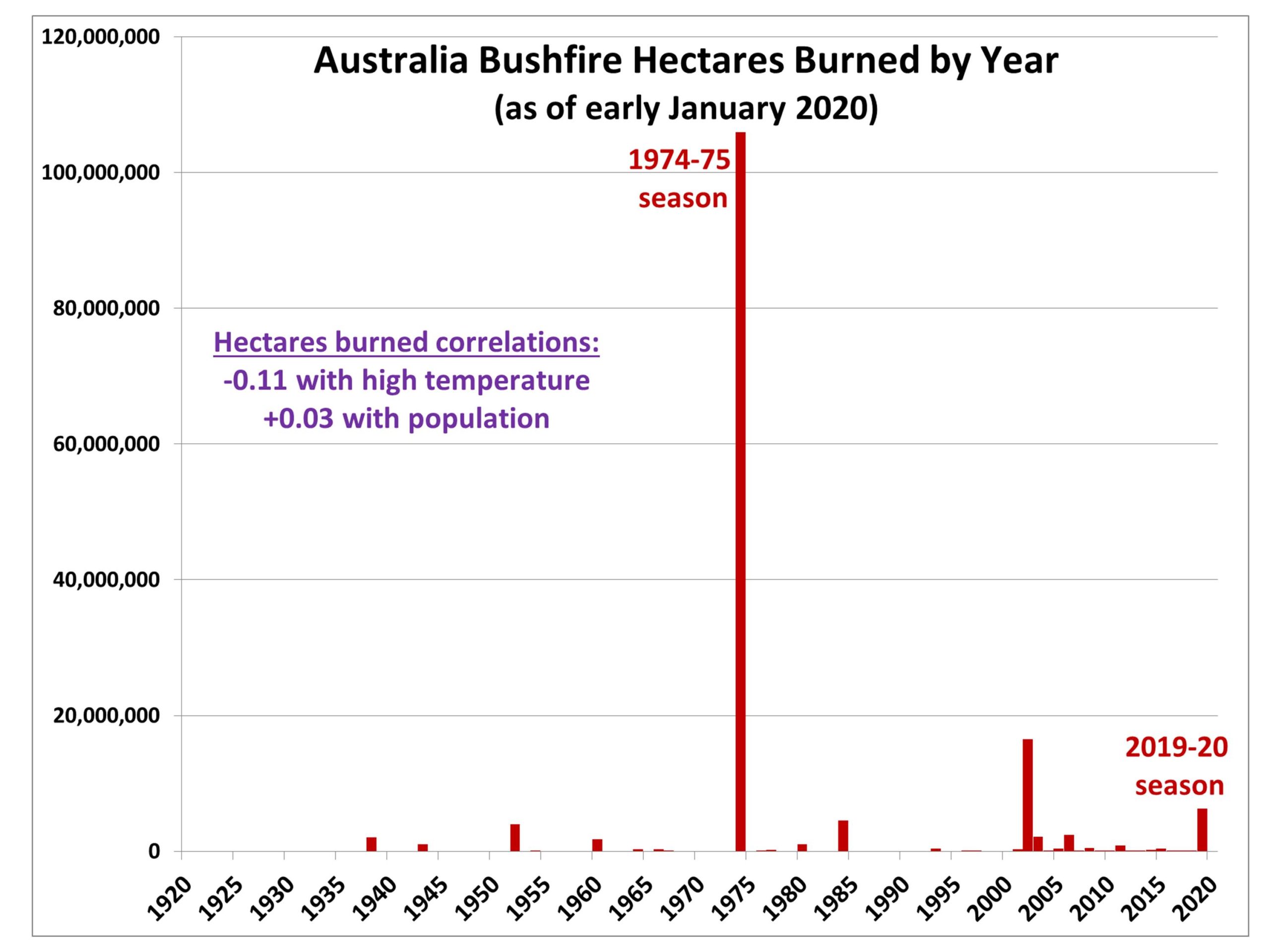
Fig. 1. Yearly fire season (June through May) hectares burned by major bushfires in Australia since the 1919-20 season (2019-20 season total is as of January 7, 2020).
As can be seen, by far the largest area burned occurred during 1974-75, at over 100 million hectares (close to 15% of the total area of Australia). Curiously, though, according to Australia Bureau of Meteorology (BOM) data, the 1974-75 bushfires occurred during a year with above-average precipitation and below-average temperature. This is opposite to the narrative that major bushfires are a feature of just excessively hot and dry years.
Every dry season in Australia experiences excessive heat and low humidity.
Full story here.
It has been widely reported that the recent fires in Australia are somehow “record”. Spencer’s graph shows this to be an outright lie.
As he notes, the fires of 1974/5 burnt some 100m hectares, compared to provisionally about 10m hectares this time. The fires in 2003 were also much worse.
And although it is attractive to link hot/dry weather to wildfires, as Spencer points out, 1974/5 was both wetter and cooler than average.
[BTW- the apparent uptick in fires since pre-war can very easily be explained. Back then most of the continent was relatively uninhabited, and fires were allowed to burn themselves out, without anybody bothering to measure them.]
This fire season has seen widespread fires across Australia, but records show that the fires in 1974/5 were just as widely spread.
For instance, Queensland alone saw 7.3m ha burn that summer, while in NSW 4.5m ha was lost.
Elsewhere 16m and 29m ha was lost to fire in South and Western Australia respectively:


https://ro.uow.edu.au/cgi/viewcontent.cgi?article=1003&context=scipapers
News media readily jumps on climate change as the main cause of Australia’s bushfires, because people assume that hot, dry weather leads to fires. The facts show that things are much more complicated.
Certainly the massive increase in population must also play a major part. With any wildfire, a source of ignition is needed. In nature, lightning can be a cause, but this is extremely unlikely in such dry weather conditions.
But we do know that humans are responsible for probably the vast majority of fires in one way or another, whether deliberate arson, or unintentionally via vehicles, power lines, campfires, discarded matches and cigarettes, etc.
As Roy Spencer concludes:
So, to automatically blame the Australian bushfires on human-caused climate change is mostly alarmist nonsense, with virtually no basis in fact.
via NOT A LOT OF PEOPLE KNOW THAT
January 9, 2020 at 04:19PM
 Iowa Climate Science Education