Feb 9, 2020,9:44 am How Academic ‘Blacklists’ Impede Serious Work On Climate Science Roger Pielke Contributor Energy I research and write about science and technology in policy, politics and in sport
A climate advocacy group called Skeptical Sciencehosts a list of academics that it has labeled “climate misinformers.” The list includes 17 academics and is intended as a blacklist. We know of this intent because one of the principals of Skeptical Science, a blogger named Dana Nuccitelli, said so last Friday, writing of one academic on their list, “if you look at the statements we cataloged and debunked on her [Skeptical Science] page, it should make her unhirable in academia.”
That so-called “unhirable” academic is Professor Judy Curry, formerly the chair of the School of Earth and Atmospheric Sciences at Georgia Tech, and a Fellow of both the American Geophysical Union and American Meteorological Society. By any conventional academic metric, Curry has compiled an impressive record over many decades. The idea that she would be unhirable would seem laughable.
But there is nothing funny aboutSkeptical Science.
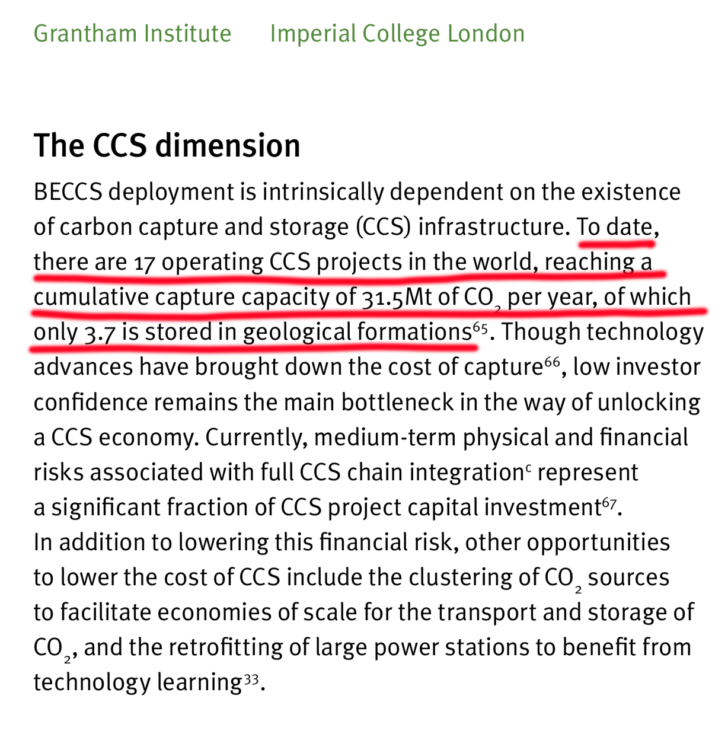
You can check out my takedown yesterday of carbon capture and sequestration (CCS) at American Greatness. But here’s something else. As of 2019, there were only 17 operational CCS projects in the world. Guess how much CO2 they store?
The existing CO2 projects store a mere 3.7 million tons of CO2 in geologic formations — that’s about 0.0067% of global emissions. The future is so bright I need a halogen lamp.
CCS is a fool’s errand. It will never happen on a large scale. The small-scale projects are just a waste of money.
All the harm Britain did to the world by creating the Industrial Revolution puts Britain under a special obligation to lead on climate change, according to British MP Michael Gove.
Michael Gove declares UK has a ‘moral responsibility’ to lead global Green Industrial Revolution
Cabinet Secretary sets out government’s priorities for COP26 Summit, but is reticent on whether he wants the job of Summit President
Michael Gove this morning declared that he was “very happy with the job I have”, while declining to be drawn on whether he wants the post of COP26 President in this week’s imminent Cabinet reshuffle.
…
He also hinted that in the face of likely opposition from the US and Brazilian administrations the UK would look to work with cities and states to secure more ambitious climate pledges. And he highlighted the importance of China’s upcoming Biodiversity COP, which he argued represented “two halves of the same process” in conjunction with the Glasgow COP Summit and as such should provide a route to securing close co-operation with China and other major emerging economies.
…
He added that “the reasons we think it is so important to demonstrate this leadership is not just because we are hosting COP, but also because we believe the UK has a moral responsibility to lead as the first country in the world to industrialise”.
“As we all know the Industrial Revolution relied – and still relies to a disproportionate extent – on the extraction and use of hydrocarbons,” Gove said. “And we have a moral responsibility on the first in, first out basis to ensure the country that pioneered the Industrial Revolution and played the biggest role in the change in our climate, [has] a responsibility to lead a Green Industrial Revolution.“
From the inconvenient data department and the IEA comes this press release.
Despite widespread expectations of another increase, global energy-related carbon dioxide emissions stopped growing in 2019, according to IEA data released today.
After two years of growth, global emissions were unchanged at 33 gigatonnes in 2019 even as the world economy expanded by 2.9%. This was primarily due to declining emissions from electricity generation in advanced economies, thanks to the expanding role of renewable sources (mainly wind and solar), fuel switching from coal to natural gas, and higher nuclear power generation. Other factors included milder weather in several countries, and slower economic growth in some emerging markets.
“We now need to work hard to make sure that 2019 is remembered as a definitive peak in global emissions, not just another pause in growth,” said Dr Fatih Birol, the IEA’s Executive Director. “We have the energy technologies to do this, and we have to make use of them all. The IEA is building a grand coalition focused on reducing emissions – encompassing governments, companies, investors and everyone with a genuine commitment to tackling our climate challenge.”
A significant decrease in emissions in advanced economies in 2019 offset continued growth elsewhere. The United States recorded the largest emissions decline on a country basis, with a fall of 140 million tonnes, or 2.9%. US emissions are now down by almost 1 gigatonne from their peak in 2000. Emissions in the European Union fell by 160 million tonnes, or 5%, in 2019 driven by reductions in the power sector. Natural gas produced more electricity than coal for the first time ever, meanwhile wind-powered electricity nearly caught up with coal-fired electricity. Japan’s emissions fell by 45 million tonnes, or around 4%, the fastest pace of decline since 2009, as output from recently restarted nuclear reactors increased. Emissions in the rest of the world grew by close to 400 million tonnes in 2019, with almost 80% of the increase coming from countries in Asia where coal-fired power generation continued to rise.
Across advanced economies, emissions from the power sector declined to levels last seen in the late 1980s, when electricity demand was one-third lower than today. Coal-fired power generation in advanced economies declined by nearly 15% as a result of growth in renewables, coal-to-gas switching, a rise in nuclear power and weaker electricity demand.
“This welcome halt in emissions growth is grounds for optimism that we can tackle the climate challenge this decade,” said Dr Birol. “It is evidence that clean energy transitions are underway – and it’s also a signal that we have the opportunity to meaningfully move the needle on emissions through more ambitious policies and investments.”
To support these objectives, the IEA will publish aWorld Energy Outlook Special Report in June that will map out how to cut global energy-related carbon emissions by one-third by 2030 and put the world on track for longer-term climate goals.
The Agency will also hold an IEA Clean Energy Transitions Summit in Paris on 9 July, bringing together key government ministers, CEOs, investors and other major stakeholders from around the world with the aim of accelerating the pace of change through ambitious and real-world solutions.
Dr Birol will discuss these results and initiatives tomorrow at a special IEA Speaker Series event at IEA Headquarters in Paris with energy and climate ministers from Poland, which hosted COP24 in Katowice; Spain, which hosted COP25 in Madrid; and the United Kingdom, which will host COP26 in Glasgow this year. More details on the IEA event, including how to watch a live webcast, are available here.





 Iowa Climate Science Education
