
by Peter Lang and Ken Gregory
A new paper ‘Economic impact of energy consumption change caused by global warming’ finds global warming may be beneficial.
In this blog post we reproduce the Abstract, Policy Implications and Conclusions and parts of the Introduction, Results and Discussion. We encourage you to read the entire paper.
Abstract: This paper tests the validity of the FUND model’s energy impact functions, and the hypothesis that global warming of 2 °C or more above pre-industrial times would negatively impact the global economy. Empirical data of energy expenditure and average temperatures of the US states and census divisions are compared with projections using the energy impact functions with non-temperature drivers held constant at their 2010 values. The empirical data indicates that energy expenditure decreases as temperatures increase, suggesting that global warming, by itself, may reduce US energy expenditure and thereby have a positive impact on US economic growth. These findings are then compared with FUND energy impact projections for the world at 3 °C of global warming from 2000. The comparisons suggest that warming, by itself, may reduce global energy consumption. If these findings are correct, and if FUND projections for the non-energy impact sectors are valid, 3 °C of global warming from 2000 would increase global economic growth. In this case, the hypothesis is false and policies to reduce global warming are detrimental to the global economy. We recommend the FUND energy impact functions be modified and recalibrated against best available empirical data. Our analysis and conclusions warrant further investigation.
Introduction
There is a scientific hypothesis and political acceptance that global warming of 2 °C or more above pre-industrial times would have a negative impact on global economic growth. This hypothesis is supported by economic models that rely on impact functions and many assumptions. However, the data needed to calibrate the impact functions is sparse, and the uncertainties in the modelling results are large. The negative overall impact projected by at least one of the main models, Climate Framework for Uncertainty, Negotiation and Distribution (FUND), is mostly due to one impact sector – energy consumption. However, the projected negative impact seems to be at odds with empirical data. If this paper’s findings from the empirical energy consumption data are correct, and if the impact functions for the non-energy sectors are correct, then the overall economic impact of global warming would be beneficial. If true, the implications for climate policy are substantial.
Integrated Assessment Models (IAM) approximately reproduce the projections from the Global Climate Models (GCM) and apply impact functions to estimate the economic impacts of global warming. The impact functions are derived from and calibrated to what the developers assess are the most suitable studies of the impacts. The impact functions require many assumptions, including projections of population, gross domestic product (GDP), per capita income, elasticities and technology progress in energy provision.
Various studies conclude that the impact functions (also called damage functions) used in the IAMs are derived from inadequate empirical data. For instance, Pindyck says “when it comes to the damage function, however, we know almost nothing, so developers of IAMs can do little more than make up functional forms and corresponding parameter values. And that is pretty much what they have done.” According to Kolstad et al., the IAM damage functions “are generated from a remarkable paucity of data and are thus of low reliability”. The National Academies of Sciences, Engineering and Medicine (NAS) says FUND needs further justification for the damage functions, the adaptation assumptions for the different sectors, the regional distribution of damages, and the parametric uncertainties overall. Tol says the impact of climate change has not received sufficient attention; he says “there is either very little solid evidence, no conclusive evidence, or no quantification of welfare impacts”.
NAS reviews the damage functions of the three main IAMs, discusses alternative approaches, reviews recent literature on damage estimation, and offers recommendations for a new damage module. It says that much of the literature on which the damage functions are based is dated and, in many cases, does not reflect recent advances in the scientific literature. For example, the FUND energy impact parameters are calibrated to reproduce the results of the 1996 papers by Downing et al. and the income elasticity results of the 1995 paper by Hodgson and Miller.
FUND is one of the three most cited IAMs; Bonen et al., National Research Council and NAS compare them. FUND is the most complex. FUND disaggregates by sixteen world regions and eight main impact sectors (agriculture, forestry, water resources, sea level rise, ecosystems, health, extreme weather, and energy consumption). This enables analysts to conduct sensitivity analyses and to separately test individual impact functions.
Tol used the national version of FUND3.6 to backcast the economic impact of global warming for these sectors for the 20th century and projected the impacts for the 21st century. Tol fitted the backcast results to observations of 20th century sectoral impacts. Tol is an important study because it estimates the impacts for the most significant impact sectors, globally and by region. It also estimates the total impact on all sectors. Figure 1 shows the backcast (observed) and projected economic impact of global warming by sector.

Figure 1 – Overnight construction cost (in 2010 US $/kW) plotted against cumulative global capacity (GW), based on construction start dates, of nuclear power reactors for seven countries, including regression lines for US before and after 32 GW cumulative global capacity. Adapted from Tol
The bottom panel of Figure 1 suggests that an increase of up to around 4 °C Global Mean Surface Temperature (GMST) above pre-industrial times would be beneficial for the total of all sectors if the projected energy impacts for 2000–2100 are excluded. Energy consumption is projected to have a substantial negative impact during the 21st century; in fact, its negative impact exceeds the total impact of all other sectors, which is positive, from about 2080.
The striking change in trend of the energy impact at the turn of the century inspired this study. The trend was positive as GMST increased by 0.61 °C during the 20th century but FUND projects it will be substantially negative for the 21st century as GMST is projected to increase further. That is, whereas the observations for 1900–2000 show the impacts were positive, FUND projects continued global warming would have negative impacts for the global economy.
Contrary to the FUND energy projection for the period 2000–2100, the US Energy Information Administration (EIA) empirical data appear to indicate that global warming would reduce US energy expenditure and, therefore, contribute positive economic impacts for the USA. The paper infers that the impacts of global warming on the US economy may be indicative of the impacts on the global economy.
If the economic impact of energy is near zero or positive, and if the total of the sectoral projections in Figure 1, other than for energy consumption, is approximately correct, global warming would be beneficial up to around 3 °C relative to 2000, and 4 °C relative to pre-industrial times. The significance of these findings for climate policy is substantial. For instance, policies that aim to reduce global warming would not be economically justifiable. Therefore, the economic impact of energy consumption projected in Tol, and by FUND3.9, warrants investigation if FUND is to be used for policy.
This paper tests the validity of the FUND energy impact functions against US empirical data. It examines EIA data for the USA to investigate whether the impact of global warming on US energy consumption would reduce or increase US economic growth and compares the results with the energy projections. Next it investigates the projections for FUND’s 16 world regions. Lastly, it discusses some policy implications.
Figure 9 compares the projected US energy expenditure impacts against the impacts calculated from the EIA empirical data.
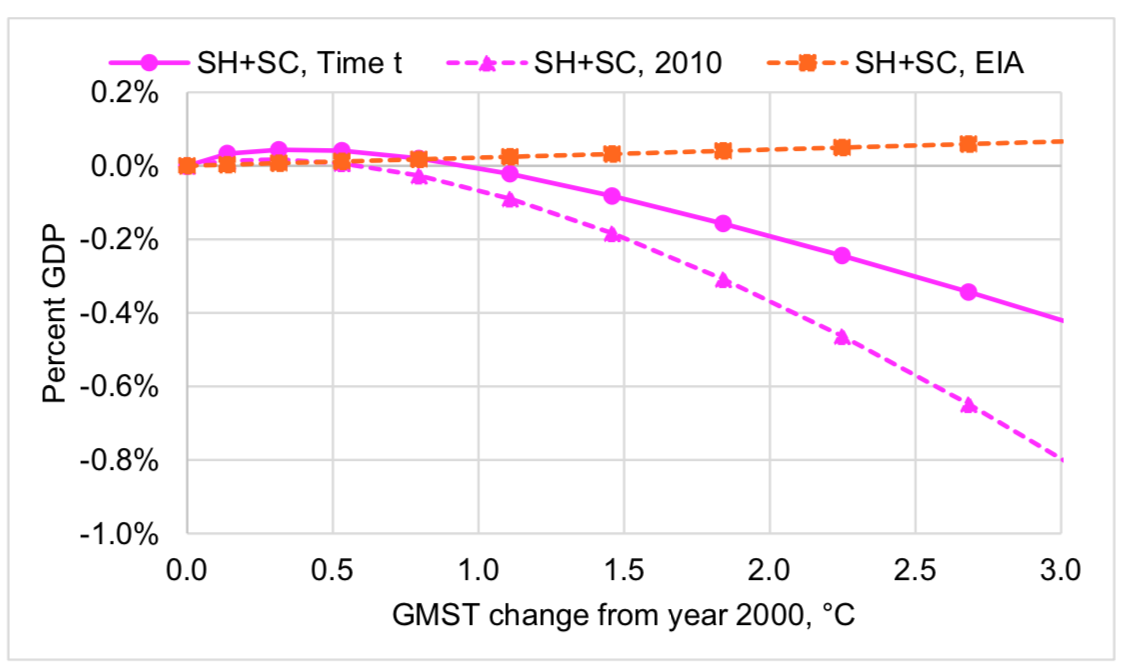
Figure 9: Economic impact of US energy expenditure as functions of GMST change, relative to 2000. Pink solid line is the Julia FUND3.9 projection. Pink dashed line is the projection with non-temperature drivers constant at 2010 values. The orange dashed line is from the EIA data.
Figure 9 shows the projected impacts are substantially negative whereas the EIA data shows they are positive.
Figure 15 plots the global economic impacts by sector as a function of GMST change from 2000 to 2100 projected by FUND3.9 with non-temperature drivers included. The total of all impact sectors, and the total excluding energy, are also shown.

Figure 15: FUND3.9 projected global sectoral economic impact of climate change as a function of GMST change from 2000. Total* is of all impact sectors except energy.
With energy impacts excluded, FUND projects the global impacts to be +0.2% of GDP at 3 °C GMST increase from year 2000. With the energy impact functions misspecifications corrected, and all other impacts are as projected, the projected total economic impact may be more positive.
The conclusion that 3 °C of global warming may be beneficial for the global economy depends, in part, on the total of the non-energy impact projections being correct, or more positive. Whether this is the case needs to be tested.
Policy Implications
The economic impact of climate policies is likely to be substantial. It is the sum of the economic impact of the policies and the cost of implementing and maintaining the policies. If global warming is beneficial, as this study indicates may be the case, then the total economic impact is the sum of the forgone benefits of the avoided global warming plus the cost of policies to mitigate warming.
Our analysis suggests that the overall impact of global warming may be positive – that is, it would increase global economic growth. If this is correct, then the positive impacts can be maximised and the negative impacts minimised by increasing wealth, but not by reducing global warming. Tol concludes that the negative impacts of global warming can be reduced by reducing global warming and/or reducing poverty. However, if global warming is beneficial, then polices aimed at reducing global warming are reducing global economic growth.
According to Lomborg any reductions in temperature resulting from the Paris Agreement promises would be minimal but at high cost. For example, Lomborg says that all Paris promises 2016–2030 will reduce global temperatures by just 0.05 °C in 2100, and by 0.17 °C if they continue to 2100. He estimates the most likely cost would be $1,848 billion per year in 2030. This is about 2% of projected world GDP in 2030, and this estimate does not include all costs of the climate change industry.
Other studies also indicate that the cost of policies to reduce global warming is high. For example, Climate Change Business Journal estimates put the climate change industry in 2013 at $1,405 billion, about 1.9% of world GDP. Further, Insurance Journal says that the ‘climate change industry’ grew at 17–24% annually 2005–2008, 4–6% following the recession, and 15% in 2011. These growth rates are much higher than the growth rate of the world economy implying that, if they continue, which is likely with international protocols, accords and agreements such as Kyoto, Copenhagen and Paris, the cost of climate policies will continue to escalate.
Conclusions
This study tests the validity of the FUND energy impact functions by comparing the projections against empirical space heating and space cooling energy data and temperature data for the USA. Non-temperature drivers are held constant at their 2010 values for comparison with the empirical data. The impact functions are tested at 0° to 3 °C of global warming from 2000.
The analysis finds that, contrary to the FUND projections, global warming of 3 °C relative to 2000 would reduce US energy expenditure and, therefore, would have a positive impact on US economic growth. FUND projects the economic impact to be -0.80% of GDP, whereas our analysis of the EIA data indicates the impact would be +0.07% of GDP. We infer that the impact of global warming on energy consumption may be positive for the regions that produced 82% of the world’s GDP in 2010 and, by inference, may be positive for the global economy.
The significance of these findings for climate policy is substantial. If the FUND sectoral economic impact projections, other than energy, are correct, and the projected economic impact of energy should actually be near zero or positive rather than negative, then global warming of up to around 3 °C relative to 2000, and 4 °C relative to pre-industrial times, would be economically beneficial, not detrimental.
In this case, the hypothesis that global warming would be harmful to the global economy this century may be false, and policies to reduce global warming may not be justified. Not adopting policies to reduce global warming would yield the economic benefits of warming and avoid the economic costs of those policies.
The discrepancy between the impacts projected by FUND and those found from the EIA data may be due to a substantial proportion of the impacts (37% for the US and 67% for the world) being due to non-temperature drivers, not temperature change, and to some incorrect energy impact function parameter values.
We recommend that the FUND energy impact functions be modified and recalibrated against best available empirical data. Further, we recommend that the validity of the non-energy impact functions be tested.
via Climate Etc.
February 8, 2020 at 10:31AM
 Iowa Climate Science Education