h/t Dr. Willie Soon; According to Cambridge Professor of Engineering Julian Allwood, zero carbon aviation is not going to happen in the foreseeable future.
The only way to hit net zero by 2050 is to stop flying
Julian Allwood
Dreaming of electric planes and planting trees will not save our planet
The writer is professor of engineering and the environment at Cambridge university
The UK aviation industry this week promised to bring its net carbon emissions down to zero by 2050 while growing by 70 per cent, and Prime Minister Boris Johnson boldly predicted that “viable electric planes” would be available in just a few years.
But past experience with innovation in aviation suggests that such ambitious targets are unrealistic and distracting. The only way the UK can get to net zero emission aviation by 2050 is by having a substantial period of no aviation at all. Let’s stop placing impossible hopes on breakthrough technologies, and try to hit emissions targets with today’s technologies. Our recent report “Absolute Zero” draws on work at six British universities to explain how.
…
So the commitment to net zero aviation by 2050 is really a commitment to zero aviation. Rather than hope new technology will magically rescue us, we should stop planning to increase fossil-fuel flights and commit to halving them within 10 years with an eye toward phasing them out entirely by 2050.
Taxing aircraft fuel at the level of the UK’s current road fuel tax would be a useful first step: I estimate that it would make flights up to four times more expensive.
Climate policy announcements so far have failed to account for the limited rate at which new technologies can reach significant scale. Fifty years after the Danes began developing wind turbines, they contribute just 2 per cent of world primary energy. Regardless of prices or incentives, new energy generation, transport and industrial processes require public consultation on regulations, land use, funding, environmental impacts and more. This all slows down their adoption.
Given how much Brits love their low cost airlines and cheap holiday flights to Mallorca, punitive taxes on aircraft fuel and an ultimate plan to destroy the industry will be a tough sell.
This article on Grist (h/t to James Taylor, The Heartland Institute) tries to point out how “terrible” the last decade was due to “climate change”. They write:
As this hottest-on-record, godforsaken decade draws to a close, it’s clear that global warming is no longer a problem for future generations but one that’s already displacing communities, costing billions, and driving mass extinctions. And it’s worth asking: Where did the past 10 years get us?
The seven charts below begin to hint at an answer to that question. Some of the changes they document, like the concentration of carbon dioxide in the atmosphere and the number of billion dollar disasters that occur each year, illustrate how little we did to reduce emissions and how unprepared the world is to deal with the warming we’ve already locked in.
We can also provide 7 charts that illustrate the last decade of climate change, and they tell a different story.
What they say:1. Atmospheric carbon dioxide rose by about 25 parts per million.
There’s no disputing that ambient CO2 has gone up in the atmosphere, however, that isn’t necessarily a bad thing. NASA, for example has this to say about the effects of that increased CO2 in study about CO2 and greening derived from satellite data.
From a quarter to half of Earth’s vegetated lands has shown significant greening over the last 35 years largely due to rising levels of atmospheric carbon dioxide, according to a new study published in the journal Nature Climate Change on April 25 2016
“We were able to tie the greening largely to the fertilizing effect of rising atmospheric CO2 concentration by tasking several computer models to mimic plant growth observed in the satellite data,” says co-author Prof. Ranga Myneni of the Department of Earth and Environment at Boston University.
“The greening over the past 33 years reported in this study is equivalent to adding a green continent about two-times the size of mainland USA (18 million km2)…”
It seems the Earth’s biosphere is responding to increased CO2 in a positive way, that’s also undeniable.
What they say:2. Climate change got expensive.
They cite this graph (produced by the Grist magazine):
And they say:
One of the best-established consequences of global warming is that it makes natural disasters, like fires and floods, more frequent and severe. In the 2010s, the costs of this consequence came into sharp focus as billion-dollar disasters struck the United States again and again.
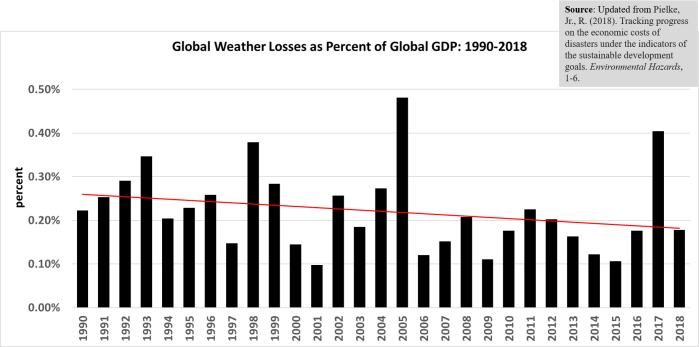
But, that’s not true when you look at normalized weather disaster costs:
It appears that 2019, is on track to continue the record of good news. Robert Muir-Wood of RMS, a leading catastrophe modeling firm, wrote a month ago “Almost three months ago we passed a remarkable record in catastrophe loss. And yet no one seems to want to celebrate it. No banner headlines in the newspapers. . . The first half of 2019 generated the lowest catastrophe insurance loss for more than a decade.” Muir-Wood labelled 2019 “the year of the kitten.” With two months left, cross your fingers.
What they say:3. More people accept the basic premises that it’s getting hot and that it’s our fault.
Well, you might think that if you believe the highly adjusted temperature data published by NASA GISS and England’s Hadley Centre on climate (ground zero for the embarrassing and revealing Climategate affair in 2009).
But when you look at unadjusted data, such as is produced by the state-of- the-art United States Climate Reference Network (USCRN) operated by NOAA, you get a wholly different idea about temperature over the last decade:
That’s right, in the contiguous US, the temperature for 2019 was actually lower than for the start of the decade at 2010. The two peaks in 2012 and 2016 were from naturally caused El Nino events in the Pacific ocean. Granted, the USA isn’t the world, but the USA routinely gets blamed for all of the climate woes of the world, so the comparison seems a fair one. But really, where’s the climate crisis?
What they say:4. But there’s a widening partisan divide when it comes to worrying about the environment.
Well that’s true, Conservatives generally think things through and look at fact based evidence compared to the liberal side, which seems to “feel” issues far more than they critically examine them.
But when people of all stripes worldwide are polled about it, such as the United Nations does, it comes in dead last as a concern:
It seems people worldwide would rather have education, food, honest government, better roads, and reliable energy than they would some climate action.
What they say:5. Coal continued its death spiral.
Citing a Grist produced graph of data from the US Energy Information Administration (EIA) that they say depicts a “death spiral” for coal use, they say coal is on the way out.
Clayton Aldern / Grist
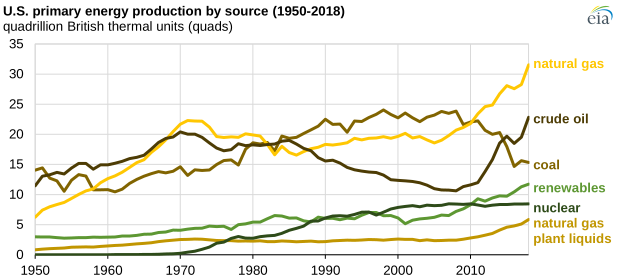
While that data is true, what they aren’t showing you is the rest of the story from the EIA:
What is really going on here is that natural gas is replacing coal because it is more efficient, less expensive to maintain, and has a smaller footprint. It’s really a market driven business decision rather than a nod to environmental concerns.
What they say:6. Solar skyrocketed, but fossil fuels still dominate.
Once again they cite a graph they produced from EIA data, and once again, it doesn’t tell the whole story.
Clayton Aldern / Grist
Gosh, it looks like the entire USA is being powered by solar energy! Hurray for environmentalism! Inconveniently, the reality is far different:
While renewables, including solar, have made gains, they still lag behind fossil fuels such as natural gas, crude oil, and coal in energy production in the USA. Without baseload (grid) generation by coal and natural gas, solar wouldn’t even work, since almost all solar installations are grid-tied – meaning that if the grid doesn’t have electricity, solar power can’t feed to it.
What they say:7. While coal flatlined, the price of renewables dropped precipitously.
I wonder what the price of renewables would be if they weren’t propped up by your tax dollars? According to EIA data, fossil fuels are still far less expensive:
The EIA estimates the two largest federal tax credit programs benefiting wind and solar paid out a combined $2.8 billion in 2016. These funds came through a tax credit worth 2.4 cents per kilowatt hour of power produced, as well as a deduction equal to 30 percent of a facility’s installation costs.
These two tax credits are set to expire at the end of 2021, though a permanent 10 percent investment tax credit for solar and geothermal installations would remain.
Anthony Watts is former television meteorologist and Senior Fellow for Environment and Climate for The Heartland Institute. He operates the most viewed website on climate in the world, WattsUpWithThat.com
Prince Harry revealed he has been in therapy for the last seven years to cope with the loss of his mother during his keynote speech at a JPMorgan summit in Miami on Thursday night after being introduced on-stage by Meghan.
The Alternative Investment Summit is the first public appearance Harry, 35, and Meghan, 38, have made since they left the royal family two weeks ago in search of a private life, and is believed to have earned them between $500,000 and $1million.
The star-studded event at the 1 Hotel South beach attracted business titans and celebrities like Bob Kraft, Alex Rodriguez and Magic Johnson.
Sources told Page Six that Gayle King introduced Meghan to the stage which was erected under an enormous tent on the beach. Meghan then spoke briefly about her ‘love for her husband’ then introduced him. After the speech, they are believed to have had a private dinner with some of the other esteemed guests.
It is not clear how Harry and Meghan – who were widely criticized for taking private jets last year after preaching about climate change publicly – traveled to Florida.
JPMorgan’s private Gulfstream jet had flown to Vancouver Airport in Canada, near to where the couple have been living since quitting royal life.
It then left at at 12.10pm Wednesday and landed in Palm Beach at 8.03pm. Harry and Meghan stayed at Serena Williams’ home in Palm Beach during the appearance.
It is unclear if they were on that jet. Palm Beach is around 80 miles north of Miami.
This article tells the uncomfortable truth about reducing CO2 emissions. It is a key argument that all the activists don’t want to mention. All of them concentrate on UK emissions even though they know that it is India and China who are increasing them year on year.






 Iowa Climate Science Education