Month: February 2020

Snowfall in Donetsk – The city is under siege

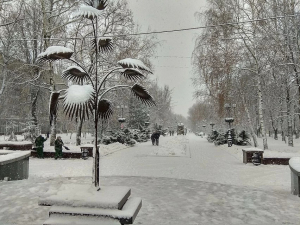
Ukraine – 7 Feb 2020 – In Donetsk, the “capital” of the “people’s republic”, heavy snowfall covers the streets. Residents are forced to walk along uncleaned streets, cars are stuck in traffic jams, and public transport runs intermittently.

The main city of Donbass, which is currently occupied by militants and Russian troops, was captured by the snow. This was reported by the Telegram channel “TRESH DNR”.

As you know, a few days ago heavy snow fell on Ukraine: under the blow of the elements were Kiev, Kharkov and the Dnieper.

https://www.dialog.ua/ukraine/200771_1581082346
https://www.dialog.ua/images/news/news_view/131146dbc03e75379fdbf330f24ee776.jpg

Thanks to Argiris Diamantis for these links

The post Snowfall in Donetsk – The city is under siege appeared first on Ice Age Now.

via Ice Age Now

https://ift.tt/2veHmhj

February 7, 2020 at 07:42PM

UNSW Psychologist: “We are all Climate Deniers”

Guest essay by Eric Worrall

According to UNSW psychology doctoral candidate Belinda Xie, everybody is somewhere on the spectrum of climate denial.

Climate change denialism is something we all suffer from

Twitter Facebook LinkedIn 07 FEB 2020   CAROLINE TANG 

Even those who don’t question human-induced climate change can fall on the spectrum of climate denialism if they are all talk and no action, a UNSW psychology researcher argues.

Climate change denialism is something that applies to more than just diehard non-believers, a UNSW Sydney researcher argues.

The unprecedented bushfire crisis has strengthened demand for government action on climate change and galvanised Australians to take to the streets protesting against the nation’s reliance on fossil fuels.

Some Australians have taken more drastic action, such as actor Yael Stone who gave up the permanent right to work in the US.

But for many people, such action seems unrealistic.

While we may know it is better for the environment to give up our car for public transport, stop using single-use plastics, or eat less meat — we do not always do all these things all the time.

“It’s almost impossible to live with zero impact on the planet, but it’s what we do when we recognise this that matters”, Belinda Xie asserts.

The UNSW Scientia PhD candidate specialises in cognitive science and researches the psychology of climate change.

“It’s important that we acknowledge we are all climate deniers, to some extent, and then understand how and why we reached this point,” Ms Xie said.

“It’s not simply because humans are bad or selfish people: there are a lot of external factors out of our control, such as the information we consume that can encourage denialism, or the way our economy is set up.

“So, we then need to ask ourselves: how do we overcome this denialism – what action can we take as a community and what can government and business do?”

“Making behavioural change at an individual level is important, but it’s just as important for the people and institutions at the top to inspire and implement change for the good of our planet and future generations.”

Read more: https://newsroom.unsw.edu.au/news/science-tech/climate-change-denialism-something-we-all-suffer

Belinda Xie’s paywalled paper is available here.

How can greens achieve that idealised state of society described by Belinda Xie, in which leaders and institutions inspire people to more fully commit to fighting climate denial, and inspire people to actively work to correct their personal climate behavioural shortcomings?

The problem Belinda describes is similar to the problem Joseph Stalin and Mao Zedong faced when trying to consolidate the authority of their respective Communist states. In the immediate aftermath of the revolutions which propelled them into power, plenty of people claimed to believe in Communism, but on an individual level there was a widespread lack of wholehearted commitment to the actual practice of Communism.

The Communist solution was institutionalised “self criticism”; encouraging people to publicly confess their personal shortcomings and pledge to do better. According to The History of the Communist Party of the Soviet Union (Bolsheviks);

In order to be fully prepared for this turn, the Party had to be its moving spirit, and the leading role of the Party in the forthcoming elections had to be fully ensured. But this could be done only if the Party organizations themselves became thoroughly democratic in their everyday work, only if they fully observed the principles of democratic centralism in their inner-Party life, as the Party Rules demanded, only if all organs of the Party were elected, only if criticism and self-criticism in the Party were developed to the full, only if the responsibility of the Party bodies to the members of the Party were complete, and if the members of the Party themselves became thoroughly active.

via Watts Up With That?

https://ift.tt/2H7fn5P

February 7, 2020 at 04:51PM

Asians Far More Likely to Die Due to Coronavirus than Other Races?

Coronavirus has sickened more than 31,500 people in China and 24 other countries, and as of this morning (7 Feb 2020), at least 638 have died.

The Main Stream Media in Western countries is stoking panic on the spread of the possibly Apocalyptic new plague, but according to Lance Welton writing for Russia Insider, “what nobody is openly reporting: the race of the victims. They appear to be all Asians.”

The two Coronavirus cases just confirmed in the U.K. turn out to be “Chinese nationals.” Similarly a case in Finland “turns out to be a Chinese tourist in Lapland, not a Finn.”

“In fact, as far as I can tell, all of the confirmed cases have been of Chinese people,” writes Welton. According to Sri Lankan radio, the case in Sri Lanka was a “Chinese tourist.” So are the cases in France and the one in the United Arab Emirates.”

“If it is true that only East Asians are dying of, or even catching, Corona, that would be consistent with long-established race differences in the susceptibility to such viruses.”

“If true, this (also) radically lessens the likelihood of a global pandemic.”

Can any of my readers confirm this? Are you aware of anyone in your country who been diagnosed with this virus? Do you know whether or not they are of Asian descent? 

See entire article:
https://russia-insider.com/en/asians-far-more-susceptible-corona-virus-other-races-more-likely-die-just-sars-report/ri28241

Thanks to Stephen Bird for this link

The post Asians Far More Likely to Die Due to Coronavirus than Other Races? appeared first on Ice Age Now.

via Ice Age Now

https://ift.tt/2OAp7K3

February 7, 2020 at 03:57PM

Corrected RCP Scenario Removal Fractions

Reposted from Dr. Roy Spencer’s blog

February 6th, 2020 by Roy W. Spencer, Ph. D.

Well, as I suspected (and warned everyone) in my blog post yesterday, a portion of my calculations were in error regarding how much CO2 is taken out of the atmosphere in the global carbon cycle models used for the RCP (Representative Concentration Pathway) scenarios. A few comments there said it was hard to believe such a discrepancy existed, and I said so myself.

The error occurred by using the wrong baseline number for the “excess” CO2 (atmospheric CO2 content above 295 ppm) that I divided by in the RCP scenarios.

Here is the corrected Fig. 1 from yesterday’s post. We see that during the overlap between Mauna Loa CO2 observations (through 2019) and the RCP scenarios (starting in 2000), the RCP scenarios do approximately match the observations for the fraction of atmospheric CO2 above 295 ppm.

CO2-removal-rates-RCP-vs-NLO-vs-simple-model-corrected-550x550CO2-removal-rates-RCP-vs-NLO-vs-simple-model-corrected-550x550

Fig. 1. (corrected) Computed average yearly rate of removal of atmospheric CO2 above a baseline value of 295 ppm from (1) historical emissions estimates compared to Mauna Loa CO2 data (red), (2) the RCP scenarios used by the IPCC CMIP5 climate models Lower right), and (3) in a simple time-dependent CO2 budget model forced with historical emissions before, and EIA-based assumed emissions after, 2018 (blue). Note the time intervals change from 5 to 10 years in 2010. 

But now, the RCP scenarios have a reduced rate of removal in the coming decades during which that same factor-of-4 discrepancy with the Mauna Loa observation period gradually develops. More on that in a minute.

First, I should point out that the CO2 sink (removal rate) in terms of ppm/yr in three of the four RCP scenarios does indeed increase in absolute terms from (for example ) the 2000-2005 period to the 2040-2050 period: from 1.46 ppm/year during 2000-2005 to 2.68 ppm/yr (RCP4.5), 3.07 ppm/yr (RCP6.0), and 3.56 ppm/yr (RCP8.5). RCP2.6 is difficult to compare to because it involves not only a reduction of emissions, but actual negative CO2 emissions in the future from enhanced CO2 uptake programs. So, the RCP curves in Fig.1 should not be used to infer a reduced rate of CO2 uptake; it is only a reduced uptake relative to the atmospheric CO2 “overburden” relative to more pre-Industrial levels of CO2.

How Realistic are the Future RCP CO2 Removal Fractions?

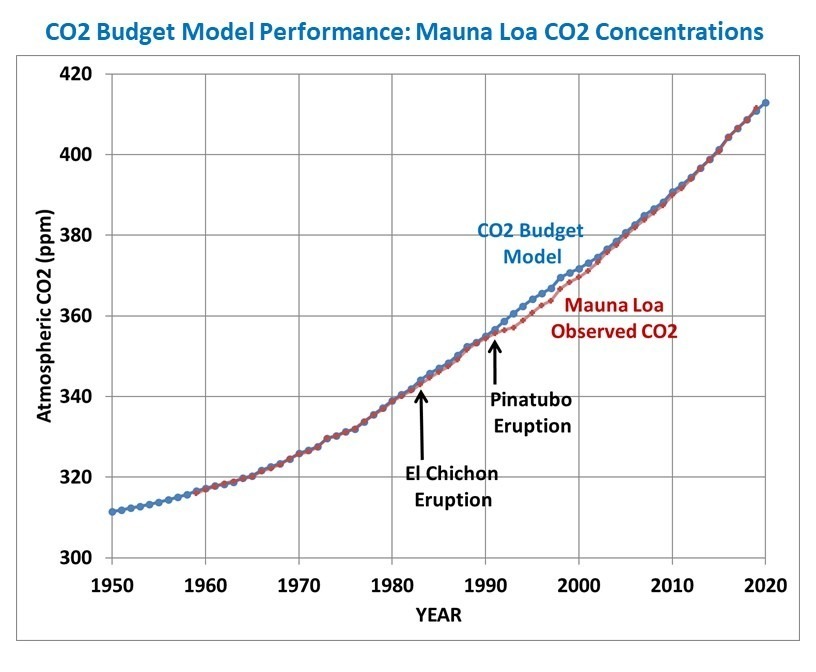
I have been emphasizing that the Mauna Loa data are extremely closely matched by a simple model (blue line in Fig. 1) that assumes CO2 is removed from the atmosphere at a constant rate of 2.3%/yr of the atmospheric excess over a baseline value of 295 ppm.

OK, now actually look at that figure I just linked to, because the fit is amazingly good. I’ll wait….

Now, if I reduce the model specified CO2 removal rate value from 2.3 to 2.0%/yr, I cannot match the Mauna Loa data. Yet the RCP scenarios insist that value will decrease markedly in the coming decades.

Who is correct? Will nature continue to remove 2.0-2.3%/yr of the CO2 excess above 295 ppm, or will that removal rate drop precipitously? If it stays fairly constant, then the future RCP scenarios are overestimating future atmospheric CO2 concentrations, and as a result climate models are predicting too much future warming.

Unfortunately, as far as I can tell, this situation can not be easily resolved. Since that removal fraction is MY metric (which seems physically reasonable to me), but is not how the carbon cycle models are built, it can be claimed that my model is too simple, and does not contain the physics necessary to address how CO2 sinks change in the future.

Which is true. All I can say is that there is no evidence from the past 60 years (1959-2019) of Mauna Loa data that the removal fraction is changing…yet.

There is no way for me to win that argument.

via Watts Up With That?

https://ift.tt/2H6SCyV

February 7, 2020 at 01:59PM