By Paul Homewood
Well I did warn you!!
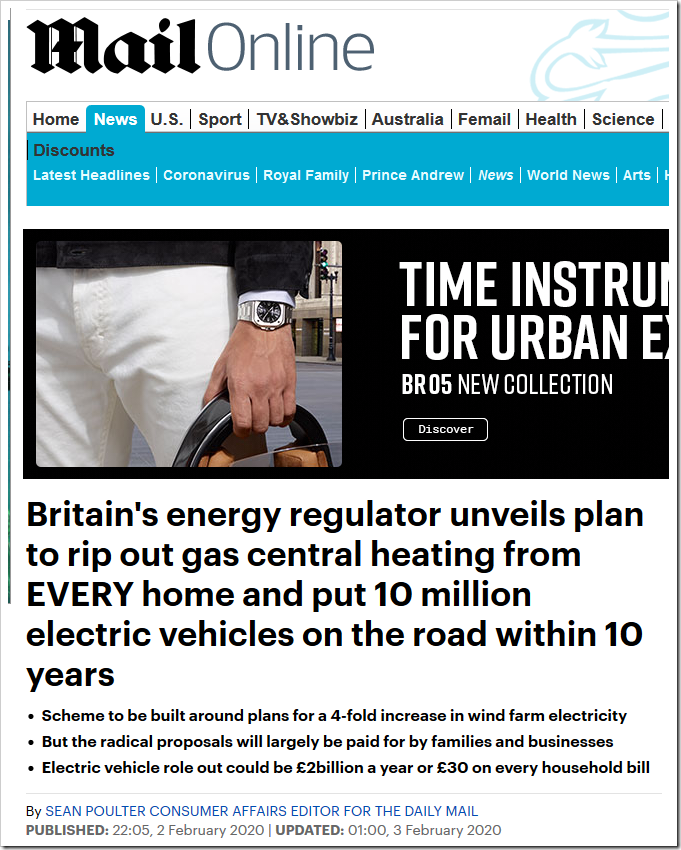
Plans to put ten million electric vehicles on the road within ten years and rip gas central heating from every home are unveiled today.
Energy regulator Ofgem has outlined how the nation will have to change the way it travels and heats homes to meet the Government’s target of net zero carbon emissions by 2050.
The radical scheme to ‘greenwire’ Britain will be built around plans for a four-fold increase in electricity from wind farms around the coast. But the proposals will largely be paid for by families and businesses, adding billions of pounds to bills over the next 30 years.
And switching away from natural gas heating and hot water for homes and businesses will require spending as much as £20billion a year by 2050.
The Citizens Advice charity says there is evidence that millions of people do not understand the enormous scale of the changes required. And it warns efforts will be needed to help customers, particularly the most vulnerable, with the costs they face.
There will be doubts as to whether the regulator and energy industry can deliver on the proposals, not least because of the delays and massive cost overrun on the installation of smart energy meters in all homes.
Ofgem argues that the electricity generated by wind farms will, in the future, be considerably cheaper than from traditional sources such as gas, coal and oil.
And it is proposing that owners of electric cars charge them through the night when power is cheap and then sell it back to the national grid at a higher price at peak periods.
As a result, the embedded power stored in the cars’ batteries will reduce the need to build new gas-fired power stations.
Ofgem said: ‘Increased uptake of electric vehicles creates a rare opportunity for a win-win-win for society, through lower carbon emissions, improved air quality and a more robust and low-cost energy system. But this will only be achieved if drivers are supported to charge their vehicles typically at off-peak times.
‘Support for drivers using their electric vehicles in novel ways will also be needed, for example by “vehicle-to-grid” technology to share energy from car batteries back to the electricity grid when it is needed.’ Ofgem envisages the number of electric vehicles will surge from 230,000 today to ten million by 2030 and 39million by 2050. It argues this will only be possible if the current total of 30,000 public car chargers rises to 210,000, plus 3,500 rapid and ultra-rapid chargers near motorways.

It is suggested that building and running the infrastructure to support the roll-out of electric vehicles could be £2billion a year, equivalent to £30 on every household bill (stock image)
At the same time, traditional natural gas central heating and hot water systems will have to be ripped out of millions of homes.
These will be replaced with electric heating and, potentially, a new gas system run on hydrogen, where the only emissions are water.
The regulator said: ‘The future of heating is less certain, with a range of possible different pathways to decarbonise.
‘In 2017, just 4.5 per cent of the energy used for heating the UK’s 29million homes and other non-residential buildings was from a low-carbon source.
‘This number needs to rise significantly by 2050.’
https://www.dailymail.co.uk/news/article-7959041/Energy-regulator-Ofgem-announces-plans-10m-electric-vehicles-road-10-years.html
I am not quite sure what any of this has to do with OFGEM, whose role is supposed to be to regulate the energy market, not set public policy.
As for the 10 million electric cars on the roads by 2030, dream on. Only 37000 fully electric cars (ie excl hybrids) were sold last year. Somehow that need to rise to an average of 1 million a year over the next decade.
Regardless of how many public chargers are installed, the problem of what all of the millions of drivers without off street parking are supposed to remains unanswered. Are they expected to queue up at these chargers for hours on their way home from work?
The claim that using EVs to sell power back to the grid, and thus save building more gas power stations is also illiterate. The grid will still need full back up from gas power, or other dispatchable sources, regardless, for the times when wind power is negligible.
But my main complaint about this report is that OFGEM still are not being honest about the true cost implications.
They claim that wind power will be considerably cheaper than from traditional sources such as gas, coal and oil. But there is absolutely no evidence for this whatsoever. Even with recent lower CfD prices for offshore wind, when the cost of integrating intermittent power and standby power is factored in wind power remains more expensive. Hence the calls for punitive carbon taxing.
A cost of £20bn a year by 2050 is mentioned, but this is way below the £50bn estimated by the CCC.
Large numbers like this don’t mean much to the public. But they would be horrified if they found out that replacing their boilers with heat pumps will cost upwards of £10000. Particularly if they are forced to stop using gas boilers which have years of life left in them.
via NOT A LOT OF PEOPLE KNOW THAT
https://ift.tt/31niTST
February 3, 2020 at 08:21AM


 Iowa Climate Science Education