Month: February 2020

Here We Go Again! Ten Years To Save Planet, Says Prince Charles

By Paul Homewood

 image

https://www.dailymail.co.uk/news/article-8017939/Weve-got-10-years-save-planet-warns-Prince-Charles.html

Well, at least that’s an improvement on the 96 months he gave us back in 2009:

image

https://www.independent.co.uk/environment/green-living/just-96-months-to-save-world-says-prince-charles-1738049.html

But by 2015, he must have bought himself a new calculator:

image

https://www.washingtontimes.com/news/2015/jul/28/prince-charles-extends-climate-doomsday-deadline/

Four years later, however, 33 years had shrunk to 18 months!

 image

The Prince of Wales has warned global leaders that if we don’t tackle climate change in 18 months the human race will go extinct.

No, really. Here are his actual words, in a speech in London yesterday to foreign ministers from the Commonwealth.

I am firmly of the view that the next 18 months will decide our ability to keep climate change to survivable levels and to restore nature to the equilibrium we need for our survival.

https://www.breitbart.com/europe/2019/07/12/rich-eco-loons-like-prince-charles-should-pay-climate-change/

via NOT A LOT OF PEOPLE KNOW THAT

https://ift.tt/32hmQJl

February 23, 2020 at 07:09AM

Electric car problems on smart motorways – government official ‘absolutely astonished’

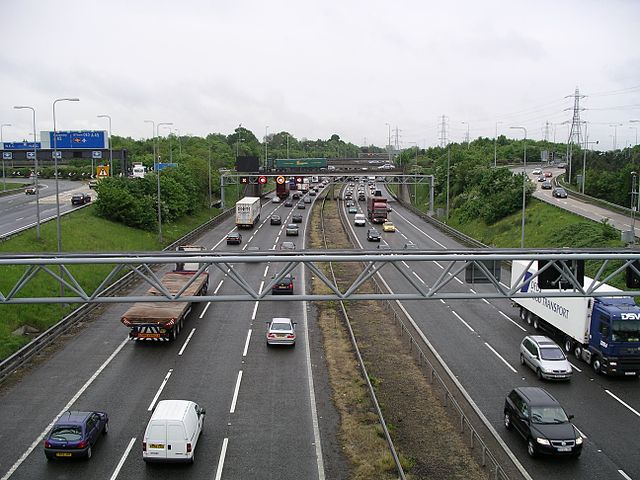
M42 ‘smart’ motorway [image credit: Snowmanradio @ Wikipedia]

Hansard (the Official Report) is the edited verbatim report of proceedings of both the House of Commons and (in this instance) the House of Lords.

These extracts from a very recent debate highlight serious EV safety issues which seem to have been ignored to date:

Lord Snape:

My Lords, like previous speakers I thank the noble Baroness, Lady McIntosh, for introducing this debate. It is apparent that smart motorways have few friends—other than perhaps in the Department for Transport.

Those of us who have used them are aware of the dangers and see from time to time the awesome consequences of all four lanes of traffic being in use at exactly the same time.

Baroness Randerson:

Finally, I raise the issue of electric vehicles. When an electric vehicle ceases to function, it stops; it does not coast in the way that other vehicles do.

Smart motorways are supposed to be the future, but the future is electric. Those vehicles stop very suddenly. They also cannot be towed; they have to be put on a low-loader, which is a much more complex and longer process that will put rescue teams in greater danger.

So can we have special consideration for how these new motorway layouts will operate when there are lots of electric vehicles on the road?

Baroness de Vere (a Parliamentary Under-Secretary of State in the Department for Transport):

I note the comments from the noble Baroness, Lady Randerson, about electric vehicles.

When I first heard this, I was absolutely astonished. Quite frankly, this is applicable not just to smart motorways but to every single road.

We will need to be able to move electric vehicles, wherever they happen to stop or end their days. I assure her that I will now look into it with great gusto, provided I keep my job.

Work is under way to look at short-term measures to make sure we can get electric vehicles off to places of safety as quickly as possible, on whichever road, because that certainly would be a large drawback to the introduction of electric vehicles.

[emphasis added]

via Tallbloke’s Talkshop

https://ift.tt/37Tg8dI

February 23, 2020 at 06:12AM

Electric cars are a hazard on motorways, Government admits

By Paul Homewood


The law of unintended consequences and all that!
 image

The potential hazards caused by electric cars on British roads are being urgently reviewed by the Government over concerns that the vehicles stop suddenly when they break down and that many cannot be towed.

Baroness Vere, a transport minister, said she was "astonished" to discover that electric vehicles tend to "stop very suddenly" when they cease to function, rather than coasting like conventional cars, and that they can take longer to be removed from motorways.

The Department for Transport is examining "short-term measures" to ensure electric cars can be removed from roads quickly when they break down, the peer revealed.

Baroness Vere disclosed details of the review during a House of Lords debate on smart motorways, which use hard shoulders as live lanes. The Sunday Telegraph has exposed serious safety concerns about the roads.

Speaking in the debate, Baroness Randerson, a Liberal Democrat transport spokesman said: "When an electric vehicle ceases to function, it stops; it does not coast in the way that other vehicles do.

"Smart motorways are supposed to be the future, but the future is electric. Those vehicles stop very suddenly. They also cannot be towed; they have to be put on a low-loader, which is a much more complex and longer process that will put rescue teams in greater danger.

"So can we have special consideration for how these new motorway layouts will operate when there are lots of electric vehicles on the road?"

Baroness Vere responded: "When I first heard this, I was absolutely astonished. Quite frankly, this is applicable not just to smart motorways but to every single road.

"We will need to be able to move electric vehicles, wherever they happen to stop or end their days … Work is under way to look at short-term measures to make sure we can get electric vehicles off to places of safety as quickly as possible, on whichever road, because that certainly would be a large drawback to the introduction of electric vehicles," she added in the debate, on Feb 13.

The concerns raised by Baroness Randerson echo a warning issued by the AA last month that the rise of electric vehicles could be incompatible with smart motorways, "due to the lack of emergency refuge areas." 

Edmund King, the AA president, said: "You can’t flat tow some electric vehicles more than 800 metres, some you can’t flat tow at all. So the problem is they will take longer to get off the motorways."

The Department for Transport said it will issue an update on the review "in due course".

https://www.telegraph.co.uk/politics/2020/02/22/electric-cars-hazard-motorways-government-admits/

via NOT A LOT OF PEOPLE KNOW THAT

https://ift.tt/39V80e2

February 23, 2020 at 05:33AM

Arctic Ice Moment of Truth

For ice extent in the Arctic, the bar is set at 15M km2. The average in the last 13 years occurs on day 62 at 15.04M before descending. Six of the last 13 years were able to clear 15M, but recently only 2014 and 2016 ice extents cleared the bar at 15M km2; the others came up short.

During February MASIE and SII both show ice extent hovering around the 13 year average, matching it exactly on day 52 at 14.85M km2. Other recent years were lower until 2019 caught up before, dropping off in the final week of the month.  We shall see what this year does with only 10 to 14 days left before the March maximum is recorded.

Region 2020052 Day 052 Average 2020-Ave. 2018052 2020-2018
 (0) Northern_Hemisphere 14875470 14857903 17567 14312247 563223
 (1) Beaufort_Sea 1070655 1070222 433 1070445 210
 (2) Chukchi_Sea 965972 964814 1158 955104 10868
 (3) East_Siberian_Sea 1087137 1087039 98 1087120 18
 (4) Laptev_Sea 897845 897824 21 897845 0
 (5) Kara_Sea 906378 917433 -11055 917969 -11591
 (6) Barents_Sea 648148 613817 34332 552077 96071
 (7) Greenland_Sea 538698 613963 -75264 428606 110092
 (8) Baffin_Bay_Gulf_of_St._Lawrence 1502218 1495888 6330 1757430 -255211
 (9) Canadian_Archipelago 854282 853074 1209 853109 1174
 (10) Hudson_Bay 1259931 1260881 -950 1260838 -907
 (11) Central_Arctic 3246709 3213870 32839 3150241 96468
 (12) Bering_Sea 731776 685013 46763 194708 537067
 (13) Baltic_Sea 25524 104858 -79334 94201 -68677
 (14) Sea_of_Okhotsk 1117881 1022253 95628 1060733 57148


As reported previously, Pacific sea ice is a big part of the story this year.  Out of the last 13 years, on day 52 only two years had Okhotsk ice extent higher than 2020, and only four years had higher Bering ice. Those surpluses offset a small deficit in Greenland Sea ice.

Typically, Arctic ice extent loses 67 to 70% of the March maximum by mid September, before recovering the ice in building toward the next March.

What will the ice do this year?  Where will 2020 rank in the annual Arctic Ice High Jump competition?

Drift ice in Okhotsk Sea at sunrise.


via Science Matters

https://ift.tt/39TYLeb

February 23, 2020 at 04:21AM