Month: February 2020

German Resistance: Furious Rural Residents Bring Wind Farm Construction to Dead Halt

Much to the horror of wind power promoters, all eyes are on Germany at the minute, with its wind industry in freefall, turbine manufacturers in ruin and rural residents in revolt. In 2019 less than 200 turbines were erected onshore [a figure of 325 is given below which apparently includes offshore turbines] and a trifling […]

via STOP THESE THINGS

https://ift.tt/39LNM6m

February 21, 2020 at 12:31AM

China and India rejecting renewables for coal-fired futures

clip_image001[4]clip_image001[4]

By Ronald Stein

Founder and Ambassador for Energy & Infrastructure of PTS Advance, headquartered in Irvine, California

China and India are NOT buying into the global alarm movement. Never in human history have we seen two countries (China and India), each with over a billion people, in need of such gargantuan amounts of energy to keep their economies accelerating and their citizens alive.

China and India are the two most populous countries in the world. As of 2018, China had almost 1.4 billion people, a figure that is projected to grow to 1.5 billion by 2045. India accounted for approximately 1.3 billion people in 2018 and is expected to grow to almost 1.7 billion by 2045.

Though China has spent more on clean energy than any other country and is pushing to burn natural gas (a different fossil fuel) instead of coal to counter smog, it’s still pumping money at home and abroad into coal-fired generation.

Bloomberg reports that China has enough coal-fired power plants in the pipeline to match the entire capacity of the European Union, driving the expansion in global coal power and confounding

the movement against the polluting fossil fuel.

Over half (5,884) of the world’s coal power plants (10,210) are in China and India whose populations of mostly poor peoples is roughly 2.7 billion. Together they are in the process of building 634 new ones. They are putting their money and backs into their most abundant source of energy – coal.

Currently, 2 out of every 7 people on our planet are Chinese or Indian. Both countries are desperate for energy and are rejecting renewables for coal fired power plants. They are not following Germany’s failed climate goals which should be a wake-up all for governments everywhere. Germany’s obsession with intermittent wind and solar has resulted in power prices that are now the highest in Europe, if not the world, for those Germans who are lucky enough to be supplied with it.

How these two countries use energy is obviously of great importance to world emissions levels, since coal is the dirtiest form of scalable, reliable, affordable, and abundant energy currently available to the billions in the developing world. The International Energy Association (IEA) shows that CO2 emissions in 2019 outside advanced economies (like China and India) are growing.

China isn’t embracing this “Green New Deal.” Chinese President Xi Jingping has touted his country’s transition to clean, carbon-free energy and electricity from renewables, but the facts show a much different energy reality. China accounts for roughly half the world’s coal consumption.

Tom Steyer, the same guy that wants to claim a national climate crisis in and obliterate the fossil fuel industry in America, is the same guy that made his billions financing coal fired power plants around the world. For more than 15 years, Mr. Steyer’s fund, Farallon Capital Management, pumped hundreds of millions of dollars into companies that operate coal mines and coal-fired power plants from Indonesia to China for some of the largest coal-fired power plants in India locking in decades of carbon pollution.

Shockingly, the U.S. could literally turn off the entire country from any source of energy, and global emissions would still grow according to U.S. Congressional testimony in 2017. The entire U.S. economy, military and government could disappear, and global pollution, and respiratory illness would still rise. The reason why is “one of the biggest sources of carbon dioxide emissions is developing countries.” Think China, India, and Africa.

China and India are placing themselves on the opposite end of the energy spectrum by continuing year after year to import and burn tankers full of coal, oil, and natural gas from countries that are authoritarian, human rights abusers, and that couldn’t care less about carbon emissions, countries like Saudi Arabia, Russia, Iran, Venezuela, Iraq, Nigeria, Angola, and Algeria.

The quest for energy is how China and India will struggle for power in the 21st century. Both countries will not accept the threat of global warming stopping or even deterring their growth. Both governments and their economies have militaries and billions of people who are energy hungry.

Both China and India view energy as an amoral source of power that is to be used for survival and advancement during this century. The rest of the world should take careful note.

Ronald Stein, P.E.

Founder and Ambassador for Energy & Infrastructure

PTSadvance.com

via Watts Up With That?

https://ift.tt/37OCVam

February 21, 2020 at 12:06AM

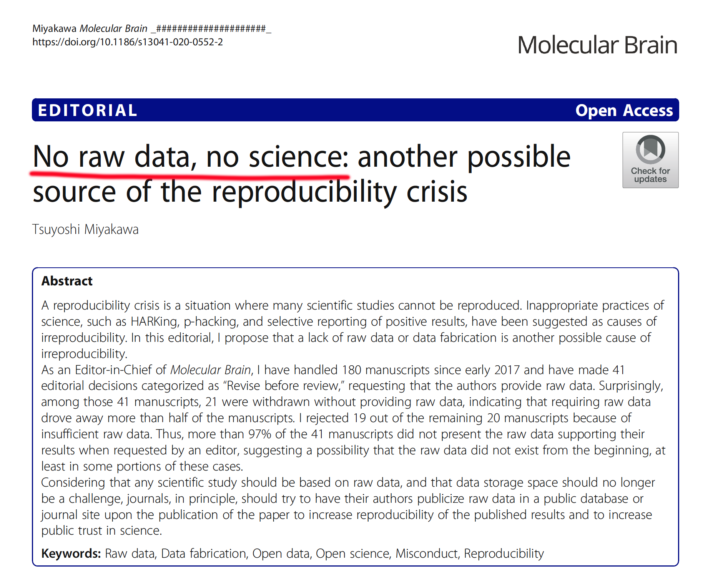
No Raw Data, No Science

Like it says.

The media release is below. The paper is here.

###

How a ‘no raw data, no science’ outlook can resolve the reproducibility crisis in science
FUJITA HEALTH UNIVERSITY

When we look for reliable sources of information, we turn to studies published in peer-reviewed scientific journals. But in some cases, researchers find it difficult to reproduce the results of certain studies, and often, their findings turn out to be different from the original ones–even when the same methods and procedures are used–thereby making the study unreliable. This discrepancy is called a “reproducibility crisis”–or the inability of scientific findings to be replicated by other researchers. This problem has become more prevalent over the past few decades, and according to existing evidence, it affects up to a quarter of studies in cancer research and over a third of studies in psychology. Naturally, it has attracted the attention of scientists globally, who have proposed various explanations for the reproducibility crisis–including the selective publication of positive results, poor statistical practices, and forming hypotheses only after results are known. But, scientists often tend to avoid suggesting research misconduct as a cause, possibly to avoid controversies. In an editorial published in Molecular Brain, Prof Tsuyoshi Miyakawa, one of the Editors-in-chief, shows how this inhibition might further aggravate the issue. He goes on to explain how many authors fail to provide raw data upon request and speculates that this may be because the requested data never actually existed.

Prof Miyakawa based his analyses on manuscripts that were submitted to the peer-reviewed journal Molecular Brain, for which he has served as an Editor-in-Chief since 2017. “As an Editor-in-Chief of the journal, it is sometimes difficult to believe the results of manuscripts that are ‘too beautiful to be true’.” In 41 such cases, Prof Miyakawa asked the manuscripts’ authors to provide the raw data supporting their conclusions. Surprisingly, in more than 97% of cases, the authors either withdrew their manuscripts without providing any raw data or provided incomplete raw data (many of which did not match the results of their studies). These issues resulted in their manuscripts being rejected. In only one case did the authors provide the complete raw data, and that paper was subsequently reviewed and accepted for publication. Thus, most of the authors were either unable or unwilling to provide raw data to support their conclusions.

Prof Miyakawa also noted that, of the 40 manuscripts that were withdrawn or rejected, 14 subsequently appeared in other journals. In 12 cases, the publishing journals had policies requiring or encouraging the authors to make their raw data available upon request from a reader. He sent requests for raw data to the authors of those 12 papers but did not receive a response in 10 cases. In another case, the authors refused to provide their data, and in the remaining case, the authors provided him with an incomplete set of raw data.

In reflecting on these experiences, Dr Miyakawa surmises that at least some of the failures to provide raw data was because the data did not exist from the beginning. He acknowledges that some cases may have other explanations, such as “honest” mistakes or an unwillingness to share raw data prior to completing planned future analyses, but he believes that such explanations are not adequate. He even notes that his suspicions of research misconduct may cause a stir within the world of science. He muses, “Under the current publication system, the field of life sciences is like a ‘house built on sand’, and thus it is important to dig deeper to get to the root of the issue.”

Lastly, to address the widespread problem of fabricated data, Dr Miyakawa argues that journals should require, as a condition of publication, the deposition of raw data in publicly available databases or on journal websites. He says, “Such policies may be difficult and costly to adhere to, but once implemented, they will greatly improve the credibility of scientific studies in general.” Praising Dr Miyakawa’s editorial, Dr Min Cho, Editor-in-Chief of Neuroscience Next and former Senior Editor of Nature Neuroscience, says, “I’ve read with great interest Dr Miyakawa’s editorial in Molecular Brain. Because the piece provides an analysis of real-world submissions, we get a rare glimpse into the inner workings of a scientific journal. Promoting data transparency by being editorially transparent about its submissions, this journal’s editorial here is a reality check for the scientific honor system.”

Dr Miyakawa concludes by calling on research institutions, funding agencies, and science publishers to develop policies and practices to implement a publishing system based on a “no raw data, no science” outlook.

###

via JunkScience.com

https://ift.tt/32bHB92

February 20, 2020 at 08:17PM

Bankers JP Morgan Warn of “Catastrophic” Climate Change

Guest essay by Eric Worrall

JP Morgan wants the world to act on climate change – but critics claim they are still “funding fossil fuel”.

JP Morgan economists warn of ‘catastrophic’ climate change

By Tom EspinerBusiness reporter, BBC News

In a hard-hitting report to clients, the economists said that without action being taken there could be “catastrophic outcomes”.

The bank said the research came from a team that was “wholly independent from the company as a whole”.

Climate campaigners have previously criticised JP Morgan for its investments in fossil fuels.

The firm’s stark report was sent to clients and seen by BBC News.

While JP Morgan economists have warned about unpredictability in climate change before, the language used in the new report was very forceful.

“We cannot rule out catastrophic outcomes where human life as we know it is threatened,” JP Morgan economists David Mackie and Jessica Murray said.

However, JP Morgan itself has been strongly criticised in the past for heavy investment in fossil fuels.

The Rainforest Action Network released a 2019 report claiming that the US banking giant provided the most fossil fuel firm financing of any bank in from 2016 to 2018.

Rupert Read, an associate professor of philosophy at the University of East Anglia, and a spokesperson for campaign group Extinction Rebellion, said that the bank is “taken by some to be the largest fossil fuel funder in the world.”

Read more: https://www.bbc.com/news/business-51581098

JP Morgan were early carbon trading enthusiasts in 2008, though it all went a bit sideways in the wake of the GFC, when carbon prices in Europe collapsed thanks to all the EU member state governments trying to give their own national champions an unfair advantage, by issuing too many carbon credits.

If the world does act on climate change, banks like JP Morgan stand ready to do their bit, though this time around they seem to be backing a centralised carbon tax.

via Watts Up With That?

https://ift.tt/38K34Ze

February 20, 2020 at 08:00PM