National Weather Service Newport/Morehead City NC – 20 Feb 2020
WINTER STORM WARNING UNTIL 10 AM FRIDAY…
Heavy snow expected. Total snow accumulations of 4 to 6 inches, with locally higher amounts up to 8 inches possible.
Snow will be heavy at times overnight with the highest snow totals across the northern half of Eastern NC. Snow will taper off Friday morning, with gusty winds
continuing through the day.
WHERE
Martin, Pitt, Washington, Greene, Beaufort, Lenoir and Northern Craven Counties.
Including the cities of Williamston, Robersonville, Oak City, Jamesville, Greenville, Bethel, Farmville, Grifton, Grimesland, Plymouth, Roper, Creswell, Snow Hill, Hookerton, Walstonburg, Washington, Chocowinity, Belhaven, Bath, Aurora, Kinston, La Grange, Pink Hill, Vanceboro, Ernul, Dover, and Cove City.
A new study published in Science indicates that even if methane is released from these large natural stores in response to warming, very little actually reaches the atmosphere.
The media release is below.
###
Old carbon reservoirs unlikely to cause massive greenhouse gas release UNIVERITY OF ROCHESTER
Permafrost in the soil and methane hydrates deep in the ocean are large reservoirs of ancient carbon. As soil and ocean temperatures rise, the reservoirs have the potential to break down, releasing enormous quantities of the potent greenhouse gas methane. But would this methane actually make it to the atmosphere?
Researchers at the University of Rochester–including Michael Dyonisius, a graduate student in the lab of Vasilii Petrenko, professor of earth and environmental sciences–and their collaborators studied methane emissions from a period in Earth’s history partly analogous to the warming of Earth today. Their research, published in Science, indicates that even if methane is released from these large natural stores in response to warming, very little actually reaches the atmosphere.
“One of our take-home points is that we need to be more concerned about the anthropogenic emissions–those originating from human activities–than the natural feedbacks,” Dyonisius says.
WHAT ARE METHANE HYDRATES AND PERMAFROST?
When plants die, they decompose into carbon-based organic matter in the soil. In extremely cold conditions, the carbon in the organic matter freezes and becomes trapped instead of being emitted into the atmosphere. This forms permafrost, soil that has been continuously frozen–even during the summer–for more than one year. Permafrost is mostly found on land, mainly in Siberia, Alaska, and Northern Canada.
Along with organic carbon, there is also an abundance of water ice in permafrost. When the permafrost thaws in rising temperatures, the ice melts and the underlying soil becomes waterlogged, helping to create low-oxygen conditions–the perfect environment for microbes in the soil to consume the carbon and produce methane.
Methane hydrates, on the other hand, are mostly found in ocean sediments along the continental margins. In methane hydrates, cages of water molecules trap methane molecules inside. Methane hydrates can only form under high pressures and low temperatures, so they are mainly found deep in the ocean. If ocean temperatures rise, so will the temperature of the ocean sediments where the methane hydrates are located. The hydrates will then destabilize, fall apart, and release the methane gas.
“If even a fraction of that destabilizes rapidly and that methane is transferred to the atmosphere, we would have a huge greenhouse impact because methane is such a potent greenhouse gas,” Petrenko says. “The concern really has to do with releasing a truly massive amount of carbon from these stocks into the atmosphere as the climate continues to warm.”
GATHERING DATA FROM ICE CORES
In order to determine how much methane from ancient carbon deposits might be released to the atmosphere in warming conditions, Dyonisius and his colleagues turned to patterns in Earth’s past. They drilled and collected ice cores from Taylor Glacier in Antarctica. The ice core samples act like time capsules: they contain tiny air bubbles with small quantities of ancient air trapped inside. The researchers use a melting chamber to extract the ancient air from the bubbles and then study its chemical composition.
Dyonisius’s research focused on measuring the composition of air from the time of Earth’s last deglaciation, 8,000-15,000 years ago.
“The time period is a partial analog to today, when Earth went from a cold state to a warmer state,” Dyonisius says. “But during the last deglaciation, the change was natural. Now the change is driven by human activity, and we’re going from a warm state to an even warmer state.”
Analyzing the carbon-14 isotope of methane in the samples, the group found that methane emissions from the ancient carbon reservoirs were small. Thus, Dyonisius concludes, “the likelihood of these old carbon reservoirs destabilizing and creating a large positive warming feedback in the present day is also low.”
Dyonisius and his collaborators also concluded that the methane released does not reach the atmosphere in large quantities. The researchers believe this is due to several natural “buffers.”
BUFFERS PROTECT AGAINST RELEASE TO THE ATMOSPHERE
In the case of methane hydrates, if the methane is released in the deep ocean, most of it is dissolved and oxidized by ocean microbes before it ever reaches the atmosphere. If the methane in permafrost forms deep enough in the soil, it may be oxidized by bacteria that eat the methane, or the carbon in the permafrost may never turn into methane and may instead be released as carbon dioxide.
“It seems like whatever natural buffers are in place are ensuring there’s not much methane that gets released,” Petrenko says.
The data also shows that methane emissions from wetlands increased in response to climate change during the last deglaciation, and it is likely wetland emissions will increase as the world continues to warm today.
Even so, Petrenko says, “anthropogenic methane emissions currently are larger than wetland emissions by a factor of about two, and our data shows we don’t need to be as concerned about large methane releases from large carbon reservoirs in response to future warming; we should be more concerned about methane released from human activities.”
###
This study was supported by the US National Science Foundation and the David and Lucille Packard Foundation.
In July of this year, one of Lauren Jeffrey’s science teachers made an off-hand comment about how climate change could be apocalyptic. Jeffrey is 17 years old and attends high school in Milton Keynes, a city of 230,000 people about 50 miles northwest of London.
“I did research on it and spent two months feeling quite anxious,” she told me. “I would hear young people around me talk about it and they were convinced that the world was going to end and they were going to die.”
In September, British psychologists warned of the impact on children of apocalyptic discussions of climate change. “There is no doubt in my mind that they are being emotionally impacted,” one expert said.
“I found a lot of blogs and videos talking about how we’re going extinct at various dates, 2030, 2035, from societal collapse,” said Jeffrey. “That’s when I started to get quite nervous and worried. I tried to forget it at first but it kept popping up in my mind.”
[…]
I did research and found there was a lot of misinformation on the denial side of things and also on the doomsayer side of things,” said Jeffrey.
Since early October, Jeffrey has posted seven videos to YouTube, and joined Twitter. I discovered her videos after googling “extinction rebellion millions will die.”
“As important as your cause is,” said Jeffrey in one of the videos, an open letter to Extinction Rebellion, “your persistent exaggeration of the facts has the potential to do more harm than good to the scientific credibility of your cause as well as to the psychological well-being of my generation.”
Why There’s No Apocalypse in Science
In my last column, I pointed out that there is no scientific basis for claims that climate change will be apocalyptic, and argued that environmental journalists and climate activists alike have an obligation to separate fact from fiction.
If you haven’t read that column yet, I hope you do so before continuing.
[…]
“The global energy system today, as modeled by IEA, is tracking much closer to 2˚ of warming this century than previously thought,” notes Ritchie, due to lower use of coal.
The full article is well-worth reading. Mr. Shellenberger does a great job in pointing out how the apocalyptic exaggerations by the media, activists and some scientists are possibly (I would say definitely) causing more harm than anthropogenic greenhouse gas emissions.
His article featured this graph from the UN FAO:
“UN Food and Agriculture concludes food production will rise 30% by 2050, and technical change outweighs climate change in every single one of FAOs scenarios. UNITED NATIONS FOOD & AGRICULTURE ORGANIZATION”
Basically, even if the climate models were right (they aren’t), technological advances will more then compensate for any negative AGW impacts on food production.
Mr. Schellenberger had another great article in Forbes a few days ago…
Feb 17, 2020
If They Are So Alarmed By Climate Change, Why Are They So Opposed To Solving It?
Michael Shellenberger I write about energy and the environment
Nobody appears to be more concerned about climate change than Democratic presidential front-runner Bernie Sanders, student activist Greta Thunberg, and the thousands of Extinction Rebellion activists who shut down London last year.
Last year, Sanders called climate change “an existential threat.” Extinction Rebellion said, “Billions will die.” And Thunberg said, “I don’t want you to be hopeful” about climate change, “I want you to panic.”
But if Sanders, Thunberg, and Extinction Rebellion are so alarmed about carbon emissions, why are they fighting to halt the use of two technologies, fracking and nuclear, that are most responsible for reducing them?
Sanders says he would ban both natural gas and nuclear energy, Thunberg says she opposes nuclear energy, and Extinction Rebellion’s spokesperson said in a debate with me on BBC that she opposes natural gas.
And yet, emissions are declining thanks to the higher use of nuclear energy and natural gas. Carbon emissions have been declining in developed nations for the last decade. In Europe, emissions in 2018 were 23% below 1990 levels. In the U.S., emissions fell 15 percent from 2005 to 2016.
[…]
Can They Be Serious?
What gives? Why are the people who are most alarmist about climate change so opposed to the technologies that are solving it?
One possibility is that they truly believe nuclear and natural gas are as dangerous as climate change. This appears to be partly the case for nuclear energy, even though neither Sanders nor Thunberg offers anti-nuclear rhetoric anywhere nearly as apocalyptic as their rhetoric on climate change.
Before progressives were apocalyptic about climate change they were apocalyptic about nuclear energy. Then, after the Cold War ended, and the threat of nuclear war declined radically, they found a new vehicle for their secular apocalypse in the form of climate change.
Though nuclear energy has prevented the premature deaths of nearly two million people by reducing air pollution, and though nuclear weapons have contributed to the Long Peace since World War II, many people remain phobic of the technology.
In the case of natural gas, neither Sanders, Thunberg, or Extinction Rebellion claim it is more dangerous or worse than coal. They simply argue that we don’t need it, thanks to renewables and energy efficiency.
[…]
Why Alarmism Requires Opposing Technology
What’s happening with climate change is not the first time those who are most alarmist about an environmental problem have been most opposed to solving it.
In the early 1800s, the British economist Thomas Malthus opposed birth control, even as he raised the alarm over overpopulation and the threat of famines.
After World War II, scientists and environmentalists in Europe and the U.S. opposed fossil fuels and the provision of chemical fertilizers to poor nations even as they raised the alarm about soil erosion, overpopulation, and famine.
And today, environmentalistsoppose the building of hydro-electric dams and flood control in poor nations, even as they raise the alarm about climate-driven flooding.
In every case, alarmists claim some moral basis for their opposition to technical fixes.
[…]
The End of Civilization
Apocalyptic environmentalists like Sanders, Thunberg, and Extinction Rebellion insist that if we don’t enact their agenda, industrial civilization will come to an end. But if they are so concerned with protecting industrial civilization, why do they advocate solutions that would end it?
[…]
Do Sanders, Thunberg, Extinction Rebellion and other apocalyptic greens really believe that, by raising the alarm about the end of the world, they will persuade societies to choose the low-energy path?
Perhaps. But they may also fear, consciously or unconsciously, that the outsized role played by natural gas and nuclear means that climate apocalypse can be averted without any of the radical societal transformations they demand. After all, if nations were to simply use natural gas to transition to nuclear, there would be little need to stop traffic in London, moralize about the virtues of foregoing meat, flying, and driving, or deploy renewables.
And yet, emissions are declining thanks to the higher use of nuclear energy and natural gas.
Emissions are declining thanks to the higher use of natural gas. However, the only viable path to low-carbon energy production would require a massive expansion of nuclear power production. The fact that the alarmists oppose both natural gas and nuclear power is prima facie evidence that they are Enviromarxists and that the Green New Deal is just like Stalin’s grave: A Communist plot.
I also have to give a mini-attaboy to the midget oligarch for getting in Bernie’s face last night, I think he even called him a Communist…
Sanders and Bloomberg split over fracking
Ben Geman
Tonight’s Democratic primary debate in Las Vegas laid bare the candidates’ differences over fracking as Bernie Sanders defended his push for an outright ban and challenged concerns that it could hurt Democrats politically.
Driving the news: NBC’s Chuck Todd asked Sanders what he would tell workers in Pennsylvania, a swing state where natural gas extraction via fracking is a major industry. Todd cited this New York Times piece on the politics of fracking there.
Sanders, who is leading in national polls, replied he would tell workers of the need to act “incredibly boldly” in the near future to prevent “irreparable” global damage from climate change.
‘The Green New Deal that I support, by the way, will create up to 20 million good-paying jobs as we move our energy system away from fossil fuel to energy efficiency and sustainable energy,” said Sanders.
The other side: Michael Bloomberg, whose has donated heavily to anti-coal and other climate efforts, said he did not support a ban a fracking, the technique that has enabled the decade-plus surge in U.S. oil and natural gas production.
“If we enforced some of the rules on fracking so that they don’t release methane into the air and into the water, you will make a big difference, but we are not going to get rid of fracking for a while,” he said.
“We want to go to all renewables, but that is still many years from now,” Bloomberg said.
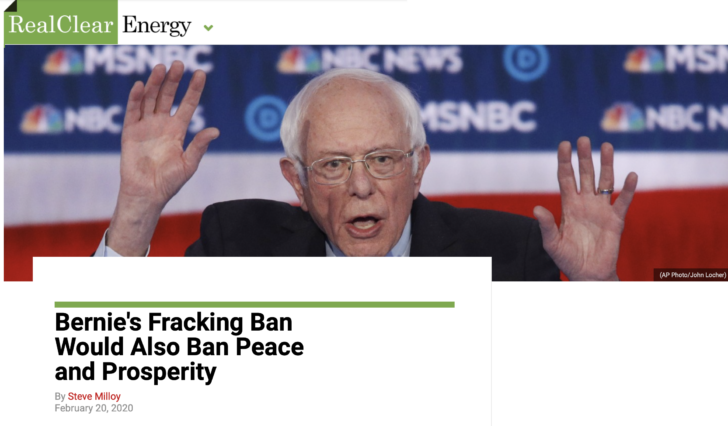
Bernie Sanders just introduced a bill to ban fracking on federal lands. Consider what would and would not happen if anti-frackers like Sanders had their way.
Fracking has been an energy game changer, if not a miracle. Before large-scale fracking began in the late 2000s, the United States was anything but energy independent. The vast majority of our natural gas was imported. The price of gasoline was subject to the whims of the OPEC cartel and the price swings of oil. Fracking has totally changed this.
In August 2005, a shortage of natural gas pushed the Henry Hub price to $19.19 per million cubic feet. Andrew Liveris, then CEO Dow Chemical told the New York Times in 2005 that, “American consumers worry about oil and the price of gasoline.They should worry that there may not be enough natural gas to heat and cool their homes.”
But within just a few years the development and fracking technology exposed a virtual glut of natural gas, pushing the price down to about $2.00 per million cubic feet today. We no longer import natural gas except where environmentalists force imports by blocking pipelines.
In July 2008, an oil crunch sent the price of oil to $147 per barrel. Thanks to fracking the price of oil is now in the mid-$50 range.
So the first consequence of ending fracking would be economic. Oil and gas would likely cost a lot more, especially since countries like China and India have become much larger consumers of oil over the past 15 years.
Next, all this oil and gas belongs to the United States. We have so much oil and gas that we are a net exporter for the first time since the early 1950s. This means that we are much less at the mercy of the whims and manipulations of OPEC members.
Without fracking, for example, the recent turmoil with Iran might have caused another serious spike in the price of oil. The economic consequence of a price spike would then affect how the crisis was managed. But thanks to fracking, we sailed through the recent Iran crisis with a hardly a blip in the price of oil.
But there’s more. There’s jobs and GDP.
In Pennsylvania alone, there are 350,000 fracking-related jobs. Ohio and Michigan have another 400,000 fracking workers. There are as many 1.5 million workers in the industry and there are another 4 million jobs industries that depend on cheap natural gas. Fracking is worth at least $1 trillion to the US economy.
For those who are concerned about climate change and emissions, fracking is a winner, too. Burning natural gas emits about half the carbon dioxide of burning coal. Fracking is what has made it possible for US utilities to cut their reliance on coal by more than half, from slightly more than 50% of power generation to less than 25%. This has allowed the US to reduce its emissions the most of any industrialized country — while simultaneously accelerating economic growth.
Bernie Sanders’ fracking ban would also trigger global energy and economic crises. The contagion would start in the US because, at this point, there is no fast, easy or cheap way to replace cheap natural gas.
Wind and solar are nowhere near ready to supplant natural gas for the production of electricity. It would take years to rebuild the coal industry and many more years to add nuclear power. What would our economy do for affordable energy in the meantime?
Electricity and gasoline prices would soar, undoubtedly causing mass unemployment, recession and then depression. A failure of the US economy would spread world-wide threatening a global economy that 7.6 billion people depend on.
As always happens, a poor economy would cause domestic social unrest and spur international bad actors (think Iran, Russia and China) to take advantage of a weakened, if not chaotic US.
Yet CO2 emissions would continue to grow, because the rest of the world, particularly Asia, has no plans to reduce fossil fuel use.
Bernie’s fracking ban may sound great – if you understand nothing about energy, the economy and the environment – but it would rapidly become a global disaster. And a pointless one at that.
Steve Milloy publishes JunkScience.com, served on the Trump EPA transition team and is the author of “Scare Pollution: Why and How to Fix the EPA” (Bench Press 2016).


 Iowa Climate Science Education