Month: February 2020

Polar bear habitat at mid-winter as extensive as 2013 & better than 2006

From Dr. Susan Crockford’s Polar Bear Science

Posted on February 14, 2020 | Comments Off on Polar bear habitat at mid-winter as extensive as 2013 & better than 2006

Arctic sea ice at the middle of winter (January-March) is a measure of what’s to come because winter ice is the set-up for early spring, the time when polar bears do most of their feeding on young seals.

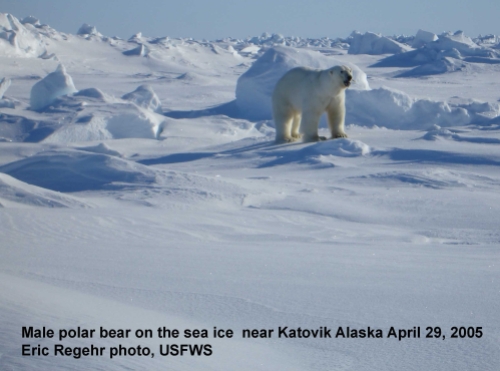
Polar_Bear_male on sea ice_Alaska Katovik Regehr photo_April 29, 2005_sm labeledPolar_Bear_male on sea ice_Alaska Katovik Regehr photo_April 29, 2005_sm labeled

[Mid-winter photos of polar bears are hard to come by, partly because the Arctic is still dark for most hours of the day, it’s still bitterly cold, and scientists don’t venture out to do work on polar bears until the end of March at the earliest]

At 12 February this year, the ice was similar in overall extent to 2013 but higher than 2006.

sea-ice-extent-2020-and-2013-and-2006-at-13-feb-2020_closeup-nsidc-interactivesea-ice-extent-2020-and-2013-and-2006-at-13-feb-2020_closeup-nsidc-interactive

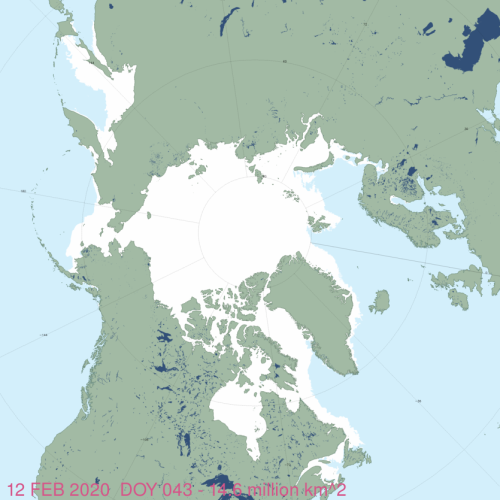
Remember, as far as polar bears are concerned, we can discount what’s happening in the Sea of Okhotsk, the Baltic Sea and the Gulf of St. Lawrence because these are outside the bears’ range (12 Feb 2020 below).

masie_all_zoom_4km 2020 Feb 12masie_all_zoom_4km 2020 Feb 12

So for ice extent relevant to polar bears, this year is very like 2009 (below, 12 Feb 2009 at 14.9 mkm2) – especially with respect to the Barents Sea.

Sea ice 2009 Feb 12 Day 43 MASIE_14 point 9 mkm2Sea ice 2009 Feb 12 Day 43 MASIE_14 point 9 mkm2

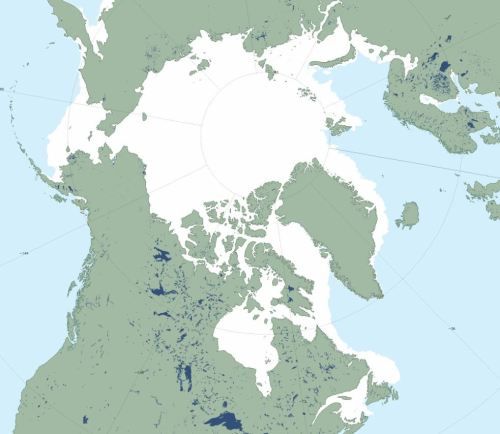
This extent of ice around Svalbard and Novaya Zemlya (below) has been rare since the late 1990s. Ice is within swimming distance of Bear Island and if the island becomes surrounded, as happened in March 2019, visits by polar bears are a near-certainty. However, this pack-ice tends to advance and retract at the edges over the season, so it’s possible that Bear Island will not see the ice this year.Barents Sea ice 2020 Feb 12 NIS closeupBarents Sea ice 2020 Feb 12 NIS closeup

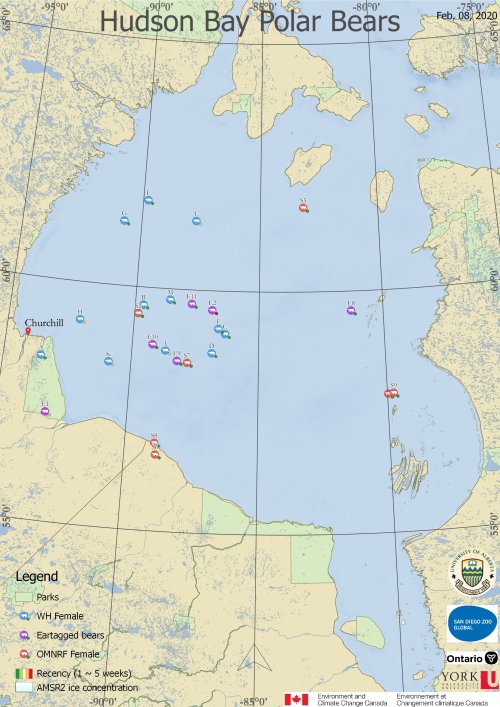
Polar bear researcher Andrew Derocher posted a map of the locations of his collared and ear-tagged bears last week (8 Feb 2020):

Derocher 2020 WHB tracking map 8 FebDerocher 2020 WHB tracking map 8 Feb

Ice thickness charts from the Canadian Ice Service for last week on Hudson Bay (week of Feb 10), below, shows a broad swath of medium first year ice (70-120 cm) across the centre and that will continue to thicken over the next few months:

Hudson Bay weekly stage of development 2020 Feb 10Hudson Bay weekly stage of development 2020 Feb 10

via Watts Up With That?

https://ift.tt/2UXcP25

February 17, 2020 at 12:03AM

Aussie Climate Emergency Summit: “Climate change must be accepted as an overriding threat to national and human security”

Corona Virus John Hopkins 20200216Corona Virus John Hopkins 20200216
John Hopkins Corona Virus Dashboard 2020-02-16

Guest essay by Eric Worrall

In the face of overwhelming evidence there are worse problems than climate change, climate activists are still trying to keep the spotlight of global attention.

Climate summit calls for urgent action after Australia’s fire-hit summer

Ben Doherty @bendohertycorro
Sat 15 Feb 2020 11.43 AEDTLast modified on Sat 15 Feb 2020 13.46 AEDT

The Climate Emergency Summit, held in Melbourne this week and of which Guardian Australia was a partner, released a declaration saying the warming world was a clear threat to Australian society and civilisation.

“The climate is already dangerous – in Australia and the Antarctic, in Asia and the Pacific – right around the world. The Earth is unacceptably too hot now,” the declaration said.

“If the climate warms 1.5 degrees above pre-industrial levels, the Great Barrier Reef will likely be lost, sea levels could rise metres and massive global carbon stores such as the Amazon and Greenland, will hit tipping points, releasing millions of tonnes of carbon into the atmosphere.”

Climate change must be accepted as an overriding threat to national and human security, with the response being the highest priority at national and global levels.”

Read more: https://www.theguardian.com/environment/2020/feb/15/climate-summit-calls-for-urgent-action-after-australias-fire-hit-summer

Give it up guys. Climate change has always been an issue of marginal public interest, a fake crisis plaything of academia, slow news days and the political bubble. You got a slight uptick of public concern about climate change in the wake of Australia’s devastating bushfires, but right now, in the midst of a potential global pandemic, people are busy worrying about a real problem.

Google Trends Coronavirus vs Climate Change 2020-02-16

via Watts Up With That?

https://ift.tt/2UXmd67

February 16, 2020 at 08:04PM

New findings from the Neotropics suggest contraction of the ITCZ

News Release 14-Feb-2020

Warmer climate leads to current trends of social unrest and mass migration

University of New Mexico

The University of New Mexico research team was led by Professor Yemane Asmerom (3rd from left) and included (l. to r.): Valorie Aquino, Keith Prufer and Victor Polyak. The team found contraction of the Intertropical Convergence Zone (ITCZ) during a warming Earth, leading in turn to drying of the Neotropics, including Central America. Credit: The University of New MexicoThe University of New Mexico research team was led by Professor Yemane Asmerom (3rd from left) and included (l. to r.): Valorie Aquino, Keith Prufer and Victor Polyak. The team found contraction of the Intertropical Convergence Zone (ITCZ) during a warming Earth, leading in turn to drying of the Neotropics, including Central America. Credit: The University of New Mexico

The University of New Mexico research team was led by Professor Yemane Asmerom (3rd from left) and included (l. to r.): Valorie Aquino, Keith Prufer and Victor Polyak. The team found contraction of the Intertropical Convergence Zone (ITCZ) during a warming Earth, leading in turn to drying of the Neotropics, including Central America. Credit: The University of New Mexico

Research by an international team of scientists led by University of New Mexico Professor Yemane Asmerom suggests contraction of the Intertropical Convergence Zone (ITCZ) during a warming Earth, leading in turn to drying of the Neotropics, including Central America, and aggravating current trends of social unrest and mass migration.

Positioned near the equator where the trade winds of the northern and southern hemisphere converge, the ITCZ is the world’s most important rainfall belt affecting the livelihood of billions of people around the globe. Globally, seasonal shifts in the location of the ITCZ across the equator dictate the initiation and duration of the tropical rainy season. The behavior of the ITCZ in response to the warming of the Earth is of vital scientific and societal interest.

Previous work based on limited data suggested a southward migration of the ITCZ in response to global cooling, such as during the Little Ice Age a few hundred years ago. In contrast, modeling and limited observational data seemed to suggest the ITCZ expands and contracts in response to cooling and warming. Which of these scenarios is correct has a huge implication for understanding rainfall variability and its economic and social impacts across the tropics. In order to resolve these seemingly contradictory alternatives the authors undertook this paleoclimate reconstruction study from the margin of the ITCZ and combined that with existing data from across the full annual north-south excursion of the ITCZ.

The study titled, “Intertropical Convergence Zone Variability in the Neotropics During the Common Era,” was published today in Science Advances. In addition to UNM, the research also includes scientists from the University of Durham (UK), Northumbria University (UK) and the University of California, Santa Barbara.

“Much of our understanding of ITCZ variability was based on records from South America, especially the Cariaco Basin (Venezuela), which was the gold standard,” explained Asmerom. “But these studies were only able to present half of the picture. As a result, they suggested southward movement of the mean position of the ITCZ during cool periods of Earth, such as during the Little Ice Age, and by implication it shifts northward during warm periods.

“This would imply regions in the northern margin of the ITCZ, such as Central America would get wetter with warming climate. This contradicted modeling results suggesting drying as a consequence of warming.”

With two testable hypotheses, Asmerom and his colleagues used 1,600 years of new bimonthly-scale speleothem rainfall reconstruction data from a cave site located at the northern margin of the ITCZ in Central America, coupled with published data from the full transect of the ITCZ excursion in Central America and South America. The combined data elucidate ITCZ variability throughout the Common Era including the warmer Medieval Climate Anomaly and the cooler Little Ice Age. The results of this study are consistent with models suggesting ITCZ expansion and weakening during global periods of cold climate and contraction and intensifying during periods of global warmth.

“Stable isotopic data obtained at Durham University, and trace element data and a precise uranium-series chronology, with an average 7 year uncertainty, obtained at the University of New Mexico, provided us with a nearly bi-monthly record of past climate variability between 400 CE to 2006. This level of resolution is unprecedented for continental climate proxies”, said Polyak.

“What we found was that in fact during the Medieval Climate Anomaly Southern Belize was very dry, similar to modern central Mexico. In contrast, during the Little Ice Age cool period, when it should have been dry by the standard old model, it was the wettest interval over the last 2000 years,” said Asmerom. “The pattern that emerges when all the data across the full transect of ITCZ excursion is supportive of the expansion-contraction model.” The implication of this that regions currently in the margins of the ITCZ are likely to experience aridity with increased warming, consistent with modeling data from Central America. These data have important implications for rainfall-dependent agriculture system on which millions of people depend for food security.

Co-author and UNM Professor of Anthropology Keith Prufer is an environmental archaeologist, who has been conducting research in Belize for 25 years. “In the last five years there have been mass migrations of people in Guatemala and Honduras – partially driven by political instability, but also driven by drought-related conditions and changes in seasonality. This is creating enormous problems for agricultural production and feeding a growing population. There is growing evidence that these changes are a direct consequence of climate change.”

“This work highlights the convergence of good science with policy relevancy. It also illustrates the strength of cross-disciplinary collaborative work, in this case international,” said Asmerom.

###

Additional co-authors include James Baldini, Lisa Baldini, Colin Macpherson and Harriet Ridley (University of Durham), Valorie Aquino (UNM), Sebastian Breitenbach (Northumbria University) and Douglas Kennett (The University of California, Santa Barbara).

From EurekAlert!

via Watts Up With That?

https://ift.tt/31XoPlS

February 16, 2020 at 04:04PM

Greenland Temperature Update

By Paul Homewood


 image

 https://notalotofpeopleknowthat.wordpress.com/2019/08/29/climate-change-melts-12-5bn-tons-of-ice-in-greenland-50-years-earlier-than-predicted-telegraph/


You will recall all those stories from last summer about heatwaves and meltdowns in Greenland.

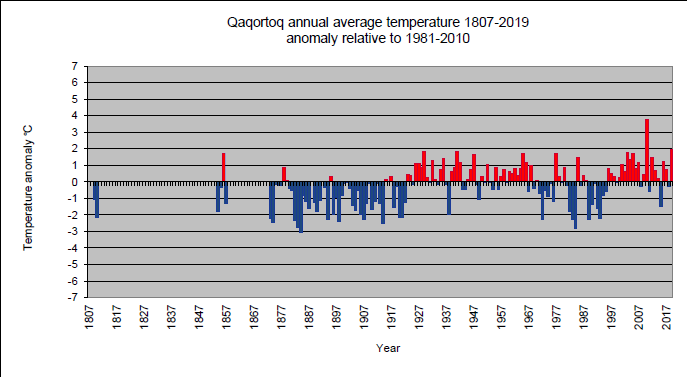
DMI have now published the temperature data for last year, which shows those claims to be fake:

image

image

image

 image

image

image

image


Across Greenland, annual temperatures last year were no higher than in the 1930s and 40s.

The only exception was Narsarsuaq, at the SW tip of Greenland, and even there it was much colder than in 2010.

And at the long running site at Ilulissat, temperatures were even higher in the 19thC.

image

image


 tsgcos.corr.81.159.104.52.46.12.18.57

https://www.esrl.noaa.gov/psd/cgi-bin/gcos_wgsp/tsanalysis.pl?tstype1=91&tstype2=0&year1=&year2=&itypea=0&axistype=0&anom=0&plotstyle=0&climo1=&climo2=&y1=&y2=&y21=&y22=&length=&lag=&iall=0&iseas=0&mon1=0&mon2=11&Submit=Calculate+Results

The temperature cycles in Greenland closely follow the AMO cycle. When that was in its warm phase in the 1930s and 40s, Greenland’s climate warmed. And when it went through its cold phase, temperatures correspondingly fell.

Based on past cycle lengths, the AMO will likely go cold again in the coming decade. In the meantime, we will still have to put up with ludicrous headlines.

There again, cooling in Greenland will probably blamed on climate change, just the same as every other natural event seems to be.

via NOT A LOT OF PEOPLE KNOW THAT

https://ift.tt/2UVHD3p

February 16, 2020 at 01:33PM