Month: February 2020

Germany’s Transition To Green Energies Is “An Impending Disaster”, German Expert Tells Audience

Last Thursday evening in Münster, Germany, amid an atmosphere of loudly protesting students and Extinction Rebellion activists outside shouting obscenities and beating drums, prominent SPD social democrat and climate science critic Prof. Fritz Vahrenholt spoke on why Germany was headed down the wrong path with its now flailing transition to green energies, dubbed “Energiewende“.

Prof. Fritz Vahrenholt. Image: GWPF. 

Vahrenholt called the Energiewende: “An impending disaster.”

According to the Westfälische Nachricten here, “Scientists for Future activists handed out leaflets to emphasize that in their opinion the climate models of the IPCC (‘Intergovernmental Panel on Climate Change’) accurately depicted climate warming and that only trace gas CO2 was responsible for it.”

Hat-tip: Die kalte Sonne

But Vahrenholt, former environment senator of Hamburg, refuted the claims and showed why he thought CO2 is only half responsible for climate change today and that the rest was due to natural factors like sun and clouds.

In his 45-minute presentation, Vahrenholt showed those in attendance how Germany’s foray into green energies was doomed to fail. As leaders in Germany continue to insist wind energy is able to supply the country’s energy needs, Vahrenholt – an environmentalist and one of the founders of Germany’s modern environmental movement – pointed out the major technical obstacle: the inability to store wind energy for periods of low wind.

“Not even in the grid, like one well-known Green politician claimed,” said Vahrenholt, taking a shot at Green party leader Annalena Baerbock, who once famously claimed the power grid could store energy.

German electricity prices among world’s highest

Vahrenholt also reminded that the Energiewende has made Germany’s electricity prices among the highest in the world and that it would hit the poor especially hard. “I never understood the SPD here,” said Vahrenholt, criticizing his own party. The retired professor said it would take 90,000 wind turbines to supply Germany with electricity, a number that would lead to the country having a turbine every 2 kilometers.

The Westfälische Nachrichten sums up on whether the Energiewende is going to work:

At the end of the complex, 45-minute presentation, the majority in the hall were probably convinced: it can’t. The facts and figures presented by the environmentalist were too overwhelming.”

via NoTricksZone

https://ift.tt/2HpZQhF

February 16, 2020 at 10:52AM

Waiting for Thwaites

News Review by Kip Hansen – 16 February 2020


featured_imagefeatured_imageSeveral media pieces have followed up on a study about the Thwaites Glacier in Antarctica.  Even the (in)famous climatologist who shares my last name pulled out this story for the press in Australia.  Newsweek ran with it as part of a catastrophe article: These Five Cities Are Vulnerable to Rising Seas, Including Miami and New York.   Phys.org carried this:  New study models impact of calving on retreat of Thwaites Glacier.

What are they saying?

“The Thwaites Glacier is about the size of a U.S. swing state and holds enough ice to raise sea levels by about 10 feet. This alone is scary enough to justify its nickname, the Doomsday Glacier, but there’s more. The Thwaites sits along a 75-mile stretch of shoreline in Antarctica that serves to partially shield the vast West Antarctic Ice Sheet from the warm ocean waters. The WAIS has enough ice to raise the seas by 200 feet.”

“These projections carry some uncertainty, but one thing seems pretty clear: the next century will be tough for coastal city dwellers. Sea levels are rising about 3 millimeters each year. By the end of the century, the oceans could rise at least 2 feet over 2005 levels, according to a 2018 study in the Proceedings of the National Academies of Science. Michael Mann, a climate scientist, told NBC News that unless emissions of greenhouse gases are abated, by the end of the century more than 650 million people will be living on land that is under water all or much of the time.”

Newsweek

“We think that possibly in a few years or decades, we don’t know yet, the remainder of the ice shelf in front of Thwaites might be gone,” explained Hongju Yu, an assistant specialist at the University of California, Irvine and lead author of the new study.

If the ice shelf disappeared, it would no longer provide resistance to the glacier’s flow, allowing the glacier to accelerate. The glacier would then begin losing mass mainly through increasing breakup of chunks of ice at its leading edge—a process called calving. The aim of the new study was to simulate how much Thwaites’ retreat would accelerate through calving once the ice shelf disappears.”

If Thwaites collapsed, it could raise global sea level by more than half a meter (nearly two feet) and lead to a domino effect of further glacier collapse in West Antarctica.  Worst-case scenario, it is going to be gone in less than a century,” Yu said. “But it may also take much longer.”  — Phys.org

That’s a lot of scary talk.  What is it all about?

The Thwaites Glacier is one of the many West Antarctic glaciers.

Antarctica_ThwaitesAntarctica_Thwaites

Thwaites is inside the Red Box on the left, in West Antarctica.  It is not the largest of the glaciers in Antarctica, but there has been long term concern about Thwaites because it is flowing faster than many others.

Part of the concern with Thwaites is the “grounding line” – will Thwaites retreat from the grounding line and thus allow the main glacier to flow faster into the sea?

Thwaites_offshoreThwaites_offshore

The Thwaites story is part of the ongoing controversy over Antarctic ice gain/loss that has been being fought in the journals for the last five or ten years.  NASA supports a variety of  views —  1) NASA Study: Mass Gains of Antarctic Ice Sheet Greater than Losses ;   2) Antarctica’s contribution to sea level rise was mitigated by snowfall3) Ramp-up in Antarctic ice loss speeds sea level rise

The first study, Zwally (2017), claims Antarctica is gaining mass —  not losing.  The second claims that even though Antarctica is getting more snow, it isn’t gaining overall.  And the third claims   “Ice losses from Antarctica have tripled since 2012, increasing global sea levels by 0.12 inch (3 millimeters) in that timeframe alone”.  The controversy has spawned articles such as “What to Believe in Antarctica’s Great Ice Debate”, written by freelance science journalist, which  says “In 2015 a study was published claiming that East Antarctica is in fact gaining mass, contrary to the majority of studies conducted thus far” [the study was done in 2015 but published in 2017] but fails to mention that the study is from Jay Zwally, a glaciologist with NASA Goddard Space Flight Center in Greenbelt, Maryland, which was published on Oct. 30 2017 in the Journal of Glaciology and which is still headlined on the NASA website.  The Scientific American article was rushed into publication 4 days before the Zwally study appeared in the Journal of Glaciology.

In recent years, the media has often gone way overboard about Thwaites and Pine Island glaciers.But if carbon emissions continue to track on something resembling a worst-case scenario, the full 11 feet of ice locked in West Antarctica might be freed up, their study showed.” [according to DeConto and Pollard]

The controversy hinges on whether the floating ice shelf of Thwaites will continually retreat and eventually lead to it losing its buttressing effect on the bulk of the glacier.  Then if the buttressing is removed, will the bulk of the glacier then rush into the sea?     Hongju Yu and his team do not think so: removing the ice shelf abruptly does not have a long-lasting impact on the retreat and cumulative mass loss of the glacier.”  [study conclusions] – and yet Hongju Yu is seemingly quoted to the contrary in the media.

OPINION:  Personally, I think Hongju Yu has been carefully interviewed into saying things that the study itself does not support – subtly coerced into statements desired for the narrative of climate alarm.

Interested readers can plow through the conflicting studies for themselves but the bottom line is that there is a “consensus” opinion, backed by many studies intended to confirm what may be the “prevailing bias in the field” and then there are other studies that find the opposite or show greatly reduced long-term concern.

What does the featured study really find?

The study being spoken of is “Impact of iceberg calving on the retreat of Thwaites Glacier, West Antarctica over the next century with different calving laws and ocean thermal forcing” [.pdf]  by Hongju Yu et al. published in Geophysical Research Letters.

Its published conclusions are:

“We investigate the impact of calving on the evolution of Thwaites Glacier, West Antarctica over the next century without its buttressing ice shelf. Our simulations suggest that removing the ice shelf abruptly does not have a long-lasting impact on the retreat and cumulative mass loss of the glacier. We calibrate a von Mises calving law with Haynes Glacier, which does not have an ice shelf. Within the calibrated range of the calving parameters, we find a considerable enhancement of the retreat of the glacier compared to the case where the glacier is only experiencing ice shelf melt. The retreat rate varies significantly depending on the selection of σmax. Conversely, we find that a buoyancy driven calving law does not influence the retreat by more than 20% and ice front melt by the ocean modulates the retreat by 15% to 50%, with the highest increase associated with a maximum thermal forcing of 4°C.  Based on our experiments, we conclude that Thwaites Glacier will raise global sea level by 13-19 mm if the grounding line stabilizes on the western ridge; otherwise, its collapse will proceed and raise global sea level by 50 mm within this century.

What was said in the media:

2 FEET — “By the end of the century, the oceans could rise at least 2 feet over 2005 levels,”

10 FEET — “The Thwaites Glacier is about the size of a U.S. swing state and holds enough ice to raise sea levels by about 10 feet.”

200 FEET — “The WAIS has enough ice to raise the seas by 200 feet.”

650 MILLION UNDER WATER – “…by the end of the century more than 650 million people will be living on land that is under water” —  Michael Mann

ACTUAL MODELLED PREDICTIONS:

13-19 mm = 0.5 to 0.75 inches by 2100

Worst Case — 50 mm = 2 inches

(Of course, both of these scenarios are “IFs” based on a lot of computer modelling. )

Bottom Line:

We will have to wait on Thwaites to see what it is going to do.  We don’t really understand the dynamics involved with Antarctic glaciers yet – what makes them speed up and slow down.    But in any case, even Hongju Yu’s worst case conclusion only minimally adds to expected sea level rise  of about 12 inches ( other opinions vary butn possible values over 2 feet are extremely unlikely) by 2100.

# # # # #

Author’s Comment:

I have emailed Professor Hongju Yu and asked him about the apparent disconnect between his study’s conclusions and the statements attributed to him in the media.  If he responds, I’ll either add it to Comments or the main body of the essay.

Despite repeated assertions of Antarctic ice melt and glacier collapse, the sea level record does not show discernible effects – global sea levels still rising at their centuries long 2-3 mm per year as the Earth climate warms from the Little Ice Age.

The study of the Antarctic is a valid scientific endeavor – but not if its only purpose is to attempt to raise more and more alarm about climate change.

# # # # #

via Watts Up With That?

https://ift.tt/2uNSzoY

February 16, 2020 at 08:02AM

Ben Pile: There’s nothing democratic about this ‘climate assembly’

The first two meetings of Climate Assembly UK, dubbed a ‘citizens’ assembly’ on climate change, have taken place in Birmingham over the course of a couple of weekends in January and February.

The climate assembly has brought together 110 randomly selected members of the public to discuss a range of climate issues and policies with a range of experts, including David Attenborough. The task of the assembly, which will meet over two more weekends this spring, is to decide on a set of recommendations for how the government can best meet its pledge to achieve Net Zero carbon emissions by 2050.

The reason for establishing the climate assembly is clear enough. It is an attempt to exorcise the democratic deficit that haunts political environmentalism. And it seeks to do this by involving a tiny, but supposedly representative, sample of citizens in the policymaking process. But can it really achieve its aim, given it excludes approximately 45million other members of the electorate from its decision-making?

In short, no. Watching the proceedings of the first assembly, it became clear very quickly that the process is rigged in favour of the environmentalist agenda. Expert after expert, each echoing the same message, made his or her presentation to the assembly. This was followed by a rapid question-and-answer session in which the assembled were told what’s what by said experts. It didn’t look much like a democratic debate. It looked like instruction.

These shortcomings should not be a surprise, however, given the climate assembly’s origins. Initially advocated by Extinction Rebellion, the climate assembly was eventually set up last year by six House of Commons select committees, in partnership with several third-sector organisations. None of these organisations has a democratic mandate. But they do all have a commitment to promoting the green agenda. RECOMMENDEDThe making of trans childrenJOANNA WILLIAMS

Take, for instance, the participation of Involve, the Sortition Foundation, and mySociety. These three organisations claim to want to encourage democratic engagement, and to reformulate the democratic process. All noble aims. But their role in the climate assembly is less to encourage democratic engagement than to limit and set the parameters of debate. Hence, the climate assembly will not hear from anyone remotely critical of climate science, environmental ideology or emissions-reduction policies.

Dig deeper and you discover that the majority of the assembly’s funding comes from the the Esmée Fairbairn Foundation (EFF) (which also funds Involve and mySociety), and the European Climate Foundation (ECF). These are not neutral organisations. Both the EFF and the ECF are explicitly committed to promoting an environmentalist agenda. As the ECF puts it on its website: ‘[We call for] the transformation of our systems and markets and the creation of a Net Zero society.’

The ECF is also the major funding partner of the Energy and Climate Intelligence Unit (ECIU), which provides communication support for the assembly. Indeed, the ECF is one of the largest funders of climate-change campaigns throughout Europe.

The ECF itself is part-funded by the US-based organisation it best resembles: the ClimateWorks Foundation. According to its website, the ClimateWorks Foundation acts as a ‘strategist to a wide range of foundations, helping them evaluate the global landscape of greenhouse-gas-reductions opportunities, develop philanthropic strategies, and coordinate and evaluate their investments’. Or, in other words, it acts as an environmentalist coordinator, distributing millions upon millions of dollars to numerous climate campaigns, using the funds of a few foundations. RECOMMENDEDWhy I’m anti-wokeANDREW DOYLE

The ECF does something similar in Europe. It distributes funding to myriad campaigning organisations. These organisations, like the ECIU, are intended to appear as autonomous ‘grassroots’ groups. But they all act under the umbrella of the ECF. Such organisations make much of the virtue of ‘transparency’ in public life. But when I approached the ECF for details of which organisations it funds, and who it is funded by, its representative refused to tell me.

Through its various organisational money-go-rounds, the ECF is not so much fostering civil-society participation as it is trying to enforce groupthink. Just look at the climate assembly in action. It is a choreographed exercise, in which the participants are directed towards the ‘correct’ conclusions.

For instance, during one question-and-answer session, Joanna Haigh, a former co-director of the Grantham Institute for Climate Change and the Environment at Imperial College London, was asked about other countries’ commitments to reducing CO2 emissions – the implication being that if other countries are committed to reducing CO2 emissions, then the UK ought to be, too. Haigh said that other nations were indeed set on reducing CO2 emissions. She even told the assembly that China, one of the world’s largest CO2 emitters, has decided it is not going to build any more coal-fired power stations.

But this is not true. In the period up to 2050, during which the UK has pledged to reduce CO2 emissions to Net Zero, China has committed to increase its use of coal. And not just domestically. It is also financing coal-infrastructure projects across Asia and Africa.

Haigh is not some undergraduate fudging an answer to an exam. She is an ‘expert’. Her role in the climate assembly is to provide the participants with the facts on which they are to base their decisions. But she didn’t provide a fact. She provided a fiction that suited the environmentalist agenda of the climate assembly.

Perhaps Haigh was simply mistaken. Either way, she was not challenged within the climate assembly. And that is the key problem with this setup. It doesn’t allow for the robust, open debate one might expect of the public sphere proper. Instead it elevates its chosen experts to positions of authority – positions, that is, above scrutiny. As a result, mistakes and falsehoods can proliferate unchallenged.

Of course, a few of the 110 assembly members might spot the errors. They might rise to the challenge and take on the experts. But it is far more likely that they will be hectored into submission by the endless ‘expert-led’ repetition of one side of the argument.

If, as seems to be the intention, the government uses the recommendations of the climate assembly to formulate future climate policy, it will not be a victory for democracy. The only true democratic test of the government’s carbon-cutting policies is a free and open debate, in which all views can be heard, not just those of 110 ‘jurors’ and their hand-picked ‘expert’ witnesses.

Ben Pile blogs at Climate Resistance.

via Tallbloke’s Talkshop

https://ift.tt/31ZloLg

February 16, 2020 at 06:24AM

“The link between climate change and Britain’s winter storms”–(Clue–There is not one)

By Paul Homewood


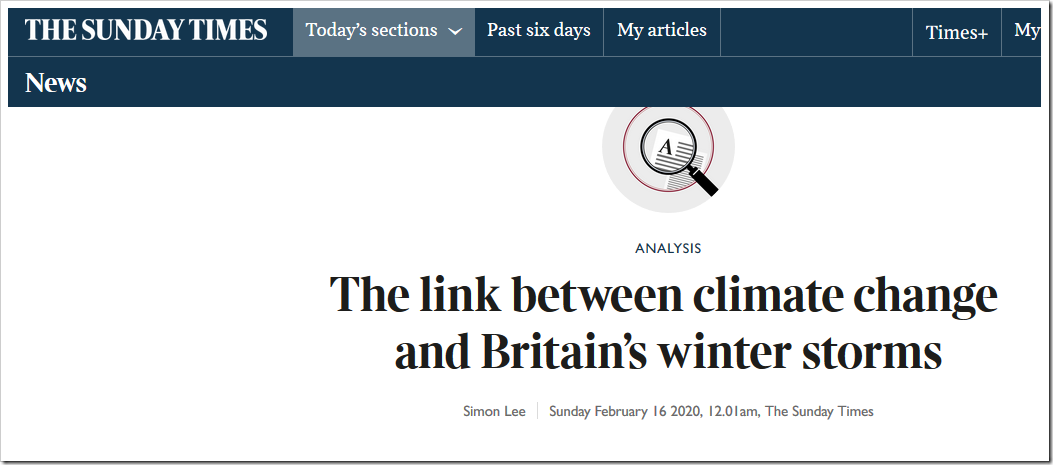
There is a very muddled piece in the Sunday Times today by meteorologist Simon Lee, which attempts to link winter storms with climate change:
 image

Every winter Britain gets hit by a series of storms. Ciara and Dennis are just the latest — but with two key differences.

The first is their strength. Our storms get their energy from temperature gradients in the atmosphere over north America. Recently that gradient has been much greater than normal.

The second is good PR. In 2015 the Met Office decided to start naming storms, which gave them a much higher media profile.
In 1993 Britain had the powerful Braer storm. In 2013-14 we faced about 12 of these weather systems. But in other years there are hardly any, which is why this year might be feeling so extraordinary to people coping with flooding, high winds and lots of rain.

A key question: why does the number vary so much?
Part of the answer lies in the jet stream, the powerful westerly wind blowing about six miles above us which, driven by that steep temperature gradient, has accelerated and got bigger. That energy feeds into our storms.

On their own, Ciara and Dennis are not symptomatic of climate change or a global weather crisis. What climate change does is to alter the likelihood of such events.

Computer models of the impact of climate change predict an increase in winter rainfall for the UK, along with warmer atmospheric temperatures and changes to the tracks followed by storms across the north Atlantic. This year may not be a sign of things to come, but we will probably see more severe winter flooding in future.

January 2020 was the warmest or second warmest on record in every global temperature dataset. It was rivalled only by 2016, when there was a strong El Niño event in the Pacific that temporarily raised global temperatures. Given that there is no El Niño this year, these record global temperatures — up to 1.5C above pre-industrial levels — are a cause for concern.

It emphasises the rapid warming of the planet. These record temperatures are consistent with recent events such as the Australian wildfires, the rising temperatures in the Antarctic and the unprecedented lack of ice and snow in parts of Europe.

What does this mean for Britain’s weather? So far the world has seen warming of about 1C. That is going to continue and the best guess is that the world could be 4C-6C warmer by 2080.

That may not sound much – but multiplied by the area of the planet it means that the atmosphere will hold an enormous amount more energy.

That energy will not only be felt as heat. It will also power our weather like never before. That means more and bigger storms, stronger winds and changes in the temperature of the oceans, which will make the sea levels rise. If our weather is exciting now, it may soon be overwhelming.

Simon Lee is a meteorologist at Reading University

https://www.thetimes.co.uk/edition/news/the-link-between-climate-change-and-britains-winter-storms-v3k99nh7s 

Let’s take it apart:

1) He is right that storms get their energy from temperature gradients in the atmosphere over north America. However global warming theory (and observations) tell us that this gradient should be getting less, not greater, because the Arctic has warmed faster than temperate latitudes.

Lower troposphere temperature anomalies from UAH, however, show a much more complex picture. Alaska and Greenland were much colder than average during January, but tucked between them is a warmer than normal area in eastern Canada:

image

https://www.nsstc.uah.edu/climate/


This is a classic example of a meridional jet stream, where it loops around, rather than flowing in a straighter zonal fashion. For more detail, see here.

In simple terms, Alaska and Greenland have been stuck to the polar side of the jet stream, whilst Canada has been to the south.

 image

Global Jet Stream

https://www.netweather.tv/charts-and-data/global-jetstream#2020/02/16/0600Z/jetstream/surface/level/overlay=jetstream/orthographic=-64.78,55.57,712


Meridional jet stream patterns are a normal meteorological event, and have nothing to do with global warming. As well as being responsible for atmospheric blocking, they can also speed up the jet stream.

And because of the looping, they can bring the jet stream further south than normal, as has happened this month, along with associated storms where they can have more impact.

2) He then goes on to suggest that storms such as Ciara and Dennis are becoming more frequent.

Yet, according to the Met Office, storminess has actually declined since the 1990s.

image

image

image

https://rmets.onlinelibrary.wiley.com/doi/epdf/10.1002/joc.6213


3) Finally he invokes those climate models, which tell us we will end up with wetter winters, thus implying that this month’s storms have been made more likely by global warming. Lots of maybes and probablies.

But again the data does not support this conjecture:

image

https://www.metoffice.gov.uk/research/climate/maps-and-data/summaries/index


The rest of the article is no more than childish imaginings of apocalypse, hardly worth commenting on.

Overall, Lee tries to give the impression that there is something abnormal about our winter weather in recent years.

Analysis of the data, along with historical observations, tell us that it is nothing of the sort.

via NOT A LOT OF PEOPLE KNOW THAT

https://ift.tt/2uDPxDX

February 16, 2020 at 06:03AM