
By Paul Homewood
Just following up on Joe Bastardi’s article yesterday about El Ninos and Arctic warming, it is worth looking at longer term trends.
Below is the chart of the MEI, with red indicating El Ninos and blue La Ninas.:
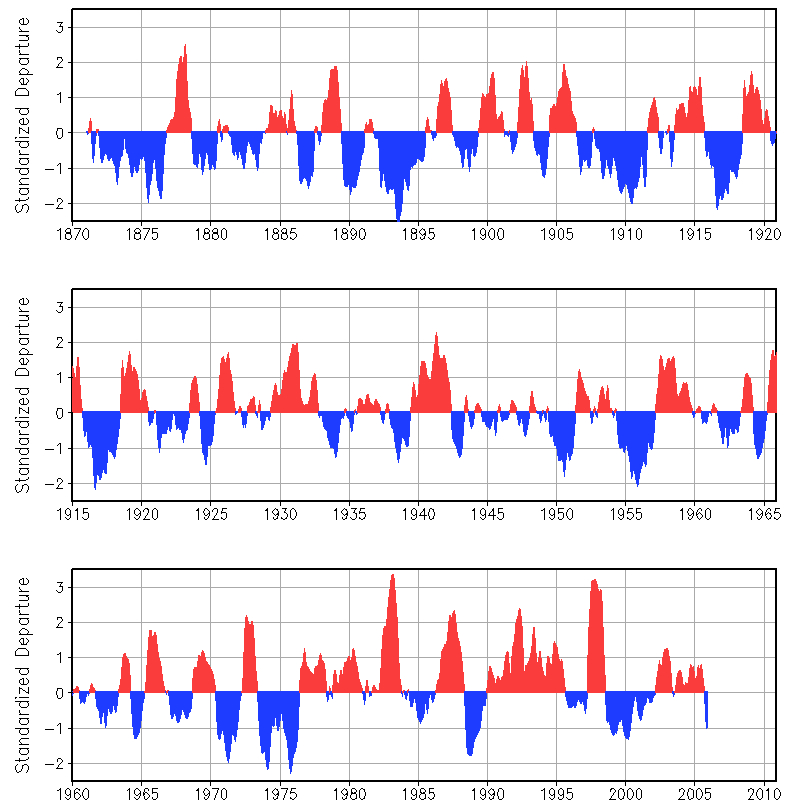
Extended Multivariate ENSO Index
https://www.esrl.noaa.gov/psd/enso/mei.ext/
As we can see, the period 1925 to 1945 was dominated by powerful El Ninos. This of course was also the time of great warming in the Arctic, known as “The Warming in The North”, when temperatures across much of the Arctic were as high as they are now.
During the 1950s, a much colder climate took over in the Arctic, until it became warmer again in the 90s. This was also a period when La Ninas dominated.
Coincidence?
The climate in the Arctic is also very well correlated with the Atlantic Multidecadal Oscillation (AMO):

Both of the warming regimes were marked by the inflow of warmer Atlantic waters, which also would have had the effect described by Joe Bastardi, ie the introduction of moist air into the Arctic.
Whether the AMO supplemented the effect of super El Ninos, or whether in fact the two oceanic phenomena are interconnected remains to be seen.
via NOT A LOT OF PEOPLE KNOW THAT
April 4, 2020 at 12:03PM

