
“Whenever I came across green energy, it wasn’t green energy”
By Die kalte Sonne
(Text translated by P. Gosselin)
American documentary filmmaker Michael Moore presents on YouTube a film that critically examines renewable energies in the USA. All the more astonishing is his relentless portrayal of the situation in the USA regarding these energies.
The Oscar winner presents a work directed by Jeff Gibbs “Planet Of The Humans“.
Greens tangled in contradiction
Similarly ruthless as other Moore films, it is enlightened, even exaggerated, but first and foremost proponents and critics of renewable energies speak out. Especially supporters contradicted each other, sometimes rather unwittingly as the intention of the documentary film was not clear to them. But nobody was ambushed, the questions were always asked fairly. What is striking is the speechlessness of some when it came to unpleasant issues or the financing of certain movements.
The film is about the sell out green ideas, and this happens in the USA in a variety of ways. To be clear, the film criticizes any kind of pollution, and it starts by digging out a 1958 film that warns of global warming caused by CO2: “The Unchained Goddess”.
Director Gibbs also makes his position very clear at the beginning. In Germany he is what you would probably call an environmental fundamentalist, with a self-built wooden house in the wilderness, solar panel on the roof and self-chopped wood as fuel in the wood stove. His first documentaries also deal with the mistreatment of nature.
Fossil fuels always in the background, out of sight
Gibbs had his awakening at a solar festival in Vermont. At a kind of hippie festival everything was powered by solar panels, or so he thought. But when a rain came up and Gibbs suddenly noticed nervousness among the organizers, he asked about it. He discovered there were diesel generators to provide the necessary power and that the panels at the festival were more of a decoration.
The film then describes the rise of green energy with the inauguration of Barack Obama. Investors like Richard Branson or Vinod Koshla entered this market with billions, as did investment banks. Again and again there are times that remind us of the diesel generator moment in Vermont, for example, when GM introduced its Volt electric vehicle. But when asked, it becomes clear that the charging station is 95% powered by coal.
And Gibbs lets engineers have their say, describing exactly what also counts in Europe: renewable energies need backups in the absence of storage. In the USA, natural gas is often used for this purpose when it comes to new power plants, because they can cope better with ramp-ups and slow-downs than nuclear or coal-fired power plants.
Fraudulent claims?
Throughout the film there are time and again astonishing discoveries like the one at the Ivanpah Solar Park in the Mojave Desert in California, where natural gas has to be used to preheat the plant for hours every morning before it can even start up.
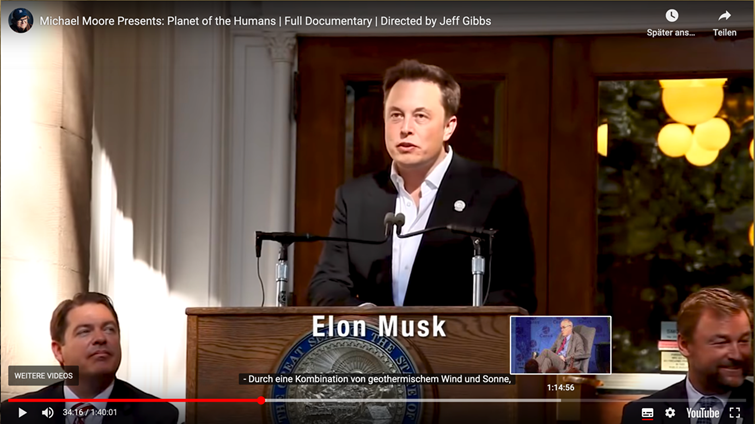
Very nice are also statements, like the one from Elon Musk, claiming a battery factory can supply itself off grid with electricity and heat:
Screenshot from Planet of the Humans
But why the described factory needs its own transformer station remains a mystery. This phenomenon is also common at other companies such as Apple or Google, which are all connected to the power grid that also offers electricity from fossil fuels. Appearances count.
Koch brothers
The documentary also takes a look behind the scenes and looks at the business of the heavily wealthy Koch brothers. Anyone in the USA who is opposed to solar energy systems like Ivanpah is often accused of being a lobbyist for the Koch brothers, even though they are the ones who are making big money from green technologies. Gibbs shows some of the Koch companies that are doing good business.
Green project leaves town run down
In Daggett, California, the first solar park in the USA was built. But a visit to the town leaves Gibbs in shock. The place is run-down, and sand now blows where solar modules used to stand because the ground has no plants to hold the sand down. The soil is barren.
The increasing consumption of resources and the issue of the earth’s overpopulation are other topics in the film, as is biomass, which in the USA means burning wood in power plants. Environmental groups even praise it because they call it climate neutral, which is by no means the case.
It is harmful because CO2 is produced and CO2 storage is lost. An example shows that such plants can burn shredded car tyres or toxic railroad ties.
The documentary also introduces 350.org, comparable to Fridays For Future (FFF) in Europe. Students in Michigan who are involved with 350.org managed to get the university to stop using coal for heating. Now biomass is used, which means wood is burned.
Sierra Club merges with crony capitalism
This is followed by a look at the links to various US movements like the Sierra Club. Gibbs finds another interesting document from 2004, two years before the Gore movie “An Inconvenient Truth” when Gore founded the company Generation Investment Management with his partner David Blood (note the pun Blood and Gore). The aim was to promote biofuels and biomass, which, as I said, means burning trees in the USA.
And anyone who invested in forests in 2004 should benefit from the countless wood-fired power plants that have since been built in the USA. Gore and his company are among them.
Gibbs asks the question: Was this a film about climate change or about something completely different? The environmental movement has been taken over by capitalists, Gibbs concludes.
People want to hear lies
At the end, something comes full circle when Gibbs makes the same discovery at an Earth Day festival as he did previously in Vermont at the Solar Festival. Earth Day founder Denis Hayes explains to an enthusiastic crowd that the festival is powered entirely by solar energy. Several panels have been set up for this. But a technician behind the stage explains the power would only be enough for a toaster – the needed electricity is supplied by diesel generators. People want to be lied to.
Even Cayman Islands are part of Gore’s Green Movement
It is also worth watching the credits. It has more information about a new sustainability fund from Gore and Blood, on the Cayman Islands. Sustainability at Blood and Gore obviously does not mean paying taxes.
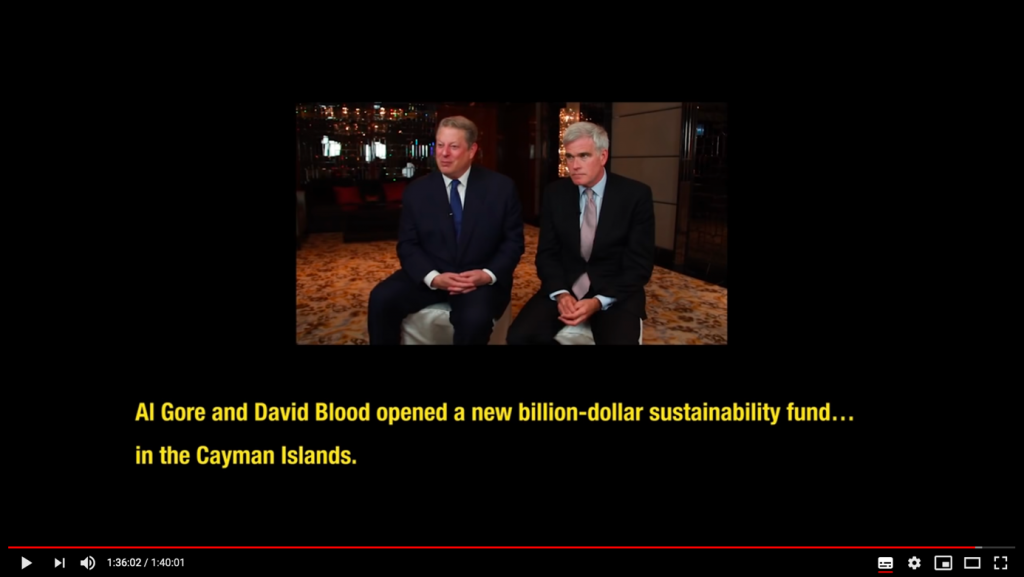
Image cropped from Planet of the Humans
via NoTricksZone
April 24, 2020 at 01:03PM
 Iowa Climate Science Education
Reblogged this on uwerolandgross.
LikeLike