
In a new climate reconstruction for the Tibetan Plateau (Liang et al., 2020), scientists report a) the highest Holocene temperatures occurred about 8,500 to 6,000 years ago; b) “century-scale climate fluctuations” correlate “statistically and visually” with solar forcing estimates; and c) “we are in the middle of the 500-yr-long relatively warm period” and “this natural climate will persist for about some more decades”.
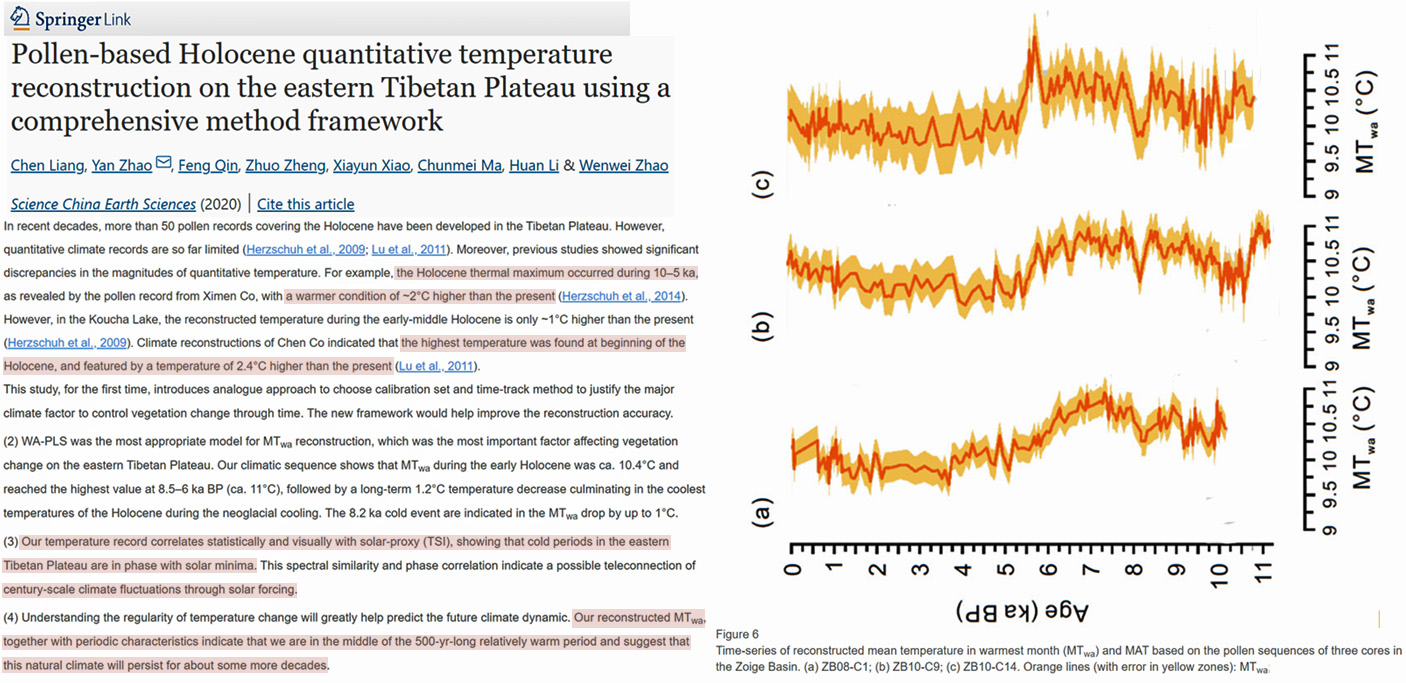
Image Source: Liang et al., 2020
Liang et al., 2020
“Our climatic sequence shows that MTwa [warmest month] during the early Holocene was ca. 10.4°C and reached the highest value at 8.5–6 ka BP (ca. 11°C), followed by a long-term 1.2°C temperature decrease culminating in the coolest temperatures of the Holocene during the neoglacial cooling. The 8.2 ka cold event are indicated in the MTwa drop by up to 1°C.”
“[T]he Holocene thermal maximum occurred during 10–5 ka, as revealed by the pollen record from Ximen Co, with a warmer condition of ~2°C higher than the present (Herzschuh et al., 2014). However, in the Koucha Lake, the reconstructed temperature during the early-middle Holocene is only ~1°C higher than the present (Herzschuh et al., 2009). Climate reconstructions of Chen Co indicated that the highest temperature was found at beginning of the Holocene, and featured by a temperature of 2.4°C higher than the present (Lu et al., 2011).”
“Our temperature record correlates statistically and visually with solar-proxy (TSI), showing that cold periods in the eastern Tibetan Plateau are in phase with solar minima. This spectral similarity and phase correlation indicate a possible teleconnection of century-scale climate fluctuations through solar forcing.”
“Understanding the regularity of temperature change will greatly help predict the future climate dynamic. Our reconstructed MTwa, together with periodic characteristics indicate that we are in the middle of the 500-yr-long relatively warm period and suggest that this natural climate will persist for about some more decades.”
via NoTricksZone
May 25, 2020 at 09:22AM
 Iowa Climate Science Education