Month: July 2020

Latest Developments In Virus Science

via Real Climate Science

https://ift.tt/3j05Cbs

July 12, 2020 at 04:29PM

Covid-19: The Winter Disease Which Hates Humid Summers?

Businessman in fear of recession due to the coronavirus

Guest essay by Eric Worrall

Researchers are consistently claiming Summer humidity impedes the transmission of Covid-19. But some humid tropical countries like Singapore have as much difficulty controlling the spread of Covid as the rest of us.

Could high humidity slow the spread of COVID-19?

Emergency room physician Jeff Gusky spreads the message that high humidity could slow the spread of the novel coronavirus.

In the small sanctuary of Starlight Bethel Missionary Church in South Dallas, emergency room physician Jeff Gusky stands before a handful of listeners. 

“It’s the humidity, stupid!” Dr. Gusky says. 

“It’s accepted that many viruses spread during the winter when the air is dry. COVID-19 is a virus,” Gusky tells his audience. 

Data linking the spread of the flu to dry indoor air has been around for years, including in the decade-old study, “Absolute Humidity and the Seasonal Outbreak of Influenza in the Continental United States” by Dr. Jeffrey Shaman. 

In June, a group in Australia published a study linking dry air to the spread of the coronavirus there. The study compared 749 cases of COVID-19 to relative humidity. It found that with every 1% decrease in humidity, coronavirus cases increased 6%. 

Read more: https://www.wfaa.com/article/news/health/coronavirus/could-high-humidity-slow-spread-coronavirus/287-6aa63537-1ed7-47ef-baa4-64716d29c730

The abstract of the Australian study;

The role of climate during the COVID‐19 epidemic in New South Wales, Australia

Michael P. Ward Shuang Xiao Zhijie Zhang
First published: 21 May 2020

Previous research has identified a relationship between climate and occurrence of SARS‐CoV and MERS‐CoV cases, information that can be used to reduce the risk of infection. Using COVID‐19 notification and postcode data from New South Wales, Australia during the exponential phase of the epidemic in 2020, we used time series analysis to investigate the relationship between 749 cases of locally acquired COVID‐19 and daily rainfall, 9 a.m. and 3 p.m. temperature, and 9 a.m. and 3 p.m. relative humidity. Lower 9 a.m. relative humidity (but not rainfall or temperature) was associated with increased case occurrence; a reduction in relative humidity of 1% was predicted to be associated with an increase of COVID‐19 cases by 6.11%. During periods of low relative humidity, the public health system should anticipate an increased number of COVID‐19 cases.

Read more: https://onlinelibrary.wiley.com/doi/full/10.1111/tbed.13631

The tropical city state Singapore has had a difficult time controlling the spread of Covid-19, though they have a surprisingly low death rate according to official figures – only 26 deaths to date. According to Straits Times, Singapore uses Remdesivir to treat Covid patients.

Singapore population 5,851,851, infections 45,783, deaths 26 is an infection rate of 7823 / million, deaths 26.

New York, population 8,175,133, infections 405,827, infection rate 21,940 / million, deaths 32,393.

Singapore’s difficulties with Covid could be due to factors which interfere with realisation of the potential benefits of Singapore’s tropical humidity. Singaporeans spend a lot of time indoors in air conditioned comfort, they take their air conditioning very seriously.

Lee Kuan Yew, founder of modern Singapore, once said:

Question: Anything else besides multicultural tolerance that enabled Singapore’s success?

Answer: Air conditioning. Air conditioning was a most important invention for us, perhaps one of the signal inventions of history. It changed the nature of civilization by making development possible in the tropics.

Without air conditioning you can work only in the cool early-morning hours or at dusk. The first thing I did upon becoming prime minister was to install air conditioners in buildings where the civil service worked. This was key to public efficiency.

Read more: https://www.vox.com/2015/3/23/8278085/singapore-lee-kuan-yew-air-conditioning

I am not disputing claims that humidity impedes the spread of Covid-19, but clearly there are other important factors.

Like this:

Like Loading…

Related

via Watts Up With That?

https://ift.tt/38NOKQt

July 12, 2020 at 04:24PM

A Busy Hurricane Season? Maybe, But It Won’t Be Due To Global Warming

By Paul Homewood


Today’s fake news from the BBC:


 image

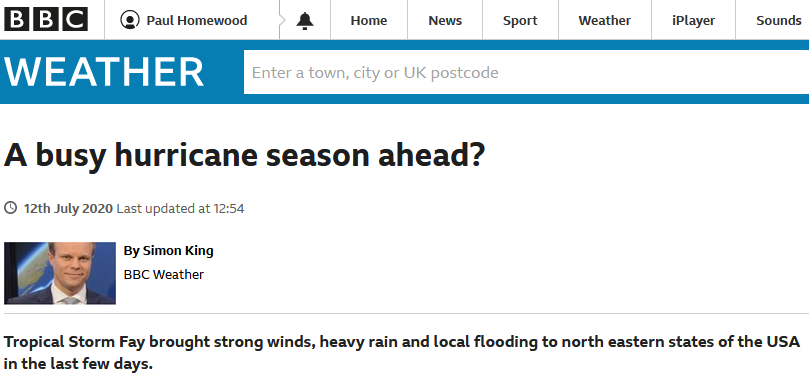
Tropical Storm Fay brought strong winds, heavy rain and local flooding to north eastern states of the USA in the last few days.

It was the earliest "F" named storm on record and follows fast on the heels of the earliest "E" – Edouard – which formed earlier in the week.

And we may be looking at more to come. In an update to their hurricane season forecast, which includes all storms which are given a name, specialists at Colorado State University are now predicting there could be 20 named storms – up from 16 in their previous forecast. The long term average is 12.

And when it comes specifically to hurricanes – storms with winds of more than 74mph – that’s gone up too, from eight to nine. The forecast for the number of major hurricanes – Category 3 or above – stays at four.

This is the sixth consecutive year that has seen named tropical storms before the official start of the hurricane season on 1 June. Arthur and Bertha formed in May, also marking the first time since 2012 that two storms formed in that month. Cristobal, Edouard and Fay became, respectively, the earliest third, fifth and sixth named storms on record.

None of these storms became particularly large, which may have had something to do with the unusually large amounts of Saharan dust – a hurricane inhibitor – across the Atlantic.

https://www.bbc.co.uk/weather/features/53367575 


It may well be that this year will see an above average number of storms – that is what averages are all about.

But the idea that this year, and indeed recent years, are anything special is ludicrous. This is, of course, the implication from the claim that there could be 20 named storms – up from 16 in their previous forecast. The long term average is 12.

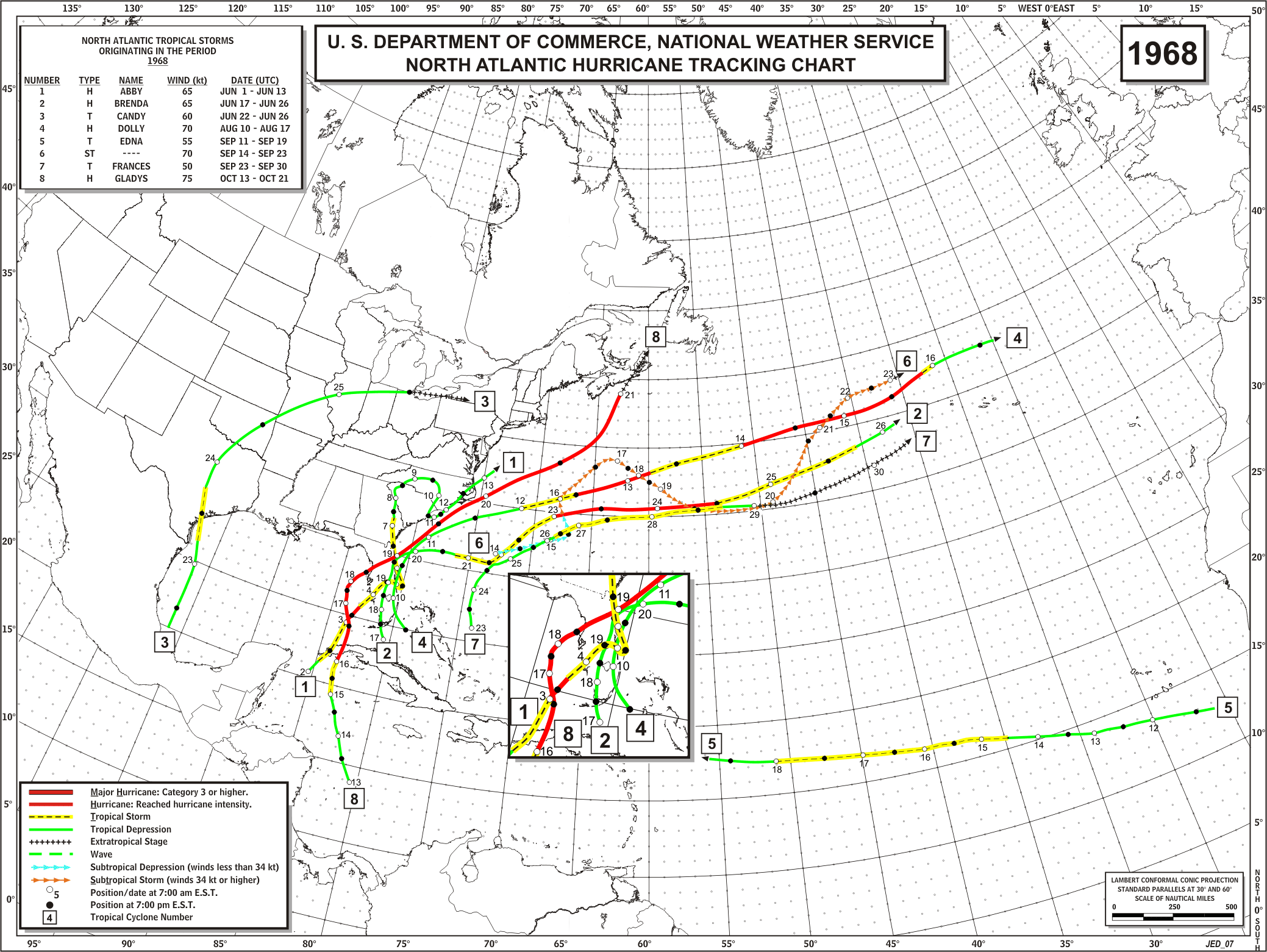
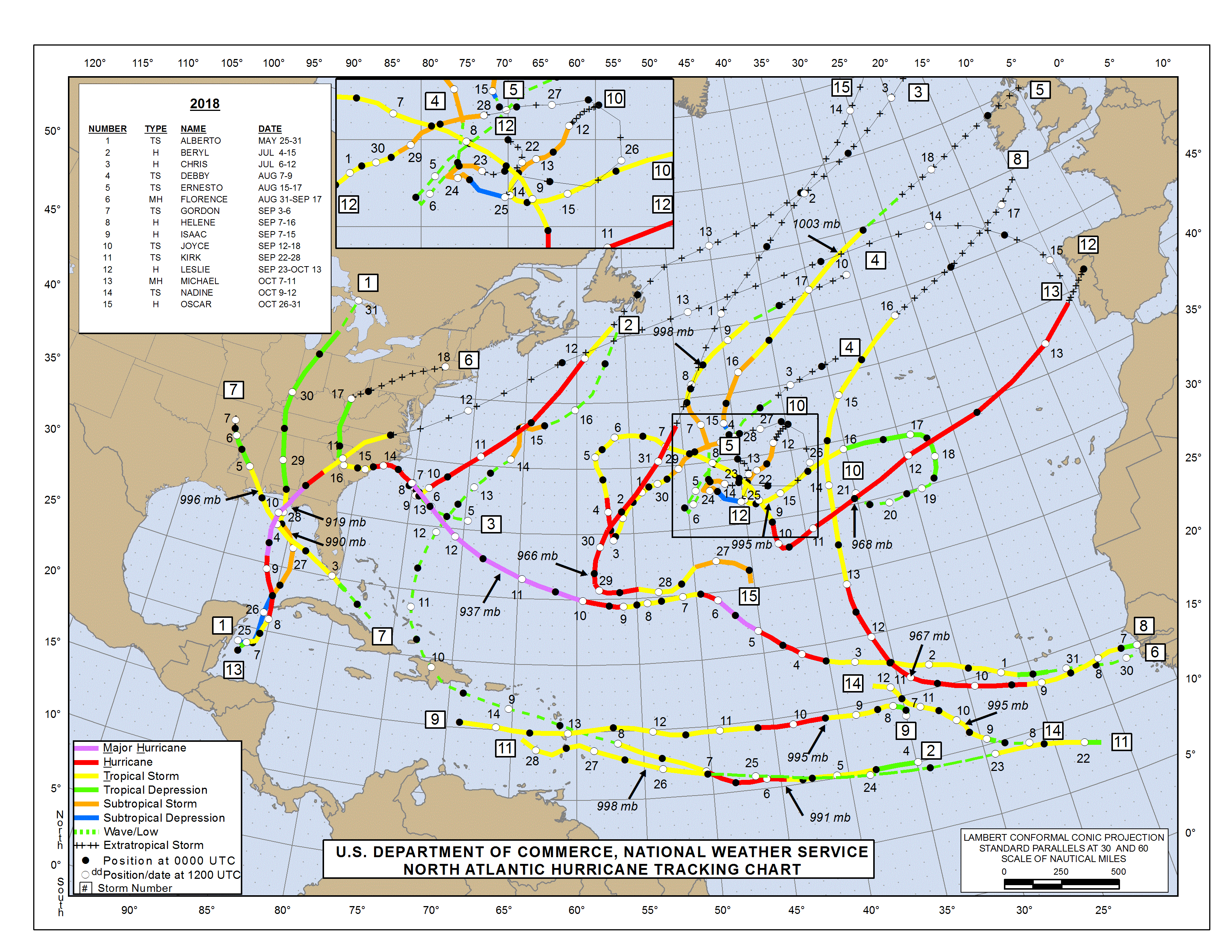
The average of 12 is based on 1968 to 2018, but in the early days it was still common to miss many short lived storms out in the middle of the Atlantic, even as recently as the 1990s.

A comparison of 1968 and 2018 shows clearly how very few mid Atlantic storms were picked up in 1968, despite the early beginnings of satellite monitoring.
https://www.aoml.noaa.gov/hrd/hurdat/tracks-at-2018.png

https://www.aoml.noaa.gov/hrd/hurdat/DataByYearandStorm.html


And even when they struck the US, they were not even given names all of the time:

 imageimage

 https://www.aoml.noaa.gov/hrd/hurdat/uststorms.html


The only meaningful trends that can be drawn are for US landfall storms in the last 30 years, and HURDAT data shows clearly that tropical storms and hurricanes have become much less frequent in the last decade:


image

https://www.aoml.noaa.gov/hrd/hurdat/uststorms.html


So far this summer, three tropical storms have hit the US, so there is no sign that this summer will end up being unusual.


The BBC article ends:

 image


The three factors are :

  1. A warm Atlantic
  2. Thunderstorms in Central Africa
  3. La Nina

Weasel words indeed! The actual data, of course, shows that there has been no long term trend in Atlantic hurricanes, which rather puts paid to the BBC’s climate stirring.

In the past the BBC have had to retract claims that climate change was making hurricanes worse, following my complaints. Having had their fingers burned once, they have obviously decided to be more circumspect!

via NOT A LOT OF PEOPLE KNOW THAT

https://ift.tt/2DrCpFN

July 12, 2020 at 04:12PM

Will New Hygiene Standards Propel Automation?

Robot Meat Packing MachineRobot Meat Packing Machine
Screenshot Scott Automation and Robotics Meat Packing Robot

Guest essay by Eric Worrall

h/t Breitbart; As Coronavirus immigration controls and outbreaks amongst workers cuts off the supply of cheap Labor, meat packing plants are increasingly turning to robots to fill the labor shortage. But there is nothing new about labor shortages triggering a wave of innovation.

Tyson and other meat processors are reportedly speeding up plans for robot butchers

By Alicia Wallace, CNN Business

Updated 2106 GMT (0506 HKT) July 10, 2020

(CNN) Tyson Foods and other meat processors that became early hotspots for the Covid-19 pandemic are reportedly accelerating plans to have robots replace human meatcutters.

Tyson (TSN) engineers and scientists — with the help of some designers from the auto industry — are developing an automated deboning system to help butcher the nearly 40 million chickens processed each week, the Wall Street Journal reported Thursday.

A labor shortage is behind the push to automate. Meat processing companies were already facing difficulties in recruiting workers, the Journal report said. That was made worse by the pandemic.

Read more: https://edition.cnn.com/2020/07/10/business/tyson-meatpacking-plants-automation/index.html

Obviously this is a multi-dimensional issue.

As automation continues to rise, the people who used to pack meat will need to find something else to do, possibly leading to some people who find it difficult to learn new skills experiencing hardship as they compete for an ever shrinking pool of repetitive semi-skilled jobs which have not yet been automated.

But the benefits to society of automation are too great to ignore.

Just as the end of mass hand weaving led to more affordable higher quality clothes, so automated meat packing will help keep meat affordable. And in the age of Coronavirus and ever stricter hygiene standards, the concept of food untouched by humans at every stage of processing is an attractive selling point.

Video of Scott Automation’s Meat Processing Technology. The robot uses x-ray vision to map the skeletal structure of the carcass, to help identify the correct cutting points.

Like this:

Like Loading…

Related

via Watts Up With That?

https://ift.tt/3epQL6m

July 12, 2020 at 12:09PM