Could there even be more than one black hole? The search for a significant extra planet has drawn a blank so far.
– – –
A coming sky survey will help test a wild idea — that a grapefruit-sized black hole lurks undiscovered in the outer solar system, says Mike Wall @ Space.com.
Over the past few years, researchers have noticed an odd clustering in the orbits of multiple trans-Neptunian objects (TNOs), which dwell in the dark depths of the far outer solar system.
Some scientists have hypothesized that the TNOs’ paths have been sculpted by the gravitational pull of a big object way out there, something 5 to 10 times more massive than Earth (though others think the TNOs may just be tugging on each other).
This big “perturber,” if it exists, may be a planet — the so-called “Planet Nine,” or “Planet X” or “Planet Next” for those who will always regard Pluto as the ninth planet.
But there’s another possibility as well: The shepherding object may be a black hole, one that crams all that mass into a sphere the size of a grapefruit.
Astronomers are already scanning the heavens for any sign of Planet Nine, and they should soon be able to hunt for the putative black hole as well, a new study reports.
The highly anticipated Vera C. Rubin Observatory, a big telescope under construction in the Chilean Andes, is scheduled to begin a wide-ranging, decade-long survey of the southern sky called the Legacy Survey of Space and Time (LSST) in late 2022.
Overview:Death certificate data, corrected for recent under-reporting, reveals a 10-20% decrease in weekly deaths compared to seasonal norms commencing in early March, 2020. This date coincides with the widespread closing of public schools. It is hypothesized that a decrease in traffic accidents is the most likely explanation for the decrease, a conclusion which would be confirmed from detailed analysis of the death certificate data.
I had previously blogged on the caution needed when analyzing the death counts from death certificate data compiled by the CDC. The most recent weeks always have under-counted totals because it takes weeks to months for all of the death certificates to trickle in and be counted. Use of the data without knowing this can lead to false conclusions about recently declining death rates. I outlined a simple method for doing a first-order correction of the data based upon the number of additional death reports in each successive week, a method which I use here.
The CDC data report weekly deaths in three age groups: less than 18 years old (“child”), 18-64, and 65 on up. The data are updated weekly, and the data online extend back to week 40 in 2015. I examined the death totals for the under-18 year old group versus the totals for the 18-and-older (combined) group. (Only those recent reports that were labeled as “100% reporting” were used, but this notation is misleading because the CDC means 100% of the locations around the country had submitted reports, not that all of the reports were complete.)
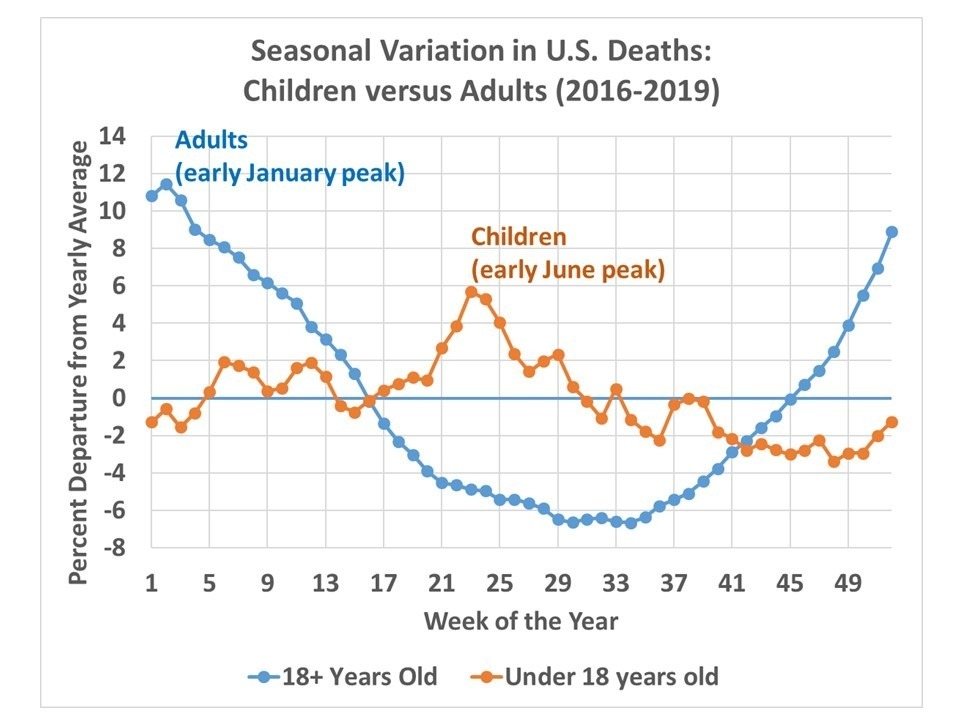
I removed the average seasonal cycle (2016-2019) from the weekly totals, which show a seasonal ~11% peak in deaths in early January for adults, and a weaker ~6% peak in children’s deaths in early June (Fig. 1).
Fig. 1. Seasonal variations (%) in deaths (all causes) for adults versus children, 2016 through 2019.
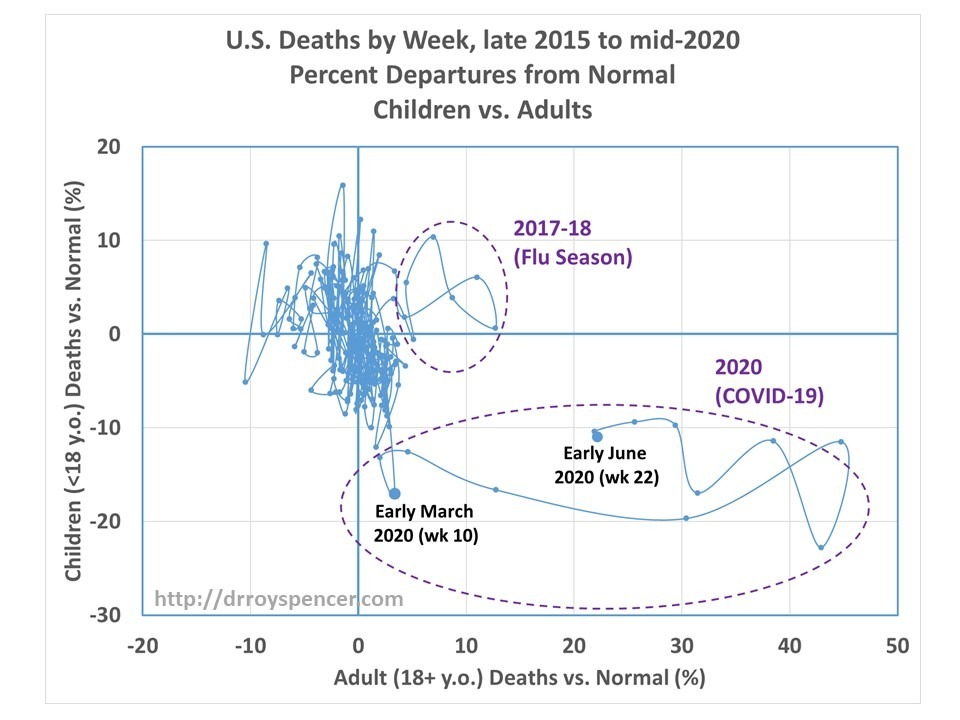
Fig. 2. Weekly number of deaths as percent departures from seasonal normals, for adults versus children, plotted as a phase space diagram (successive weeks connected by a line).
In order to corrected for under-reporting of recent deaths, I used the data from 4 successive weeks earlier this year to correct the most recent 52 weeks of data. Those 4 successive weeks yielded average week-to-week adjustments which accumulated to 16.5% under-reporting for 1 week previous to latest reported week; 10.4% at 2 weeks previous; 7.8% at 3 weeks; 6.4% at 4 weeks, dropping below 1% at 10 weeks previous, etc.
I then computed the weekly percent departures from the average seasonal cycle for the entire time period (since week 40 of 2015). The results (Fig. 2) show the unusually bad peak in seasonal flu and pneumonia deaths in 2017-18, which as expected results in a larger increase in adults that children.
Note that there is a 10-20% decrease in child deaths beginning in early March, which is when most schools in the U.S closed down. Since the most frequent cause of death in the under-18 age group is auto accidents, it makes sense that the greatly reduced traffic activity during “lockdown” led to fewer deaths.
Of course, the same kind of reduction would be expected in the adult age category, but it is completely overwhelmed in Fig. 2 by the large increase due to COVID-19 deaths, which peaked in mid-April. Since there have been very few COVID-19 deaths in children we more clearly see the reduction in that age group. In absolute terms, a 15% reduction in childhood deaths equates to about 85 children per week.
Expect this new study to be greeted by an angry mob with pitch forks and torches. Results Big Pharma, Bill Gates and social engineering technocrats don’t want to see.
So picture this: tens of thousands of scientists, doctors and health authorities worldwide spending billions and billions in a frenzied search for new medicines and vaccines – and imposing economy-crippling lock downs – all to combat the COVID 19 virus. Meanwhile, a large part of the solution is likely just sitting right there on the supermarket shelf – to be had for just a few bucks!
It may be that simply gargling regularly in fact goes a long way in combating the spread of COVID-19 and doing away with all the costumed theatrics we’ve been seeing lately.
Promising results
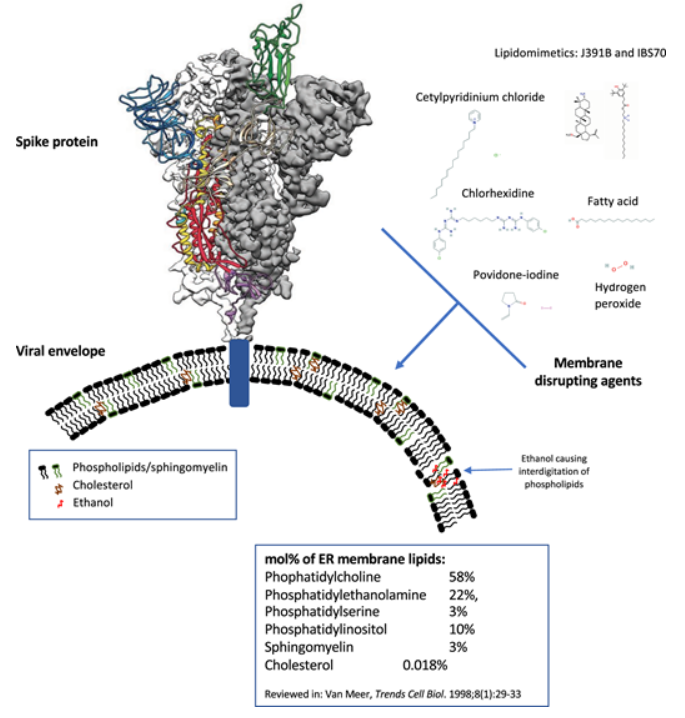
A team of scientists led by Valerie B O’Donnell reviewed known mechanisms of viral lipid membrane disruption by widely available dental mouthwash components that include ethanol, chlorhexidine, cetylpyridinium chloride, hydrogen peroxide, and povidone-iodine and assessed their potential ability to disrupt the SARS-CoV-2 lipid envelope, based on their concentrations.
Direct evidence: “Potential way to reduce transmission”
The preliminary results are promising enough to warrant serious further investigation, the authors say. Moreover, citing already published research on other enveloped viruses, they conclude that several deserve clinical evaluation.
These studies “directly support the idea that oral rinsing should be considered as a potential way to reduce transmission of SARS-CoV-2,” the authors say.
Mixing science and politics
If this turns out to be so, there are going to be lots of “experts” out there looking awfully silly. But so it is so often when social engineering politics get mixed with science.
IMAGE: A MAP OF THE ARCTIC OCEAN SHOWS THE LOCATION OF THE AMERASIAN AND EURASIAN BASINS. ARROWS SHOW THE PATH OF WARM, FRESH PACIFIC WATER AND WARM, SALTY ATLANTIC WATER INTO… view more CREDIT: GRAPHIC ADAPTED FROM POLYAKOV ET AL. 2020, FRONTIERS IN MARINE SCIENCE PAPER.
New research explores how lower-latitude oceans drive complex changes in the Arctic Ocean, pushing the region into a new reality distinct from the 20th-century norm.
The University of Alaska Fairbanks and Finnish Meteorological Institute led the international effort, which included researchers from six countries. The first of several related papers was published this month in Frontiers in Marine Science.
Climate change is most pronounced in the Arctic. The Arctic Ocean, which covers less than 3% of the Earth’s surface, appears to be quite sensitive to abnormal conditions in lower-latitude oceans.
“With this in mind, the goal of our research was to illustrate the part of Arctic climate change driven by anomalous [different from the norm] influxes of oceanic water from the Atlantic Ocean and the Pacific Ocean, a process which we refer to as borealization,” said lead author Igor Polyakov, an oceanographer at UAF’s International Arctic Research Center and FMI.
Although the Arctic is often viewed as a single system that is impacted by climate change uniformly, the research stressed that the Arctic’s Amerasian Basin (influenced by Pacific waters) and its Eurasian Basin (influenced by Atlantic waters) tend to differ in their responses to climate change.
Since the first temperature and salinity measurements taken in the late 1800s, scientists have known that cold and relatively fresh water, which is lighter than salty water, floats at the surface of the Arctic Ocean. This fresh layer blocks the warmth of the deeper water from melting sea ice.
In the Eurasian Basin, that is changing. Abnormal influx of warm, salty Atlantic water destabilizes the water column, making it more susceptible to mixing. The cool, fresh protective upper ocean layer is weakening and the ice is becoming vulnerable to heat from deeper in the ocean. As mixing and sea ice decay continues, the process accelerates. The ocean becomes more biologically productive as deeper, nutrient-rich water reaches the surface.
By contrast, increased influx of warm, relatively fresh Pacific water and local processes like sea ice melt and accumulation of river water make the separation between the surface and deep layers more pronounced on the Amerasian side of the Arctic. As the pool of fresh water grows, it limits mixing and the movement of nutrients to the surface, potentially making the region less biologically productive.
The study also explores how these physical changes impact other components of the Arctic system, including chemical composition and biological communities.
Retreating sea ice allows more light to penetrate into the ocean. Changes in circulation patterns and water column structure control availability of nutrients. In some regions, organisms at the base of the food web are becoming more productive. Many marine organisms from sub-Arctic latitudes are moving north, in some cases replacing the local Arctic species.
“In many respects, the Arctic Ocean now looks like a new ocean,” said Polyakov.
These differences change our ability to predict weather, currents and the behavior of sea ice. There are major implications for Arctic residents, fisheries, tourism and navigation.
This study focused on rather large-scale changes in the Arctic Ocean, and its findings do not necessarily represent conditions in nearshore waters where people live and hunt.
The study stressed the importance of future scientific monitoring to understand how this new realm affects links between the ocean, ice and atmosphere.
###
Co-authors of the paper include Matthew Alkire, Bodil Bluhm, Kristina Brown, Eddy Carmack, Melissa Chierici, Seth Danielson, Ingrid Ellingsen, Elizaveta Ershova, Katarina Gårdfeldt, Randi Ingvaldsen, Andrey V. Pnyushkov, Dag Slagstad and Paul Wassmann.



 Iowa Climate Science Education