Never seen so much snow in July,” reads the headline on the Norwegian website nrk/no
We have not had such snowfall as this year, says Knut Kinne, watercourse technical manager at the energy company BKK.
With ten meters (more than 32 feet) of packed snow, it may not have melted in the summer and fall if we had not removed it, says communications adviser Jarle Hodne at BKK.
That’s how glaciers begin! When the snow doesn’t melt in the summer and fall.
The World Meteorological Organisation says there’s a growing chance that global temperatures will break the 1.5C threshold over the next five years, compared to pre-industrial levels.
It says there’s a 20% possibility the critical mark will be broken in any one year before 2024.
But the assessment says there’s a 70% chance it will be broken in one or more months in those five years.
Scientists say that keeping below 1.5C will avoid the worst climate impacts.
The target was agreed by world leaders in the 2015 Paris climate accord accord.
They committed to pursue efforts to try to keep the world from warming by more than 1.5C this century.
This new assessment, carried out by the UK’s Met Office for the World Meteorological Organisation (WMO), says there’s a growing chance that this level will be breached.
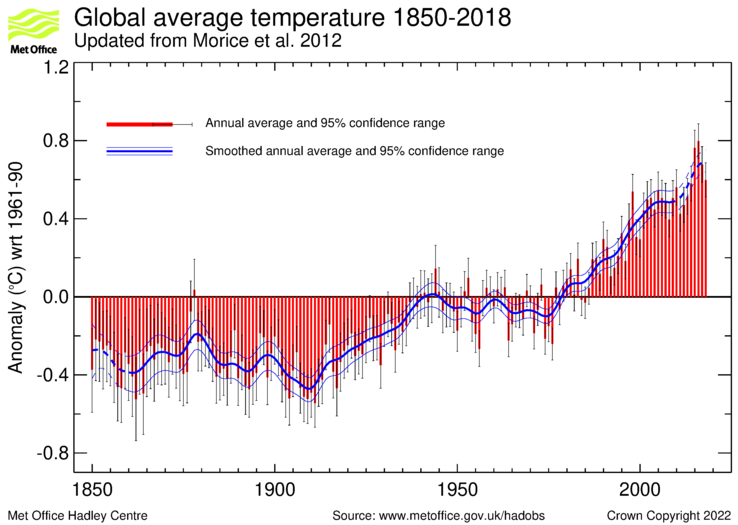
Researchers say that the Earth’s average annual temperature is already more than 1C higher than it was in the 1850s – and will probably stay around this level over the next five years.
The rest of the article is the usual load of drivel from Matt McGrath, including the absurd claim that there will be more storms over western Europe thanks to rising sea levels. What on earth do rising sea levels have to do with storms?
I still cannot understand the obsession with pre-industrial temperatures. For whatever reason the world has warmed up a bit since the Little Ice Age, and is a thoroughly better place to live as a result.
As McGrath notes, the world appears to be about a degree warmer than back then. So when they talk of 1.5C warming, they don’t mean from now, but from the 1850s:
So they really mean half a degree of warming from current temperatures. Yet global temperatures can fluctuate by about half a degree anyway from year to year, and the El Nino year of 2016 was already pushing the 1.5C mark.
Why then should anybody be scared by the prospect of similar years in future?
Of course, the real reason for the 1.5C marker is that it sounds much scarier than 0.5C. Unfortunately for themselves, climate scientists, green activists and governments, having staked their reputations on the 1.5C mark, now find themselves in the position where it could come and go without anybody actually noticing. This would really undermine their apocalyptic threats.
This no doubt is one reason why Matt McGrath has included this chart. (It also plays a video on the BBC page. It ends with weatherman, Matt Taylor, telling us we must curb our emissions. I’m not quite sure when it became the job of a weatherman to tell the public how to live their lives!):
He no doubt hopes to scare people about increasing heatwaves, though I’m not sure why they would worry about 19 hot days in a decade?
But what about the figures? Do they reflect what has actually been happening?
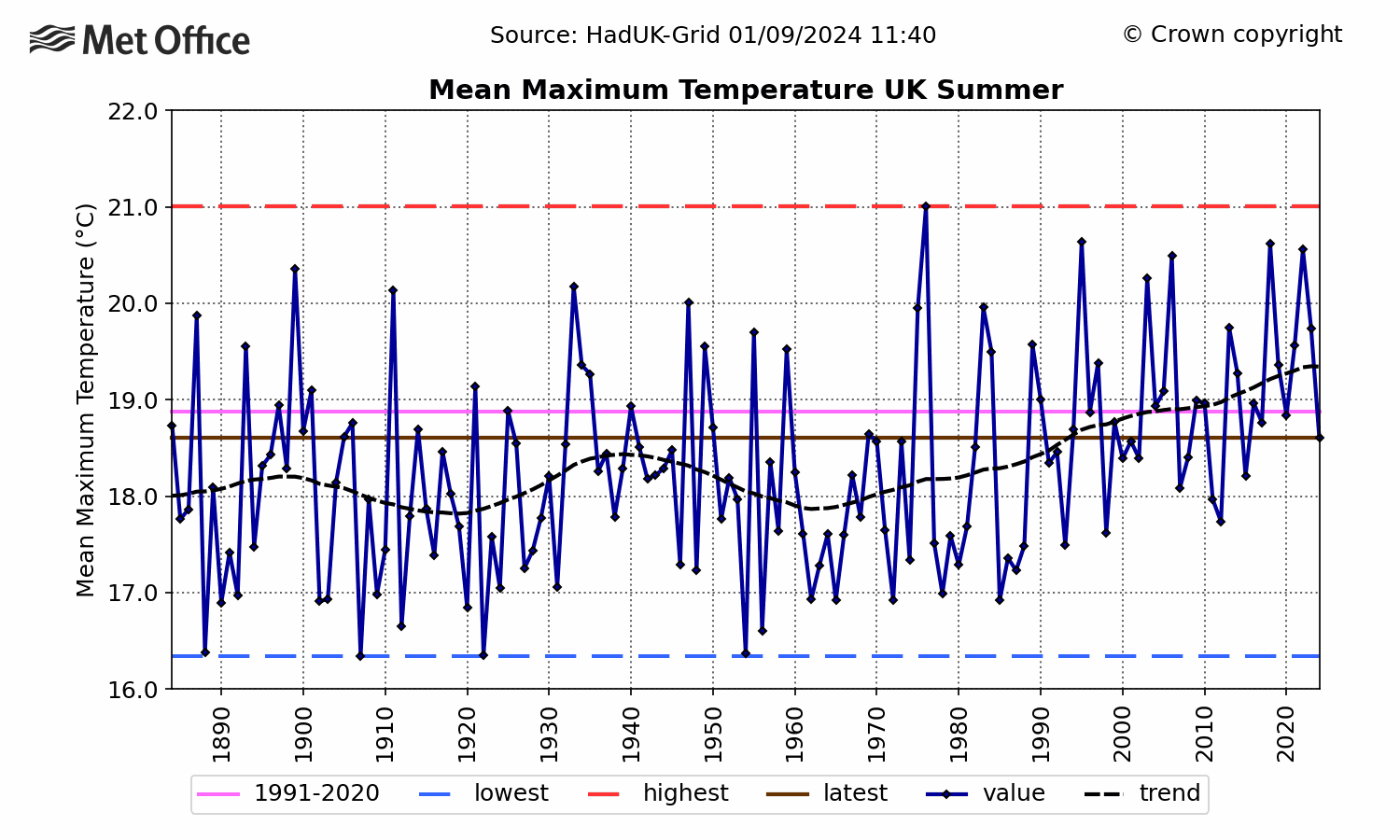
A glimpse at the average maximum temperatures in summer suggests that summers are not getting hotter, as the BBC chart implies. Certainly not since 1976:
The BBC’s chart is actually pretty meaningless and misleading, as it is based on an everchanging mix of stations, many affected by UHI. As more and more sites get added to the Met Office monitoring network, the more likely it becomes that one station will record a 30C day.
And, of course, some parts of the country are naturally warmer than others, so you cannot compare a temperature at Heathrow with one in Sheffield. There is only one way to monitor trends, and that is to use a consistent database of daily temperatures. The only one we have, other than individual stations, is the Central England Temperature series.
When we analyse daily temperatures above 28C, we find:
Decades run from 1880 to 1889, etc. I have chosen a 28C threshold, as CET tends to be a bit lower than the temperatures in the southeast, where most of the 30C days occur. But we can also do the same exercise with 30C days:
Neither chart shows any evidence that hot days are becoming more frequent, as the BBC purport to claim. Hot days in the most recent decade are less frequent than in the 1970s and 1990s. They are also not distinguishable from the 1940s.
It is worthwhile noting, however, that the BBC chart begins in the cold 1960s. It also, for no obvious reason, only considers June temperatures. Maybe a chart beginning in 1900, and using temperatures across the summer as a whole, might have yielded different conclusions!
This updated blog post of mine from last year is as pertinent now as it was then: it’s a fully-referenced rebuttal to the misleading ‘facts’ so often presented this time of year to support the notion that polar bears are being harmed due to lack of summer sea ice. Polar Bears International developed ‘Arctic Sea Ice Day’ (15 July) to promote their skewed interpretation of polar bear science at the height of the Arctic melt season. This year I’ve add a ‘Polar Bears and the Arctic Food Chain‘ graphic, which readers are free to download and share. For further information, see “The Polar Bear Catastrophe That Never Happened“.
Summer sea ice loss is finally ramping up: first year is disappearing, as it has done every year since ice came to the Arctic millions of years ago. But critical misconceptions, fallacies, and disinformation abound regarding Arctic sea ice and polar bear survival. Ahead of Arctic Sea Ice Day (15 July), here are 10 fallacies that teachers and parents especially need to know about.
As always, please contact me if you would like to examine any of the references included in this post. These references are what make my efforts different from the activist organization Polar Bears International. PBI virtually never provide references within the content it provides, including material it presents as ‘educational’. Links to previous posts of mine that provide expanded explanations, images, and additional references are also provided.
In many regions – including Western Hudson Bay, Wrangel Island, and Franz Josef Land – pregnant females that will give birth on land in December come ashore in summer and stay until their newborn cubs are old enough to return with them to the ice the following spring. See Andersen et al. 2012; Ferguson et al. 2000; Garner et al. 1994; Jonkel et al. 1978; Harington 1968; Kochnev 2018; Kolenosky and Prevett 1983; Larsen 1985; Olson et al. 2017; Richardson et al. 2005; Stirling and Andriashek 1992.
Ten fallacies and disinformation about sea ice
1. ‘Sea ice is to the Arctic as soil is to a forest‘. False: this all-or-nothing analogy is a specious comparison. In fact, Arctic sea ice is like a big wetland pond that dries up a bit every summer, where the amount of habitat available to sustain aquatic plants, amphibians and insects is reduced but does not disappear completely. Wetland species are adapted to this habitat: they are able to survive the reduced water availability in the dry season because it happens every year. Similarly, sea ice will always reform in the winter and stay until spring. During the two million or so years that ice has formed in the Arctic, there has always been ice in the winter and spring (even in warmer Interglacials than this one). Moreover, I am not aware of a single modern climate model that predicts winter ice will fail to develop over the next 80 years or so. See Amstrup et al. 2007; Durner et al. 2009; Gibbard et al. 2007; Polak et al. 2010; Stroeve et al. 2007.
3. Ice algae is the basis for all Arctic life. Only partially true because plankton also thrives in open water during the Arctic summer, which ultimately provides food for the fish species that ringed and bearded seals eat during the summer, which fattens the seals up before the long Arctic winter (as the graphic below shows).
Recent research has shown that less ice in summer has improved ringed and bearded seal health and survival over conditions that existed in the 1980s (when there was a shorter ice-free season and fewer fish to eat): as a consequence, abundant seal populations have been a boon for the polar bears that depend on them for food in early spring. For example, despite living with the most profound decline of summer sea ice in the Arctic polar bears in the Barents Sea around Svalbard are thriving, as are Chukchi Sea polar bears – both contrary to predictions made in 2007 that resulted in polar bears being declared ‘threatened’ with extinction under the Endangered Species Act. See Aars 2018; Aars et al. 2017; Amstrup et al. 2007; Arrigo and van Dijken 2015; Crawford and Quakenbush 2013; Crawford et al. 2015; Crockford 2017, 2019; Frey et al. 2018; Kovacs et al. 2016; Lippold et al. 2019; Lowry 2016; Regehr et al. 2018; Rode and Regehr 2010; Rode et al. 2013, 2014, 2015, 2018.
4. Open water in early spring as well as summer ice melt since 1979 are unnatural and detrimental to polar bear survival. False: melting ice is a normal part of the seasonal changes in the Arctic. In the winter and spring, a number of areas of open water appear because wind and currents rearrange the pack ice – this is not melt, but rather normal polynya formation and expansion. Polynyas and widening shore leads provide a beneficial mix of ice resting platform and nutrient-laden open water that attracts Arctic seals and provides excellent hunting opportunities for polar bears. The map below shows Canadian polynyas and shore leads known in the 1970s: similar patches of open water routinely develop in spring off eastern Greenland and along the Russian coast of the Arctic Ocean. See Dunbar 1981; Grenfell and Maykut 1977; Hare and Montgomery 1949; Smith and Rigby 1981; Stirling and Cleator 1981; Stirling et al. 1981, 1993.
Recurring polynyas and shore leads in Canada known in the 1970s. From Smith and Rigby 1981
5. Climate models do a good job of predicting future polar bear habitat. False: My recent book, The Polar Bear Catastrophe That Never Happened, explains that the almost 50% decline in summer sea ice that was not expected until 2050 actually arrived in 2007, where it has been ever since (yet polar bears are thriving). That is an extraordinarily bad track record of sea ice prediction. Also, contrary to predictions made by climate modelers, first year ice has already replaced much of the multi-year ice in the southern and eastern portion of the Canadian Arctic Archipelago, to the benefit of polar bears. See also ACIA 2005; Crockford 2017, 2019; Durner et al. 2009; Hamilton et al. 2014; Heide-Jorgensen et al. 2012; Perovich et al. 2018; Stern and Laidre 2016; Stroeve et al. 2007; SWG 2016; Wang and Overland 2012.
Simplified predictions vs. observations up to 2007 provided by Stroeve et al. 2007 (courtesy Wikimedia). Sea ice hit an even lower extent in 2012 and all years since then have been below predicted levels.
6. Sea ice is getting thinner and that’s a problem for polar bears. False: First year ice (less than about 2 metres thick) is the best habit for polar bears because it is also the best habitat for Arctic seals. Very thick multi-year ice that has been replaced by first year ice that melts completely every summer creates more good habitat for seals and bears in the spring, when they need it the most. This has happened especially in the southern and eastern portions of the Canadian Arctic Archipelago (see ice chart below from Sept 2016). Because of such changes in ice thickness, the population of polar bears in Kane Basin (off NW Greenland) has more than doubled since the late 1990s and numbers of bears in M’Clintock Channel (in the SE Archipelago) have reportedly also increased. See Atwood et al. 2016; Durner et al. 2009; Lang et al. 2017; Stirling et al. 1993; SWG 2016.
Loss of summer sea ice per year, 1979-2014. From Regehr et al. 2016.
8. Breakup of sea ice in Western Hudson Bay now occurs three weeks earlier than it did in the 1980s. False: Breakup now occurs about 2 weeks earlier in summer than it did in the 1980s. The total length of the ice-free season is now about 3 weeks longer (with lots of year-to-year variation). WH polar bears tagged last year were still on the ice at the end of June 2020. See Castro de la Guardia et al. 2017; Cherry et al. 2013; Lunn et al. 2016; and video below, showing the first bear spotted off the ice at Cape Churchill, Western Hudson Bay, on 5 July 2019 – fat and healthy after eating well during the spring:
9. Winter sea ice has been declining since 1979, putting polar bear survival at risk. Only partially true: while sea ice in winter (i.e. March) has been declining gradually since 1979 (see graph below from NOAA), there is no evidence to suggest this has negatively impacted polar bear health or survival, as the decline has been quite minimal. The sea ice chart at the beginning of this post shows that in 2020 there was plenty of ice remaining in March to meet the needs of polar bears and their primary prey (ringed and bearded seals), despite 2019 being the 11th lowest since 1979 (and the highest since 2013).
10. Experts say that with 19 different polar bear subpopulations across the Arctic, there are “19 sea ice scenarios playing out“ (see also here), implying this is what they predicted all along. False: In order to predict the future survival of polar bears, biologists at the US Geological Survey in 2007 grouped polar bear subpopulations with similar sea ice types (which they called ‘polar bear ecoregions,’ see map below). Their predictions of polar bear survival were based on assumptions of how the ice in these four sea ice regions would change over time (with areas in green and purple being similarly extremely vulnerable to effects of climate change). However, it turns out that there is much more variation within and between regions than they expected and more differences in responses to summer sea ice loss than predicted: contrary to predictions, the Barents Sea has had a far greater decline in summer ice extent than any other region, and both Western and Southern Hudson Bay have had relatively little (see #7). See Amstrup et al. 2007; Atwood et al. 2016; Crockford 2017, 2019, 2020; Durner et al. 2009; Lippold et al. 2019; Regehr et al. 2016. My latest book, The Polar Bear Catastrophe That Never Happened, explains why this prediction based on sea ice ecoregions failed so miserably.
References
Aars, J. 2018. Population changes in polar bears: protected, but quickly losing habitat. Fram Forum Newsletter 2018. Fram Centre, Tromso. Download pdf here (32 mb).
Aars, J., Marques,T.A, Lone, K., Anderson, M., Wiig, Ø., Fløystad, I.M.B., Hagen, S.B. and Buckland, S.T. 2017. The number and distribution of polar bears in the western Barents Sea. Polar Research 36:1. 1374125. doi:10.1080/17518369.2017.1374125
ACIA 2005.Arctic Climate Impact Assessment: Scientific Report. Cambridge University Press. See their graphics package of sea ice projections here.
AMAP 2017. [ACIA 2005 update]. Snow, Water, Ice, and Permafrost in the Arctic Summary for Policy Makers (Second Impact Assessment). Arctic Monitoring and Assessment Programme, Oslo. pdf here.
Amstrup, S.C. 2003. Polar bear (Ursus maritimus). In Wild Mammals of North America, G.A. Feldhamer, B.C. Thompson and J.A. Chapman (eds), pg. 587-610. Johns Hopkins University Press, Baltimore.
Amstrup, S.C., Marcot, B.G. & Douglas, D.C. 2007. Forecasting the rangewide status of polar bears at selected times in the 21st century. US Geological Survey. Reston, VA. Pdf here
Andersen, M., Derocher, A.E., Wiig, Ø. and Aars, J. 2012. Polar bear (Ursus maritimus) maternity den distribution in Svalbard, Norway. Polar Biology 35:499-508.
Atwood, T.C., Marcot, B.G., Douglas, D.C., Amstrup, S.C., Rode, K.D., Durner, G.M. et al. 2016. Forecasting the relative influence of environmental and anthropogenic stressors on polar bears. Ecosphere 7(6): e01370.
Castro de la Guardia, L., Myers, P.G., Derocher, A.E., Lunn, N.J., Terwisscha van Scheltinga, A.D. 2017. Sea ice cycle in western Hudson Bay, Canada, from a polar bear perspective. Marine Ecology Progress Series564: 225–233. http://www.int-res.com/abstracts/meps/v564/p225-233/
Cherry, S.G., Derocher, A.E., Thiemann, G.W., Lunn, N.J. 2013. Migration phenology and seasonal fidelity of an Arctic marine predator in relation to sea ice dynamics. Journal of Animal Ecology 82:912-921. http://onlinelibrary.wiley.com/doi/10.1111/1365-2656.12050/abstract
Crawford, J. and Quakenbush, L. 2013.Ringed seals and climate change: early predictions versus recent observations in Alaska. Oral presentation by Justin Crawfort, 28th Lowell Wakefield Fisheries Symposium, March 26-29. Anchorage, AK. Abstract below, find pdf here:http://seagrant.uaf.edu/conferences/2013/wakefield-arctic-ecosystems/program.php
Crawford, J.A., Quakenbush, L.T. and Citta, J.J. 2015. A comparison of ringed and bearded seal diet, condition and productivity between historical (1975–1984) and recent (2003–2012) periods in the Alaskan Bering and Chukchi seas. Progress in Oceanography 136:133-150.
Crockford, S.J. 2017. Testing the hypothesis that routine sea ice coverage of 3-5 mkm2 results in a greater than 30% decline in population size of polar bears (Ursus maritimus). PeerJ Preprints 19 January 2017. Doi: 10.7287/peerj.preprints.2737v1 Open access. https://peerj.com/preprints/2737/
Crockford, S.J. 2019. The Polar Bear Catastrophe That Never Happened. Global Warming Policy Foundation, London. Available in paperback and ebook formats.
Crockford, S.J. 2020. State of the Polar Bear Report 2019. Global Warming Policy Foundation Report 39, London. pdf here.
Dunbar, M.J. 1981. Physical causes and biological significance of polynyas and other open water in sea ice. In: Polynyas in the Canadian Arctic, Stirling, I. and Cleator, H. (eds), pg. 29-43. Canadian Wildlife Service, Occasional Paper No. 45. Ottawa.
Durner, G.M. and Amstrup, S.C. 1996. Mass and body-dimension relationships of polar bears in northern Alaska. Wildlife Society Bulletin24(3):480-484.
Durner, G.M., Douglas, D.C., Nielson, R.M., Amstrup, S.C., McDonald, T.L., et al. 2009. Predicting 21st-century polar bear habitat distribution from global climate models. Ecology Monographs 79: 25–58.
Ferguson, S. H., Taylor, M. K., Rosing-Asvid, A., Born, E.W. and Messier, F. 2000. Relationships between denning of polar bears and conditions of sea ice. Journal of Mammalogy 81: 1118-1127.
Garner, G.W., Belikov, S.E., Stishov, M.S., Barnes, V.G., and Arthur, S.M. 1994. Dispersal patterns of maternal polar bears from the denning concentration on Wrangel Island. International Conference on Bear Research and Management 9(1):401-410.
Gibbard, P. L., Boreham, S., Cohen, K. M. and Moscariello, A. 2005. Global chronostratigraphical correlation table for the last 2.7 million years, modified/updated 2007. Boreas 34(1) unpaginated and University of Cambridge, Cambridge Quaternary http://www.qpg.geog.cam.ac.uk/
Hamilton, S.G., Castro de la Guardia, L., Derocher, A.E., Sahanatien, V., Tremblay, B. and Huard, D. 2014. Projected polar bear sea ice habitat in the Canadian Arctic Archipelago. PLoS One 9(11):e113746.
Hammill, M.O. and Smith T.G. 1991. The role of predation in the ecology of the ringed seal in Barrow Strait, Northwest Territories, Canada. Marine Mammal Science7:123–135.
Harington, C. R. 1968. Denning habits of the polar bear (Ursus maritimus Phipps). Canadian Wildlife Service Report Series 5.
Heide-Jorgensen, M.P., Laidre, K.L., Quakenbush, L.T. and Citta, J.J. 2012. The Northwest Passage opens for bowhead whales. Biology Letters 8(2):270-273. doi:10.1098/rsbl.2011.0731
Jonkel, C., Land, E. and Redhead, R. 1978. The productivity of polar bears () in the southeastern Baffin Island area, Northwest Territories. Canadian Wildlife Service Progress Notes 91.
Kochnev, A.A. 2018. Distribution and abundance of polar bear (Ursus maritimus) dens in Chukotka (based on inquiries of representatives of native peoples). Biology Bulletin 45 (8):839-846.
Kolenosky, G.B. and Prevett, J.P. 1983. Productivity and maternity denning of polar bears in Ontario. Bears: Their Biology and Management 5:238-245.
Lang, A., Yang, S. and Kaas, E. 2017. Sea ice thickness and recent Arctic warming Geophysical Research Letters. DOI: 10.1002/2016GL071274
Larsen, T. 1985. Polar bear denning and cub production in Svalbard, Norway. Journal of Wildlife Management 49:320-326.
Lippold, A., Bourgeon, S., Aars, J., Andersen, M., Polder, A., Lyche, J.L., Bytingsvik, J., Jenssen, B.M., Derocher, A.E., Welker, J.M. and Routti, H. 2019. Temporal trends of persistent organic pollutants in Barents Sea polar bears (Ursus maritimus) in relation to changes in feeding habits and body condition. Environmental Science and Technology 53(2):984-995.
Lunn, N.J., Servanty, S., Regehr, E.V., Converse, S.J., Richardson, E. and Stirling, I. 2016. Demography of an apex predator at the edge of its range – impacts of changing sea ice on polar bears in Hudson Bay. Ecological Applications 26(5):1302-1320. DOI: 10.1890/15-1256
Obbard, M.E., Cattet, M.R.I., Howe, E.J., Middel, K.R., Newton, E.J., Kolenosky, G.B., Abraham, K.F. and Greenwood, C.J. 2016. Trends in body condition in polar bears (Ursus maritimus) from the Southern Hudson Bay subpopulation in relation to changes in sea ice. Arctic Science 2:15-32. 10.1139/AS-2015-0027 http://www.nrcresearchpress.com/doi/abs/10.1139/AS-2015-0027#.VvFtlXpUq50
Overland, J.E. and Wang, M. 2013. When will the summer Arctic be nearly sea ice free? Geophysical Research Letters 40: 2097-2101.
Perovich, D., Meier, W., Tschudi, M.,Farrell, S., Hendricks, S., Gerland, S., Haas, C., Krumpen, T., Polashenski, C., Ricker, R. and Webster, M. 2018. Sea ice. Arctic Report Card 2018, NOAA. https://www.arctic.noaa.gov/Report-Card/Report-Card-2018
Polyak, L., Alley, R.B., Andrews, J.T., Brigham-Grette, J., Cronin, T.M., Darby, D.A., Dyke, A.S., Fitzpatrick, J.J., Funder, S., Holland, M., Jennings, A.E., Miller, G.H., O’Regan, M., Savelle, J., Serreze, M., St. John, K., White, J.W.C. and Wolff, E. 2010. History of sea ice in the Arctic. Quaternary Science Reviews 29:1757-1778.
Regehr, E.V., Laidre, K.L, Akçakaya, H.R., Amstrup, S.C., Atwood, T.C., Lunn, N.J., Obbard, M., Stern, H., Thiemann, G.W., & Wiig, Ø. 2016. Conservation status of polar bears (Ursus maritimus) in relation to projected sea-ice declines. Biology Letters 12: 20160556. http://rsbl.royalsocietypublishing.org/content/12/12/20160556 Supplementary data here.
Regehr, E.V., Hostetter, N.J., Wilson, R.R., Rode, K.D., St. Martin, M., Converse, S.J. 2018. Integrated population modeling provides the first empirical estimates of vital rates and abundance for polar bears in the Chukchi Sea. Scientific Reports 8 (1) DOI: 10.1038/s41598-018-34824-7 https://www.nature.com/articles/s41598-018-34824-7
Richardson, E., Stirling, I. and Hik, D.S. 2005. Polar bear (Ursus maritimus) maternity denning habitat in western Hudson Bay: a bottoms-up approach to resource selection functions. Canadian Journal of Zoology 83: 860-870.
Rode, K. and Regehr, E.V. 2010. Polar bear research in the Chukchi and Bering Seas: A synopsis of 2010 field work. Unpublished report to the US Fish and Wildlife Service, Department of the Interior, Anchorage. pdf here.
Rode, K.D., Douglas, D., Durner, G., Derocher, A.E., Thiemann, G.W., and Budge, S. 2013.Variation in the response of an Arctic top predator experiencing habitat loss: feeding and reproductive ecology of two polar bear populations. Oral presentation by Karyn Rode, 28th Lowell Wakefield Fisheries Symposium, March 26-29. Anchorage, AK.
Rode, K.D., Regehr, E.V., Douglas, D., Durner, G., Derocher, A.E., Thiemann, G.W., and Budge, S. 2014. Variation in the response of an Arctic top predator experiencing habitat loss: feeding and reproductive ecology of two polar bear populations. Global Change Biology20(1):76-88. http://onlinelibrary.wiley.com/doi/10.1111/gcb.12339/abstract
Rode, K. D., R. R. Wilson, D. C. Douglas, V. Muhlenbruch, T.C. Atwood, E. V. Regehr, E.S. Richardson, N.W. Pilfold, A.E. Derocher, G.M Durner, I. Stirling, S.C. Amstrup, M. S. Martin, A.M. Pagano, and K. Simac. 2018. Spring fasting behavior in a marine apex predator provides an index of ecosystem productivity. Global Change Biologyhttp://onlinelibrary.wiley.com/doi/10.1111/gcb.13933/full
Rode, K.D., Wilson, R.R., Regehr, E.V., St. Martin, M., Douglas, D.C. & Olson, J. 2015. Increased land use by Chukchi Sea polar bears in relation to changing sea ice conditions. PLoS One 10 e0142213.
Smith, M. and Rigby, B. 1981. Distribution of polynyas in the Canadian Arctic. In: Polynyas in the Canadian Arctic, Stirling, I. and Cleator, H. (eds), pg. 7-28. Canadian Wildlife Service, Occasional Paper No. 45. Ottawa.
Stern, H.L. and Laidre, K.L. 2016. Sea-ice indicators of polar bear habitat. Cryosphere 10: 2027-2041.
Stirling, I. and Andriashek, D. 1992. Terrestrial maternity denning of polar bears in the eastern Beaufort Sea area. Arctic 45:363-366.
Stirling, I., Andriashek, D., and Calvert, W. 1993. Habitat preferences of polar bears in the western Canadian Arctic in late winter and spring. Polar Record29:13-24. http://tinyurl.com/qxt33wj
Stirling, I., Calvert, W., and Andriashek, D. 1984. Polar bear ecology and environmental considerations in the Canadian High Arctic. Pg. 201-222. In Olson, R., Geddes, F. and Hastings, R. (eds.). Northern Ecology and Resource Management. University of Alberta Press, Edmonton.
Stirling, I. and Cleator, H. (eds). 1981.Polynyas in the Canadian Arctic. Canadian Wildlife Service, Occasional Paper No. 45. Ottawa.
Stirling, I, Cleator, H. and Smith, T.G. 1981. Marine mammals. In: Polynyas in the Canadian Arctic, Stirling, I. and Cleator, H. (eds), pg. 45-58. Canadian Wildlife Service Occasional Paper No. 45. Ottawa. Pdf of pertinent excerpts from the Stirling and Cleator volume here.
Stirling, I, Kingsley, M. and Calvert, W. 1982. The distribution and abundance of seals in the eastern Beaufort Sea, 1974–79. Canadian Wildlife Service Occasional Paper 47. Edmonton.
Stirling, I. and Øritsland, N. A. 1995. Relationships between estimates of ringed seal (Phoca hispida) and polar bear (Ursus maritimus) populations in the Canadian Arctic. Canadian Journal of Fisheries and Aquatic Sciences52: 2594 – 2612. http://www.nrcresearchpress.com/doi/abs/10.1139/f95-849#.VNep0y5v_gU
SWG [Scientific Working Group to the Canada-Greenland Joint Commission on Polar Bear]. 2016. Re-Assessment of the Baffin Bay and Kane Basin Polar Bear Subpopulations: Final Report to the Canada-Greenland Joint Commission on Polar Bear. +636 pp. http://www.gov.nu.ca/documents-publications/349
Wang, M. and Overland, J. E. 2012. A sea ice free summer Arctic within 30 years: An update from CMIP5 models. Geophysical Research Letters 39: L18501. doi:10.1029/2012GL052868
Wang, M. and Overland, J.E. 2015. Projected future duration of the sea-ice-free season in the Alaskan Arctic. Progress in Oceanography 136:50-59.
Whiteman, J.P., Harlow, H.J., Durner, G.M., Anderson-Sprecher, R., Albeke, S.E., Regehr, E.V., Amstrup, S.C., and Ben-David, M. 2015. Summer declines in activity and body temperature offer polar bears limited energy savings. Science 349:295-298.
Windy Standard wind farm, Scotland [credit: RWE.com]
H/T Chaeremon
We’re supposed to believe that spending £25 million is going to somehow make UK power supplies cheaper. No explanation of where the energy for the flywheel is going to come from. Maybe more trees will have to be burnt, as wind can’t be relied on? Don’t even think about a catastrophic failure of the flywheel itself.
A giant flywheel in the north-east of Scotland could soon help prevent power outages across Britain by mimicking the effect of a power plant but without using fossil fuels, reports FR24News.
The pioneering project near Keith in Moray, which would cost around £25 million, will not produce electricity or produce carbon emissions – but it could help keep the lights on by stabilizing the grid’s electrical frequency.
Norwegian energy company Statkraft hopes that starting next winter, the new flywheel, designed by a division of General Electric, will be able to mimic the rotating turbines of a traditional power plant, which have helped balance the network frequency at around 50 hertz for decades.
Currently, the National Grid Electricity System Operator (ESO) is forced to close wind farms and operate gas-fired power plants even if there is more than enough renewable energy to meet British electricity demand, in order to keep the network frequency stable.
By simulating the mass of rotating metal in a power plant turbine without producing emissions, Statkraft should be able to help ESO depend less on fossil fuels and make more use of renewable energy.
It is the first time that a project of this type will be used anywhere in the world and ESO thinks that it could be a “huge step forward” in the management of a zero carbon electricity network.





 Iowa Climate Science Education