Month: July 2020

First direct evidence of ocean mixing across the gulf stream

University of Maryland researcher discovers important ocean blender effect that may influence climate and fisheries from Florida to Newfoundland

University of Maryland

IMAGEIMAGE
IMAGE: The “Triaxus ” towing platform breaks through the choppy surface of the ocean during a storm. By towing such a platform with monitoring instruments through the water, changing its depth in… view more  Credit: Photo credit Craig M. Lee, UW APL

New research provides the first direct evidence for the Gulf Stream blender effect, identifying a new mechanism of mixing water across the swift-moving current. The results have important implications for weather, climate and fisheries because ocean mixing plays a critical role in these processes. The Gulf Stream is one of the largest drivers of climate and biological productivity from Florida to Newfoundland and along the western coast of Europe.

The multi-institutional study led by a University of Maryland researcher revealed that churning along the edges of the Gulf Stream across areas as small as a kilometer could be a leading source of ocean mixing between the waters on either side of the current. The study was published in the Proceedings of the National Academy of Sciences on July 6, 2020.

“This long-standing debate about whether the Gulf Stream acts as a blender or a barrier to ocean mixing has mainly considered big ocean eddies, tens of kilometers to a hundred kilometers across,” said Jacob Wenegrat, an assistant professor in UMD’s Department of Atmospheric and Oceanic Science and the lead author of the study. “What we’re adding to this debate is this new evidence that variability at the kilometer scale seems to be doing a lot of mixing. And those scales are really hard to monitor and model.”

As the Gulf Stream courses its way up the east coast of the U.S. and Canada, it brings warm salty water from the tropics into the north Atlantic. But the current also creates an invisible wall of water that divides two distinct ocean regions: the colder, fresher waters along the northern edge of the Gulf Stream that swirl in a counterclockwise direction, and the warmer, saltier waters on the southern edge of the current that circulate in a clockwise direction.

How much ocean mixing occurs across the Gulf Stream has been a matter of scientific debate. As a result, ocean models that predict climate, weather and biological productivity have not fully accounted for the contribution of mixing between the two very different types of water on either side of the current.

To conduct the study, the researchers had to take their instruments to the source: the edge of the Gulf Stream. Two teams of scientists aboard two global-class research vessels braved winter storms on the Atlantic Ocean to release a fluorescent dye along the northern front of the Gulf Stream and trace its path over the following days.

The first team released the dye along with a float containing an acoustic beacon. Downstream, the second team tracked the float and monitored the concentration of dye along with water temperature, salinity, chemistry and other features.

Back on shore, Wenegrat and his coauthors developed high-resolution simulations of the physical processes that could cause the dye to disperse through the water in the manner the field teams recorded. Their results showed that turbulence across areas as small as a kilometer exerted an important influence on the dye’s path and resulted in significant mixing of water properties such as salinity and temperature.

“These results emphasize the role of variability at very small scales that are currently hard to observe using standard methods, such as satellite observations,” Wenegrat said. “Variability at this scale is not currently resolved in global climate models and won’t be for decades to come, so it leads us to wonder, what have we been missing?”

By showing that small-scale mixing across the Gulf Stream may have a significant impact, the new study reveals an important, under-recognized contributor to ocean circulation, biology and potentially climate.

For example, the Gulf Stream plays an important role in what’s known as the ocean biological pump–a system that traps excess carbon dioxide, buffering the planet from global warming. In the surface waters of the Gulf Stream region, ocean mixing influences the growth of phytoplankton–the base of the ocean food web. These phytoplankton absorb carbon dioxide near the surface and later sink to the bottom, taking carbon with them and trapping it in the deep ocean. Current models of the ocean biological pump don’t account for the large effect small-scale mixing across the Gulf Stream could have on phytoplankton growth.

“To make progress on this we need to find ways to quantify these processes on a finer scale using theory, state-of-the-art numerical models and new observational techniques,” Wenegrat said. “We need to be able to understand their impact on large-scale circulation and biogeochemistry of the ocean.”

###

The field research was conducted from the University-National Oceanographic Laboratory System vessels R/V Knorr and R/V Atlantis and was supported by the Scalable Lateral Mixing and Coherent Turbulence Departmental Research Initiative of the Office of Naval Research. The content of this article does not necessarily reflect the views of these organizations.

In addition to Wenegrat, co-authors of the study included researchers from Stanford University, University of Massachusetts, Dartmouth, University of Cambridge, University of Washington, University of Victoria and Oregon State University.

The research paper, “Enhanced mixing across the gyre boundary at the Gulf Stream front,” Jacob O. Wenegrat, Leif N. Thomas, Miles A. Sundermeyer, John R. Taylor, Eric A. D’Asaro, Jody M. Klymak, R. Kipp Shearman, and Craig M. Lee, was published in the July 6, 2020 issue of the Proceedings of the National Academy of Sciences.

From EurekAlert!

Like this:

Like Loading…

Related

via Watts Up With That?

https://ift.tt/2VUUDpE

July 7, 2020 at 12:10PM

Some offer guilt and division, Trump offers heroes, peace and unity

Some can inspire others to do great things. Others inspire people to wreck statues.

The NY Times called his speech an effort to “sow division” to “exploit race”.The Washington Post said it’s dark and divisive. The National Review said the reaction was unhinged.  A guy called Roger Kimball says the Mt Rushmore Speech was the moment Donald Trump won reelection.

So, if you haven’t already, read it yourself, extracts below, or watch it.

President Trump at the 2020 Salute to America

July 4th 2020

 Greatest nation on Earth:

Two hundred and forty-four years ago in Philadelphia, the 56 signers of our Declaration of Independence pledged their lives, their fortunes, and their sacred honor to boldly proclaim this eternal truth: that we are all made equal by God.  (Applause.)

Thanks to the courage of those patriots of July 4th, 1776, the American Republic stands today as the greatest, most exceptional, and most virtuous nation in the history of the world.

Our workers, our factories have revolutionized industries and lifted millions into prosperity.  Our artists, architects, and engineers have inspired the globe with transcendent works of beauty.  American heroes defeated the Nazis, dethroned […]

Rating: 0.0/10 (0 votes cast)

via JoNova

https://ift.tt/31V3NXc

July 7, 2020 at 11:26AM

Facebook now the arbiter of science?

Facebook censors one of my science articles.

Back on January 9, I posted an article entitled “Volcanoes Melting West Antarctic Glaciers, Not Global Warming.” Then I posted the same article on Facebook. It never dawned on me that Facebook might consider my articles important enough to be monitoring me, so I’ve never checked on this before.

Anyway, as I was reviewing my own Facebook page yesterday, I found this.

Not very subtle is it? It doesn’t say, “Some people might question this,” or “Other studies came to a different conclusion,” or some sort of disclaimer like that. No, it goes directly to “False information.”

Here is the offending article in its entirety. See if you think it is false information. Or does Facebook have an agenda?
______________

Volcanoes Melting West Antarctic Glaciers, Not Global Warming

Not only are volcanoes melting the ice in Antarctica, previous studies show that underwater volcanoes (not humans) are melting ice in the Arctic.
______________

“Three new research studies confirm that geothermal heat flow, not man-made global warming, is the dominant cause of West Antarctic Ice Sheet (WAIS) melting,” writes geologist James Edward Kamis.

Outlined in red is West Antarctica’s subglacial Marie Byrd bedrock mantle plume “hotspot”. Red shading shows West Antarctic Ice Sheet (WAIS) thinning from 1992 to 2017 (credit research study to NASA, mantle plume outline by J. Kamis).

(1) One study, entitled “Evidence of an active volcanic heat source beneath the Pine Island Glacier“, proves that the Pine Island Glacier of West Antarctica is melting and retreating from geothermal heat from a currently active subglacial volcano, not man-made global warming. See National Science Foundation’s press release here.

“Our finding of a substantial heat source beneath a major WAIS glacier highlights the need to understand subglacial volcanism, its interaction with the marine margins and its potential role in the future stability of the WAIS,” the researchers write in the Nature Communications article.

They also note that volcanic activity could be increasing the rate of collapse of the Thwaites Glacier, which is adjacent to the Pine Island Glacier.

(2) A different study entitled “Bedrock in West Antarctica rising at a surprisingly rapid rate” shows that the Marie Byrd bedrock mantle plume “hotspot” region is rising rapidly and forming an extensive high elevation dome.

Kamis contends that the high elevation rise rate of this plume region is the result of geothermal bottom melting of the ice column and upward bulging of the bedrock, not post-glacial rebound.

Additional information concerning the geologically active Marie Byrd bedrock mantle plume “hotspot” and the giant deep-earth fault that fuels this plume and more than a 100 subglacial volcanoes can be found at these previous Climate Change Dispatch articles (see herehereherehere, and here).

(3) Yet a third study, entitled New study suggests surprising wrinkle in the history of West Antarctic Ice Sheet”, proves that the West Antarctic Ice Sheet(WAIS) significantly melted and retreated 10,000 years ago, then quickly recovered to its full extent.

This is an event that obviously pre-dates human involvement. Additionally, neither this study or other previous studies have found evidence that the giant East Antarctic Ice Sheet (EAIS) retreated during the same ancient time frame.

This strongly indicates that ancient ice melting of the WAIS is almost certainly related to underlying bedrock geothermal heat flow from geographically specific geological features and not worldwide atmospheric global warming.

It’s difficult, if not impossible, for atmospheric warming to significantly melt the WAIS while not melting the adjacent EAIS.

“By combining the data and conclusions of three brand new research studies with very telling older research studies and previous CCD articles, it becomes very clear that melting of West Antarctica’s Ice Sheet is the result of bedrock geothermal heat flow, not atmospheric global warming,” Kamis concludes.

“Climate scientists strongly advocating the theory of the global warming to explain the WAIS melting should broaden their research and analyzation process to include the impact of geological forces, like subglacial volcanoes.”

“It’s time for all of us to help these well-intentioned scientists achieve this goal.”

See entire article:
http://www.plateclimatology.com/three-new-studies-confirm-volcanism-is-melting-west-antarctic-glaciers-not-global-warming

See National Science Foundation’s press release, entitled “Previously unsuspected volcanic activity confirmed under West Antarctic Ice Sheet at Pine Island Glacier”
https://www.nsf.gov/news/news_summ.jsp?cntn_id=295861&org=NSF&from=news

Also see “Underwater volcanoes melting Arctic Ice, says geologist.”
https://www.iceagenow.info/underwater-volcanoes-melting-arctic-ice-says-geologist/

Thanks to Benjamin Napier for these links


The post Facebook now the arbiter of science? appeared first on Ice Age Now.

via Ice Age Now

https://ift.tt/3gvB2Ec

July 7, 2020 at 11:15AM

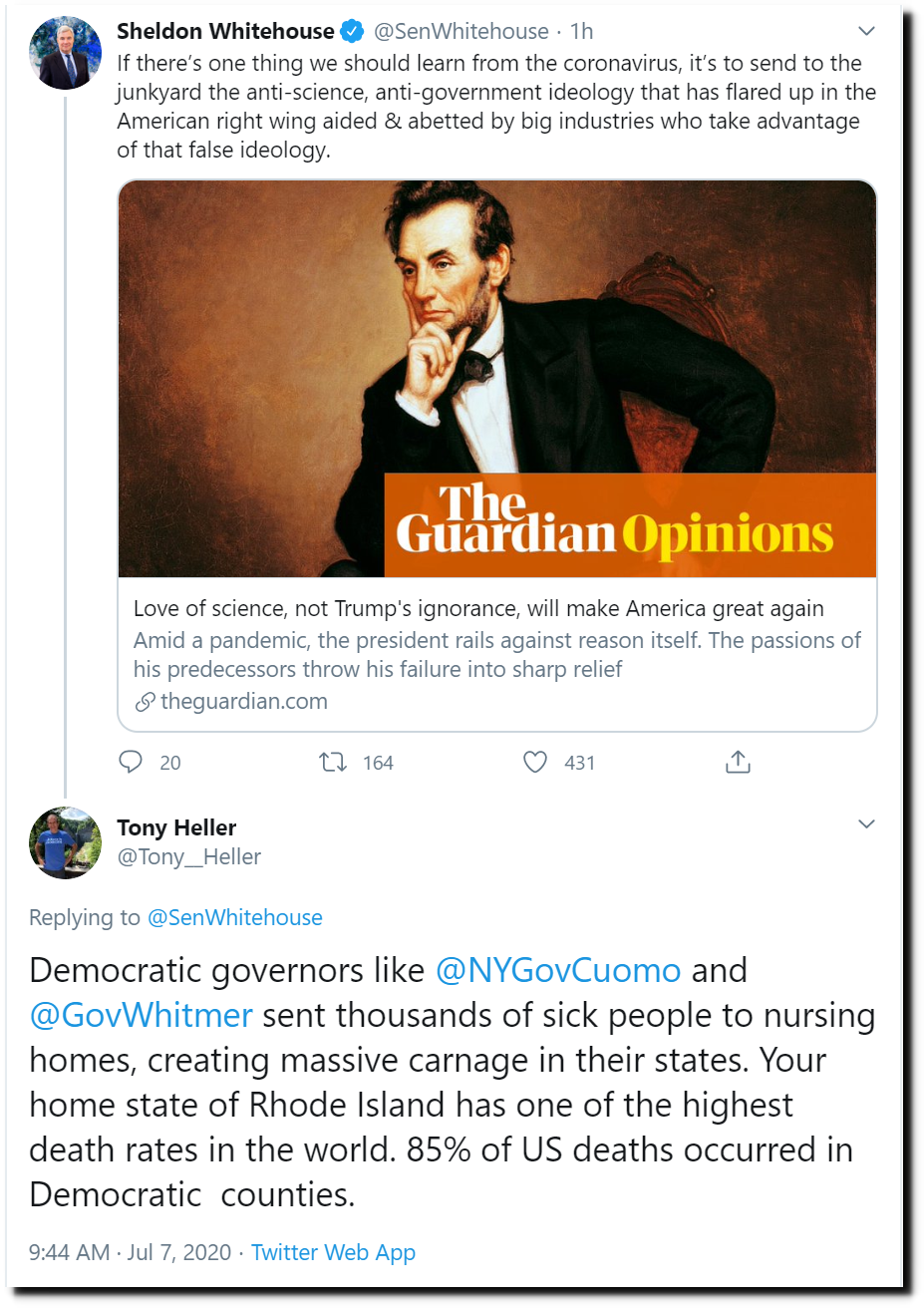
The Anti-Science Party

The Anti-Science Party

When Senator Whitehouse isn’t busy lying about the climate, he spends his time lying about viruses.

This entry was posted in

Uncategorized

. Bookmark the

permalink

.

via Real Climate Science

https://ift.tt/2O4xBsg

July 7, 2020 at 10:56AM