Month: July 2020

Common Cold Now Being Counted as a Positive COVID-19 Result

If you have two minor symptoms (sneezing, fever) or one major symptom, (respiratory major) you are COUNTED as a COVID case – hence the so-called “spike”. If you have allergies, you’re a case.

In other words, even if you have the same symptoms as an allergy or the common cold, you could be classified as having COVID-19.

It gets worse.

Earlier, only proven cases were counted.

  • Now, there are about 15 new ways you can get counted as positive.
  • Now, “probable” cases are counted (whether or not the person displays any symptoms).
  • Now, if you have had close contact with a “probable” case you are counted.
  • Now, if you display any two of the symptoms as mentioned above (whether you actually have the virus or not), you are counted
  • Now, if you have been to a location where the virus is endemic (a location where there are lots of cases – such as the entire State of Texas), and you test positive (even if you had it long ago) you are still counted.

I posted about this yesterday, and provided a video showing the Commissioners of Collin County Texas being instructed (ordered?) to follow the new guidelines (See https://www.iceagenow.info/states-ordered-to-inflate-covid-19-cases-15-times-actual-rate/) The video was dated 18 May 2020, which means the CDC issued its new profiling guidelines about six weeks ago. I assume that every jurisdiction in the U.S. was given similar guidelines (orders?)

The Center for Disease Control and Prevention (CDC) is essentially setting policy across the country, endlessly putting out a stream of so-called facts (that they then revise or rescind).

According to cuzzblue.com, the CDC’s latest update on COVID-19, posted on Tuesday, confirmed that a positive test result could simply mean that you have a cold. Here’s what the CDC said in a section headlined: “What do your results mean?”

“A positive test result shows you may have antibodies from an infection with the virus that causes COVID-19. However, there is a chance a positive result means that you have antibodies from an infection with a virus from the same family of viruses (called coronaviruses), such as the one that causes the common cold.”

My take on all this? We are being scammed.

The post Common Cold Now Being Counted as a Positive COVID-19 Result appeared first on Ice Age Now.

via Ice Age Now

https://ift.tt/2D7D1Ap

July 3, 2020 at 11:05AM

Michigan Gets Results with HCQ

BREAKING: ‘Trump Drug’ Hydroxychloroquine ‘Significantly’ Reduces Death Rate From COVID-19, Henry Ford Health Study Finds. H/T Jaime Jessop.  Excerpts in italics with my bolds

A Henry Ford Health System study shows the controversial anti-malaria drug hydroxychloroquine helps lower the death rate of COVID-19 patients, the Detroit-based health system said Thursday.

Officials with the Michigan health system said the study found the drug “significantly” decreased the death rate of patients involved in the analysis.

The study analyzed 2,541 patients hospitalized among the system’s six hospitals between March 10 and May 2 and found 13% of those treated with hydroxychloroquine died while 26% of those who did not receive the drug died.

Among all the patients in the study, there was an overall in-hospital mortality rate of 18%, and many who died had underlying conditions, the hospital system said. Globally, the mortality rate for hospitalized patients is between 10% and 30%, and 58% among those in the ICU or on a ventilator.

“As doctors and scientists, we look to the data for insight,” said Steven Kalkanis, CEO of the Henry Ford Medical Group. “And the data here is clear that there was a benefit to using the drug as a treatment for sick, hospitalized patients.”

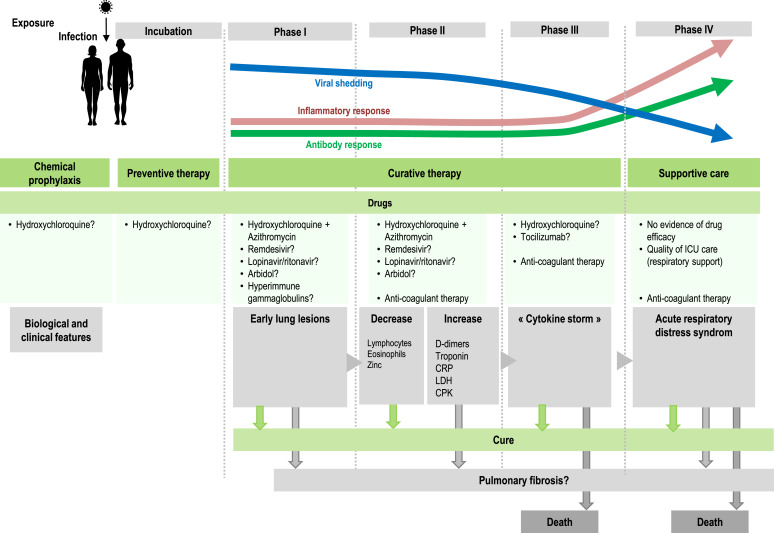
A previous study by French doctors considered the efficacy of HCQ along with other widely available drugs during the several stages of Covid19.  The Michigan study shows benefits for people hospitalized in phases II and III.  The French study emphasized early use during phase I at onset of testing positive for SARS CV2.

See Pandemic Update: Virus Weaker, HCQ Stronger


via Science Matters

https://ift.tt/2VIy6wl

July 3, 2020 at 09:46AM

Hot Summer Epic Fail: New Climate Models Exaggerate Midwest Warming by 6X

For the last 10 years I have consulted for grain growing interests, providing information about past and potential future trends in growing season weather that might impact crop yields. Their primary interest is the U.S. corn belt, particularly the 12 Midwest states (Iowa, Illinois, Indiana, Ohio, Kansas, Nebraska, Missouri, Oklahoma, the Dakotas, Minnesota, and Michigan) which produce most of the U.S. corn and soybean crop.

Contrary to popular perception, the U.S. Midwest has seen little long-term summer warming. For precipitation, the slight drying predicted by climate models in response to human greenhouse gas emissions has not occurred; if anything, precipitation has increased. Corn yield trends continue on a technologically-driven upward trajectory, totally obscuring any potential negative impact of “climate change”.

What Period of Time Should We Examine to Test Global Warming Claims?

Based upon the observations, “global warming” did not really begin until the late 1970s. Prior to that time, anthropogenic greenhouse gas emissions had not yet increased by much at all, and natural climate variability dominated the observational record (and some say it still does).

Furthermore, uncertainties regarding the cooling effects of sulfate aerosol pollution make any model predictions before the 1970s-80s suspect since modelers simply adjusted the aerosol cooling effect in their models to match the temperature observations, which showed little if any warming before that time which could be reasonably attributed to greenhouse gas emissions.

This is why I am emphasizing the last 50 years (1970-2019)…this is the period during which we should have seen the strongest warming, and as greenhouse gas emissions continue to increase, it is the period of most interest to help determine just how much faith we should put into model predictions for changes in national energy policies. In other words, quantitative testing of greenhouse warming theory should be during a period when the signal of that warming is expected to be the greatest.

50 Years of Predictions vs. Observations

Now that the new CMIP6 climate model experiment data are becoming available, we can begin to get some idea of how those models are shaping up against observations and the previous (CMIP5) model predictions. The following analysis includes the available model out put at the KNMI Climate Explorer website. The temperature observations come from the statewide data at NOAA’s Climate at a Glance website.

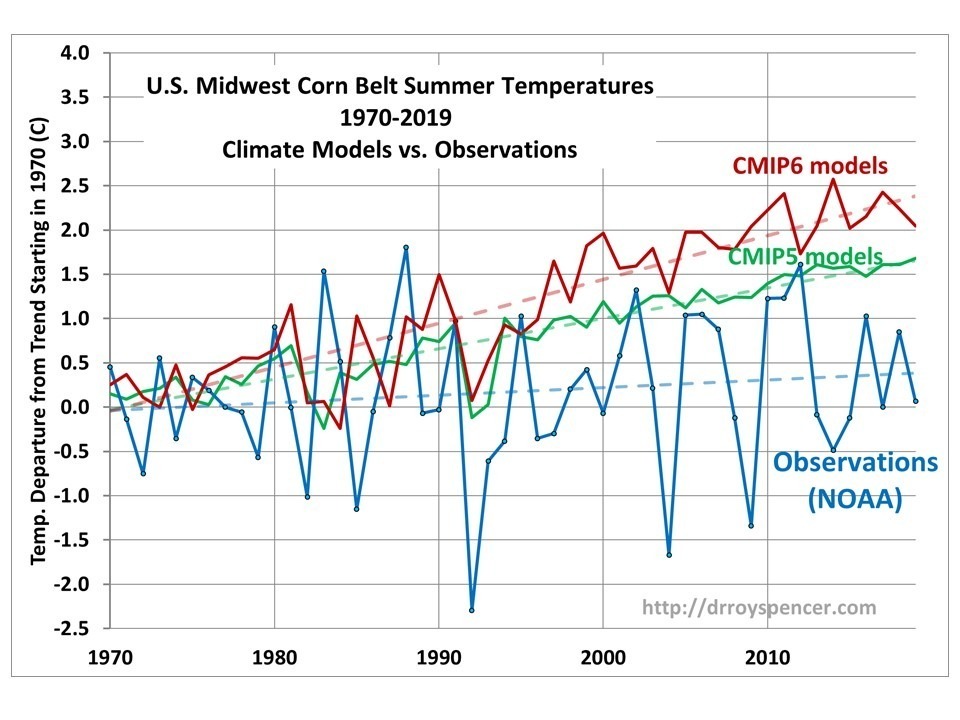
For the Midwest U.S. in the summer (June-July-August) we see that there has been almost no statistically significant warming in the last 50 years, whereas the CMIP6 models appear to be producing even more warming than the CMIP5 models did.

Fifty years (1970-2019) of U.S. corn belt summer (JJA) warming since 1970 from observations (blue); the previous CMIP5 climate models (42 model avg., green); and the new CMIP6 climate models (13 model avg., red). The three time series have been vertically aligned so their trend lines coincide in the first year (1970), which is the most meaningful way to quantify the long-term warming since 1970.

The observed 50-year trend is only 0.086 C/decade (barely significant at the 1-sigma level), while the CMIP5 average model trend is 4X as large at 0.343 C/decade, and the CMIP6 trend is 5.7X as large at 0.495 C/decade. While the CMIP6 trend will change somewhat as more models are added, it is consistent with the report that the CMIP6 models are producing more average warming than their CMIP5 predecessors.

I am showing the average of the available models rather than individual models, because it is the average of the models which guides the UN IPCC reports and thus energy policy. It is disingenuous for some to claim that “not all IPCC models disagree with the observations”, as if that is some sort of vindication of all the models. It is not. If there are one or two models that agree the best with observations, why isn’t the IPCC just using those to write its reports? Hmmm?

What I find particularly troubling is that the climate modelers are increasingly deaf to what observations tell us. How can the CMIP5 models (let alone the newer CMIP6 models) be used to guide U.S. energy policy when there is such a huge discrepancy between the models and the observations?

I realize this is just one season (summer) in one region (the U.S. Midwest), but it is immensely important. The U.S. is the world leader in production of corn (which is used for feed, food, and fuel) and behind only Brazil in soybean production. Blatantly false claims (e.g. here) of observed change in Midwest climate have fed the popular opinion that U.S. crops are already feeling the negative effects of human-caused climate change, despite the facts.

This is just one example of many that the news media have been complicit in the destruction of rational climate debate, which is now extending to outright censoring of alternative climate views on not only social media, but also in mainstream news sources like Forbes which disappeared environmentalist Michael Shellenberger’s op-ed in which he confessed he no longer believes in a “climate crisis”.

via Roy Spencer, PhD.

https://ift.tt/2D7UN6D

July 3, 2020 at 09:12AM

UN Warns Electric Automobile Rush is Causing Human Rights Abuses

Child Cobalt Miners in Kailo, Congo - Author Julien Harneis, source Wikimedia.Child Cobalt Miners in Kailo, Congo - Author Julien Harneis, source Wikimedia.
Child Cobalt Miners in Kailo, Congo – Author Julien Harneis, source Wikimedia.

Guest essay by Eric Worrall

h/t JoNova, MaxD – The United Nations has issued a belated warning that soaring demand for raw materials for the electric vehicle revolution is creating dangerous conditions for children working in toxic mines.

UN highlights urgent need to tackle impact of likely electric car battery production boom

28 June 2020 Climate Change

Electric cars are rapidly becoming more popular amongst consumers, and UNCTAD predicts that some 23 million will be sold over the coming decade: the market for rechargeable car batteries, currently estimated at $7 billion, is forecast to rise to $58 billion by 2024 .

The shift to electric mobility is in line with ongoing efforts to reduce the world’s dependence on fossil fuels, and reduce harmful greenhouse gas emissions responsible for climate change, but a new report from UNCTAD, warns that the raw materials used in electric car batteries, are highly concentrated in a small number of countries, which raises a number of concerns.

Drilling down in DRC, Chile

For example, two-thirds of all cobalt production happens in the Democratic Republic of the Congo (DRC). According the UN Children’s Fund (UNICEF), about 20 per cent of cobalt supplied from the DRC comes from artisanal mines, where human rights abuses have been reported, and up to 40,000 children work in extremely dangerous conditions in the mines for meagre income.

Read more: https://news.un.org/en/story/2020/06/1067272

JoNova also provides a link to a 2018 Australian ABC report which drills into the Cobalt issue in more detail.

Children mining cobalt in slave-like conditions as global demand for battery material surges

The Signal / By Angela LavoipierreStephen Smiley and Lin Evlin
Posted 25 July 2018

Former child labourer Yannick from Kolwezi, a city of more than 500,000 people in the south of the DRC, dropped out of school and went into full-time work at the age of seven.

“When I was going to the mines it was to look after my family, because there was a lot of suffering,” Yannick said.

Yannick said the work in the mine involved intense physical labour using only a crowbar, and said conditions underground were generally hot and sticky.

He also described former bosses who insisted their underage employees put in long working days without breaks.

People died in the mine, and you could suffocate when you are deep in the mine,” he said.

“When it rained, it created a lot of landslides.

“When we were working there and when someone hurts himself, we could not even look at him — the person had to go and get treated on his own, as we were there to work.

“It is not good to let children work at the mines.

Read more: https://www.abc.net.au/news/2018-07-25/cobalt-child-labour-smartphone-batteries-congo/10031330

The UN report also mentions human rights abuses in Chile, with locals in an arid region being deprived of water and forced to relocate, as the water they depend on is being diverted to lithium mining.

What is so important about Cobalt?

Cobalt oxide adds durability to batteries, by supporting chemically stable matrices. This stability prevents the matrix from shattering, when lithium ions migrate in and out of the matrix during violently energetic high power battery discharge and recharge cycles.

There are strenuous efforts to eliminate cobalt from batteries, because it is expensive and because of the human rights abuses associated with Cobalt mining.

For example Tesla has launched a line of cobalt free battery powered vehicles in China. The batteries replace Cobalt oxide with iron phosphate. Anybody who has painted treatment solution primer straight onto rusty steel has already seen the durability of iron phosphate.

If this new iron phosphate battery technology wins broad acceptance, the link might be broken between human rights abuses in Congo, and batteries for electric vehicles and renewable energy backup systems.

There are also efforts to eliminate lithium from batteries, replacing lithium with other alkali metals like sodium, which if successful would take the pressure off vulnerable people living near Lithium mines in the Andean highlands.

Having said that, Lithium might still be used for many applications. Lithium is a very lightweight metal, a lot less dense than sodium. Weight matters in portable devices.

And most of the best experimental sodium batteries use, you guessed it, a Cobalt based electrode.

Regardless of the promise of these new technologies, we’re not quite there yet. For now, the majority of the world’s production ready high energy density rechargeable batteries use Lithium and Cobalt.

Demand for Lithium and Cobalt is surging, as governments and industry rush their plans to electrify the world’s vehicle fleets.

Like this:

Like Loading…

Related

via Watts Up With That?

https://ift.tt/2BxZMNi

July 3, 2020 at 08:53AM