Month: July 2020

Banning The Sale Of Petrol Cars Would Be ‘A Colossal Error’

Eminent engineer reveals major flaw in UK Govt’s electric car plans
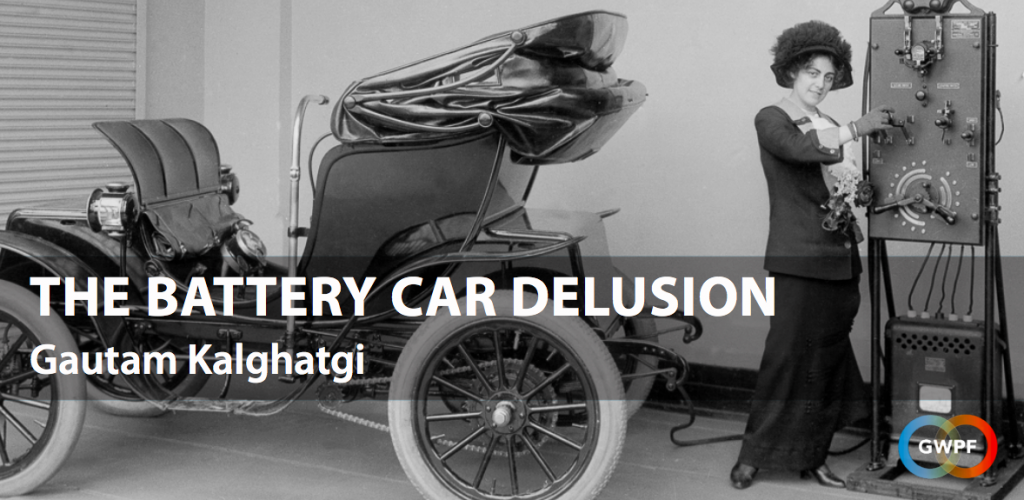
London, 29 July: A new paper published today by the Global Warming Policy Foundation reveals another major flaw in plans to electrify the economy.

According to the author, Professor Gautam Kalghatgi, because most vehicles will still run on fossil fuels in ten years’ time, banning the sale of new ones would prevent any improvement in the efficiency of most of the vehicle fleet.

As Professor Kalghatgi explains:

“Even with an improbable hundred-fold increase to 10 million in battery electric vehicle numbers in 2030, 75% of cars will still run on petrol and diesel”, says Professor Kalghatgi.

“But no manufacturer is going to invest in more advanced cars if they are banned from selling them”.

And Professor Kalghatgi says those advances could bring about significant improvements in efficiency:

“If a battery car delivers a 25% saving in greenhouse gas emissions on a life cycle basis, the overall reduction for the UK would be less than 4% by 2030. A larger reduction emissions could be delivered with a 5% improvement in fuel consumption of petrol and diesel vehicles.”

“Banning the sale of new petrol and diesel cars simply means abandoning the possibility of future emissions reductions in this sector by freezing the technology of a vast majority of vehicles running U.K. transport for decades to come “.

Gautam Kalghatgi: The Battery Car Delusion (pdf)

About the author

Professor Gautam Kalghatgi is a fellow of the Royal Academy of Engineering, the Institute of Mechanical Engineers and the Society of Automotive Engineers. He is currently a visiting professor at Oxford University, and has held similar professorial appointments at Imperial College, Sheffield University, KTH Stockholm and TU Eindhoven. He has 39 years of experience in combustion, fuels, engine and energy research; 31 years with Shell and 8 years with Saudi Aramco.

The post Banning The Sale Of Petrol Cars Would Be ‘A Colossal Error’ appeared first on The Global Warming Policy Forum (GWPF).

via The Global Warming Policy Forum (GWPF)

https://ift.tt/310ERuW

July 29, 2020 at 08:31AM

False Gods for Lost Souls

Environmentalism, with its promises of fire and brimstone, is the new religion. But where’s the humility, the compassion, the spiritual transcendence?

One of the most interesting parts of Michael Shellenberger’s new book, Apocalypse Never: Why Environmental Alarmism Hurts Us All, is the final chapter, titled “False Gods for Lost Souls.”

Shellenberger observes that, according to Greta Thunberg’s mother, frightening climate prognostications were partly responsible for her daughter’s descent into depression at age 11. According to Greta’s father, climate activism helped her overcome depression.

There’s a poignancy to that tale. One wonders how many youngsters of her generation have experienced similar mental health struggles. There are so many street preachers in our public square, promising fire and brimstone, urging repentance.

The Thunberg family helps to illustrate Shellenberger’s view that

Environmentalism today is the dominant secular religion of the educated, upper-middle-class elite in most developed and many developing nations. It provides a new story about our collective and individual purpose. It designates good guys and bad guys, heroes and villains. And it does so in the language of science, which provides it with legitimacy.

But this religion doesn’t uplift spirits, feed orphans, or bless the poor. Rather than comforting the elderly, it sentences them to cold-weather misery. Big picture, this religion harms, rather than heals.

Here are a few more quotes from that chapter:

…negativity has triumphed over positivity. In place of love, forgiveness, kindness, and the kingdom of heaven, today’s apocalyptic environmentalism offers fear, anger, and the narrow prospects of avoiding extinction.

…The stories we tell matter. The picture promoted by apocalyptic environmentalists is inaccurate and dehumanizing. Humans are not unthinkingly destroying nature.

…Emissions are a by-product of energy consumption, which has been necessary for people to lift themselves, their families, and their societies out of poverty, and achieve human dignity.

…the vast majority of people in the world want both prosperity and nature, not nature without prosperity.


If what you’ve just read is useful or helpful,
please support this blog

please support this blog

LINKS:


via Big Picture News, Informed Analysis

https://ift.tt/2COIWut

July 29, 2020 at 06:06AM

What Greta missed from skipping school: Presentation by Willie Soon

Camp Constitution is an all volunteer association of Americanists. We run a week-long family camp, man information tables at various venues, have a book publishing arm, and post videos from our camp and others that we think are of importance.

Like this:

Like Loading…

Related

via Watts Up With That?

https://ift.tt/2Ev84Xz

July 29, 2020 at 04:28AM

A quasi-periodic ~2400-year climate cycle – or not?


We’ll look here at examples of where a 2400 year period has been identified by researchers in radiocarbon data.
– – –
Part of the abstract below is highlighted for analysis. The original Talkshop post on the paper in question:
S. S. Vasiliev and V. A. Dergachev: 2400-year cycle in atmospheric radiocarbon concentration

Abstract. We have carried out power spectrum, time-spectrum and bispectrum analyses of the long-term series of the radiocarbon concentrations deduced from measurements of the radiocarbon content in tree rings for the last 8000 years. Classical harmonic analysis of this time series shows a number of periods: 2400, 940, 710, 570, 500, 420, 360, 230, 210 and 190 years. A principle feature of the time series is the long period of ~ 2400 years, which is well known. The lines with periods of 710, 420 and 210 years are found to be the primary secular components of power spectrum. The complicated structure of the observed power spectrum is the result of ~ 2400-year modulation of primary secular components. The modulation induces the appearance of two side lines for every primary one, namely lines with periods of 940 and 570 years, of 500 and 360 years, and 230 and 190 years. The bi-spectral analysis shows that the parameters of carbon exchange system varied with the ~ 2400-year period during the last 8000 years. Variations of these parameters appear to be a climate effect on the rate of transfer of 14C between the atmosphere and the the ocean.

Looking at the ‘primary’ numbers:
‘The lines with periods of 710, 420 and 210 years are found to be the primary secular components of power spectrum. The complicated structure of the observed power spectrum is the result of ~ 2400-year modulation of primary secular components.’
[See Figure 3 and Table 1 in the paper]
– – –
Analysing this:
2400-year modulation = Mod-2400
210-year = de Vries cycle
420-year = de Vries pair (21 Jupiter-Saturn conjunctions)

With these periods we can derive as an approximation:
Square root of 2400*210 = 709.93 years
Therefore, the geometric mean of Mod-2400 and de Vries pair = ~710-year

The periods quoted in the abstract are rounded by the authors to the nearest ten years, but the pattern is there.

Substituting more accurate numbers for the de Vries pair:
21 Jupiter-Saturn = 417.16575 years
(via NASA JPL data: https://ssd.jpl.nasa.gov/?planet_phys_par)

Using the formula from this post:
24 * 2503y = 25 * 2402.88y
(24:25 = 2.4:2.5)

Then:
2402.88 * 417.16575 = (1001.1988y)² [geometric mean of the two periods]
2402.88 / 2.4 = 1001.2
417.16575 * 2.4 = 1001.1978

1001.2 * 2.5 = 2503
(2.4 = 12/5)

By the same method for the single de Vries period:
2402.88 * 208.58287 = (707.9545)² [geometric mean of the two periods]
This corresponds to the 710 year period referred to in the paper as a ‘primary secular component’ of the power spectrum.

Cross-check: 707.9545 * √2 = 1001.1988
– – –
Vasiliev and Dergachev cite a NASA-sponsored paper by Hood and Jirikowic:
A Probable Approx. 2400 Year Solar Quasi-cycle in Atmospheric Delta C-14

They say:
The residual record can be modeled to first order as an amplitude modulation of a century-scale periodic forcing function by a approx. 2400 year periodic forcing function.

The caption to their Figure 4 says:
Figure 4. Simple model of amplitude modulation of a 200 year sinusoid (a) by a 2400 year sinusoid (b). The product is shown in (c) and has characteristics that are qualitatively similar to those of the residual 14-C record.

They also refer to:
the empirical evidence discussed here for a dominantly solar origin of both the century-scale and longer-term (~ 2400 year) residual variations in the Conference 14-C record.

Figure 4 is worth a look to get a better idea of what they mean.
– – –
A series of three articles under the title ‘Nature Unbound IV – The 2400-year Bray cycle’ can be found here:
https://judithcurry.com/?s=bray

Finally, Ivanka Charvatova finds a ~2402 year solar inertial motion period in this paper:
Responses of the basic cycles of 178.7 and 2402 yr in solar–terrestrial phenomena during the Holocene

via Tallbloke’s Talkshop

https://ift.tt/3jRVEZN

July 29, 2020 at 03:45AM
