
Sixteen-year-old Fiona Snodgrass-Greencaper (not her real name) arrives home from Williamstown Terrific College and asks, “Mummy, what’s for tea?” Williamstown, for those blessed not to live in Melbourne, is a gentrified suburb, now very much upper-middle class, across the bay from Melbourne’s CBD.
Mummy: I’ve cooked what your sustainability teacher recommends. We’re starting with kangaroo-tail soup, then roast kangaroo ribs for mains. Dessert will be dough-cake made from native millet and nardoo.
Fiona: That’s so great, Mummy!
Mummy: Now put on your kangaroo-skin slippers, and here’s your kangaroo-skin cloak.
Fiona: It’s so great that my sustainability teacher has shown Australia how to cool the planet with kangaroos because they emit little methane, unlike sheep, cows … and Daddy. And our Dan Andrews-run kangaroo industry, skilfully managed by Aboriginal firestick farming, is restoring the landscape that ignorant farmers were degrading.
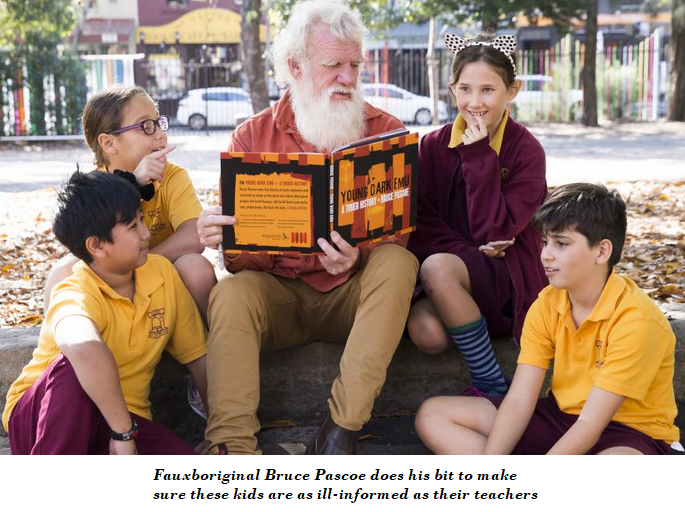
This hypothetical teacher-led overhaul of the meat industry originates from self-styled Aboriginal Bruce Pascoe and his faux-history of Aboriginal farmer civilisations. Dark Emu(for credulous adults) has spawned his glossy Young Dark Emu – A Truer History (for brain-washable kids). That in  turn has spawned Dark Emu in the Classroom: Teacher Resources for High School Geography. (Pascoe spruiks his Emu Classroomversion here.)
My editor’s job depends on readers’ clicks. Click HERE to see his original work on this story at Quadrant Online.
One author of Teacher Resources is Simone Barlow (right, in 2009) B.A (Syd), Dip.Ed (Melb), cited as a geography teacher at Williamstown High Senior Campus. The other is Ashlee Horyniak M.Ed (Melb), and BA (Hons) with a history minor in Aboriginality “through an anthropological and historical lens”. Ms Horyniak is cited as Humanities Coordinator at the Williamstown High. They say: “Simply put, Dark Emu should be compulsory reading for every teacher.”
Teacher ignorance is no barrier to foisting potted Pascoe piffle on our kids. The authors:
Whilst we recommend reading Dark Emu for yourself, this teacher resource is designed so that teachers without the book, Dark Emu, and with little prior knowledge, can pick it up and teach.
Bruce Pascoe is the darling of the ABC and all other left-thinkers because he claims that pre-colonial Aborigines included crop-growers in permanent towns of 1000 who kept their livestock (wallabies? wombats?) in pens. This accords with currently fashionable thinking about Aboriginal “nations” and treaties. He’s won a prize awarded to Aboriginal authors but has not rebutted genealogies suggesting his forebears, every single one of them, were from British stock.
The ABC is preparing a two-part tribute to Pascoe scheduled to be broadcast this year and has already put up a 14-chapter Pascoe extravaganza on ABC Education.[1] But even the ABC has quietly added a Prologue update that Pascoe’s thesis is contestable.[2]
In the NSW Parliament last March, the Education Minister affirmed that Dark Emu is not part of the NSW curriculum but is mentioned in two sample texts. Schools work out for themselves how subjects are taught and have “the scope to present topics in ways that support the school ethos and the diversity of student needs,” the minister said. I don’t know the official status of Dark Emu in the Classroom: Teacher Resources in Victoria, but it’s a lavish production suggestive of high sales volume.
The Williamstown teachers’ kangaroo-led plan for agriculture occupies six pages of their 94-page Resource. Students role-play interest groups. For example, animal-rights activists give ‘roo-culls thumbs down, consumers love that ‘roo taste, and rather weirdly, the outback’s hard-bitten ‘roo types say: “European colonisation has greatly changed what was a happy cohabitation between Aboriginals and animals for thousands of years. The commercial harvest is a replacement of Aboriginal hunting and dingo predation…”[3]
I’m not sure how happy your average ‘roo was to get a spear through its ribs.
The luckiest kids get to role-play Bruce Pascoe himself, whom we are told by the two teacher authors is an Aboriginal of Bunurong/Tasmanian heritage. (Somehow his additional claim to Yuin heritage has faded out, although still bruited by the ABC). With the Aboriginal Mr Pascoe as avatar, role-playing kids say, “We need to be consulted on [kangaroos]. We have been here forever, since the Dreaming, and have managed the land very effectively until the arrival of white man.”
Actually the Bunurong are adamant that Pascoe is not one of theirs,[4] and Tasmania’s clan led by Michael Mansell has outed Pascoe even more forcibly as “fake”[5].
The teachers’ kangaroo-futures lessons end with two (and only two) of what are dubbed “Scenario Cards”. The first card seeks kids’ views on a 10 per cent increase in culling. The second is a corker:
Most of Australia’s agricultural areas have been destroyed by erosion and desertification. The price of beef and lamb has risen by ten times as there are very few viable farms. Consumers are frustrated and looking elsewhere. Is kangaroo meat the future of the Australian meat industry? What should be done?
“Points to discuss in your group: How do you feel about this?[6] How does this affect you? What do you think needs to be done? Are there any other possible solutions to the problem?
A wipe-out of Australian agriculture would indeed be “a problem” unless, say, we buy up rice paddies in China. Kids will intuit that “the problem” is climate-related and that the solution is more wind turbines.
The authors deny that British-based agriculture was more productive than the Aborigines’ version.
The colonists ignored Aboriginal methods and brought their own, which were poorly suited to the landscape…We can only assume it was a combination of ignorance and cultural blindness, because it is clear that the land was well managed prior to colonists, and degraded in such a short period of time after their arrival.
Scepticism about Pascoe’s Aboriginal-farmer fantasies is out of bounds. The authors tell kids,
You can link in the ideas of this [Pascoe] truth being inconvenient, that it cancels out the very foundations of colonisation on ‘Terra Nullius’ and the implications of accepting this perspective.
Here’s more guidance for teachers:
# The authors spurn what they call the capitalist view of human evolution – “only the fittest survive … the weakest individuals – and civilisations – eventually die”. They recommend a rival creed of “cooperation with, and care for, other humans and the natural environment … and the preservation of the planet.” They claim this caring non-capitalist community “aligns more closely” with pre-colonial Aboriginality: “Modern economic systems often prioritise profit and progress over the protection of air quality, land or clean water.”
# The authors urge the “more able students” to read a piece by Aboriginal feminist trade unionist Celeste Liddle praising Labor’s Paul Keating and saying that ex-PM John Howard’s “downplaying of Indigenous suffering was so despicable that Indigenous people took to turning their back on him in public forums.” The only other article the authors recommend in this section blasts PM Turnbull’s lack of action on Aboriginal federal representation and says, “Aboriginal leader Sean Gordon will help form a new political party after this week quitting the Liberals in disgust.”
So much for non-politicised classrooms!
# Farming and farmers are disparaged and I assume city kids’ views are shaped accordingly:
Resource use is a current challenge to Australia. Our lands are being degraded by current farming methods. Our cities are struggling to meet our water demands [thanks to greenies’ dam bans]…Our current farming methods are having devastating impacts on the environment. Let’s embrace [Aboriginal knowledge] and change our current degrading ways.
# Pascoe’s exercise goes
some way toward reducing the continuing damage of colonialism. This is not a simple task but we can begin by acknowledging that Aboriginal Australians built houses, cultivated and irrigated crops and sewed clothes. Over many thousands of years Aboriginal Australia learnt how to increase the productivity of the land and this enormous expertise is useful to us today.
Those interested in actual film of some non-Westernised Aboriginals’ foraging and clothing can watch here.
# The book says,
The yam daisy was once a crucial plant in Australia, and, as the population continues to grow and climate change remains a barrier to food security, its current value must be considered.
The past century’s 1degC warming has seen global grain output rising to records for each of the past two years and Australian winter crop production this year forecast to increase to 11 per cent above the 10-year average. While the figures post-date the 2019 book, any glance at crop data shows the long-term rising yields.
# The book also asks
Is firestick farming an effective management tool? Should it be more widespread today? … Should firestick farming be adopted as a method of managing the landscapes of rural Australia?
Fact-check: Firestick farming in Indonesia creates the vast annual smoke hazes across SE Asia and into northern Australia. Firestick farming also blights the Amazon forests.
Despite Pascoe and teacher enthusiasms, native wild rice doesn’t seem the answer. Its productivity and potential is miniscule, according to an ABC article referenced by the authors. It would have to be hand-sorted after milling to get rid of waste, which is why, back in 2014, it was costed at $120 per kilogram. Woollies is selling rice this week for as little as $1.50. But you may be inspired to try Indigenous soughdough dancing-grass-seed damper after hearing Pascoe on the ABC.
# How might Indigenous fish traps become a model for the aquaculture industry?
Aquaculture today is a high-tech biological industry, the opposite of trapping of wild fish.
The authors ask, “What role could ATSI [Aboriginal] strategies[7] play in ensuring food security across Australia?” To inject some anthropology into this stuff, a tribal strategy even into the 1960s to cope with drought and food scarcity was infanticide. These extracts are just from SA:
1865: The issuer of rations at Overland Corner, SA, reports that in his district in the recent years, ‘every living child appears to have been destroyed immediately after birth.’
1874: Point McLeay missionary, Rev. Taplin, writes, “Savage life is most destructive of infant life.” In the same year, Sub-Protector W.R. Thompson reported ‘half-castes’ in camps rarely survive to adulthood.
1924: Protector William Garnett South writes, “It is generally reported and doubtless true, that aborigines in these parts of Australia often kill children not wanted, and especially ‘half-castes’.”
1960s: Infanticide rates around Ernabella Mission are up to a fifth of all births, according to anthropologist Aram A. Yengolen.
West Australian MLA W.L. Grayden caused controversy when he reported in 1956 about alleged starving bands in the Warburton Ranges, with infanticide being common. Others disagreed. Professor Ronald Berndt (my 1960 anthropology lecturer) investigated and reported: “It seems clear that although occasional cases [of infanticide] do occur among traditionally oriented Aborigines, these are becoming even less frequent than they were in the past (p33).
The Teacher Resource book disparages evidence against Aborigines as farmers:
When examining the sources for bias, students should look at the author and their [sic] motivations for producing the source.
But Pascoe’s own claims go unqueried. In Dark Emu they include Walt Disney-style stories like:
When the natives see a whale being chased by killer whales one of the old men pretends to be lame and frail … to excite the compassion of the killer whales and the man calls on the killers to bring the whale ashore. When the injured whale drifts in to shore the other men come out of hiding to kill the whale and call on neighbouring tribes to join the feast.
Peter O’Brien in his Bitter Harvest debunks this and countless other Pascoe tales. O’Brien finds documents only about white whalers’ cooperation with killer whales on the south coast of NSW, with the skeleton of the leading killer whale, “Old Tom” now preserved in the Eden Killer Whale Museum.
The Resource’s text, sadly, goes haywire when it approaches some rigorous material amid its Pascoe blather. A section on correct graphing techniques reads, “Ensure you use a consistent scale (ie 1.5cm represents 1 million years or 1cm represents 1 million years). Ensure your graph has SALTS (scale, axis, legend, title and sources).” Problem is, the cited data for graphing covers only 38 years, 1980-2018. The “million years” is quite a typo.
It’s disturbing that the Resource and much other teaching these days tell kids how social conditions should be, rather than how things verifiably are. Hence the Resource’s ‘kangaroo dreaming’ in lieu of educating kids about Australia’s meat production and productivity, exports (including the genuine ‘live sheep’ controversies) and trading partners.
The educationists’ final and explicit goal is to turn the kids into activists, but only for OK green-left causes. Kids are constantly exhorted to send letters to their local Member or gee-up their own school principal to make the school more woke. The impetus in all states (Labor and Conservative) is from the top through the national curriculum authority (ACARA) which mandates:
The learning area [ideally] provides content that supports the development of students’ world views, particularly in relation to judgements about past social and economic systems, and access to and use of Earth’s resources … Students explore contemporary issues of sustainabilityand develop action plans and possible solutions to local, national and global issues which have social, economic and environmental perspectives.” (My emphases. Maybe teens should solve global problems after they solve the mess in their bedrooms and their own laundry requisites).
The crowning insult to conservative parents is the three Julia Gillard-endorsed “cross-curriculum priorities” since 2009 which force teachers to lard all subjects with sustainability, Aboriginality and (lame-duck) Asian emphases.[8] Do primary maths teachers now ask, “What is 12 boomerangs plus 11 boomerangs?” Worst of all, “sustainability” has become an open-sesame for every green-left lobby from Cool Australia to ACF and Greenpeace to inject their agitprop into classrooms.
The Williamstown duo’s Teacher Resources opens a window onto how kids are actually taught and what stories they are force-fed. Are conservative politicians asleep as the education system converts trusting youngsters into green variants of China’s Red Guards? Or is that they are simply too cowardly to raise a fuss?
Tony Thomas’s new book, Come to think of it – essays to tickle the brain, is available as book ($34.95) or e-book ($14.95) here.
[1] How has the ABC’s remit been extended to pedagogy? To which educationists is ABC Education accountable for its quasi-curricula materials? What is ABC Education’s budget?
[2] “Note also that since 2019, Pascoe’s work has been evaluated differently by some people, who don’t agree with his interpretations of historical sources. This resource contains excerpts from the original texts and scientific evidence that Bruce draws on. We encourage you to evaluate the strengths and weaknesses of all historical sources.”
[3] To be fair to the book, it is citing from the Kangaroo Industries Association, although I haven’t been able to turn up that quote of theirs.
[4] Lawyer Jason Briggs, Chairman of the Boonwurrung Land & Sea Council:
To the best of our knowledge and research, we do not accept Mr Bruce Pascoe as possessing any Boonwurrung ancestry whatsoever.
We have a sophisticated (and utilised in a recent Federal Court of Australia matter) ancestral database of all peoples/families who can rightfully claim to be of Boonwurrung (aka Bunurong) descent.
[5] Although the first three editions of “The Little Red Yellow Black Book” encyclopaedia by AIATSIS have Pascoe as author, and although Pascoe is cited online by AIATSIS as author of the fourth edition, and elsewhere as joint author with AIATSIS, the fourth edition I bought last week does not mention Pascoe among its 22 authors and reviewers. My AIATSIS 4th edition cites Dark Emu once under “Writing and Literature” and once under “Environment and Economic Management”, but not under “History”. AIATSIS stands for Australian Institute of Aboriginal and Torres Strait Islander Studies.
[6] Teaching resources these days constantly tell kids to consult and catalogue their “feelings”. In the real world employers are less interested in youngsters “feelings” than getting tasks done.
[7] The authors, although woke, have not caught up with the edicts against “ATSI” for Aboriginal and Torres Strait Islanders, which is like calling refugees “reffos”
[8] Launched by federal-state education ministers, eight Labor and one Independent.
via Climate Scepticism
July 28, 2020 at 06:41PM


 Iowa Climate Science Education