Month: July 2020

Modern Ancient Temperatures

OK, no need to torture me, I confess it—I’m a data junkie.

And when I see a new (to me at least) high-resolution dataset, my knees get weak. Case in point? The temperature dataset of the Colle Gnifetti ice core. It has a two-year resolution thanks to some new techniques. Better, it stretches clear back to the year 800. And best, it extends up to near the present, 2006. This lets us compare it to modern datasets.

Let me start with where Colle Gnifetti is located. Unusual among ice core records, it’s from Europe, specifically in the Alps on the border of Switzerland and Italy.

Figure 1. Location of the ice cores in the study.

This is good because some of the longest thermometer-based temperature records are in Europe.

One interesting thing about the site is that usually, ice core drilling occurs at the literal ends of the earth, in Antarctica and Greenland and the like. But this site is not far from the foot of the Margherita Hut, which is at over 4500 metres elevation.

Figure 2. The best advertisement ever for becoming a glaciologist.

Now, I wanted to see how well the ice core records matched up with the temperature records. So I calculated three records from the Berkeley Earth land-only dataset. (I used the land-only dataset because I’m comparing with a location on land. However, there is only a minimal difference from using their “land and ocean” dataset.)

The first record I calculated is the global temperature anomaly. Next is the northern hemisphere temperature anomaly. Finally, I looked at a 6° longitude by 4° latitude roughly square box around Colle Gnifetti itself. 

Curiously, of these three the best match is with the northern hemisphere data. Figure 2 below shows the comparison. I’ve linearly adjusted the ice core data to give the best fit to the Berkeley Earth data. 

Why linearly adjust it? Because the variance of a single ice core record at one location high on a mountain is different than the variance of e.g. the northern hemisphere average land temperature. This allows us to compare the records to the same scale.

So here is the comparison between thermometer data and the recent end of the Colle Gnifetti ice core data. Data sources are listed on the graph.

Figure 3. Berkeley Earth land-only temperatures and Colle Gnifetti ice core temperatures. Ice core temperatures have been linearly adjusted to give the best fit to the modern data, by multiplying them by about 1.6 and subtracting about 0.2°C. The background is the drilling hut at Colle Gnifetti

Man, I love it when two totally separate datasets line up in such an excellent fashion. I’d say that the Colle Gnifetti ice core tracks the northern hemisphere temperature very well. The only real anomaly is recent when the two diverge. No idea what that’s about. The answer may be in either dataset. But look at the excellent agreement of the large peaks and swings in the earlier part of the dataset.

So now that we have the paleo dataset aligned and variance-matched with the modern dataset, we can take a look at the ice core record of temperature variation over the entire time span of the data.

Figure 4. Colle Gnifetti ice core temperature, linearly adjusted to best fit modern data as shown in Figure 3. The background is the drilling area, lower right is the drilling hut at Colle Gnifetti

Now, this is a most fascinating temperature dataset. You can see the slow descent from about 1400-1500 into the Little Ice Age, bottoming out at around 1700.

The total range of the fast temperature swings is also quite interesting. For example, in the fifty years from 1190 to 1240, the temperature dropped by 2.3°C.

And the steepness of the natural warming trends is instructive. In 35 years, from 850 to 885, the temperature rose by 2.3°C. Zowie!

To take another look at the warming and the cooling, here’s a graph of the thirty-year trailing trends in the data.

Figure 5. 30-year trailing trends of the temperature record of the Colle Gnifetti ice core.

Current 30-year trailing temperature trends are on the order of 0.1 – 0.2°C/decade. But as you can see, this rate of warming is hardly unusual in the record. Indeed, twice in the period of record the trend has been four times as large as in the modern era. And the current rate of warming has been exceeded many other times in the past.

So … what kind of conclusions and questions can we draw from the data? Let me toss Figure 4 up again for reference.

Figure 4 (repeated).

First, what the heck caused the big swings in temperature? The earlier part of this paleo record shows swings that are both much larger and much faster than anything in modern times. Call me crazy, but on a planet with naturally occurring warmings of e.g. over two degrees C in 35 years from 850 to 885, I’m not seeing how people can possibly rule out such natural swings in looking at the relatively featureless and certainly in no way anomalous modern record.

This brings up my recommendation for the field of climate science—stop projecting the future and start reflecting on the past. Until we can explain things like why temperatures crashed around the year 1200, falling by 2.3°C in a mere fifty years, and then bouncing right back, we have NO BUSINESS MAKING PROJECTIONS. 

But I digress … next, we see warming in the data starting at the end of the Little Ice Age, around the year 1700. It occurs in two waves. The first rise in temperature, from about 1700 to 1790, is both faster and larger than the succeeding rise, which was from about 1820 to the present.

In fact, the modern temperature rise, supposedly fueled by CO2, is the slowest rise of the various longer-term temperature increases in this paleo record. Every other temperature rise is steeper … say what? I thought CO2 was supposed to be driving faster warming, but out here in the real world, there’s slower warming.

Next, in this ice core record, the peak of the later “Medieval Warm Period” around 1190 is about the same temperature as at present. However, the earlier peak around 920 is about half a degree warmer than that. It seems that current temperatures are not as unusual as is often claimed.

Finally, the caveats. The main caveat is the underlying assumption of invariability—that ceteris paribus, the past is operating under the same rules as the present. 

For example, to linearly adjust the modern end of the ice core data to be best fit to the modern temperature data you multiply it by about 1.6 and subtract about 0.2. The figure above assumes that the same thing is true in the past. This is a very reasonable assumption, we know no reason why it wouldn’t be so … and yet …

Next caveat? it’s only one study. I’d be happy to see more using the improved methods that give biennial resolution.

However, given those caveats, I find it a most instructive dataset.


Here on the Northern California coast, summer is in full swing. Many days, the inland valleys heat up. The heated air rises, pulling cool foggy air in from the cold nearby ocean. This cools the entire sea-facing side of the coastal mountain range, including our couple acres … so today it’s cool and foggy here.

I greatly enjoy the local symmetry. It gets hotter in one place … and it gets colder in another place. Lovely.

Figure 6. Satellite view of where I live, about 6 miles (10 km) inland from Bodega Bay, on the ocean-facing side near the top of the first big ridge in from the coast. Blue flag in the large patch of redwood forest marks the location of our house.

The layer of fog isn’t all that thick, typically maybe a couple thousand feet (600m). This leads to a curious acoustic phenomenon. Sounds down along the coast get “tunnel ducted” all the way up the hill. So even though the ocean is six miles (10km) away from our house as the crow flies, on certain foggy days we can hear the waves breaking on the shore. And sometimes, we can even hear the foghorn out at the end of the breakwater in Bodega Bay, my old commercial fishing home port, calling out its endless paean to the souls of those poor fisherwomen and men who never came back home to their loved ones …

Stay well, dear friends. Life is short, be sure to take the time to take the time.

w.

Further Reading: It’s instructive to compare the listed temperatures with the data in A Chronological Listing of Early Weather Events.

As Usual: I ask that when you comment you quote the exact words you are discussing, so that we can all follow the bouncing ball and avoid misunderstandings.

Like this:

Like Loading…

Related

via Watts Up With That?

https://ift.tt/39y6YG0

July 24, 2020 at 04:52PM

Press & Bookies Work “Hottest July Evah” Scam Again

By Paul Homewood


 The same thing happens very year. Out comes the sun for a couple of days and the press and bookmakers start their “hottest month evah” scam:


This was the Mirror on June 30th, before the month had even started:

 image

Bookmakers have slashed the odds on it being the hottest July on record as UK temperatures are set to soar again.

The odds have been cut from 5/1 to 5/2 on it being a record-breaking July.

https://www.mirror.co.uk/news/uk-news/uk-weather-bookmakers-slash-odds-22275679


And the Express on July 13th:


image

HOT weather could be making a return to the UK this weekend, as some parts of Europe could see temperatures as high as 38C. Here are the latest weather forecasts, maps and charts…..

June was a record month for UK weather, with many regions seeing heatwave conditions….

For the UK, this month could prove to be the hottest July on record according to bookmakers Ladbrokes.

Jessica O’Reilly of Ladbrokes said: "July’s forecast is looking joyful and it looks like the mercury is going up and up for the rest of the month."

Ladbrokes have cut their odds to 13/8 that July 2020 sets a new record as the hottest ever.

https://www.express.co.uk/news/weather/1308803/UK-hot-weather-map-heatwave-Met-Office-forecast-Europe-latest


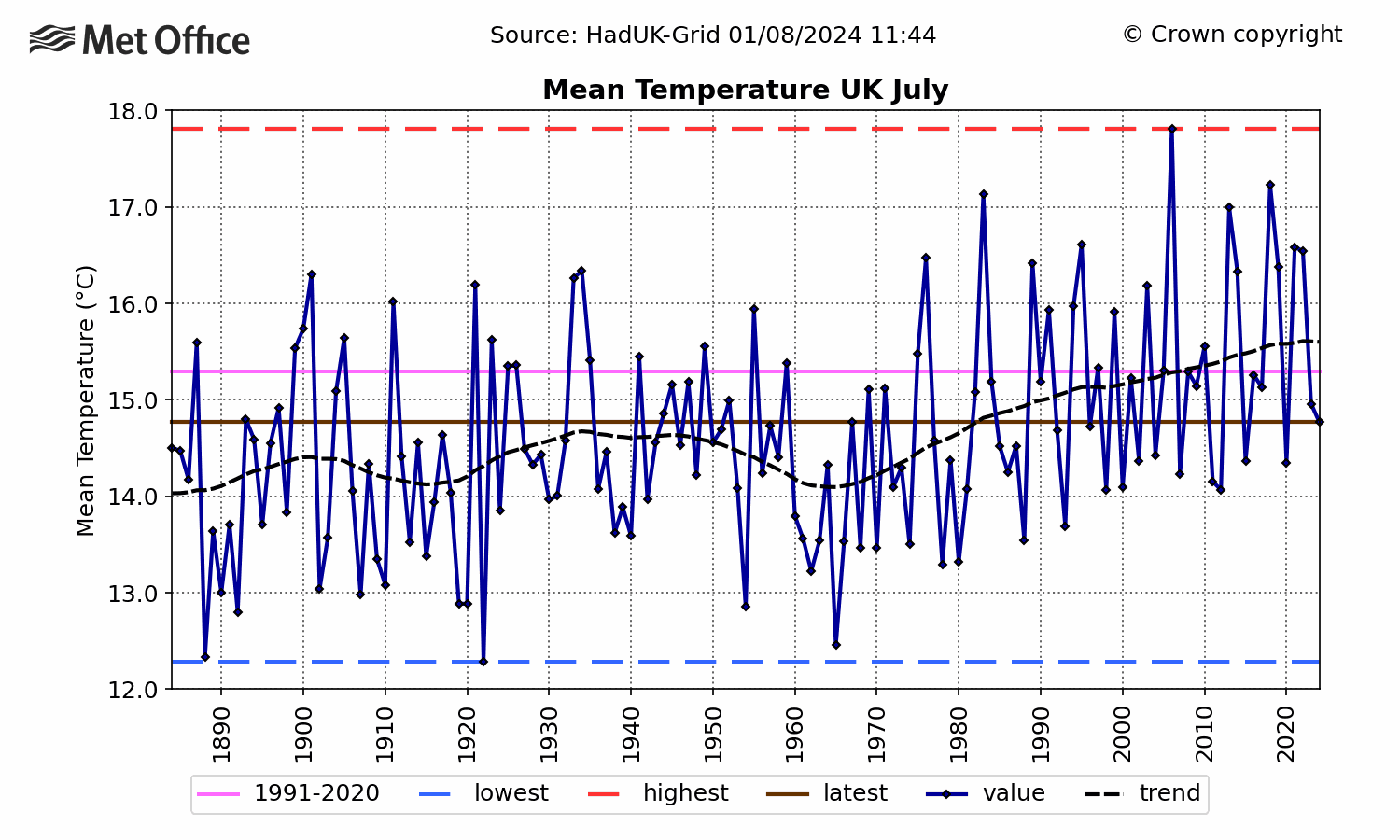
Certainly by mid-month there was no chance at all of a record, given that temperatures were already below average:

image

https://www.metoffice.gov.uk/hadobs/hadcet/cet_info_mean.html


And the idea that there was a 5/2 chance even before the month started is absurd, given that no year has got within 0.6C of the July record set in 2006:


https://www.metoffice.gov.uk/research/climate/maps-and-data/uk-temperature-rainfall-and-sunshine-time-series


I sometimes wonder whether the newspapers and bookies are in league. The papers get their click-bait and Ladbrokes get punters throwing their money away on no hope bets. (I wonder what odds they were offering that July would not be the hottest!)


Of course, bookies are preying on the sad naivety of people who have fallen hook, line and sinker for the global warming scam. They seem genuinely to believe that the world is burning up, that heatwaves are increasing, and all of the other lies thrown at them.

Throw in a forecast of a few sunny days, and the fools and their money are easily parted.

via NOT A LOT OF PEOPLE KNOW THAT

https://ift.tt/2EhErJa

July 24, 2020 at 01:12PM

Herd Immunity Already?

Don’t Fence Me In!

Professor Sunetra Gupta provides a wise, wholistic perspective on the pandemic in her interview published at Reason We may already have herd immunity.  Excerpts in italics with my bolds. H/T Paul Yowell.

I particularly appreciate her sense of the complexity of multiple factors and values, and humility in the challenge of getting the balance right.  This contrasts with so many narrow and overly confident technical pronouncements we read and hear in the media.

Are we already immune to coronavirus? Professor Sunetra Gupta, a theoretical epidemiologist at Oxford University, discusses her recent study on the herd immunity threshold, as well as her views on the social costs of lockdown, the inaccuracy of epidemiological models, and the curtailment of academic debate.

A study produced by a team at Oxford University indicated that some parts of the United Kingdom may already have reached herd immunity from coronavirus. A significant fraction of the population, according to the study published last week, may have “innate resistance or cross-protection from exposure to seasonal coronaviruses”, making the proportion vulnerable to coronavirus infection much smaller than previously thought.

The Oxford team is led by Sunetra Gupta, a professor of theoretical epidemiology. In recent months, she has argued that the cost of lockdown will be too high for the poorest in society and questioned the language and quality of debate on the pandemic’s impact.

Reaction interviewed Professor Gupta about these matters and more, with questions from Maggie Pagano, Alastair Benn and Mutaz Ahmed.

Cross-immunity Matters

Yes, exactly. The principle of protection from exposure to related viruses, and indeed any kind of pathogen, is one that we’ve known for a very long time. The very first vaccine we had, which is smallpox, was based on the idea that cowpox protects against smallpox. This idea was already there well in advance of us knowing that smallpox was a virus – and indeed in advance of germ theory having been properly established. So we knew about this cross protection even before we knew that diseases were caused by germs. It’s a very old idea.

In my own studies, beginning with malaria and then later thinking about flu, the role of cross-immunity in protecting against disease seemed to be something that very much needed to be factored into our thinking. Most of the people who die from malaria are children, and they die upon their first exposure, because they have no immunity at that stage. That was one of the first things that struck me when I was working on malaria.

And then later when I was working on flu, it seemed to me a very good way of explaining why the 1918 flu had killed so many people, but why that didn’t seem to be repeating itself, was that it was likely that people hadn’t been exposed to flu. Many people would have not had the flu at all. So then that built up this population of naive immunity in people under the age of thirty who were very badly affected when the pandemic came through.

Having those ideas in mind, when the Covid-19 virus started to spread, I was pretty certain it wouldn’t have a huge, devastating impact in terms of mortality, because we had all these other coronaviruses circulating.

What I didn’t anticipate was that some of our responses to previous exposure to seasonal coronaviruses might actually protect us from infection. It’s one thing to get infected and not ill, but what the new studies are showing is that people are actually fighting off infection. So at an even more basic level, the pre-existing antibodies or T-cell responses against coronaviruses seem to protect against infection, not just the outcome of infection.

Low Seroprevalence May be a Good Thing

What we know is that the seropositivity rates in many parts of the world are much lower than we’d expect them to be if we assume that the epidemic has passed through and that people are resistant. If you take a very simple scenario where everyone is susceptible, you’d expect 60-70% of them to have some marker of exposure. And that is not what’s been observed.

One of the things that’s been done in reporting the seroprevalence, which is not correct, is that they’ve been homogenised. When people say only 5-6% of the UK population has been exposed, that’s not correct. I think very few people would agree that exposure rates in London are less than 20%.

The picture that we’re getting is heterogeneous. But even in hotspots, apart from a few reports, they’re still quite low. So why is that?

One reason might be that lockdown stopped the spread of infection, so it was halted at a stage when, say, 20% of people were immune and the rest of the people were still susceptible to infection. Well, under those circumstances, the easing of lockdown should result in fairly rapid growth of cases. And that’s not something we’re seeing.

So we’ve got those two bits of information. The third bit, the missing piece of the puzzle, is this idea that some people are fully resistant to infection, because they just have really good defences. That could just be part of our innate immunological makeup. It’s also becoming clear that some of the people that have beaten it off have had responses to other coronaviruses which could have played a role.

The other bit of the puzzle is that some people do get infected and they make antibody responses, but those responses die very quickly. So if you’re trying to measure exposure, you won’t get the full picture. Some of the measures of seroprevalence might be underestimates.

We’ve got four pieces of the puzzle, then. If we put them all together, which is what the paper that we published on Friday does, it gives you a theoretical framework that you can use to look at how these bits connect up together.

You can see two things. You can see why the seroprevalence level might be low, and you can also infer that the level of herd immunity needed to stop the thing from exploding again is actually much lower than the figures that are currently being thrown around quite incautiously might suggest.

The fifth piece of this jigsaw could be that there is some seasonality. I suspect that in the winter it will probably come back, but hopefully only to the regions where it was kept from going by lockdown, and where the seroprevalence levels are genuinely extremely low.

We can be cautiously hopeful that in areas where the seroprevalence levels have achieved a certain value that’s compatible with there being a proportion who are resistant, that it might not come back with such vehemence.

Quality of Life Matters

What’s disappointed me about the way this has been approached is it has been approached along a single axis, which, if you like, is a scientific one. Even within that context, you could argue that it’s too one-dimensional, so we’re not thinking about what’s happening with other infectious diseases or how many people are going to die of cancer.

That’s the axis of disease, but then there’s the socioeconomic axis, which has been ignored. But there’s a third, aesthetic access, which is about how we want to live our lives. We are closing ourselves off not just to the disease, but to other aspects of being human.

I think the trade-off is very extreme. Obviously the most extreme manifestation of that trade-off is the 23 million people who will be pushed below the poverty line as a result of this sledgehammer approach. The costs to the arts is I think also incredibly profound – the theatres and all other forms of performing art. But also the inherent art of living, which I think is being compromised.

Acts of kindness are being eschewed. Someone was telling me yesterday that their mother said to them “please don’t come home, you’re going to kill us”.

Carrying On with Living is Social Responsibility

Because actually, the only way we can reduce the risk to the vulnerable people in the population is, for those of us who are able to acquire herd immunity, to do that.

Even if there is a little bit of a risk. I’m 55 years old, there’s some slight risk out there. But I would be willing to take that, just as I do with the flu. There’s a risk I might die of flu, but I’m willing to take that risk, because I know that if I don’t then flu will appear as it did before, it will enter the population of immunologically naive individuals, and then there will be a high risk of infection which will have a disproportionate effect on the vulnerable sector of the population.

Maybe the way to counter it now is to say, actually, not only is it a good thing for young people to go out there and become immune, but that is almost their duty. It’s a way of living with this virus. It’s how we live with other viruses. Flu is clearly a very dangerous virus, but the reason we don’t see more deaths from flu every year is because, through herd immunity, the levels of infection are kept to as low a level as we can get.

The truth is that herd immunity is a way of preventing vulnerable people from dying. It is achieved at the expense of some people dying, and we can stop that by preventing the vulnerable class in the process. In an ideal situation, you would protect the vulnerable as best you can, let people go about their business, allow herd immunity to build up, make sure the economy doesn’t crash, make sure the arts are preserved, and make sure qualities of kindness and tolerance remain in place.

We live, it seems, in this state of terror. Yes, international travel facilitates the entrance of contagion, but what it also does is it brings immunity.

Good Thing It’s Not Our First Coronavirus

If coronavirus had arrived in a setting where we had no coronavirus exposure before, we might be much worse off. It also seems that in addition to protection against severe disease as a result of exposure to related coronaviruses, some fraction of us seem to be resistant to infection.

That’s just fantastic news, actually. Hopefully that will be consolidated at a scientific, laboratory level. We ourselves are looking at how antibodies to seasonal coronaviruses can impact on protection against infection and disease.

Maybe we will be able to build up a picture that will reassure the public that actually we are much better off having been exposed to related coronaviruses. We are in a better place to fight off this infection than we actually thought.


via Science Matters

https://ift.tt/2ZUf4Fw

July 24, 2020 at 01:03PM

Searching for the missing link: the hole in the zero-carbon bucket 


*Missing* being the operative word. Any article such as this one, showing electricity cooling towers appearing to emit black steam – by careful use of dusk shadowing – instantly announces itself as human-accusing climate propaganda, like all the others before it using the same camera trick. But as Star Trek’s Scotty used to say: ‘Ye canna change the laws of physics’, which climate dreamers tend to forget. Outlandish costs and highly inefficient methods are not going to work on an industrial scale either. In short, there’s a massive hole in their renewables-based bucket.
– – –
Governments and electric utilities are rapidly embracing the imperative to decarbonize energy use, says the Atlantic Council.

In the context of this effort, they have made substantial commitments to renewable energy generation and battery-based electricity storage through renewable portfolio standards and contractual commitments.

But while the costs of renewable energy generation have rapidly decreased, and their performance has improved, renewable generation is intermittent, and electric-system operators continue to rely on existing thermal resources, particularly natural gas generation, to fill in the gaps when renewable generation is not available.

Battery-based electricity storage is part of the solution, but storage timeframes are currently only on the order of hours.

In addition, the ability to draw on renewable resources varies dramatically by geography.

Baseload or “firm” zero-carbon generation resources, which are not necessarily intended to run all the time, but can be available at any time, will be needed to complement renewable resources in the future, without emitting the CO2 produced by today’s fossil energy system.

These resources might include, for example, fossil-fuel power plants with carbon capture, nuclear power plants with improved dispatchability, geothermal power, and bio-fueled generators.

But the path to developing, and certainly deploying, such resources has been slower and more fraught than for renewables; these “firm” electricity generation resources represent a missing link in the path towards a decarbonized electricity grid.

Continued here.

– – –
Note – the original article headline was:
“Searching for the missing link: Options for firm zero-carbon power”.

via Tallbloke’s Talkshop

https://ift.tt/3fWBtI4

July 24, 2020 at 01:03PM