Month: July 2020

Climate change: Summers could become ‘too hot for humans’-BBC

By Paul Homewood

h/t Robin Guenier


An utterly ridiculous article, even by BBC standards!

 image

Millions of people around the world could be exposed to dangerous levels of heat stress – a dangerous condition which can cause organs to shut down.

Many live in developing countries, and do jobs that expose them to potentially life threatening conditions.

These include being out in the open on farms and building sites or indoors in factories and hospitals.

Global warming will increase the chances of summer conditions that may be "too hot for humans" to work in.

When we caught up with Dr Jimmy Lee, his goggles were steamed up and there was sweat trickling off his neck.

An emergency medic, he’s labouring in the stifling heat of tropical Singapore to care for patients with Covid-19.

There’s no air conditioning – a deliberate choice, to prevent the virus being blown around – and he notices that he and his colleagues become "more irritable, more short with each other".

And his personal protective equipment, essential for avoiding infection, makes things worse by creating a sweltering ‘micro-climate’ under the multiple layers of plastic.

"It really hits you when you first go in there," Dr Lee says, "and it’s really uncomfortable over a whole shift of eight hours – it affects morale."……

A system known as the Wet Bulb Globe Temperature (WBGT) measures not only heat but also humidity and other factors to give a more realistic description of the conditions.

Back in the 1950s, the US military used it to work out guidelines for keeping soldiers safe.

When the WBGT reaches 29C, for example, the recommendation is to suspend exercise for anyone not acclimatised.

Yet that’s the level Dr Lee and his colleagues are regularly experiencing at Singapore’s Ng Teng Fong General Hospital.

And at the top of the scale – when the WBGT registers 32C – the US says strenuous training should stop because the risk becomes "extreme".

But levels that high have recently been recorded inside hospitals in Chennai in India by Prof Vidhya Venugopal of the Sri Ramachandra University.

She’s also found workers in a salt pan enduring a WBGT that climbs during the day to 33C – at which point they have to seek shelter.

And in a steel plant, a ferocious level of 41.7C was recorded, the workers being among the most vulnerable to what she calls "the huge heat".

"If this happens day-in, day-out, people become dehydrated, there are cardiovascular issues, kidney stones, heat exhaustion," Prof Venugopal says.

As global temperatures rise, more intense humidity is likely as well which means more people will be exposed to more days with that hazardous combination of heat and moisture.

Prof Richard Betts of the UK Met Office has run computer models which suggest that the number of days with a WBGT above 32C are set to increase, depending on whether greenhouse gas emissions are cut.

And he spells out the risks for millions of people already having to work in the challenging combination of extreme heat and high humidity.

"We humans evolved to live in a particular range of temperatures, so it’s clear that if we continue to cause temperatures to rise worldwide, sooner or later the hottest parts of the world could start to see conditions that are simply too hot for us."

https://www.bbc.co.uk/news/science-environment-53415298


The problem in the Singapore hospital has nothing to do with global warming – it is down to the switching off of air conditioning and the use of PPE, both as a result of COVID-19.

Indeed, air conditioning is the solution for the billions who already live all their lives in hot and humid conditions. And a widespread roll out of air conditioning in poorer countries requires economic growth and a cheap, reliable source of energy.

As for those who work outside, the solution is pretty obvious, as the article notes:

According to Dr Jimmy Lee, "it’s not rocket science". People need to drink plenty of fluid before they start work, take regular breaks and then drink again when they rest.

 Indeed, as southern European countries learnt centuries ago, you simply go and lie down in the shade during the heat of midday.

Perhaps Richard Betts has never heard of a siesta?

via NOT A LOT OF PEOPLE KNOW THAT

https://ift.tt/2ODKNnX

July 18, 2020 at 04:13AM

BEIS Committee’s Fake “Proposals From The Public”

By Paul Homewood


 image

https://committees.parliament.uk/event/1443/formal-meeting-oral-evidence-session/


While I was away, the BEIS Select Committee held an oral evidence meeting for the My BEIS inquiry.

It sounds like a wonderfully democratic idea:

image

image

https://committees.parliament.uk/publications/1837/documents/17997/default/


Although responses covered a wide range of topics falling the BEIS remit, the Committee conveniently decided to “predominantly shortlist” energy and climate proposals:

image

image


Now you might think that there would be loads of contributions from companies and consumers worried about how energy price rises would affect them. Or from energy experts, concerned about how the country could manage on useless renewable energy alone.

Or from car manufacturers and motorist lobby groups, who could foresee what a dire effect the policy to ban fossil fuel powered cars would have.

Or from Citizens Advice organisations who knew that most householders simply could not afford to scrap their central heating boilers, and spend more than 10 grand replacing them with utterly impracticable heat pump technology, all in the name of Zero Carbon.

Or on electrical engineers who know that electrification of heating and transport will necessitate a fundamental and unaffordable upgrading of our power distribution network.

Sadly the Select Committee is considering no such criticisms of current government strategy. Instead it has focussed on proposals from a bunch of lobbyists, out to either promote climate alarmism, or profit from it.

Maybe, you would think, Citizens Advice would have consumers’ interests at heart? Sadly no. All they can come up with is this load of gobbledegook:

image

Or what about that “Fuel Poverty Strategy” from the NEA? While they acknowledge the immense costs involved, their only concern is that the cost does not fall on poor people. It does not seem to have occurred to them that the money saved by cancelling decarbonisation could actually be usefully spent on relieving poverty instead.


image


This whole exercise is far from the democratic consultative exercise it is made out to be. Clearly the Select Committee are determined not to allow contributions from anybody opposed to the government’s agenda.

And in the end, no doubt, the “consultation” will be presented as a justification for current policies.

Rather like the Soviets used to do in fact!

via NOT A LOT OF PEOPLE KNOW THAT

https://ift.tt/2ODKIAF

July 18, 2020 at 04:06AM

40 Countries Discuss Depriving World Of Inexpensive Safe Energy

.
.
Wind, solar and a few batteries are not going to propel less developed countries to any sort of prosperity.

PA Pundits – International

By Dr. Jay Lehr and Tom Harris~

It should be no surprise to our readers that socialists across the world would recognize an opportunity in the china-virus pandemic to further handicap the use of inexpensive dependable fossil fuels to raise the standard of living of the poorest of the world by forcing them to use only undependable expensive wind and solar energy. The pandemic has allowed a world wide experiment in socialism where governments have been able to exercise tyrannical power over their citizens.

On Thursday, July 9, the International Energy Agency (IEA) convened a huge on-line event, pictured above, misleadingly titled the Clean Energy Transitions Summit. It brought together government representatives of 40 of the worlds largest economies as well as developing nations, accounting for 80% of global greenhouse gas emissions. Although IEA executive director Dr. Fatih Birol called the summit the most important…

View original post 866 more words

via Tallbloke’s Talkshop

https://ift.tt/32wt0as

July 18, 2020 at 03:57AM

Energy Magic: Wind & Solar ‘Industries’ Pin Their Future on Great Hydrogen Hoax

RE rent seekers are touting hydrogen gas produced with unpredictable and unreliable wind and solar power as the next ‘green’ energy Nirvana.

If producing industrial volumes of hydrogen using electricity were even vaguely economic, then the obvious way of doing so would be to use coal-fired power; the cheapest and most reliable power source, of all.

But that’s not the point and purpose of the great hydrogen hoax. This is about corporate greed and rent seeking.

The rules of physics (not least thermodynamics) means that, whatever the power source, more energy will be expended than will ever be returned from the process of turning electricity into hydrogen gas, storing and distributing it. Which means it will not result in a net energy benefit.

Because the whole thing is a pipe dream, no one pushing the “let’s turn wind and solar power into hydrogen” line has bothered with the Energy Return On Investment or EROI – the ratio between the energy delivered by a particular fuel source to society and the energy invested in the capture and delivery of that energy.

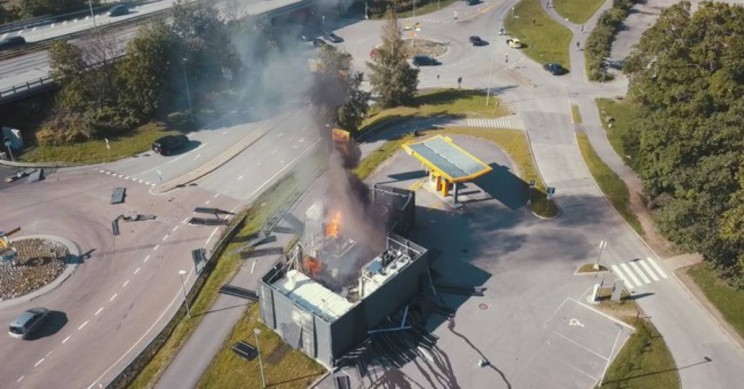
Oh, almost forgot to mention a couple of other laws of physics – the storage and distribution of hydrogen gas is not without its challenges. Attempting to contain the gas in large volumes comes with the threat of industrial scale explosions, thanks to its the low ignition point and highly combustible nature, and also because it tends to leak easily from tanks. More than a few hydrogen storage facilities and filling stations have exploded – as to which, see below the image from Norway where one went up with one hell of a bang.

When it comes to promoting the hydrogen hoax, Australia’s rent seeking crowd are hard at it; but the Germans appear to have seized the lead on pushing the most ridiculous proposition ever put forward by the green energy cult. Eric Worral reports.

Germany’s Climate Friendly Hydrogen Strategy
Watts Up With That?
Eric Worall
15 June 2020

Germany has affirmed its climate leadership by announcing a plan to embrace a hydrogen-powered future. But nobody can explain where they will get all the hydrogen.

Germany plans to spend billions funding green hydrogen

Up to 2030, Germany’s federal government wants to establish 5 GW in electrolysis capacity, only to be doubled again in the subsequent five years. The country acknowledges that it will also need outside help to achieve the goal.

BY MAZ PLECHINGER Published: 10.06.20 at 13:54

“As the first step in accelerating the market for hydrogen technologies, a strong, sustainable production and consumption – a ‘home market’ – is crucial. A robust national market will also create a signal effect for the use of hydrogen technologies internationally,” the federal government writes in the strategy.

Mainly in its steel and chemical sectors, Germany already uses significant volumes of industrial hydrogen, although the resource is currently derived from natural gas rather than renewable power and water.

Doesn’t cover requirement

Precisely how Germany will build the bridge to economic viability is not revealed in the plan, which does, however, mention that Berlin is considering a tax exemption for electricity used for hydrogen production – not least giving a tax pass to green H2 from the Erneuerbare-Energien-Gesetz (EEG) fee that’s used to finance the green energy transition and which had EUR 11 billion earmarked in connection with the economic recovery plan as an aid ceiling.

Another top limit is how much green hydrogen Germany will be able to produce itself. When the offshore wind build-out target for 2030 was recently raised by 5 GW to 15 GW, and the 52 GW solar cap was scrapped, green hydrogen production was one factor given consideration.

But even though 5 GW of electrolysis in the hydrogen strategy multiplies current domestic capacity 200 fold, the government says this is grossly inadequate to cover demand. According to the strategy, 5 GW of electrolysis is enough to produce 14 TWh made from 20 TWh of renewable energy – while the requirement for the resource is estimated to be 90-110 TWh.

The renewable energy powered hydrogen economy takes expensive renewable electricity, and discards 60% of the energy in the form of conversion losses. Ignoring compression, storage and transport losses; electrolysis (80% efficient) x Fuel cell (50% efficient) = 40% (60% lost) – 40% efficiency end to end hydrogen conversion makes hydrogen at least 2.5x more expensive than the original renewable energy used to produce the hydrogen (1/0.4 = 2.5).

There are lots of wild claims these days that renewables are incredibly cheap – but renewables still seem to require a lot of government life support, either directly through subsidies or by forcing distributors to purchase a fixed quota of renewable energy.

No doubt adding the expense of converting the electricity to hydrogen and back to electricity will make it all better.

The German publication DW understands;

“But despite being a promising energy carrier in a low-carbon energy system, green hydrogen is still facing significant technical and commercial challenges. Its disadvantages like weak energy efficiency and huge infrastructure requirements could be overwhelming outside a few core uses.“

Watts Up With That?

Hydrogen: It’s a ‘gas’. …

Like this:

Like Loading…

Related

via STOP THESE THINGS

https://ift.tt/2ZEZA8j

July 18, 2020 at 02:30AM