Month: July 2020

New posts suspended – WUWT moving to new server

A couple of days ago, I mentioned that WUWT was being deplatformed by our current hosting provider.

We are moving again, after 2+ years on this hosting provider, we are headed back to where we originally were on wordpress.com where their cloud servers can handle the load, the DDoS attacks, and other issues that come with running a world-class website.

To that end, so we don’t lose comments and content, I’m putting new posts on hold for at least a day. I’ll have one “Friday Funny” tomorrow that will appear below this one, and then that’s it until we get settled again.

I wish to thank everyone who has donated towards covering the cost of the move (it wasn’t insignificant, and I had to hire a consultant). I didn’t even ask for donations, and yet, there they were, rolling in.

It is a testament to the kindness and character of our readers. I’ll let you know when we are back up on the new site, and what sort of things you might have to do (like clearing cache etc) to access it right away.

Sincere thanks for your patience. – Anthony

Like this:

Like Loading…

Related

via Watts Up With That?

https://ift.tt/32rRly3

July 16, 2020 at 07:22PM

Google vs Hydroxychloroquine

Google search results for ‘hydroxychloroquine’ include a Knowledge Panel with misinformation:Screenshot of Google search for HCQ with wrong knowledge panel
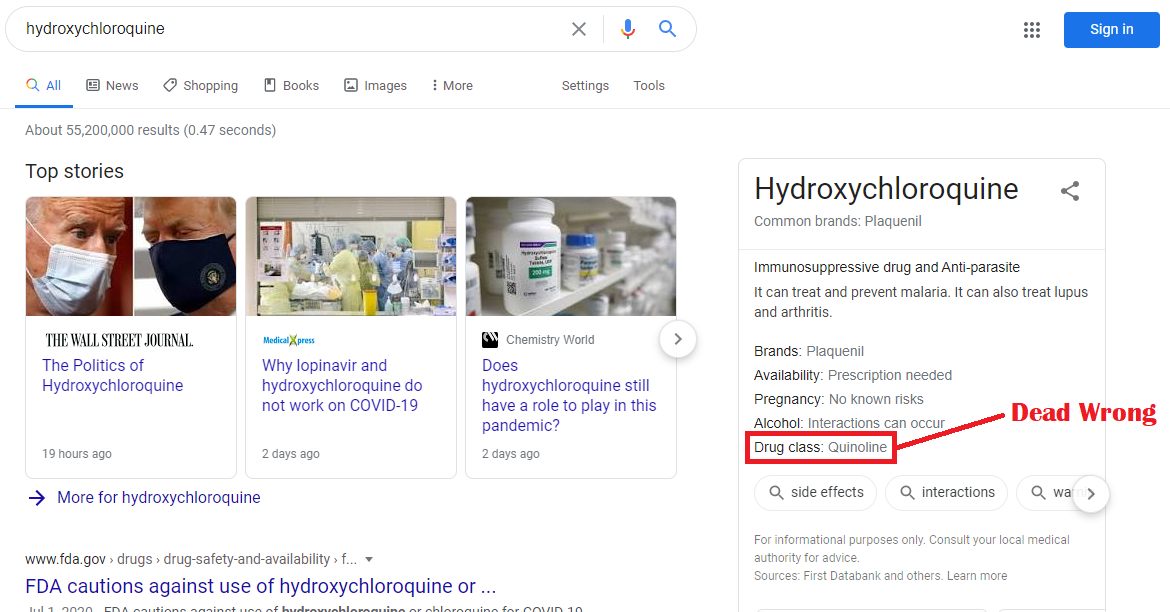
This knowledge panel features what looks like a scientific description of hydroxychloroquine, except it is fraught with inaccurate information. It attributes to Hydroxychloroquine (HCQ) the properties of an unrelated drug – hydroxyquinoline (HNL). 

Immunosuppressive drug and Anti-parasite

Drug class: Quinoline

Hydroxychloroquine is an Aminoquinoline, not Quinoline (chemical class)! FDA classifies Hydroxychloroquine as antirheumatic and antimalarial, NOT antiparasitic.

But  HNL does belong to the Quinoline class. HNL has been used against amoeba dysentery (amoebiasis). Amoeba is parasite, so HNL can be considered antiparasitic. Also, “[Topical] hydroxyquinoline is used to lubricate and deodorize the vagina, and to prevent the growth of bacteria” (Drugs.com). 

The chemical formulas of the two drugs differ significantly:

Hydroxychloroquine (for the Wuhan coronavirus): C18H26ClN3O

Hydroxyquinoline (other uses): C9H7NO 

The PubChem website warns that HNL is Acute Toxic, Health Hazard, Environmental Hazard, and Corrosive. HCQ has none of these warnings.

WHO Classification

The World Health Organization (WHO) has its own classification system for drugs, and it is fraught with confusion. One top category of drugs (P) is  ANTIPARASITIC PRODUCTS, INSECTICIDES AND REPELLENTS. (WHO knows why one would include insecticides in a database of drugs?) It includes a subcategory ANTIPROTOZOALS. Under it:

ANTIMALARIALS -> Aminoquinolines -> Hydroxychloroquine

ANTIPARASITIC PRODUCTS, INSECTICIDES AND REPELLENTS
    P01 ANTIPROTOZOALS
        P01B ANTIMALARIALS
            P01BA Aminoquinolines , including Hydroxychloroquine

AGENTS AGAINST AMOEBIASIS AND OTHER PROTOZOAL DISEASES -> Hydroxyquinoline derivatives

ANTIPARASITIC PRODUCTS, INSECTICIDES AND REPELLENTS
    P01 ANTIPROTOZOALS
        P01A AGENTS AGAINST AMOEBIASIS AND OTHER PROTOZOAL DISEASES
            P01AA Hydroxyquinoline derivatives

The RECOVERY Trial

There was a recent RECOVERY Clinical Trial, researching the effectiveness of HCQ on COVID-19 patients, in which the clinicians made massive errors in dosage.  Google’s Knowledge Panel is misleading. This is likely the reason why doctors performing the RECOVERY Clinical Trial erroneously used HCQ in the dosages recommended for HNL treatment for amoebic dysentery.  They therefore overdosed their patients and then blamed HCQ for their mistake. In an interview with France Soir, the doctors acknowledged that they used the dosage from a treatment for amoebic dysentery, i.e., HNL, and gave their patients 2,400 mg/day of HCQ, instead of the already established 400-800 mg/day.  Here are quotes from their interview, referring to dosages used for amoebic dysentery – a disease not treated with HCQ, but with HNL:

FS: How did you decide on the HCQ dosage?

ML: The doses were chosen on the basis of pharmacokinetic modeling and these are in line with the dosages used for other diseases such as amoebic dysentery.

 FS: Is there a maximum dosage for hydroxychloroquine in the UK?

ML: I have to check, but it’s much more important than 2400mg, I think it’s six or ten times more.

Also, see an interesting tweets  thread by James Todaro, MD.

Google’s Conduct

No government website could be found that places HCQ among quinolines. Google says that its erroneous result for Hydroxychloroquine is from First Databank and others. On its website, Google contradicts this claim by saying that it creates such medical information internally: “teams of doctors carefully review and refine the information, and licensed medical illustrators create visuals.” Also, the First Databank has multiple documents about HCQ, none of which mentioning quinolines.

Many medical researchers and public health officials are likely confused by Google’s erroneous information and classification. In addition to falsely conflating  HCQ with HNL, Google was also scrubbing the web and YouTube of any mentions of HCQ-based treatments for COVID-19

The following screenshot is from April 12, 2020.
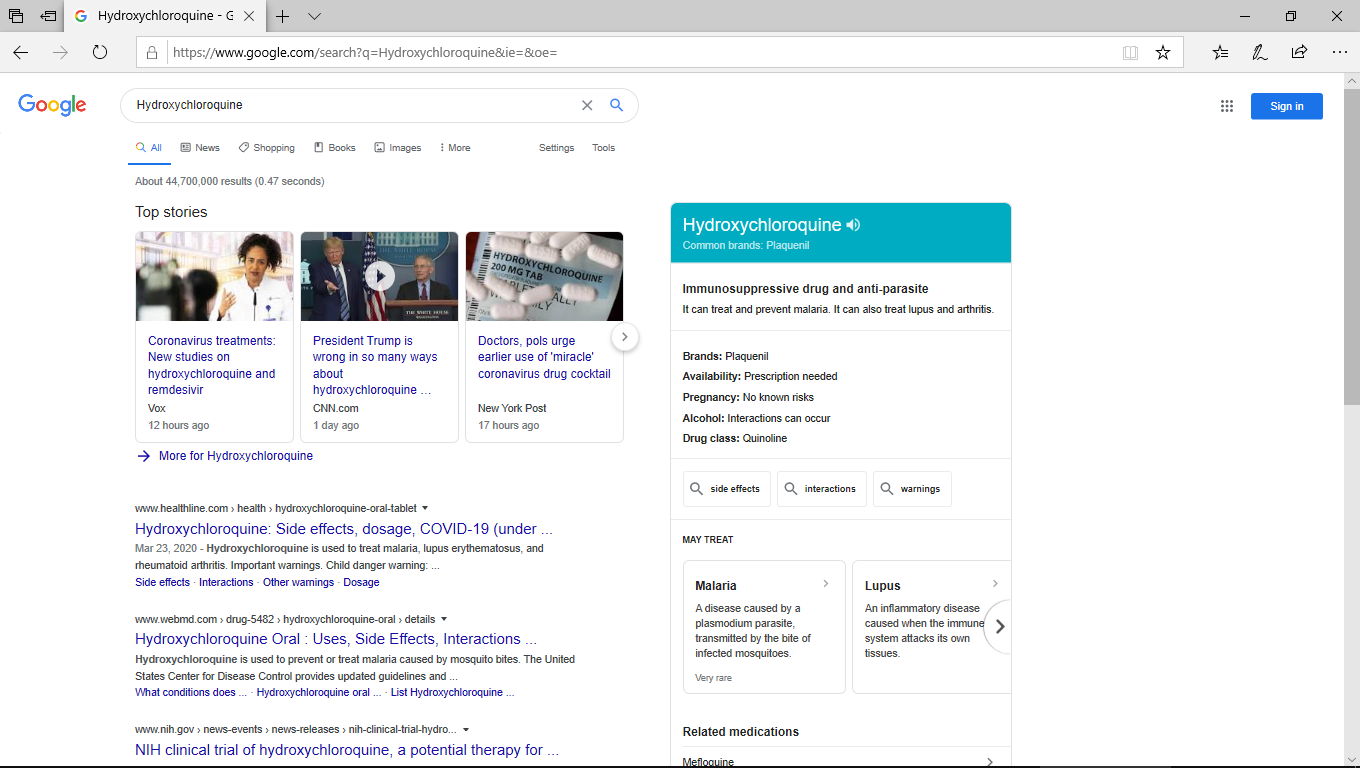
Screenshot of Google search for HCQ with wrong knowledge panel, from April 12

The searches were done using a browser in a clean configuration (no cookies, cached images, and other tracking attributes) in Texas.

via Science Defies Politics

https://ift.tt/3jbsSTP

July 16, 2020 at 06:07PM

Heat stress: The climate is putting European forests under sustained pressure

UNIVERSITY OF BASEL

IMAGEIMAGE
IMAGE: IN A FOREST NEAR BASEL RESEARCHERS STUDY THE EFFECTS OF CLIMATE CHANGE ON THE MOST IMPORTANT AND SENSITIVE PART OF THE TREES – THE CANOPY. A TOTAL OF 450 TREES… view more CREDIT: UNIVERSITY OF BASEL

No year since weather records began was as hot and dry as 2018. A first comprehensive analysis of the consequences of this drought and heat event shows that central European forests sustained long-term damage. Even tree species considered drought-resistant, such as beech, pine and silver fir, suffered. The international study was directed by the University of Basel, which is conducting a forest experiment unique in Europe.

Until now, 2003 has been the driest and hottest year since regular weather records began. That record has now been broken. A comparison of climate data from Germany, Austria and Switzerland shows that 2018 was significantly warmer. The average temperature during the vegetation period was 1.2°C above the 2003 value and as high as 3.3°C above the average of the years from 1961 to 1990.

Part of the analysis, which has now been published, includes measurements taken at the Swiss Canopy Crane II research site in Basel, where extensive physiological investigations were carried out in tree canopies. The goal of these investigations is to better understand how and when trees are affected by a lack of water in order to counter the consequences of climate change through targeted management measures.When trees die of thirst

Trees lose a lot of water through their surfaces. If the soil also dries out, the tree cannot replace this water, which is shown by the negative suction tension in the wood’s vascular tissue. It’s true that trees can reduce their water consumption, but if the soil water reservoir is used up, it’s ultimately only a matter of time until cell dehydration causes the death of a tree.

Physiological measurements at the Basel research site have shown the researchers that the negative suction tension and water shortage in trees occurred earlier than usual. In particular, this shortage was more severe throughout all of Germany, Austria and Switzerland than ever measured before. Over the course of the summer, severe drought-related stress symptoms therefore appeared in many tree species important to forestry. Leaves wilted, aged and were shed prematurely.Spruce, pine and beech most heavily affected

The true extent of the summer heatwave became evident in 2019: many trees no longer formed new shoots – they were partially or wholly dead. Others had survived the stress of the drought and heat of the previous year, but were increasingly vulnerable to bark beetle infestation or fungus. Trees with partially dead canopies, which reduced the ability to recover from the damage, were particularly affected.

“Spruce was most heavily affected. But it was a surprise for us that beech, silver fir and pine were also damaged to this extent,” says lead researcher Professor Ansgar Kahmen. Beech in particular had until then been classified as the “tree of the future”, although its supposed drought resistance has been subject to contentious discussion since the 2003 heatwave.Future scenarios to combat heat and drought

According to the latest projections, precipitation in Europe will decline by up to a fifth by 2085, and drought and heat events will become more frequent. Redesigning forests is therefore essential. “Mixed woodland is often propagated,” explains plant ecologist Kahmen, “and it certainly has many ecological and economic advantages. But whether mixed woodland is also more drought-resistant has not yet been clearly proven. We still need to study which tree species are good in which combinations, including from a forestry perspective. That will take a long time.”

Another finding of the study is that it is only possible to record the impacts of extreme climate events on European forests to a limited extent using conventional methods, and thus new analytical approaches are needed. “The damage is obvious. More difficult is precisely quantifying it and drawing the right conclusions for the future,” says Kahmen. Earth observation data from satellites could help track tree mortality on a smaller scale. Spatial patterns that contain important ecological and forestry-related information can be derived from such data: which tree species were heavily impacted, when and at which locations, and which survived without damage? “A system like this already exists in some regions in the US, but central Europe still lacks one.”

###

From EurekAlert!

Like this:

Like Loading…

Related

via Watts Up With That?

https://ift.tt/3fAV1l7

July 16, 2020 at 05:00PM

Solar panel owners asked to pay “to sell back to the grid”

Solar Owners in South Australia are furious that they might be charged to sell back to the grid. They are used to getting all the transmission lines and power plants for free.

The awful truth:

Mr Preus said he had installed his household solar PV system to save money and help the environment, but was now questioning his investment.

“We’ll never, ever in our lifetime recoup our investment, the return is just not there.”

“People will just disconnect them, and tell them to get stuffed, that’s what I would do,” he said.

They’ve been sold a lemon: misled into believing the energy the panels made was useful and economic. Instead solar owners without batteries can only provide excess energy no one needs at lunchtime. Lunchtime voltages are surging and their inverters are tripping off anyhow. And they themselves need to be hooked up to the grid to get the electro-juice they want, most hours of the day.

Finally there is some attempt to fix the Soviet-level planning disaster. People are just starting to notice that the poor are paying for the networks to supply the rich.

But the call to […]

Rating: 0.0/10 (0 votes cast)

via JoNova

https://ift.tt/3h5NURR

July 16, 2020 at 01:00PM