
By Andy May
Roger Revelle was an outstanding and famous oceanographer. He met Al Gore, in the late 1960s, when Gore was a student in one of his classes at Harvard University. Revelle was unsure about the eventual impact of human carbon dioxide emissions on climate, but he did show that all carbon dioxide emitted by man would not be absorbed by the oceans. For an interesting discussion of Revelle’s work in this area see this post on “The Discovery of Global Warming,” by Spencer Weart (Weart, 2007). The original paper, on CO2 absorption by the oceans, published in 1957 by Roger Revelle and Hans Suess, is entitled: “Carbon Dioxide Exchange Between Atmosphere and Ocean and the Question of an Increase of Atmospheric CO2, during the Past Decades” (Revelle & Suess, 1957). This meant that human emissions of carbon dioxide would accumulate in the atmosphere and that the CO2 atmospheric concentration would increase, probably causing Earth’s surface to warm at some unknown rate. This is not an alarming conclusion, as Revelle well knew, but Al Gore turned it into one.
One of Revelle’s good friends was Dr. S. Fred Singer. Singer was a professor of environmental science at the University of Virginia and both Revelle and Singer had been science advisors in the U.S. Department of the Interior. They first met in 1957 and were more than professional colleagues, they were personal friends (Singer, 2003). Unfortunately, Revelle passed away in July 1991 and Singer passed away in April 2020, so we will refer to them and their friendship in the past tense. Both were leading Earth scientists and at the top of their fields, it was natural they would become friends. They also shared an interest in climate change and chose to write an article together near the end of Revelle’s life.
The article was published in Cosmos and entitled “What To Do about Greenhouse Warming: Look before You Leap” (Singer, Revelle, & Starr, 1991). Singer and Revelle had already written a first draft of the article, when they invited the third author, Chauncey Starr, to help them complete it. Starr was an expert in energy research and policy. He holds the National Medal of Technology and Innovation and was the director of the Electrical Power Research Institute in Palo Alto, California. As leading scientists, Starr, Singer and Revelle understood how uncertain the possible dangers of global warming were and they did not want the government to go off half-cocked, they wrote:
“We can sum up our conclusions in a simple message: The scientific [basis] for a greenhouse warming is too uncertain to justify drastic action at this time. There is little risk in delaying policy responses to this century old problem since there is every expectation that scientific understanding will be substantially improved within the next decade.” (Singer, Revelle, & Starr, 1991)
Indeed, ten years later, CO2 emissions were still increasing, but the world had started to cool as shown in Figure 1. This casts considerable doubt on the idea that human emissions somehow control global warming, since some other factor, presumably natural, is strong enough to reverse the overall warming trend for ten years. Revelle was correct to encourage the government to wait for ten more years. Just a year before their paper was published the IPCC reported that warming to date fell within the range of “natural variability” and that the detection of a human influence on climate was “not likely for a decade or more.” (IPCC, 1990, p. XII).
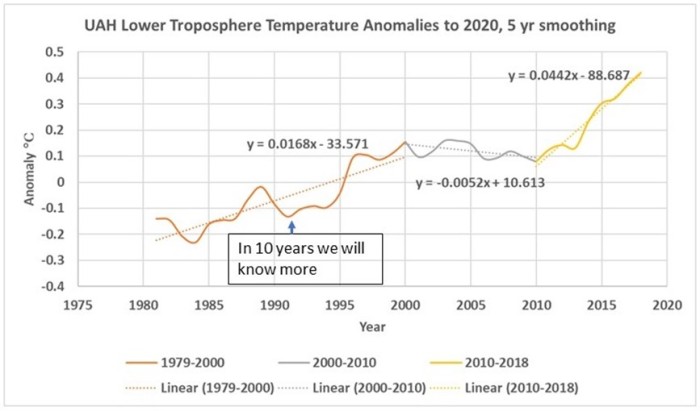
Figure 1. In 1990 and 1991, respectively, the IPCC and Roger Revelle and colleagues said it was too early to do anything about possible man-made climate change, they thought we would know more in 10 years. The plot is smoothed with a 5-year running average to reduce the effect of El Nino and La Nina events. This makes the longer term trends easier to see.
While Revelle was unsure if warming was a problem. Al Gore, who had little training in science, suffered no such doubts. He was sure that burning fossil fuels was causing carbon dioxide to rise to “dangerous” levels in the atmosphere and was convinced this was a problem for civilization through rising sea levels and extreme weather. There was no evidence to support these assumptions, but Al Gore didn’t need evidence, he could always rely on climate models and he did. Revelle distrusted the models.
Al Gore and Climate Change
In 1992, after Singer, Revelle and Starr published their Cosmos article, their statements caused Al Gore, who was running for Vice-President at the time, some problems. Gore had just published The Earth in the Balance (Gore, 1992) and in it he credited Revelle with discovering that human emissions of carbon dioxide were causing Earth to warm and this could be very dangerous. Yet, Singer, Revelle and Starr’s paper said:
“Drastic, precipitous—and, especially, unilateral—steps to delay the putative greenhouse impacts can cost jobs and prosperity and increase the human costs of global poverty, without being effective. Stringent economic controls [on CO2 emissions] now would be economically devastating particularly for developing countries…” (Singer, Revelle, & Starr, 1991)
They also quote Yale economist and Nobel Laureate William Nordhaus, who wrote:
“…those who argue for strong measures to slow greenhouse warming have reached their conclusion without any discernible analysis of the cost and benefits…” (Nordhaus W. , 1990)
Nordhaus had studied both the costs of reducing CO2 and the benefits of doing so. His analysis shows there is little to be gained, economically, from reducing emissions (Nordhaus W. , 2007, p. 236). While Nordhaus supports a “carbon tax,” he acknowledges that the “pace and extent of warming is highly uncertain.” Contrast this with how Al Gore characterizes Roger Revelle’s view in his book:
“Professor Revelle explained that higher levels of CO2 would create what he called the greenhouse effect, which would cause the earth to grow warmer. The implications of his words were startling; we were looking at only eight years of information, but if this trend continued, human civilization would be forcing a profound and disruptive change in the entire global climate.” (Gore, 1992, p. 5) italics added.
The differences between what Nordhaus and Revelle are saying and what Al Gore is saying are stark. All three believe human emissions of CO2 might cause Earth to warm. But Gore naively assumes that is a bad thing. Revelle and Nordhaus acknowledge it might be, but they recognize that we don’t know. Further, they understand destroying our fossil fuel-based economy may not alleviate the warming and may cause more harm than good. To quote Bertrand Russell:
“The whole problem with the world is that fools and fanatics are always so certain of themselves, and wiser people so full of doubts.” Bertrand Russell
To a scientist, like Roger Revelle, the uncertainty was obvious. Politicians, like Al Gore and most of the news media do not do uncertainty, everything must be black and white and false dichotomies are how they think. Notice Al Gore presumptively writes “would be forcing” when Revelle would clearly write “could be forcing.” The difference between a politician with an agenda and a scientist who understands uncertainty.
The incompatibility between Revelle’s true views and the way they are presented in Gore’s book was noticed by Gregg Easterbrook, a Newsweek editor, who wrote about it in the July 6, 1992 issue of New Republic (Easterbrook, 1992). This article angered Al Gore and his supporters. Walter Munk and Edward Frieman published a short note in Oceanography in 1992 objecting to Easterbrook’s article and claimed that the late Revelle had been worried about global warming, but probably did not want “drastic” action taken at this time (Munk & Frieman, 1992). Revelle’s views were clear and well known, nothing in Munk and Frieman’s article contradicts what Singer said or what Revelle said or wrote. The following is from a letter Revelle sent Senator Tim Wirth, an ally of Gore’s and a member of the Clinton/Gore administration in July 1988:
“we should be careful not to arouse too much alarm until the rate and amount of warming becomes clearer. It is not yet obvious that this summer’s hot weather and drought are the result of a global climatic change or simply an example of the uncertainties of climate variability. My own feeling is that we had better wait another 10 years before making confident predictions.” Written by Roger Revelle as reported by (Booker, 2013, p. 59).
Unlike Senators Al Gore and Tim Wirth, Revelle understood global warming computer models and did not trust them. He argued with Singer about this very issue and Singer convinced Revelle that the models were getting better (Singer, Revelle, & Starr, 1991). However, regardless of the accuracy of the models, Revelle was not convinced global warming was a problem and he knew the natural rate of warming and the additional amount expected from human greenhouse emissions were unknown. As shown in Figure 1, his caution was warranted, just ten years later it became apparent that warming was slowing down. The following reflects Revelle’s own views, it is from the “Look before you Leap” article:
“The models used to calculate future climate are not yet good enough because the climate balancing processes are not sufficiently understood, nor are they likely to be good enough until we gain more understanding through observations and experiments. As a consequence, we cannot be sure whether the next century will bring a warming that is negligible or a warming that is significant. Finally, even if there are a global warming and associated climate changes, it is debatable whether the consequences will be good or bad; likely some places on the planet would benefit, some would suffer.” (Singer, Revelle, & Starr, 1991)
Revelle’s views were clear and well documented, but Al Gore and his supporters were humiliated by Easterbrook’s article and follow up articles by George Will and others. Dr. Justin Lancaster was Revelle’s graduate student and teaching assistant at the Scripps Institution of Oceanography from 1981 until Revelle’s sudden death in July 1991. He was also an Al Gore supporter. Lancaster claimed that Revelle was “hoodwinked” by Singer into adding his name to the Cosmos article. He also claimed that Revelle was “intensely embarrassed that his name was associated” with it. Lancaster further claimed that Singer’s actions were “unethical” and specifically designed to undercut Senator Al Gore’s global warming policy position. Lancaster harassed Singer in 1992, accusing him of putting Revelle’s name on the article over his objections and demanding that Singer have it removed. He even demanded that the publisher of a volume that was to include the article (Geyer, 1993) remove it.
Professor Singer, the Cosmos publisher of the “Look before you Leap” article and the publisher (CRC Press) of Richard Geyer’s book, objected to these demands and charges. Then Singer sued Lancaster for libel with the help of the Center for Individual Rights in Washington, D.C. Professor Singer and the Center won the lawsuit and forced Lancaster to issue an apology.
The discovery process during the lawsuit revealed that Lancaster was working closely with Al Gore and his staff. In fact, Al Gore personally called Lancaster after the Easterbrook article appeared and ask him about Revelle’s mental capacity in the months before his death in July of 1991. Friends and family of Revelle recall that he was sharp and active right up to the moment when he passed away from a sudden heart attack. But this did not stop Al Gore and Lancaster from claiming Revelle was suffering from senility or dementia and that was why the account in Gore’s book was so different from what Revelle wrote elsewhere, including in the “Look before you leap” article. Even Lancaster wrote in a draft of a letter to Al Gore that Revelle was “mentally sharp to the end” and was “not casual about his integrity” (Singer, 2003).
During the discovery process, Singer and his lawyers found that Lancaster knew everything in the “Look before you leap” article was true and that Revelle agreed with everything in it. The article even included a lot of material that Revelle had previously presented to a 1990 AAAS (American Academy for the Advancement of Science) meeting. More details can be seen in Fred Singer’s deposition (Jones, 1993).
Roger Revelle’s daughter, Carolyn Revelle Hufbaurer, wrote that Revelle was concerned about global warming (Hufbauer, 1992). But his concern lessened later in life and he knew the problem, if there was a problem, was not urgent. He thought more study was required before anything was done. He was for modest changes, such as more nuclear power and substituting natural gas for some coal and oil, but not much else, other than a carbon tax. As usual, the news media and politicians have no sense of the complexity and uncertainty that surrounds the scientific debate about human-caused climate change. When Revelle argued against “drastic” action, he meant measures that would cost trillions of dollars and cripple the fossil fuel industry and developing countries. Up until his death, he thought extreme measures were premature. He clearly believed that we should look before we leap.
Al Gore tried to get Ted Koppel to trash Singer on his TV show and it failed spectacularly. He asked Koppel to investigate the “antienvironmental movement” and in particular “expose the fact” that Singer and other skeptical scientists were receiving financial support from the coal industry and the wacky Lyndon LaRouche organization. Rather than do Al Gore’s bidding Ted Koppel said the following on his Nightline television program, on February 24, 1994:
“There is some irony in the fact that Vice President Gore, one of the most scientifically literate men to sit in the White House in this century, [is] resorting to political means to achieve what should ultimately be resolved on a purely scientific basis. The measure of good science is neither the politics of the scientist nor the people with whom the scientist associates. It is the immersion of hypotheses into the acid of truth. That’s the hard way to do it, but it’s the only way that works.” Ted Koppel as reported in (Singer, 2003)
Calling Gore “scientifically literate” is debatable, but Koppel has the rest of it right. He has integrity that is lacking in journalism today, further he understands the scientific process. The attempt to use Koppel to tar Singer, brought a huge amount of well-deserved criticism down on Gore.
Given this, it is not surprising that Lancaster agreed to issue an apology only two months later, on April 29, 1994. Lancaster’s retraction was specific:
“I retract as being unwarranted any and all statements, oral or written, I have made which state or imply that Professor Revelle was not a true and voluntary coauthor of the Cosmos article, or which in any other way impugn or malign the conduct or motives of Professor Singer with regard to the Cosmos article (including but not limited to its drafting, editing, publication, republication, and circulation). I agree not to make any such statements in future. … I apologize to Professor Singer” (Singer, 2003)
So, in his court affidavit Lancaster admitted he lied about Singer. Then afterward, Lancaster withdrew his court-ordered retraction and reiterated his charges (Lancaster, 2006). He admits he lied under oath in a courtroom and in writing, then tells us he didn’t lie. He admits that Professor Revelle was a true coauthor of the paper, then he states “Revelle did not write it” and “Revelle cannot be an author.” What some people are willing do to their reputations, in the name of catastrophic climate change is hard to believe. He retracted his retraction despite documentary evidence in Revelle’s own handwriting, and numerous testimonials from others that Revelle did contribute to the article.
Some of Revelle’s other papers, letters and presentations have nearly identical language to that in the paper, for example compare the quote from his letter to Senator Tim Wirth above with the first page of the “Look before you Leap” paper. In the paper, they say we need to wait because “scientific understanding will be substantially improved within the next decade” (Singer, Revelle, & Starr, 1991). In the letter to Wirth, quoted above, he says “10 years,” but the meaning is the same. He, and many other climate scientists, did not feel we knew enough in the early nineties to do anything significant. He was right about this. Warming went negative from 2002 to 2010 as we see in Figure 1.
The issue was raised in the televised vice-presidential debate that year. Gore’s response was to protest that Revelle’s views in the article had been taken out of context. We can clearly see that it was Al Gore’s book that took Revelle’s comments out of context.
This post is condensed and modified from my new book, Politics and Climate Change: A History.
The bibliography can be downloaded here.
Related
via Watts Up With That?
October 31, 2020 at 08:32AM


 Iowa Climate Science Education