
Guest “you can’t fix stupid” by David Middleton
The sad thing is that this was apparently written by two geoscience professors.
The Arctic hasn’t been this warm for 3 million years – and that foreshadows big changes for the rest of the planet
September 30, 2020Every year, sea ice cover in the Arctic Ocean shrinks to a low point in mid-September. This year it measures just 1.44 million square miles (3.74 million square kilometers) – the second-lowest value in the 42 years since satellites began taking measurements. The ice today covers only 50% of the area it covered 40 years ago in late summer.
As the Intergovernmental Panel on Climate Change (IPCC) has shown, carbon dioxide levels in the atmosphere are higher than at any time in human history. The last time that atmospheric CO2 concentrations reached today’s level – about 412 parts per million – was 3 million years ago, during the Pliocene Epoch. That means the Arctic hasn’t been this warm in 3 million years.
[…]
Julie Brigham-Grette
Professor of Geosciences, University of Massachusetts AmherstSteve Petsch
Associate Professor of Geosciences, University of Massachusetts Amherst
“The Arctic hasn’t been this warm for 3 million years“

In a lot of ways, the article isn’t that bad. It just that it’s about atmospheric CO2, not Arctic temperatures. The authors provide a a nice discussion of the Pliocene Epoch paleoclimate and an explanation of the rock weathering (carbonate-silicate) cycle, which allegedly controls atmospheric CO2 over geologic time… But the article’s title is flat out stupid.
The article conflates atmospheric CO2 with temperature. While there is a subtle relationship between atmospheric CO2 and temperature, they aren’t interchangeable. It’s quite possible that atmospheric CO2 hasn’t been this high since the Pliocene Epoch. It’s also possible that it could have been nearly this high for brief periods in the Early Holocene Epoch, maybe even during the Late Pleistocene Epoch Bølling–Allerød interstadial. However, this is one of the dumbest things ever written:
“The Arctic hasn’t been this warm for 3 million years”
The Arctic was much warmer ~130,000 years ago, during the last Pleistocene interglacial stage (Eemian/Sangamonian), with CO2 levels probably only around 300 ppm.
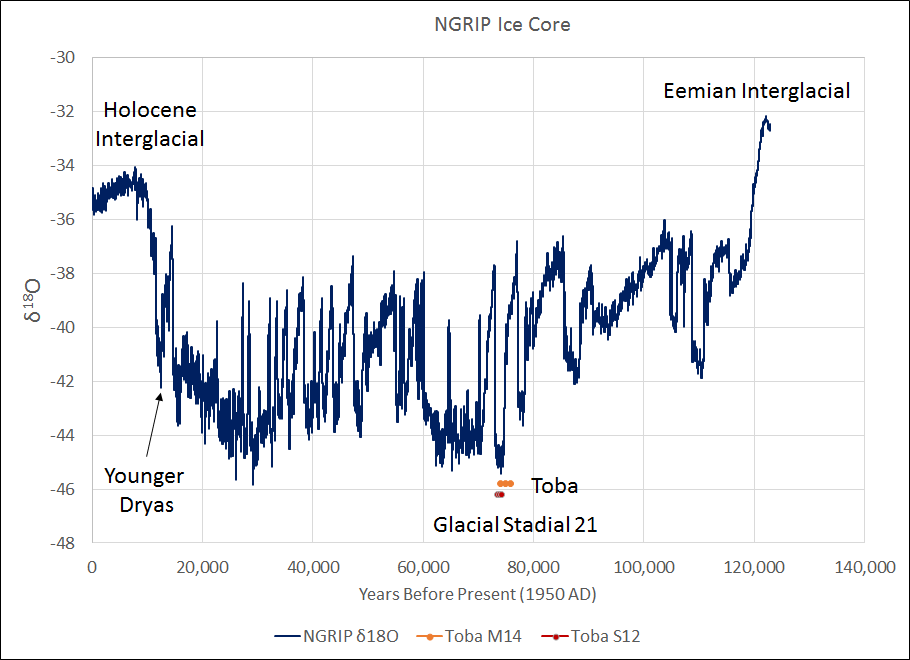
Despite the Eemian warmth, the Arctic wasn’t ice-free.
The last time that Arctic temperatures were significantly higher than today was the Early Holocene Thermal Maximum9, 10. The Holocene, however, is an interglacial cycle not concluded yet. This certainly justifies climatic evaluations of older, concluded warm interglacial cycles such as the last interglacial (LIG), i.e., Marine Isotope Stage (MIS) 5e (Eemian), lasting from about 130 to 115 ka and often proposed as a possible analog for our near-future climatic conditions on Earth11, 12. Based on proxy records from ice, terrestrial and marine archives, the LIG is characterized by an atmospheric CO2 concentration of about 290 ppm, i.e., similar to the pre-industrial (PI) value13, mean air temperatures in Northeast Siberia that were about 9 °C higher than today14, air temperatures above the Greenland NEEM ice core site of about 8 ± 4 °C above the mean of the past millennium15, North Atlantic sea-surface temperatures of about 2 °C higher than the modern (PI) temperatures12, 16, and a global sea level 5–9 m above the present sea level17. In the Nordic Seas, on the other hand, the Eemian might have been cooler than the Holocene due to a reduction in the northward flow of Atlantic surface water towards Fram Strait and the Arctic Ocean, indicating the complexity of the interglacial climate system and its evolution in the northern high latitudes12, 18, 19.Stein et al., 2017

The Arctic was “this warm” or warmer over most of the past 10,000 years…


The Arctic was intermittently “this warm” or warmer during the past 5,000 years:


The Arctic was quite possibly “this warm” or warmer during the early-mid 20th century:


Arctic sea ice extent was also lower than it is today over most of the past 10,000 years.

Conclusions
- If you don’t want your article to be ridiculed, make sure that the title/headline isn’t dumber than schist.
- Geologists should know that atmospheric CO2 and temperature aren’t interchangeable or synonymous.
- If atmospheric CO2 actually was a primary driver of climate change, the Arctic should be much warmer now than it was over the past 3 million years. It isn’t.
The University of Massachusetts Amherst earns a Ron White Lifetime Achievement Award…

References
Alley, R.B. 2000. “The Younger Dryas cold interval as viewed from central Greenland”. Quaternary Science Reviews 19:213-226.
Alley, R.B.. 2004. “GISP2 Ice Core Temperature and Accumulation Data”.
IGBP PAGES/World Data Center for Paleoclimatology Data Contribution Series #2004-013. NOAA/NGDC Paleoclimatology Program, Boulder CO, USA.
Grosjean, Martin, Suter, Peter, Trachsel, Mathias & Wanner, Heinz. (2007). “Ice‐borne prehistoric finds in the Swiss Alps reflect Holocene glacier fluctuations”. Journal of Quaternary Science. 22. 203 – 207. 10.1002/jqs.1111.
Kinnard, C., Zdanowicz,C.M., Koerner,R ., Fisher,D.A., 2008. “A changing Arctic seasonal ice zone–observations from 1870–2003 and possible oceanographic consequences”. 35, L02507. Kinnard_2008
Kobashi, T., J. P. Severinghaus, and K. Kawamura (2008a). “Argon and nitrogen isotopes of trapped air in the GISP2 ice core during the Holocene epoch (0–11,600 B.P.): Methodology and implications for gas loss processes”. Geochim. Cosmochim. Acta. 72, 4675– 4686, doi:10.1016/j.gca.2008.07.006.
Kobashi, T., Kawamura, K., Severinghaus, J. P., Barnola, J.‐M., Nakaegawa, T., Vinther, B. M., Johnsen, S. J., and Box, J. E. ( 2011). “High variability of Greenland surface temperature over the past 4000 years estimated from trapped air in an ice core”. Geophysical Research Letters. 38, L21501, doi:10.1029/2011GL049444.
Kobashi, T., Menviel, L., Jeltsch-Thömmes, A. et al. “Volcanic influence on centennial to millennial Holocene Greenland temperature change”. Scientific Reports 7, 1441 (2017). https://ift.tt/384l00f
McKay, N., Kaufman, D. “An extended Arctic proxy temperature database for the past 2,000 years”. Scientific Data 1. 140026 (2014). https://ift.tt/2H0rYaY
North Greenland Ice Core Project members. 2004. “High-resolution record of Northern Hemisphere climate extending into the last interglacial period”. Nature 431(7005):147-151.
Stein, R., Fahl, K., Gierz, P. et al. Arctic Ocean sea ice cover during the penultimate glacial and the last interglacial. Nat Commun 8, 373 (2017). https://ift.tt/3jQiAZl
Stein, R. , Fahl, K. , Schade, I. , Manerung, A. , Wassmuth, S. , Niessen, F. and Nam, S. (2017), Holocene variability in sea ice cover, primary production, and Pacific‐Water inflow and climate change in the Chukchi and East Siberian Seas (Arctic Ocean). J. Quaternary Sci., 32: 362-379. doi:10.1002/jqs.2929 stein2017
Related
via Watts Up With That?
November 6, 2020 at 04:36AM
 Iowa Climate Science Education