
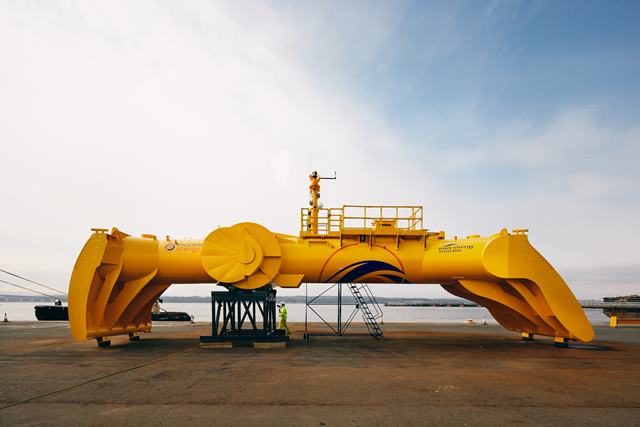
Mocean Energy’s Blue X wave energy converter at Forth Ports’ Rosyth Docks [image credit: Mocean Energy]
The article title says the experiment ‘is a blueprint for the future’, but tidal power devices have a long record of not exactly becoming a roaring success. When might this future arrive? Talk of being a ‘global leader’ sounds upbeat and optimistic, press-release style, but will there be enough – or any – followers? After the intro, we come to the prototype wave converter.
– – –
We’re standing, it seems, on the deck of a stocky, barge-like boat with yellow trim, going full steam, says the Institution of Mechanical Engineers.
Water whips past, flicking up foam. But the ‘boat’ is stationary – tethered to the sea floor, it is in fact a 1.5MW tidal energy generator.
Developed by Spanish firm Magallanes Renovables, the ATIR platform has two turbines submerged in the fast-flowing waters of the Fall of Warness, south of the island of Eday in the Orkneys.
The device is a piece of cutting-edge renewable-energy technology in a seemingly remote environment, but it is far from the only one here. Just 100m away there is another bright yellow tidal energy generator, the O2 by Orbital Marine Power.
Elsewhere, there are wave-energy converters and wind turbines. Onshore there are more wind turbines, electrolysers for the production of ‘green’ hydrogen, and infrastructure to put the gas to good use.
. . .
[Moving on, to a specific wave-energy converter …]
The Blue X device by Mocean Energy
Built entirely in Scotland, the 38-tonne machine has two main parts, connected by a giant hinge.
The front arm faces into the waves with a shovel-like part plunged 4m beneath the surface, forcing as much of the water’s energy as possible through the device. It houses a small deck, with a comms mast and access hatch, and one of two solar-panel installations.
The rear arm is much smaller, with another scoop-like extension beneath the water.
As waves travel along the length of the machine, its buoyancy forces it to flex around the hinge – once at the peak and once at the trough, rotating ±20º but accommodating more movement.
This reciprocal motion goes through a gearbox, where it is spun up to a higher speed and fed into the AC electrical generator.
The Blue X, forerunner of a planned utility-scale machine known as Blue Horizon, was created using generative design to find its optimal shape.
. . .
[Later, the solar panels are mentioned, but there’s a problem…]
The firm is also keen to integrate solar panels onto devices, and Blue X has two sets of panels when we visit.
Unfortunately, they are covered by seabirds – and, underneath the birds, a slight problem.
“We talk about bird poop a lot more now than I had expected,” says McNatt. “It’s a real challenge.”
Full article here.
via Tallbloke’s Talkshop
November 29, 2021 at 01:33PM
 Iowa Climate Science Education