Month: January 2022

Putting mRNA In The Food Supply

Grow and eat your own vaccines? | University of California Fifty years ago the United Nations, leading California academics and the New York Times wanted to poison the food and water supply in order to control population. TimesMachine: November 25, … Continue reading

via Real Climate Science

https://ift.tt/3I1FW9I

January 12, 2022 at 09:07AM

The first medically diagnosed case of….climate change?! Watch new Morano Minute

The doctor picked up the patient’s chart and penned in the words "climate change."

The post The first medically diagnosed case of….climate change?! Watch new Morano Minute appeared first on CFACT.

via CFACT

https://ift.tt/3rj17Oa

January 12, 2022 at 08:54AM

U.S. to shutter 14.9 GW of coal-fired & add 46.1 GW of utility scale solar PV in 2022

Guest “You can’t fix stupid” by David Middleton

JANUARY 11, 2022
Coal will account for 85% of U.S. electric generating capacity retirements in 2022

Operators have scheduled 14.9 gigawatts (GW) of electric generating capacity to retire in the United States during 2022, according to our latest inventory of electric generators. The majority of the scheduled retirements are coal-fired power plants (85%), followed by natural gas (8%) and nuclear (5%).

Coal. After substantial retirements of U.S. coal-fired electric generating capacity from 2015 to 2020 that averaged 11.0 GW a year, coal capacity retirements slowed to 4.6 GW in 2021. However, we expect retirement of coal-fired generators to increase again this year; 12.6 GW of coal capacity is scheduled to retire in 2022, or 6% of the coal-fired generating capacity that was operating at the end of 2021.

Most of the plants making up the operating U.S. coal fleet were built in the 1970s and 1980s. U.S. coal plants are retiring as the coal fleet ages and as coal-fired generators face increasing competition from natural gas and renewables.

The largest coal power plant planning to retire in 2022 is the 1,305-megawatt (MW) William H. Zimmer plant in Ohio. Morgantown Generating Station in Maryland plans to retire its two coal-fired units (1,205 MW combined) in June, followed by two of the plant’s six smaller petroleum-fired units in September.

[…]

EIA

JANUARY 10, 2022
Solar power will account for nearly half of new U.S. electric generating capacity in 2022

In 2022, we expect 46.1 gigawatts (GW) of new utility-scale electric generating capacity to be added to the U.S. power grid, according to our Preliminary Monthly Electric Generator Inventory. Almost half of the planned 2022 capacity additions are solar, followed by natural gas at 21% and wind at 17%.

Developers and power plant owners report planned additions to us in our annual and monthly electric generator surveys. In the annual survey, we ask respondents to provide planned online dates for generators coming online in the next five years. The monthly survey tracks the status of generators coming online based on reported in-service dates.

Solar. We expect U.S. utility-scale solar generating capacity to grow by 21.5 GW in 2022. This planned new capacity would surpass last year’s 15.5 GW of solar capacity additions, an estimate based on reported additions through October (8.7 GW) and additions scheduled for the last two months of 2021 (6.9 GW). Most planned solar additions in 2022 will be in Texas (6.1 GW, or 28% of the national total), followed by California (4.0 GW).

[…]

EIA

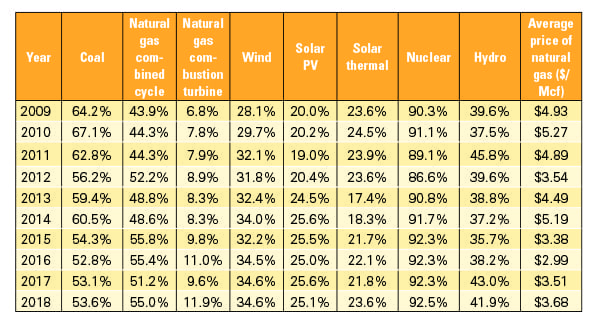
Not all generating capacities are created equal. No power plant can constantly operate at 100% of it’s nameplate capacity. All power plants require maintenance. The theoretical capacity factor is the percentage of the generating capacity a power plant can deliver at a 100% utilization rate. The realized capacity factor is driven by the utilization rate. Nuclear power plants generally have a 95% theoretical capacity factor and nearly 100% utilization rates. Therefore, their realized capacity factors are usually >90%. Solar and wind power plants also have nearly 100% utilization rates; however they have very low theoretical capacity factors because they are time of day and weather-dependent.

The theoretical capacity factor of coal-fired power plants is about 85%. The realized capacity factor is variable and tied to the price of natural gas. The higher natural gas prices go, the greater the utilization rate of coal-fired power plants.

Table 1. Installed net summer generating capacity in the U.S. by generation source. Source: U.S. Energy Information Administration (EIA). Power Mag

The EIA forecasts that natural prices will average around $4/mmBTU in 2022.

The average capacity factor of coal-fired power plants will probably be in the range of 55-60% in 2022.

Utility scale solar PV power plants achieve an average capacity factor of 25%.

The theoretical output of 14.9 GW of coal-fired capacity is greater than the average achieved capacity factor of solar PV. And the actual output of solar PV is generally the maximum achievable output.

Capacity Factor GW GWh/yr
Coal 85% 14.9   110,945
Solar PV 25% 46.1     99,747

Bear in mind that the coal-fired power plants can run 24/7/365… including nights and cloudy days. Even using the anticipated capacity factors with a $4/mmBTU natural gas price, the soon to be retired 14.9 GW of coal-fired capacity would have generated 71-78% of the electricity as the 46.1 GW of solar PV will.

Capacity Factor GW GWh/yr
Coal 60% 14.9     78,314 78%
Solar PV 25% 46.1   100,959
Capacity Factor GW GWh/yr
Coal 55% 14.9     71,788 71%
Solar PV 25% 46.1   100,959

To make matters worse, solar power tends to deliver its maximum output when demand is at its lowest. The Southwest region includes Arizona, southern Nevada and most of New Mexico. Nuclear and coal-fired power plants provide about 2/3 of very steady baseload. Natural gas provides most of the rest of the baseload and ramps up during peak demand hours (8-9 AM and 7-9 PM). Solar power ramps up as demand falls off from mid-morning to mid-afternoon.

When you replace dependable, 24/7/365 base load with this:

You get a “duck curve“…

The moral to the story…

via Watts Up With That?

https://ift.tt/3fjrldv

January 12, 2022 at 08:34AM

Firm action on Green Levies and funds could win back support for government

By Paul Homewood


 image

London, 12 January – Net Zero Watch has called on the government to take firm action and turn the energy crisis into an opportunity for the finances of households, businesses and the economy.

The campaign group is today publishing a simple guide on the options available to the government to effectively solve the energy bills crisis in the short and medium term.

At a time when millions of households are facing the prospects of sky-rocketing energy bills ministers should consider offsetting any costs arising from the measures taken by delaying international green funds – some £12 billion in total – which the government has pledged to hand out over the next five years.

The British people cannot afford handing out billions of pounds every year to green investors abroad while millions of families face unaffordable energy bills at home. Charity starts at home,” Dr Benny Peiser, Net Zero Watch director said.

The energy crisis is the result of failed policy decisions stretching back decades, and presents short-term hardship problems that are extremely difficult to address, as well fundamental problems that require long-term reform of energy policy.

However, we show that with firm action on green levies the government can redeem its reputation and emerge as a consumer champion.

In the short-term government could consider:

• Transfer of the costs of Contracts for Difference renewables subsidies to general taxation (a saving of £2.1 billion a year on the national electricity bill)

• Radical readjustment of the Renewables Obligation subsidy (a saving of up to £6.6 billion a year on the national electricity bill).

• A VAT holiday on gas and electricity, and also, for consistency, on heating oil. This would give a modest but worthwhile saving of 5% on the bill.

• Special grants to pensioners, adding to the Winter Fuel Payment, and increasing its catchment to include all pensioners.

These measures could provide direct relief to bills of households and also to industrial and commercial consumers, containing the knock-on effect on goods and services, and therefore limiting any increase in inflation.

In the medium and longer term the UK could resume fracking, could remove obstacles to the replacement of older CCGTs, could accelerate the introduction of small modular nuclear reactors for both electricity and industrial heat, could wind down and phase out all renewables subsidies, and should ensure that the renewables fleet is compelled to pay for its own system management costs and grid expansion.

These measures would provide direct and immediate relief to households – a saving equivalent to about £500 each – and also to industrial and commercial consumers.

These short-term solutions would also stimulate economic growth and reduce inflationary pressure.
Dr Benny Peiser, Net Zero Watch director, said:

By taking radical action Boris Johnson has a chance to turn the deepening energy crisis into an opportunity to reform Britain’s failing energy policies and emerge as a consumer champion. Unless he grabs this chance now he is unlikely to save consumers, businesses and himself from economic devastation and political oblivion.”

Dr John Constable, Net Zero Watch energy editor, said:

The current energy cost crisis is the result of two decades of mistaken environmental policies. Cutting the £10 billion a year burden of the green levies is the single largest and most effective measure, and will have to be done in any case at some point, so Mr Johnson could regard this as a golden opportunity to improve British competitiveness post-Brexit.”

via NOT A LOT OF PEOPLE KNOW THAT

https://ift.tt/3tlA5Z8

January 12, 2022 at 05:21AM