Month: January 2022

Deaths from 1 degree of warming nothing compared to an Electricity Grid collapse for a year

Even the worst imaginary scenarios for global warming are nothing compared to a year without electricity. Bunky Mortimer III thinks US priorities are screwed.

The US will spend some $555b to prevent a theoretical warming of a degree or two. A warming which may not occur for a century, if at all, and about which the largest competitors to the USA are doing nothing.

In contrast, a solar Carrington event, one nuclear blast, or a cyber attack taking out just nine interconnector sites could collapse the entire US grid for 18 months.

It’s hard not to agree. The West is in apoplexy over the environmental degradation affecting polar bears, but the environment we need the most right now is the one with fresh water, edible food and a room temperature above freezing.

Taki’s Magazine

A prolonged collapse of this nation’s electrical grid—through starvation, disease, and societal collapse—could result in the death of up to 90% of the U.S. population. This figure has not been disputed, yet this prospect has received virtually no attention from policy makers or the media. The environmental issue holding center stage, of course, is global warming.

The weak point are the Extra High Voltage transformers which may take one to two years to replace. Not many EHV Transformers were made in the US, and concerns were raised a decade ago, even thirty years ago. Some estimate the US manufacturing is so low they have to import 85% of them. By 2016, not much had changed, despite the urgency, and dire threat. If a crunch is widespread, these transformers will be impossible to get without long delays.

 A study published in 2010 for the Congressional EMP Commission calculated that a nuclear detonation 170 kilometers over the United States would collapse the entire U.S. power grid.

A 2017 report by the Department of Defense states that “the United States today lives in a virtual glass house.” In 2018 the Department of Homeland Security issued an alert that Russia could shut down American power plants at will. The grid is also vulnerable to small-scale coordinated military operations. An internal Federal Energy Regulatory Commission memo states that “destroy nine interconnector substations and a transformer manufacturer and the entire United States grid would be down for 18 months, possibly longer.”

With no power, there’s no frozen food, no water pumps, no fuel pumps, no banking, no internet, no phones, and soon no deliveries, no fertilizer, and no hospitals.

Hopefully adversaries of the USA haven’t been reading old reports by the US Dept of Cybersecurity, Energy Security, or Emergency Response.

Grids, who needs em? Even polar bears do. A prolonged US Grid collapse would have people hunting seals too.


10 out of 10 based on 1 rating

via JoNova

https://ift.tt/3qZmL9H

January 7, 2022 at 12:34PM

Decembers 1961 & 1971

By Paul Homewood


December 1961 can be summed up in two words – cold and snow. The month was the 9th coldest on record since 1884.

The first week saw widespread snow and severe gales, whilst the Christmas week was one of the coldest of the century, with more heavy snow:

 image

image

image

image

image

In total contrast, December 1971 was very mild. The UK mean temperature was 6.0C, higher than the preceding month, It was also higher than December 2021, which clocked 5.3C.

Temperatures were particularly above average in Scotland, where it is still the second warmest December on record behind 1988.

Top temperature was 16.3C at Colwyn Bay, just below the 16.5C clocked last month:

image

image

 https://digital.nmla.metoffice.gov.uk/SO_7498a04d-6a40-4207-a27f-772663ffd2fc/

In this monthly lookback through the archives, two things are abundantly clear for every month we have checked:

1) Weather was every bit as extreme in the past

2) The weather can vary enormously from one year to another. This can not be better exemplified than the series for December, which has offered up very mild months to very cold ones, very dry ones to very wet, and very snowy ones to very little snow.

via NOT A LOT OF PEOPLE KNOW THAT

https://ift.tt/3EZK5cF

January 7, 2022 at 12:21PM

Where Is The Top Of The Atmosphere?

Guest Post by Willis Eschenbach

In my last post, entitled Advection, I was discussing the online MODTRAN Infrared Light In The Atmosphere model. A commenter pointed out that in the past I’d wondered about why the MODTRAN results showed that a doubling of CO2 caused a clear-sky top-of-atmosphere (TOA) decrease in upwelling longwave (LW) radiation of less than the canonical value of 3.7 watts per square meter (W/m2) per doubling of CO2. Here’s that data.

Figure 1. MODTRAN results for several doublings of CO2, clear-sky only, measured at the top of the atmosphere (TOA). Units are watts per square meter (W/m2).

To figure out exactly why these values were so low, I went back to the paper giving the 3.7 W/m2 value, New estimates of radiative forcing due to well-mixed greenhouse gases, by Mhyre et al. I also recalled that in my earlier thread, commenters had mentioned that there were two “top-of-atmosphere” definitions. One of them was what I’d used for Figure 1, looking down from 70 km above the surface. And the other definition of “top-of-atmosphere” was the tropopause. Upon re-reading Mhyre and doing some further research, I confirmed that the measurements and model results giving the canonical value of 3.7 W/m2 per doubling were taken, not at the actual top of the atmosphere (TOA), but at the tropopause.

The tropopause is the boundary between the troposphere and the stratosphere. It is the location where the temperature of the atmosphere stops getting colder with altitude. The tropopause is at different altitudes at different times and locations.

The MODTRAN model offers a graph of the atmospheric temperature profile at various locations and seasons. Here’s the profile for what is called the “US Standard Atmosphere”.

Figure 2. Profile showing temperature versus altitude, US Standard Atmosphere

My calculations for Figure 1 were done from 70 km looking down … but as you can see, at that location the tropopause in Figure 2 is only at 11 km.

So I redid my MODTRAN runs shown in Figure 1, this time measuring from the appropriate tropopause levels at each location. You have to take two measurements when calculating longwave changes at the tropopause—one looking upwards and one looking downwards. The final answer is the net of the two changes.

With that as a prologue, here are my results. I’ve compared them to the results shown in Table 1 of the Mhyre et al. paper. My average results calculated as in the Mhyre et al. paper give a troposphere clear-sky increase in longwave (LW) absorption resulting from a doubling of CO2 of 4.97 watts per square meter (W/m2). This is extremely close to the Mhyre et al. Table 1 figure of 5.04 W/m2 per doubling—it’s less than 0.1 W/m2 difference. And adding in the good agreement with the CERES figures noted in my last post, these results give me confidence in the MODTRAN model.

Figure 3. As in Figure 1, except measured at the tropopause rather than from 70 km up at the top of the atmosphere (TOA).

There were a couple of surprising things about Figure 3. First, there is a slight reduction in the change per doubling as the absolute value of the atmospheric CO2 level increases. Unexpected. Presumably, this reflects a gradual saturation of the absorption bands. However, it’s not large enough to affect most calculations.

Second, and more importantly, I did not expect such a large difference between measurements taken at the two levels. The TOA measurements average about 52% smaller than the tropopause measurements.

This is interesting because of the theory of why a CO2 increase leads to surface warming. The theory goes like this:


    • The amount of atmospheric CO2 is increasing.

    • This absorbs more upwelling longwave radiation, which leads to unbalanced radiation at the top of the atmosphere (TOA). This is the TOA balance between incoming sunlight (after some of the sunlight is reflected back to space) and outgoing longwave radiation from the surface and the atmosphere.

    • In order to restore the balance so that incoming radiation equals outbound radiation, the surface perforce must, has to, is required to warm up until there’s enough additional upwelling longwave to restore the balance.


I’ve pointed out the problem with this theory, which is that there are a number of other ways to restore the TOA balance. These include:

   • Increased cloud or surface reflections can reduce the amount of incoming sunlight.

    • Increased absorption of sunlight by the atmospheric aerosols and clouds can lead to greater upwelling longwave.

    • Increases in the number or duration of thunderstorms move additional surface heat into the troposphere, moving it above some of the greenhouse gases, and leading to increased upwelling TOA longwave.

• Increases in the amount of energy advected from the tropics to the poles increase the upwelling TOA longwave

    • A change in the fraction of atmospheric radiation going upwards vs. downwards can lead to increased upwelling radiation.

So there is no requirement that surface temperatures increase in response to increasing CO2. Increasing surface temperatures are only one among a number of ways to restore the TOA radiation balance.

With that as prologue, the insight for me from the big difference between TOA and troposphere measurements is that I’ve been thinking that the imbalance at the actual TOA from a doubling of CO2 would be 3.7 W/m2 … but in fact, it is only about half of that, about 1.9 W/m2.

Now, as I pointed out just above, there are a variety of ways that the TOA radiation balance can be restored. So how much of that is from surface warming?

Well, here’s the relationship between the surface temperature and the upwelling TOA longwave.

Figure 4. Scatterplot, average upwelling TOA longwave versus surface temperature, 1° latitude by 1° longitude gridcells.

As you might expect, over much of the planet as the surface warms, the upwelling TOA longwave increases. This makes sense, a warmer surface radiates more longwave, so you’d think there would be increasing upwelling TOA longwave.

But at temperatures above about 26°C, the situation changes rapidly. Above that temperature, the upwelling TOA longwave drops very rapidly with increasing temperature.

I ascribe this to the action of tropical thunderstorms. These form preferentially at temperatures above ~ 26°C. Here’s a look at the effect using two very different datasets.

Figure 5. Rainfall from tropical thunderstorms versus sea surface temperatures. Red dots are from the Tropical Rainfall Measuring Mission. Blue dots are from the TAO/TRITON moored ocean buoy array.

And what is the long-term net of all of this over the entire globe? Figure 6 shows that result.

Figure 6. Scatterplot, monthly top-of-atmosphere upwelling longwave (TOA LW) versus surface temperature.

Other things being equal (which they never are), according to the CERES data a 1°C increase in global average temperature leads to a 1.9 W/m2 increase in upwelling TOA LW … which, by what is clearly a coincidence, is the amount of the decrease in upwelling TOA LW which would result from a doubling of CO2.

It’s worth noting in this context that because we are dealing with radiation in the atmosphere, things happen at the speed of light. A cross-correlation analysis shows that there is no delay between monthly changes in surface temperature and monthly changes in TOA longwave.

Figure 7. Cross-correlation, monthly top-of-atmosphere upwelling longwave (TOA LW) and surface temperature. Positive values show TOA LW lagging surface temperature, negative values show surface temperature lagging TOA LW. Overall, there is no lag between the two.

Since there is no lag in this, and since it directly relates surface temperature to TOA longwave radiation changes, it would seem to me that this would give a good estimate for the equilibrium climate sensitivity (ECS) of 1°C per doubling of CO2 … but what do I know, I was born yesterday.

Next, the calculated decrease in TOA upwelling LW ascribable to the increase in CO2 over the 21-year period is about -0.3 W/m2. The change in surface temperature over the period is ~ 0.4°C. This has increased the TOA LW by ~ 0.8 W/m2 … meaning that the surface is warming more than twice as fast as would be required to offset the TOA imbalance.

Why is the surface warming faster than the CO2 increase would suggest? Well, the main reason is the increase in the amount of sunlight absorbed by the surface. That solar energy has increased by 1.5 W/m2 over the 21-year period of the CERES record … as I said, other things are never equal.

My very best regards to all,

w.

PS: In analyses such as this one, it is generally useful to keep in mind what I modestly call “Willis’s First Rule Of Climate”, which states

“In climate, everything is connected to everything else … which in turn is connected to everything else … except when it isn’t.”

MY USUAL: I can defend my own words, but not your interpretation of my words. When you comment, please QUOTE THE EXACT WORDS that you are discussing. This avoids endless misunderstandings.

via Watts Up With That?

https://ift.tt/3q2KXc2

January 7, 2022 at 12:05PM

Paul Ehrlich Institute Data: Death Rate From COVID mRNA Vaccines 21 Times Higher Than All Other Vaccines!

German site Transparenztest.de has compared the figures for adverse events of COVID mRNA vaccines with other vaccines. The results are nothing less than frightening

Citing the figures in the current safety report of Germany’s renowned Paul Ehrlich Institute (PEI) from December 23, 2021, Transparenztest.de found “frightening” results: “In the last eleven months, 4 times as many suspected adverse reaction reports and 4 times as many deaths in absolute numbers were reported for COVID vaccines alone than in the last 20 years for the totality of all vaccines used in Germany.”

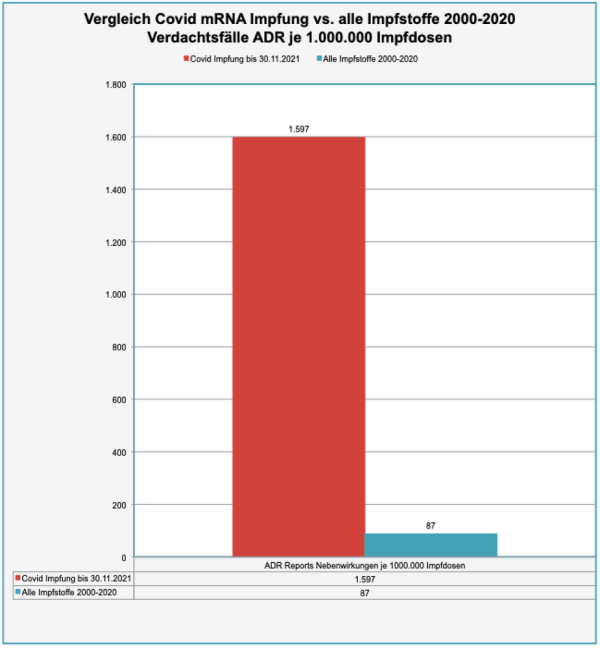
Using the PEI’s latest updated figures, a total of 123,347,849 doses of COVID mRNA vaccine had been administered in Germany up to November 30th, 2021. Correspondingly 196,974 adverse drug reactions (ADR) were reported, of which 1,919 were deaths.

Meanwhile during the period of 2000-2020, some 625,500,000 doses of all other vaccines were given, of which there were only 54,448 ADRs, of which 456 were deaths.

18 times more ADRs per million

When one compares the ADRs per million doses, there were 18 times more ADRs per million doses for COVID mRNA vaccines than for all the other vaccines:

Transparenztest, Rohdaten PEI Sicherheitsbericht 23.12.21, DB-UAW Datenbank, Vergleich Covid Impfung vs. alle Impfstoffe 2000-2020 V-Nebenwirkungen je 1.000.000 Impfdosen, 04.01.22

Comparison of ADRs per million vaccine doses in Germany. Red = COVID mRNA vaccines up to November 30, 2021; blue = all other vaccines total 2000-2020. There’s an 18-fold more suspected cases with COVID vaccines compared to all other vaccines from 2000-2020. Chart: Transparenztest.de

Shocking ADR reports for deaths

When it comes to deaths from the mRNA vaccines, the results compared to all other vaccines are astonishingly shocking.

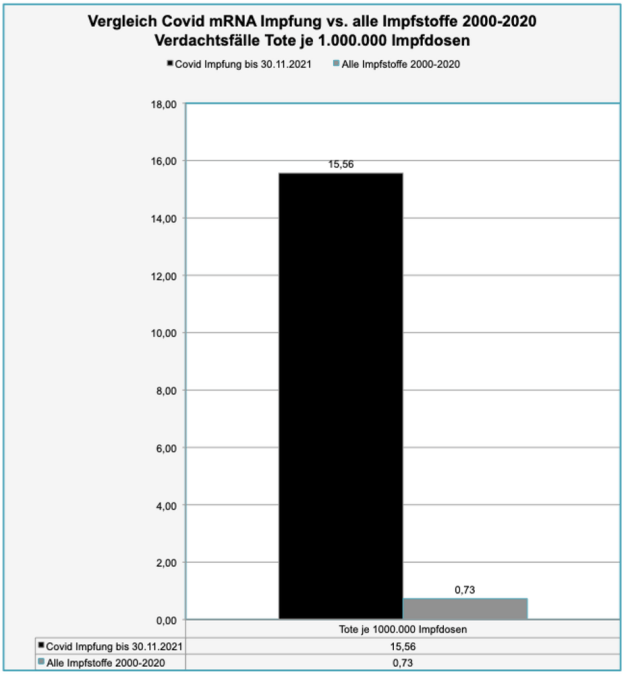
The following chart compares the COVID mRNA vaccine deaths per million doses in Germany to all other vaccines administered from 2000-2020:

Transparenztest, Rohdaten PEI Sicherheitsbericht 23.12.21, DB-UAW Datenbank, Vergleich Covid Impfung vs. alle Impfstoffe 2000-2020 V-Todesfälle je 1.000.000 Impfdosen, 04.01.22

Using the raw data from the December 23, 2021 PEI safety report, DB-UAW database, the above chart is a comparison of COVID mRNA vaccinations up to 30 Nov 2021 (black) vs all vaccines 2000-2020 (gray) in deaths per 1,000,000 vaccine doses. Chart: Transparenztest.de

In terms of presumed deaths per 1,000,000 vaccine doses, there are 21 times as many deaths with COVID vaccines as with all other vaccines vaccinated in Germany in the period 2000-2020. Expressed as a percentage, that is 2,200%.

Huge underreporting 

A meta-study by Hazell et. al suggested that the average of “underreporting” in ADR databases was 94%. And according to a PEI report, the rate of reported suspected cases may be as low as 5%.

Moreover, according to the FDA and CDC-operated VAERS vaccination database, the rate of reported cases is only 1%. The number of unreported cases is thus estimated at 99%. Deaths and injuries are extremely likely far more widespread.

Using the 95% figure for underreporting, Germany’s deaths from COVID mRNA vaccines thus would be 38,380 deaths. Note: this figure is only an estimate and an extrapolation based on underreporting.

Every booster more potentially lethal

Also extremely worrisome is that data show how the rate of ADRs rises with each COVID booster shot. The more boosters a patient takes, the greater the risk of suffering an ADR becomes.

Transparenztest.de also produced a chart showing the higher risk after a triple vaccination (booster), depending on the vaccination dose. What follows is a comparison of ADR reports: Deaths per 1,000,000 vaccine doses after triple vaccination (booster)

Transparenztest, Rohdaten PEI Sicherheitsbericht 23.12.21, DB-UAW Datenbank, Vergleich Covid Impfung vs. alle Impfstoffe 2000-2020 V-Todesfälle je 1.000.000 Impfdosen nach 3-fach Impfung, (Booster), 04.01.22

Transparenztest.de, raw data PEI safety report December 23, 2021, DB-UAW database. Comparison COVID mRNA vaccination (black) vs all vaccines 2000-2020 (gray) in deaths per 1,000,000 vaccine doses after triple vaccination, (booster). Chart: Transparenztest.de

Transparenztest.de summarizes:

The results are frightening. The difference factor to the other vaccinations increases by a factor of 43. With each additional vaccination dose (booster 4 / 5), the ratio worsens accordingly, or the risk of side effects resulting in death increases. The same applies, of course, to all other side effects.”

Donate – choose an amount

via NoTricksZone

https://ift.tt/3n5zrLo

January 7, 2022 at 11:59AM