Month: January 2022

Finally the numbers: Omicron is one tenth as severe as Delta. Good news

Finally the numbers: Omicron is one tenth as severe as Delta. Good news

The world has been waiting for better data on Omicron. Looking for the turning point that suggests we might have seen the worst.

We couldn’t know if the South African experience would translate to the overweight, indoor and diabetic parts of the world given 60% in South Africa had already had Covid — plus it was summer, and that part of the world is more familiar with certain anti-virals.

But this is about as good as we could have hoped:

DailyMail, UK


And on hospitalizations

The hospitalization curve in the UK has just (maybe) started to decline, and if there are no surprises, then it appears Omicron is roughly kinda 10% as bad as Delta was.
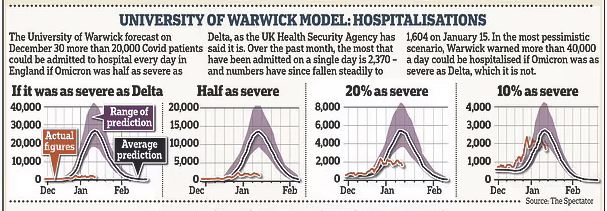
Hospitalizations in the UK, Omicron

Modelling Hospitalizations in the UK. Omicron


I know some will feel that this is no news at all and we could see this coming a long way back. But bear in mind that in South Africa, the country far ahead of us all, the deaths have only just plateaued the last three days (maybe).

The peak of infections in South Africa was December 17th. So that’s a full month’s lag.
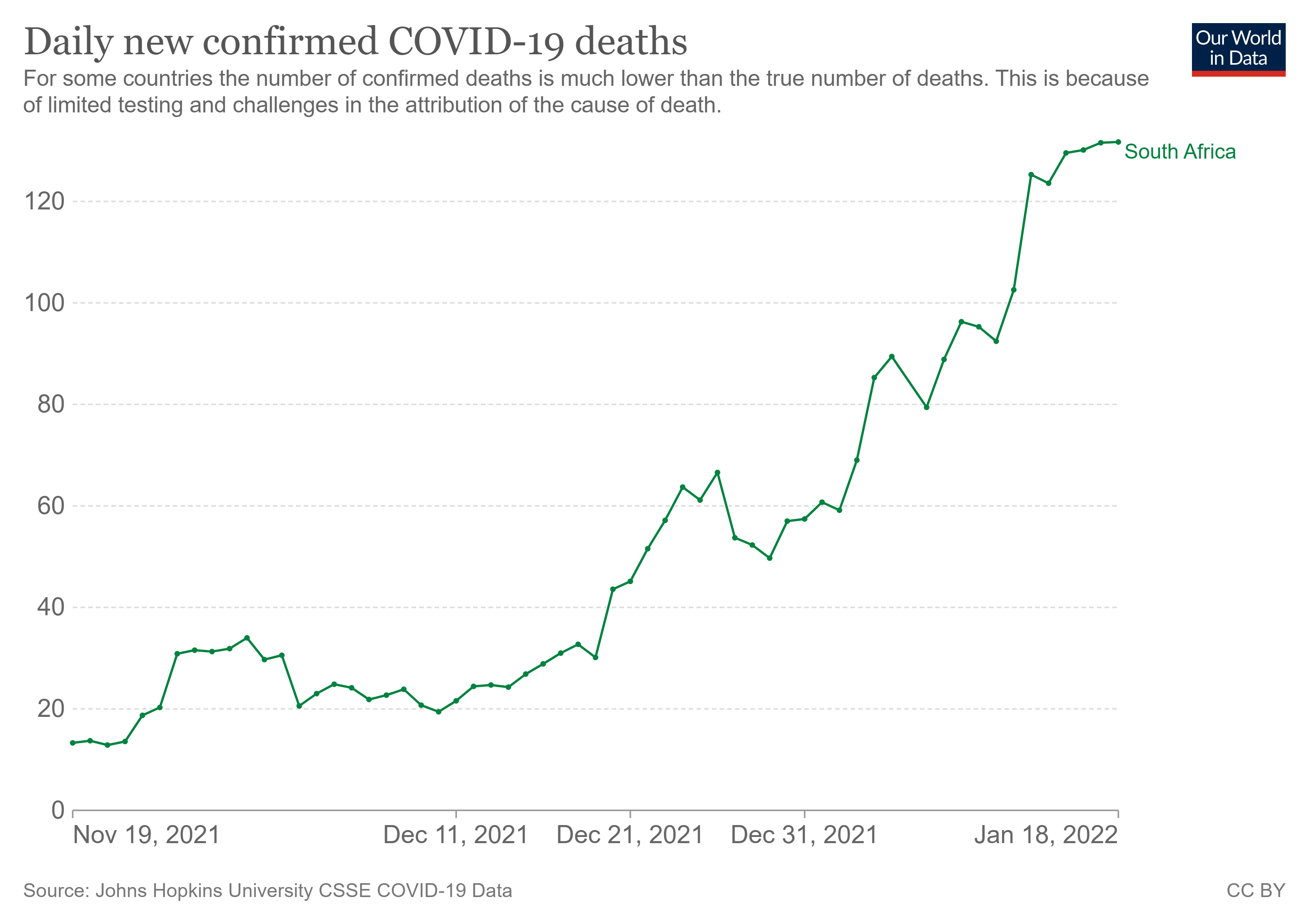
Deaths in South Africa due to Omicron. Graph. OWID.

Deaths may have only just hit the peak in South Africa. Graph OWID.


And right now, deaths are rising around the world, with the exception of Germany for some reason:
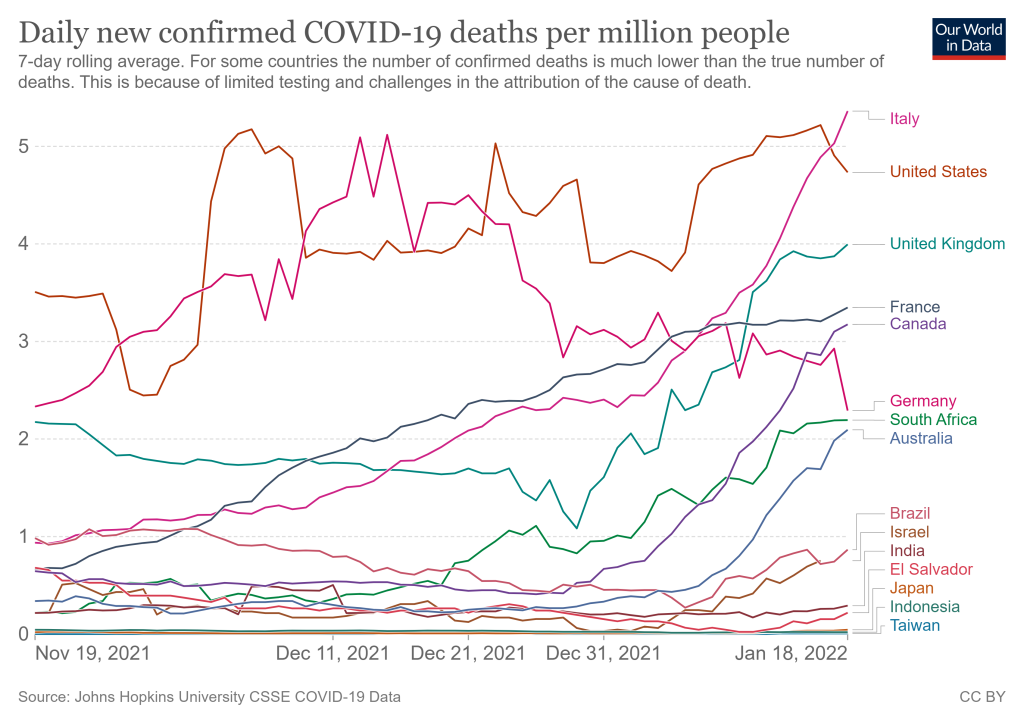
Deaths Omicron, many countries. Graph.

Source. OWID

There are plenty of ways this could have turned out differently. Even now, we don’t know the after effects or “sequelae” —  like the long Covid tally, or how long natural immunity will last, or whether there is some inflammatory, or autoimmune side effect. We are not at the end of the Omicron track yet. And as long as we suppress safe cheap drugs and inject 90% of the population with a leaky ineffective vaccine, the next variant-of-concern is in production right now.

0 out of 10 based on 0 rating

via JoNova

https://ift.tt/3o1yvIr

January 19, 2022 at 10:59AM

California Drought Update

By Paul Homewood


The BBC called it a megadrought, so how is that drought going in California?


Climate at a Glance | National Centers for Environmental Information (NCEI) (noaa.gov)

We’ve heard a lot about California drought in the last few years, but the data continues to show that it has been no worse than several others since 1895.

News you won’t hear on the BBC!

via NOT A LOT OF PEOPLE KNOW THAT

https://ift.tt/32cQQdC

January 19, 2022 at 09:27AM

Tomorrow There Will Be Rain and Social Collapse

This is not so much an article as a hastily thrown together note that provides the flimsy pretext for starting a discussion regarding the role of the Met Office in the climate debate.  It started as a comment posted by myself on Open Mic, drawing attention to a Daily Mail article that leads with the headline: “The Met Office warns of armed militias roaming a UK ravaged by climate change in doomsday report.”

According to the Daily Mail, the Met Office study predicts:

“… a surge in ‘Right-wing populism’, resulting in the collapse of ‘political and governance systems’. After that ‘a tipping point is reached when the police and justice system (as known in the past) cease to exist’.”

The newspaper says of the same study that:

“It advances the thesis that the most ‘sustainable’ scenario for surviving global warming would be the ‘establishment of a federal UK, with citizens’ assemblies becoming the “primary” decision-making mode’ and the UK re-entering ‘a progressive and expanded European Union’.”

It should be obvious to all that an agency tasked with a primary role of providing weather forecasts should not be in the business of offering socio-political or socio-economic predictions.

Thanks to some sterling work from dfhunter (alias Dougie, alias dfhunter) the source of the Daily Mail report was identified and brought to my attention. It is actually a study produced by UK-SCAPE as part of their Project SPEED (Spatially explicit Projections of EnvironmEntal Drivers). The output comprises five sub-studies, each speculating upon so-called Shared Socioeconomic Pathways (SSPs). On its website, UK-SCAPE explains that:

“The UK-SSPs products have been jointly developed with Cambridge Econometrics, University of Edinburgh and University of Exeter through co-funding from the Met Office as part of the UK Climate Resilience Programme (DN420214 – CR19-3).”

If anything, this makes the Met Office’s involvement look all the more inappropriate. The real concerns, however, materialize upon reading the detail in the study. As explained:

“Shared Socioeconomic Pathways (SSPs) describe a set of alternative plausible trajectories of societal development, which are based on hypotheses about which societal elements are the most important determinants of challenges to climate change mitigation and adaptation.”

The five supposedly ‘plausible’ developments are:

  • SSP 1 Sustainability: “Taking the Green Road” (in which the UK chooses to fully adopt green politics)
  • SSP 2 Middle of the road (in which there are intermediate levels of challenge for both mitigation and adaptation)
  • SSP 3 Regional Rivalry: “A Rocky Road” (for which climate change is not taken seriously and many nightmare outcomes are duly predicted)
  • SSP 4 Inequality: “A Road Divided” (for which adaption challenges dominate)
  • SSP 5 Fossil-fuelled Development: “Taking the Highway” (In which mitigation challenges dominate)

You need to look at the scenario reports yourself to fully appreciate them. Suffice it to say that the words ‘plausible’ and ‘hypotheses’ are being egregiously abused here by the architects of the SSPs and that only by taking the ‘Green Road’ do things turn out well for society come 2100.

So rather than a serious study undertaken by serious academics, the whole thing comes across as a puerile, political exercise – nothing more than fanciful contrivances created on behalf of the Green Party and dressed up to look like serious futurology. However, I don’t want to say much more for fear of putting you off reading the study for yourself. What I actually want is for as many people as possible to do so and to comment below. The more that this sort of naked and simplistic politicking is exposed for what it is, the better.

I’m sure that the Met Office believes it is flying high a high kite on this one but, from where I am stood, it looks more like what an aviation accident expert would refer to as ‘CFIT’ –  Controlled Flight Into Terrain.

via Climate Scepticism

https://ift.tt/33sezY6

January 19, 2022 at 09:26AM

SSE Chief Talks With Forked-Tongue!

By Paul Homewood


h/t Dave Ward


 image

In my two decades working in the energy industry we have faced seemingly impossible choices.

Do we cut carbon emissions – or do we keep the lights on and the bills affordable? Do we build new infrastructure cheaply – or do we prioritise UK jobs and supply chains?

You could be forgiven for thinking these choices are now starker than ever.

But only by building more of our own clean energy infrastructure here in Britain can we protect ourselves from the next energy crisis.

Let me give an example.

We recently finalised arrangements for the third phase of building at Dogger Bank, the world’s largest offshore wind farm, which we’re constructing off the north-east coast of England.

Each of 190 turbines will be almost as tall as the Shard. Just one turn of its giant blades will be enough to power a home with clean electricity for more than two days. Sounds expensive? You might be surprised.

Like most new low-carbon generation being built, Dogger Bank has a ‘contract for difference’ (CfD).

This means it is paid a fixed price for its output, regardless of the wholesale price at the time. When the wholesale price is lower than this ‘strike price’, it receives a top-up payment to bridge the gap.

When the wholesale price is higher, as it is now, the generator pays the money back into the pot, which should result in bills being lower than otherwise through a reduced price cap and lower tariffs.

In recent months, Dogger Bank’s strike price has been under £50 per megawatt hour compared with a wholesale price north of £200.

https://www.dailymail.co.uk/money/markets/article-10415679/We-solve-clean-energy-conundrum-says-SSE-boss.html


What he does not tell you is that those CfDs can be torn up at any time by SSE, who can then take advantage of higher market prices. The penalty for doing so is miniscule.

Will Mr Phillips-Davies give a categorical assurance that SSE will do no such thing?

SSE currently own two operational offshore wind farms:

image

Beatrice is paid £164.73/MWh, three times the historical market price:

image

https://www.lowcarboncontracts.uk/cfd-register/register/INV-BEA-002/


Meanwhile Greater Gabbard is subsidised via ROCs to the tune of £100/MWh, which they receive on top of the income from sales of electricity. With a wholesale price of £200.MWh, SSE are getting an obscene £300/MWh for every unit of electricity they sell.

Funny how Mr Phillips-Davies forgot to mention these inconvenient facts!

via NOT A LOT OF PEOPLE KNOW THAT

https://ift.tt/3GVdVk0

January 19, 2022 at 08:57AM