Month: April 2022

Guest post by Rafe Champion. Energy security on the edge of a cliff

We are approaching a tipping point in the electricity system where there will not be enough dispatchable power available to get through windless nights. When solar and wind power are both out of action at the same time, clearly the lights will go out unless there is 10%% backup from conventional power. Forget about grid-scale storage, there is none in sight for the foreseeable future that is feasible or affordable.

The RE enthusiasts get excited every time they record more penetration of wind and solar into the grid. They don’t appear to notice that the same AEMO data that record increasing penetration, , also show zero penetration on windless nights. That is especially clear in South Australia where there is always a deficit when the wind is low overnight. They depend on brown coal power from Victoria to keep the lights on, and no amount of additional RE capacity will help.

Those periods of zero penetration are like the holes in the wall of a dam, or gaps in the fence around a paddock of sheep or cattle, or gaps in a flood protection levee. If the dam has a gap in the wall it ceases to function as a dam, the holes in the fence allow the stock to get out and gaps in a flood protection levee eliminate the protective effect.

Building more installed capacity of RE does not help on windless nights because when next to no power being generated, increasing the installed capacity of the generators by a factor of five, ten or twenty still delivers next to nothing.

To see what that looks like in practice, see the chart from a paper by Paul McArdle who has been studying the low wind problem for many years. Jo Nova reproduced the chart in a recent post.

THE IRRIGATION SCHEME WITH NO WATER

We are approaching the situation of a massive irrigation scheme with all the infrastructure in place, dams, canals, pumping stations, and the like. The crops are planted but when we get to the growing season we find we there is not enough water in the dams for the system to work so the plants all die. This irrigation scheme is actually an addition to the regular farming system that still exists to there will be enough food but it will be very expensive if you count the cost of the useless irrigation system that the taxpayers have funded.

The point is that nobody checked the rainfall figures to be sure that the dams could be filled and the works were built in hope, on the back of government subsidies, without due diligence to check the viability of the project.

Our RE system will soon be revealed as an irrigation scheme without water, we just need to lose another coal-fired power station or two and we will be travelling without spare capacity to handle peak loads. Indeed we may scrape along without Liddell but when the massive Eraring plant goes we will be in deep trouble every time the wind is low. Get familiar with the wind data and tell your friends and relations about the NemWatch widget!

The widget.

10 out of 10 based on 1 rating

via JoNova

https://ift.tt/BDhbwV0

April 14, 2022 at 05:10PM

Musk Has Twitter All Atwitter

Sergei Klebnikov at Forbes reports Musk Says He Has ‘Sufficient Funding’ To Buy Twitter, Claims He Has ‘Plan B’ If Offer Is Rejected.  Excerpts in italics with my bolds.

Tesla’s billionaire CEO Elon Musk, who submitted a $43 billion bid to buy Twitter on Thursday, said later in the day at a TED conference in Vancouver that he has “sufficient assets” to buy the social media company and already has a “Plan B” ready if the board decides to reject his offer.

KEY FACTS

♦  “I can do it if possible,” Musk said at the conference when asked if he could actually afford to buy Twitter, adding that he has “sufficient assets” to carry out such a deal, amid doubts that he has enough liquidity given almost all his wealth is tied up in SpaceX and Tesla stock.

♦  The Tesla billionaire also said that he “has a Plan B” if Twitter’s board of directors, which will meet to discuss his attempted acquisition, reject his offer.

♦  The comments notably contrast with what Musk said earlier in filings with the Securities and Exchange Commission, when he described his $43 billion takeover bid for Twitter as his “best and final offer.”

♦  Musk reiterated that he wants to buy the social media platform as it has become the “de facto town square” and it remains imperative for there to be “an inclusive arena for free speech” in society.

♦  “I don’t care about the economics at all,” Musk responded when asked about making money on Twitter, adding that he wants to convert the platform to an open-source algorithm where users could review the code, instead of “having tweets sort of be mysteriously promoted and demoted with no insight.”

Musk’s bid to buy Twitter was met with mixed reactions from Wall Street analysts on Thursday. Some experts are adamant that Twitter will have a hard time rejecting the $43 billion offer or that this is just the beginning of a hostile takeover battle. Others remain highly skeptical, with some analysts calling Musk’s latest moves a “distraction” from challenges at Tesla.


via Science Matters

https://ift.tt/TRAfig2

April 14, 2022 at 05:00PM

Is There Anyone Taking This Green Energy Transition Thing Seriously?

From the MANHATTAN CONTRARIAN

Francis Menton

As reported in my last post, even the U.S. government’s own Energy Information Administration in the Department of Energy doesn’t believe for a minute that any kind of rapid transition to “net zero” carbon emissions is about to occur in this country. Although President Biden has supposedly committed the entire federal bureaucracy to the “net zero” by 2050 transition, the EIA projects steady and even increasing fossil fuel usage in the U.S. through the entire 28 intervening years.

But surely there must be somebody taking this green energy transition thing seriously. The obvious place to look for such serious commitment would be in New York State, and most particularly New York City. Here, deadly earnest climate campaigners dominate local politics. New York State’s Climate Leadership and Community Protection Act, enacted in 2019 and effective in 2020, commits the State to the energy transition. And to prove its own bona fides, the City Council just enacted legislation at the end of 2021 banning new buildings from burning natural gas starting for smaller buildings (up to six stories) in 2024, just two years from now, and then applying to all new buildings by 2027, just five years away. Yup, natural gas is definitely on the fast train to oblivion around here.

All of which led me to be greatly curious when I heard the jackhammers going out on the street starting around 8 AM for the last several days. On closer observation, they seem to be putting in new pipelines of some sort:

So I picked out a guy who looked like the job foreman, and asked him what is going on. Sure enough, they are installing new gas mains in the neighborhood. According to the foreman, it’s a new higher-pressure natural gas system, to replace the old low pressure system. He said that the old mains were close to 100 years old.

So it’s great to know that we will shortly have a new natural gas distribution system in Greenwich Village, ready for the next hundred years or so.

Read the full article here.

via Watts Up With That?

https://ift.tt/LEtWi61

April 14, 2022 at 04:45PM

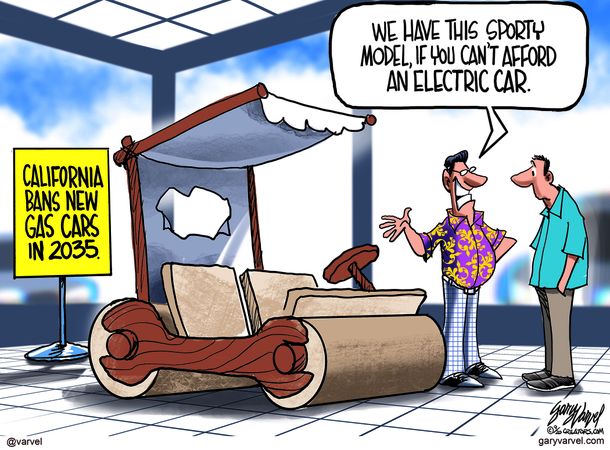
Fuel Efficiency Rule De Facto EV Mandate

Kevin Stone explains at Heartland Daily News. Fuel Producers, States Challenge New EPA Rule Effectively Mandating Electric Vehicles.  Excerpts in italics with my bolds.  H/T John Ray

An unlikely coalition is challenging the U.S. Environmental Protection Agency’s (EPA) revised fuel economy rules.

At issue is a revised fleetwide. corporate average fuel economy (CAFE) standard of 55 miles per gallon in model year 2026. The shortened timeline for the much higher fuel economy forces automakers to reduce their fleets’ carbon dioxide emissions by 22.6 percent more than previous rules required.

Sixteen states, plus groups representing the fossil fuel and ethanol industries in 15 states, are challenging the Biden EPA’s emissions rules. They argue the EPA’s new standards effectively mandate a national transition from internal combustion powered vehicles to electric vehicles starting in 2026.

Farmers, Drillers, Attorneys General

A mix of corn and soybean growers associations from the states of Illinois, Indiana, Iowa, Michigan, Minnesota, North Dakota, Ohio, and South Dakota joined with Diamond Alternative Energy in one of the lawsuits filed to block the EPA’s new rules.

In addition, Texas Attorney General Ken Paxton filed a lawsuit on behalf of Texas, joined by the states of Alabama, Alaska, Arkansas, Indiana, Kentucky, Louisiana, Mississippi, Missouri, Montana, Nebraska, Ohio, Oklahoma, South Carolina, and Utah. Arizona filed a separate lawsuit to block the rules.

The Competitive Enterprise Institute (CEI), along with additional petitioners such as the Domestic Energy Producers Alliance, a nationwide coalition of 39 associations representing the oil and gas industry, also filed a lawsuit to block the new standards.

Essentially an EV Mandate

The lawsuit filed by representatives of various states’ biofuel associations argues the new standard is an unauthorized de facto mandate forcing people to use electric vehicles.

“Through the final rule, EPA seeks to unilaterally alter the transportation mix in the United States, without congressional authorization and without adequately considering the vast greenhouse gas reduction benefits provided by renewable fuels,” the complaint states.

CEI and its co-petitioners make a similar argument in their filing by lead attorney Devin Watkins, saying the rules exceed the agency’s authority.

“EPA is trying to transform the motor vehicle market from gas-powered to electric vehicles by making gas-powered cars more expensive,” Watkins’ petition states.

Ambitious or Unworkable?

The EPA’s new standard and timeline are unrealistic because the mass adoption of electric vehicles and construction of the infrastructure needed to support and power them won’t magically appear overnight, says Paul Driessen, a senior policy advisor with the Committee For A Constructive Tomorrow, which co-publishes Environment & Climate News.

“It’s vital to remember that President Joe Biden, Rep. Alexandria Ocasio-Cortez (D-NY), and other climate-focused activists aren’t talking about just replacing current fossil fuel vehicle use or electricity generation,” said Driessen. “They also want to convert home and office heating, cooking, and water heating to electricity; convert factories from coal and gas to running on wind- and solar-generated electricity; and have massive battery modules as backup power for windless, sunless days.

“That means nearly doubling existing U.S. electricity generation, and doing all of it with intermittent, unreliable, weather-dependent power generation systems,” said Driessen. “It means millions of onshore and offshore wind turbines, billions of solar panels, billions of 1,000-pound battery modules, and thousands of new transformers, covering tens of millions of acres, all powered by wind and sunshine, and all connected via thousands of miles of new transmission lines to power users all across America.”

‘It Is a Pipedream’

Electrifying the transportation system and in fact the entire U.S. economy is a fool’s errand, doomed to fail while placing an unnecessary burden on the public, says Driessen.

“They expect, hope, and fantasize this will somehow work, that a massively stressed power grid never built or tested before will be able to handle huge, sudden electricity surges and cutoffs due to wind and sunlight cooperating with demand only incidentally, failing minutes, hours, or days at a time and crashing repeatedly and catastrophically,” said Driessen.

“It is a pipedream that has failed everywhere it’s been tried on much tinier scales than what they intend to impose on us,” said Driessen. “Think of Texas two winters ago, and South Australia a few years ago, multiplied a thousand times over. We’re going to be asked to accept having electricity for every aspect of our industry, hospitals, and lives, when it’s available instead of when we need it.”

It’s ‘MAGIC’

There is no way the United States can get the needed raw materials and do the infrastructure transformation required by the EPA’s and other agencies’ new rules implementing Biden’s “whole of government approach” to fighting climate change, says Driessen.

“Just getting the metals, minerals, plastics, concrete, and other raw materials to create this system will take mining at scales unprecedented in human history,” said Driessen. “Team Biden seems to think this will just happen, under a government-mandated program you could call Materials Acquisition for Global Industrial Change, abbreviated MAGIC.

“This new, unworkable system would totally bankrupt America,” said Driessen. “Energy analyst David Wojick, Ph.D. calculates that building a battery system to back up just New York City’s current peak electricity needs, not counting new electric cars or future growth, for one week of no wind or sunshine would cost $3 trillion! For all of New York State, it would cost $8 trillion. And that’s just New York.”


via Science Matters

https://ift.tt/7ITQgru

April 14, 2022 at 04:20PM