Month: April 2022

China Also Abuses Covid Statistics

Michael Senger writes at Brownstone Institute China’s Covid Numbers are Manifestly Absurd.  Excerpts in italics with my bolds.

The Wall Street Journal published a piece titled “Shanghai Has Recorded More Than 130,000 Covid Cases—and No Deaths.” Seeing the darkly comic headline, I was excited. Finally, after two years, the WSJ appeared to be calling out the data fraud that was the foundation for this whole sordid experiment in totalitarian virus mitigation, however belatedly.

Alas, my excitement was premature. As it turns out, the authors of the article tie themselves into knots to explain China’s data. They even trot out Ryan Tibshirani, co-leader of Carnegie Mellon’s COVID-19 modeling team, to tell us that China’s death rate “can also be affected by factors like the age distribution and racial makeup of its population, vaccination status, type of vaccine and average distance to a healthcare facility,” the implication being that Prof. Tibshirani sees nothing wrong with China’s data, thank you very much.

Apparently, China’s low vaccination rate among its elderly population means they can have 130,000 cases and zero deaths. Make it make sense. “Science!”

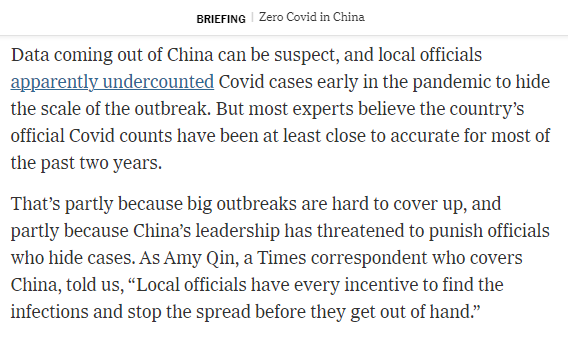
For two years, the elite journalists, scientists, politicians, and health officials who speak for our most prestigious institutions have been conspicuously and vehemently deferential to the integrity of China’s Covid data. Here’s what the New York Times’ David Leonhardt wrote just two months ago:

Well, now, in Shanghai, we have a “big outbreak” which the CCP has not covered up—but the death data coming out is still manifestly fraudulent. Would the New York Times care to revisit their conclusion that “the country’s official Covid counts have been at least close to accurate…because big outbreaks are hard to cover up”?

Perhaps it shouldn’t come as a surprise that these elites want, so badly, for China’s Covid data to be real, because for two years they’ve been imploring their citizens to emulate China, scoffing at our childish attachment to human rights and civil liberties.

By demanding western elites conform to a false reality in which they had to pretend China’s data was real, the CCP forced them into a referendum as to whom they were truly loyal—China, or their own people. In the vast majority of cases, they chose China. And two years on, even amid the horrific spectacle of China’s lockdown of Shanghai, they remain too cowardly and morally vacuous to reconsider their choice.

Even among lockdown skeptics, many can’t accept that public health officials could possibly be that incompetent. It all seems too dumb, too banal. But since March 2020, every single pandemic policy—from the strict lockdowns and masks to the tests, death coding, and vaccine passes—has been imported from China based on the idea that these “extreme social-control measures” had effectively allowed China to “control the virus.”

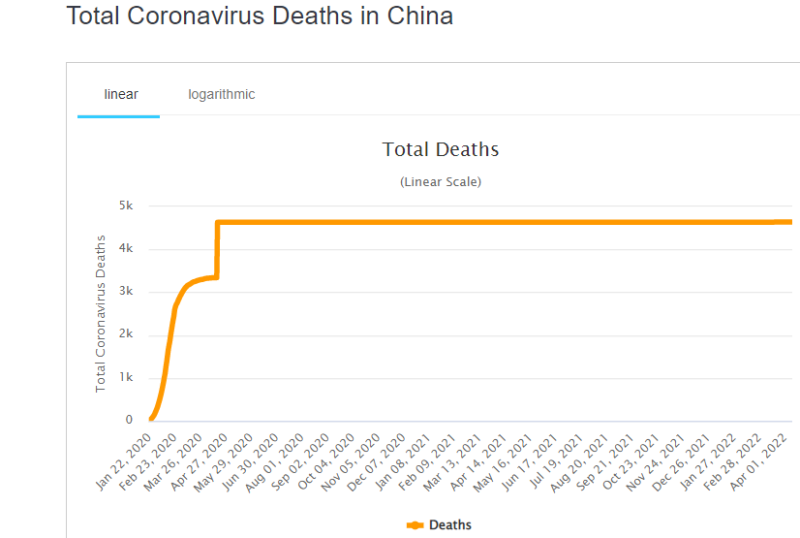
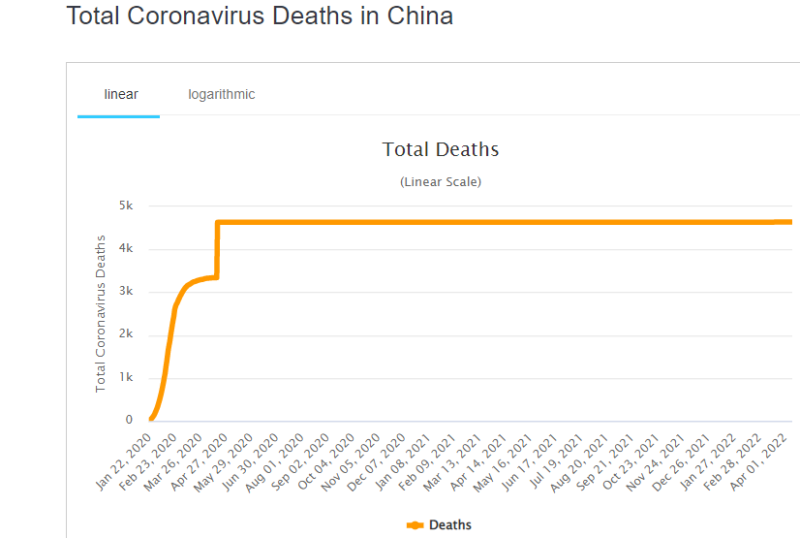
In an Orwellian “war on COVID misinformation,” those who pointed out that China’s data was obviously fake were vilified by their own governments as alt-right racists, neo-Nazis, and anti-vaxxers—even if fully-vaccinated. They were censored, professionally ostracized, and, as I experienced firsthand, had their social media accounts purged. Hundreds of millions were thrown into poverty, millions of small businesses were bankrupted, an entire generation of children was forced to isolate and cover their faces, and billions of life years were lost, all in service to the collective fantasy encapsulated by this graph.


via Science Matters

https://ift.tt/w5a3fvd

April 14, 2022 at 12:50PM

Claim: Climate Change is Spreading Japanese Encephalitis

Essay by Eric Worrall

You might think the easiest way to stop the spread of a dangerous mosquito borne disease is to spray a few mosquitoes. But the real solution, according to Washington Post, is to combat climate change.

As Australia’s climate changes, a tropical disease advances

An outbreak of Japanese encephalitis has infected 34 people and killed three

By Frances Vinall

ECHUCA, Australia — A dust cloud soars behind farmer Tim Kingma’s pickup truck as he drives down a gritty dirt track to a neat row of pig sheds. The landscapeis flat and muted: dry, mostly treeless ground and patchy grass. At this farm in the southeastern state of Victoria, there are hundreds of flies and not a single visible mosquito. It’s a world away from the verdant places one might expect to find fatal tropical diseases.

Japanese encephalitis is rare and mostly asymptomatic. In 99 percent of cases itpasses through the body without causing symptoms. But of the unlucky 1 percent, nearly a third die, and about half the survivors are left with permanent problems. There is no cure, and Australia is spending millions of dollars in a rush to import vaccine doses.

Public health professionals say the appearance of Japanese encephalitis here is just the latest example of how global warming is contributing to the spread of disease. Six years ago, melting permafrost in Siberia released frozen anthrax, which infected an Indigenous community. In 2007, the tropical chikungunya virus was detected in Europe for the first time in two Italian villages and has since appeared in France. In the United States, Lyme disease cases have doubled over 30 years as warmer conditions create longer tick seasons. And in Australia, experts warn Japanese encephalitis could be the first of several illnesses to spread south.

Read more: https://www.washingtonpost.com/world/2022/04/14/australia-japanese-encephalitis-climate-change/

The region around Echuca has seen multiple historic outbreaks of Encephalitis, such as the 1974-75 Encephalitis outbreak, which was contained with a vigorous organophosphate spraying programme. So the latest outbreak is not exactly a new problem.

The Japanese Encephalitis / climate claim is further weakened by the geographical spread of the current outbreak, which covers Echuca (36° south) to Southern Queensland (27° South). Having spent time in both regions, and visited Echuca more than once, I can personally assure you the climate in Echuca is very different to the climate of Southern Queensland.

If Japanese Encephalitis is sensitive to climate change, why is it flourishing over such a wide range of climates?

Places like Echuca do make an effort to spray the mosquitoes. Unfortunately in Australia greens tend to oppose mosquito control programmes with the same vigour they oppose forest fire fuel control burns, with hysterical claims of cancer clusters and environmental damage.

In my opinion, over the decades, this green opposition has contributed to a reduction of large scale spraying programmes, from historical proactive annual spraying programmes which fogged entire towns and surrounding regions with protective chemicals, to reactive strategies, in which vigorous spraying mostly occurs after the encephalitis outbreak or whatever has killed a few people.

Frankly I’d like to see a return to large scale proactive spraying. Admittedly the risk is small – if you visited Echuca, most likely you would have a good time admiring the architecture and enjoying the cafes and river attractions. If you picked up a few mosquito bites, you would have to be extroardinarily unlucky to catch Encephalitis, even in the middle of an outbreak. But why does anyone have to die or suffer debilitating illness, from an entirely preventable problem?

via Watts Up With That?

https://ift.tt/ehfPKiD

April 14, 2022 at 12:46PM

Hydrogen 11 times worse than CO2 for climate, says new report

By Paul Homewood

So much for “clean energy” then!!

From New Atlas:


Screenshot 2022-04-14 180300

Hydrogen will be one of humanity’s key weapons in the war against carbon dioxide emissions, but it must be treated with care. New reports show how fugitive hydrogen emissions can indirectly produce warming effects 11 times worse than those of CO2.

Hydrogen can be used as a clean energy carrier, and running it through a fuel cell to produce electricity produces nothing but water as a by-product. It carries far more energy for a given weight than lithium batteries, and it’s faster to refill a tank than to charge a battery, so hydrogen is viewed as a very promising green option in several hard-to-decarbonize applications where batteries won’t cut the mustard – for example, aviation, shipping and long-haul trucking.

But when it’s released directly into the atmosphere, hydrogen itself can interact with other gases and vapors in the air to produce powerful warming effects. Indeed, a new UK Government study has put these interactions under the microscope and determined that hydrogen’s Global Warming Potential (GWP) is about twice as bad as previously understood; over a 100-year time period, a tonne of hydrogen in the atmosphere will warm the Earth some 11 times more than a tonne of CO2, with an uncertainty of ± 5.

How does hydrogen act like a greenhouse gas?

One way is by extending the lifetime of atmospheric methane. Hydrogen reacts with the same tropospheric oxidants that "clean up" methane emissions. Methane is an incredibly potent greenhouse gas, causing some 80 times more warming than an equivalent weight of CO2 over the first 20 years. But hydroxyl radicals in the atmosphere clean it up relatively quickly, while CO2 remains in the air for thousands of years, so CO2 is worse in the long run.

When hydrogen is present, however, those hydroxyl radicals react with the hydrogen instead. There are fewer cleanup agents to go around, so there’s a direct rise in methane concentrations, and the methane stays in the atmosphere longer.

What’s more, the presence of hydrogen increases the concentration of both tropospheric ozone and stratospheric water vapor, boosting a "radiative forcing" effect that also pushes temperatures higher.

How does hydrogen escape into the atmosphere?

A lot of it is leakage, according to a second report from Frazer-Nash Consultancy. Store hydrogen in a compressed gas cylinder, and you can assume you’ll lose between 0.12 percent and 0.24 percent of it every day. It’ll leak out of pipes and valves if you distribute it that way, losing some 20 percent more volume than the methane gas that’s now running through municipal pipelines – although since hydrogen is so much lighter than methane, this larger volume equates to just 15 percent of the weight.

Where hydrogen is transported as a cryogenic liquid, boil-off is unavoidable, and you can expect to lose an average of about 1 percent of it per day. Currently, this is vented to the atmosphere.

Indeed, venting and purging operations are currently common across the hydrogen life cycle. They occur during electrolysis, during compression, during refueling, and during the process of conversion back into electricity through a fuel cell.

Where there is venting or purging, the percentages tend to dwarf what’s lost through simple leakage – for example, current electrolysis procedures using venting and purging are assumed to lose between 3.3-9.2 percent of all hydrogen produced, depending largely on how often the process starts up and shuts down – this is a bit of a worry in situations where hydrogen production is seen as a way to store excess renewable energy that’s not being snapped up by immediate demand.

Purging and venting emissions can be cleaned up significantly by adding systems to recombine the vented or purged hydrogen back into water and feed it back into the process – but it’ll be a while before these kinds of operations are economically viable.

In all, the Frazer-Nash report expects that between 1-1.5 percent of all hydrogen in its central modeling scenario will be emitted into the atmosphere, with transport emissions responsible for around half of that, and emissions at the production and consumption ends taking up roughly a quarter each.

Meanwhile, operating under different assumptions, the first report linked expects somewhere between 1 percent and 10 percent of all hydrogen in its global scenario will be emitted into the atmosphere,

Does this mean "green hydrogen" should be avoided in the race to zero emissions?

No. The UK Government report explains that "the increase in equivalent CO2 emissions based on 1 percent and 10 percent H2 leakage rate offsets approximately 0.4 and 4 percent of the total equivalent CO2 emission reductions, respectively," so even assuming the worst leakage scenario, it’s still an enormous improvement.

"Whilst the benefits from equivalent CO2 emission reductions significantly outweigh the disbenefits arising from H2 leakage," it continues, "they clearly demonstrate the importance of controlling H2 leakage within a hydrogen economy.

https://newatlas.com/environment/hydrogen-greenhouse-gas/

We already know that steam reforming natural gas emits plenty of CO2. Even if a CCS is bolted on, this cannot avoid all emissions. Worse still, there are the upstream emissions of CO2 and methane grom producing and transporting natural gas.

Now we learn that hydrogen leakage could be almost as bad as as burning gas. As I noted earlier, we can forget about “green hydrogen” making any significant contribution in any foreseeable future.

via NOT A LOT OF PEOPLE KNOW THAT

https://ift.tt/Otxbd2B

April 14, 2022 at 12:25PM

Would You Prefer With or Without Ice?

Raymond at RIC-Communications has produced the above poster on the theme expounded in a previous post In Celebration of Our Warm Climate, reprinted below. His other science infographic projects are:

The world of CO2

The World of Climate Change

The World of Energy

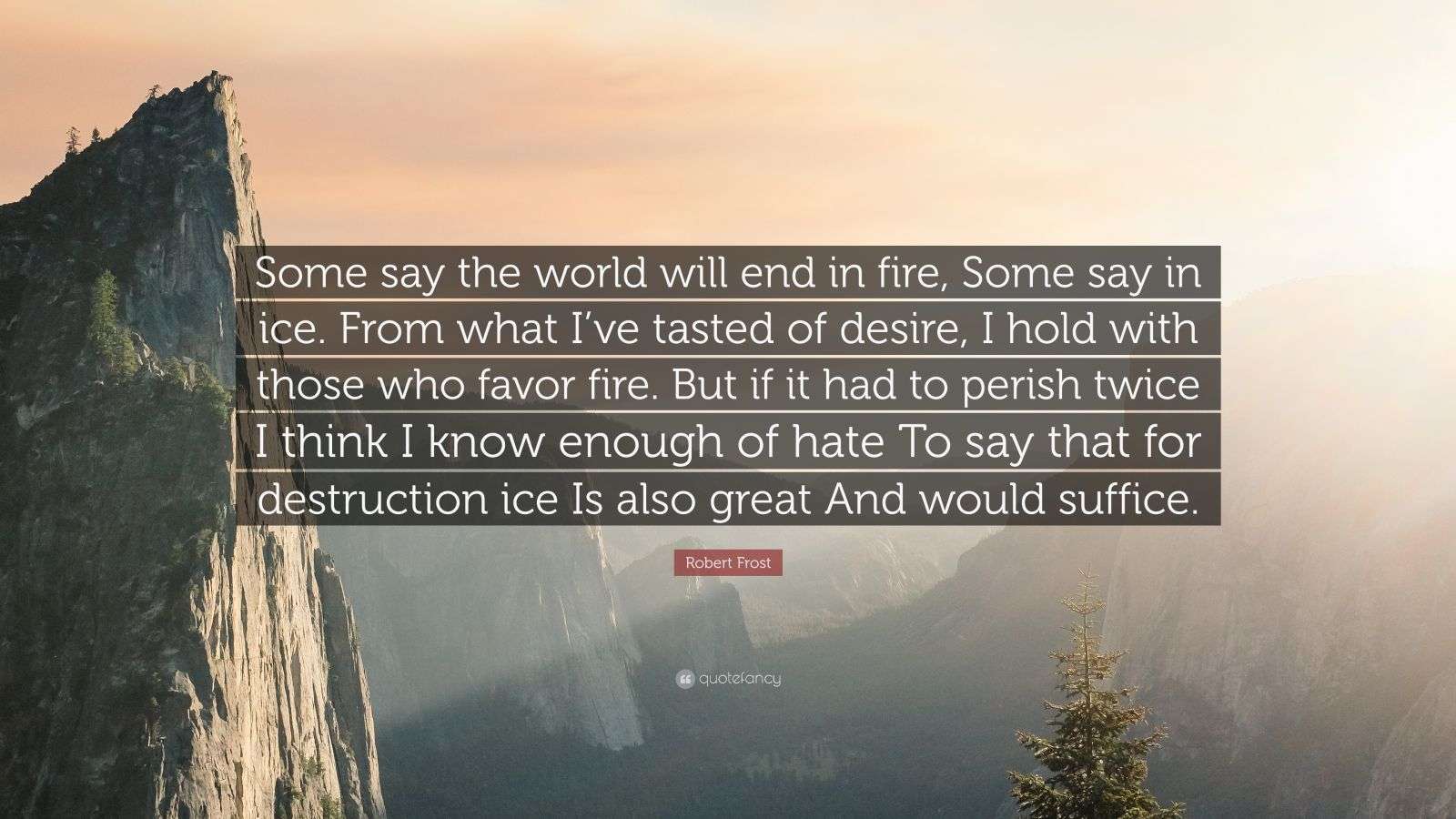
Legacy and social media keep up a constant drumbeat of warnings about a degree or two of planetary warming without any historical context for considering the significance of the alternative.  A poem of Robert Frost comes to mind as some applicable wisdom:
The diagram at the top shows how grateful we should be for living in today’s climate instead of a glacial icehouse. (H/T Raymond Inauen)  For most of its history Earth has been frozen rather than the mostly green place it is today.  And the reference is to the extent of the North American ice sheet during the Last Glacial Maximum (LGM).

For further context consider that geologists refer to our time as a “Severe Icehouse World”, among the various conditions in earth’s history, as diagramed by paleo climatologist Christopher Scotese. Referring to the Global Mean Temperatures, it appears after many decades, we are slowly rising to “Icehouse World”, which would seem to be a good thing.

Instead of fear mongering over a bit of warming, we should celebrate our good fortune, and do our best for humanity and the biosphere.  Matthew Ridley takes it from there in a previous post.

Background from previous post The Goodness of Global Warming

LAI refers to Leaf Area Index.

As noted in other posts here, warming comes and goes and a cooling period may now be ensuing. See No Global Warming, Chilly January Land and Sea.  Matt Ridley provides a concise and clear argument to celebrate any warming that comes to our world in his Spiked article Why global warming is good for us.  Excerpts in italics with my bolds and added images.

Climate change is creating a greener, safer planet.

Global warming is real. It is also – so far – mostly beneficial. This startling fact is kept from the public by a determined effort on the part of alarmists and their media allies who are determined to use the language of crisis and emergency. The goal of Net Zero emissions in the UK by 2050 is controversial enough as a policy because of the pain it is causing. But what if that pain is all to prevent something that is not doing net harm?

The biggest benefit of emissions is global greening, the increase year after year of green vegetation on the land surface of the planet. Forests grow more thickly, grasslands more richly and scrub more rapidly. This has been measured using satellites and on-the-ground recording of plant-growth rates. It is happening in all habitats, from tundra to rainforest. In the four decades since 1982, as Bjorn Lomborg points out, NASA data show that global greening has added 618,000 square kilometres of extra green leaves each year, equivalent to three Great Britains. You read that right: every year there’s more greenery on the planet to the extent of three Britains. I bet Greta Thunberg did not tell you that.

The cause of this greening? Although tree planting, natural reforestation, slightly longer growing seasons and a bit more rain all contribute, the big cause is something else. All studies agree that by far the largest contributor to global greening – responsible for roughly half the effect – is the extra carbon dioxide in the air. In 40 years, the proportion of the atmosphere that is CO2 has gone from 0.034 per cent to 0.041 per cent. That may seem a small change but, with more ‘food’ in the air, plants don’t need to lose as much water through their pores (‘stomata’) to acquire a given amount of carbon. So dry areas, like the Sahel region of Africa, are seeing some of the biggest improvements in greenery. Since this is one of the poorest places on the planet, it is good news that there is more food for people, goats and wildlife.
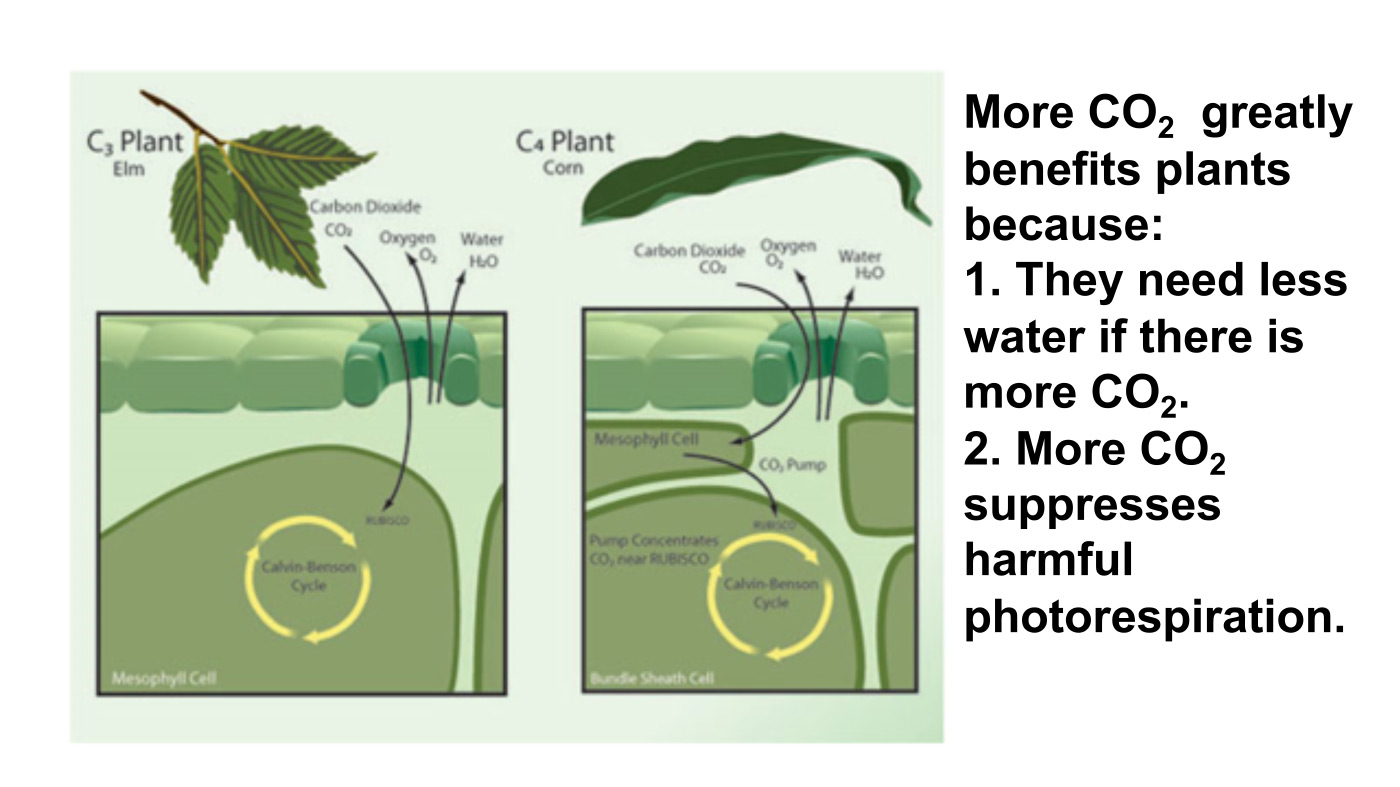
But because good news is no news, green pressure groups and environmental correspondents in the media prefer to ignore global greening. Astonishingly, it merited no mentions on the BBC’s recent Green Planet series, despite the name. Or, if it is mentioned, the media point to studies suggesting greening may soon cease. These studies are based on questionable models, not data (because data show the effect continuing at the same pace). On the very few occasions when the BBC has mentioned global greening it is always accompanied by a health warning in case any viewer might glimpse a silver lining to climate change – for example, ‘extra foliage helps slow climate change, but researchers warn this will be offset by rising temperatures’.

Another bit of good news is on deaths. We’re against them, right? A recent study shows that rising temperatures have resulted in half a million fewer deaths in Britain over the past two decades. That is because cold weather kills about ’20 times as many people as hot weather’, according to the study, which analyses ‘over 74million deaths in 384 locations across 13 countries’. This is especially true in a temperate place like Britain, where summer days are rarely hot enough to kill. So global warming and the unrelated phenomenon of urban warming relative to rural areas, caused by the retention of heat by buildings plus energy use, are both preventing premature deaths on a huge scale.

Summer temperatures in the US are changing at half the rate of winter temperatures and daytimes are warming 20 per cent slower than nighttimes. A similar pattern is seen in most countries. Tropical nations are mostly experiencing very slow, almost undetectable daytime warming (outside cities), while Arctic nations are seeing quite rapid change, especially in winter and at night. Alarmists love to talk about polar amplification of average climate change, but they usually omit its inevitable flip side: that tropical temperatures (where most poor people live) are changing more slowly than the average.

My Mind is Made Up, Don’t Confuse Me with the Facts. H/T Bjorn Lomborg, WUWT

But are we not told to expect more volatile weather as a result of climate change? It is certainly assumed that we should. Yet there’s no evidence to suggest weather volatility is increasing and no good theory to suggest it will. The decreasing temperature differential between the tropics and the Arctic may actually diminish the volatility of weather a little.
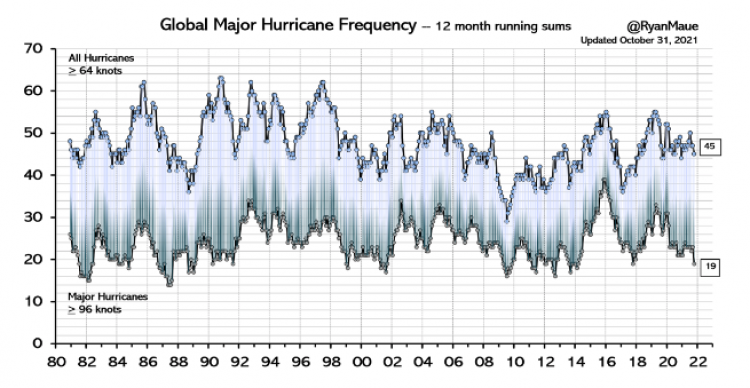
Indeed, as the Intergovernmental Panel on Climate Change (IPCC) repeatedly confirms, there is no clear pattern of storms growing in either frequency or ferocity, droughts are decreasing slightly and floods are getting worse only where land-use changes (like deforestation or building houses on flood plains) create a problem. Globally, deaths from droughts, floods and storms are down by about 98 per cent over the past 100 years – not because weather is less dangerous but because shelter, transport and communication (which are mostly the products of the fossil-fuel economy) have dramatically improved people’s ability to survive such natural disasters.

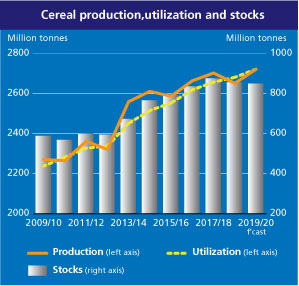
The effect of today’s warming (and greening) on farming is, on average, positive: crops can be grown farther north and for longer seasons and rainfall is slightly heavier in dry regions. We are feeding over seven billion people today much more easily than we fed three billion in the 1960s, and from a similar acreage of farmland. Global cereal production is on course to break its record this year, for the sixth time in 10 years.
Nature, too, will do generally better in a warming world. There are more species in warmer climates, so more new birds and insects are arriving to breed in southern England than are disappearing from northern Scotland. Warmer means wetter, too: 9,000 years ago, when the climate was warmer than today, the Sahara was green. Alarmists like to imply that concern about climate change goes hand in hand with concern about nature generally. But this is belied by the evidence. Climate policies often harm wildlife: biofuels compete for land with agriculture, eroding the benefits of improved agricultural productivity and increasing pressure on wild land; wind farms kill birds and bats; and the reckless planting of alien sitka spruce trees turns diverse moorland into dark monoculture.

Meanwhile, real environmental issues are ignored or neglected because of the obsession with climate. With the help of local volunteers I have been fighting to protect the red squirrel in Northumberland for years. The government does literally nothing to help us, while it pours money into grants for studying the most far-fetched and minuscule possible climate-change impacts. Invasive alien species are the main cause of species extinction worldwide (like grey squirrels driving the red to the margins), whereas climate change has yet to be shown to have caused a single species to die out altogether anywhere.

Of course, climate change does and will bring problems as well as benefits. Rapid sea-level rise could be catastrophic. But whereas the sea level shot up between 10,000 and 8,000 years ago, rising by about 60 metres in two millennia, or roughly three metres per century, today the change is nine times slower: three millimetres a year, or a foot per century, and with not much sign of acceleration. Countries like the Netherlands and Vietnam show that it is possible to gain land from the sea even in a world where sea levels are rising. The land area of the planet is actually increasing, not shrinking, thanks to siltation and reclamation.

Environmentalists don’t get donations or invitations to appear on the telly if they say moderate things. To stand up and pronounce that ‘climate change is real and needs to be tackled, but it’s not happening very fast and other environmental issues are more urgent’ would be about as popular as an MP in Oliver Cromwell’s parliament declaring, ‘The evidence for God is looking a bit weak, and I’m not so very sure that fornication really is a sin’. And I speak as someone who has made several speeches on climate in parliament.

No wonder we don’t hear about the good news on climate change.


via Science Matters

https://ift.tt/8qbjdrY

April 14, 2022 at 12:10PM