
Biden SEC regulations continue costly climate folly.
The post Another chapter in the climate war against democracy and prosperity appeared first on CFACT.
via CFACT
April 13, 2022 at 04:07AM
Biden SEC regulations continue costly climate folly.
The post Another chapter in the climate war against democracy and prosperity appeared first on CFACT.
via CFACT
April 13, 2022 at 04:07AM
Hubris and arrogance are essential character traits for those pretending that we’re well on our way to an all-wind and sun-powered future. Helpfully, the terrible events unfolding in Ukraine have exposed that whopping lie, for all to see.
Energy self-reliance is back on the agenda, with a vengeance, and that means fossil fuels and nuclear power are back in vogue, like long-lost relatives.
But, not for want of trying, the Democrats and their senile leader would have Americans believe that all is well with their Great Green Reset aka the Green New Deal.
Jerry Shenk retorts in fine style, below.
Sow the wind (power), reap the whirlwind
The Mercury
Jerry Shenk
14 March 2022
The Law of Supply and Demand is as consistent as gravity.
Americans who understand the benefits of ample supply — seventy percent — favor producing more domestic oil and gas.
Nonetheless, President(ish) Joe Biden, his administration and congressional Democrats think voters will 1) buy their fraudulent excuses for the soaring costs of fossil fuels, and 2) overlook the shortcomings of the alt-energy schemes they imagine will provide “energy independence.”
Today, energy prices are wrecking America’s economy.
Characteristically, Joe “The Buck (Never) Stops Here” Biden blames others, including Russia/Ukraine: “Putin’s war is already hurting American families at the gas pump … I’m going to do everything I can to minimize Putin’s price hike here at home.”
Biden also claimed, falsely, “It’s simply not true that my administration or policies are holding back domestic energy production,” before blaming energy companies:
“To the oil and gas companies … we understand Putin’s war against the people of Ukraine is causing prices to rise. … But it’s no excuse to exercise excessive price increases or padding profits … to exploit this situation or American consumers.”
Biden’s finger-pointing is shamelessly dishonest.
Energy prices took off more than a year before Russia invaded Ukraine.
During the 2020 primary, candidate Biden promised, “No more drilling… No ability for the oil industry to continue to drill, period. It ends.”
Biden voters approved.
Then, on his first day in office, Biden signed executive orders limiting fossil fuel exploration, canceling leases on federal land, killing the Keystone XL pipeline, and began pressuring lenders to restrict financing for exploration and production of fossil fuels.
Energy prices climbed immediately, and, today, are more than two times higher.
Abnormally-high energy prices are intentional, a result of artificial scarcity and market manipulation that are parts of a broader left-liberal war on conventional energy being waged to fundamentally transform Western society.
Russia’s invasion of Ukraine did increase prices somewhat, but Joe Biden’s executive orders and his fealty to fellow Democrats’ “Green New Deal” had already made it far costlier to feed families, heat/cool homes, drive vehicles, run businesses, and live normal lives.
The president appears unconcerned about the impact his policies have on households, and his assumption that ordinary Americans are stupid enough to take his deceitful excuses at face value and give him a pass only adds insult to injury.
Speaking of insults, part-time Secretary of Transportation Pete Buttigieg condescendingly instructed Americans upset by record gasoline prices to buy electric vehicles (EVs).
Problem solved, right?
Currently, average EV pricing — after generous government subsidies — is $56,437.00. The average 2022 income for full-time workers is estimated at $53,490.00.
Additionally, the estimated cost breakeven point for EVs over gasoline-powered vehicles is fifteen years.
Worse, Biden’s/fellow Democrat’s desire to use wind and solar power to supply America’s total energy needs is naïve — and dangerous.
Apart from being intermittent, inherently unreliable and grossly expensive, solar panels and wind turbines require tremendous amounts of copper, nickel, cobalt, rare earth and other minerals, including lithium for storage batteries.
The International Energy Agency reports that, with the exception of lithium (Australia), China enjoys substantial leads in deposits of and extracting those elements — and China dominates the processing of all of them.
China controls over 70 percent of the world’s solar panel market. Seven of the 10 largest wind turbine manufacturers are Chinese, and China controls 60 percent of global wind turbine production.
If solar panels and wind turbines performed adequately, China wouldn’t be building dozens of new coal-fired generation plants.
Even if relying on wind turbines and solar panels were feasible, doing so would effectively turn America’s energy sector — our economy — over to a dangerous geopolitical rival, and make the U.S. almost totally dependent on the Chinese Communist Party.
In a sane world, everyone could agree on nuclear power — a la France and Finland — as a far cheaper, more practical energy source. But America’s national suicide climate cultists reject zero-emission nuclear power, too.
America was the world’s largest oil producer before Joe Biden took office. The U.S. and Canada have tens of billions of barrels/cubic feet of accessible fossil fuels — centuries of supply — underground.
Remember, seventy percent of Americans want to extract and use ours.
Their callous disregard for ordinary Americans is another reason Joe Biden and the Democrats who support his energy policies will reap the whirlwind in November.
The Mercury

via STOP THESE THINGS
April 13, 2022 at 02:30AM
Marlo Lewis, Jr. is a fellow you want to meet and spend time with. A Harvard University PhD., he has long been a voice of rationality in the climate debate from his home base of the Competitive Enterprise Institute (CEI). He is all around fun and plays swing mandolin in a band, Old Town Tradition.
Lewis recently proposed “Expressing the Sense of Congress on the Paris Agreement” for serious debate now that Net Zero is fantastical. Global-government central climate planning must stop. No target should be set for carbon dioxide for reasons that are scientifically sensible and well articulated. Let the market decide with methane too, a market rich in pipeline capacity and end-user growth to naturally reduce natural gas release/flaring.
Lewis’s draft for Republicans and consumer-and-taxpayer-friendly Democrats follows:
Whereas the Paris Agreement is a global framework for pressuring U.S. policy makers and companies to achieve NetZero emissions by 2050;
Whereas achieving NetZero by imposing a carbon tax—the most efficient emission-reduction policy according to many economists—would annually cost $4.4 trillion or 11.9 percent of GDP or $11,300 per person by 2050, according to a recent study in Nature;
Whereas the NetZero agenda entails geopolitical risks, making America more dependent on Russia and OPEC for hydrocarbons and on China for the energy transition minerals used to produce advanced batteries, wind turbines, and solar panels;
Whereas participation in the Paris Agreement makes U.S. energy policy less accountable to voters and more beholden to foreign leaders, multilateral bureaucrats, and politically unaccountable non-governmental organizations;
Whereas the Paris Agreement purports to impose legally binding reporting requirements on its parties to facilitate “naming and shaming” of U.S. policy makers who fail to pledge or implement “ambitious” emission-reduction targets;
Whereas U.S. leadership in producing abundant, affordable, reliable energy strengthens the economy, reduces the cost of living, and enhances U.S. geopolitical security;
Whereas sensible people do not join clubs designed to pressure, cajole, and shame them into acting against their own best interests and better judgment;
Whereas the Paris Agreement requires revisiting energy-suppressing emission-reduction pledges every five years, in perpetuity, with each revision required to reflect the party’s “highest possible ambition;”
Whereas the vast majority of parties to the Paris Agreement submitted the agreement to their legislatures for ratification as a treaty;
Whereas Article II, Section 2, Clause 2 of the U.S. Constitution states that the President “shall have power, by and with the consent of the Senate, to make treaties, provided two-thirds of the Senators present concur;”
Whereas Presidents Obama and Biden enrolled the United States into the Paris Agreement without seeking the Senate’s advice and consent;
Whereas the Constitution requires a higher level of consent to make treaties than to appoint Supreme Court justices, which requires only the concurrence of simple majorities in the Senate;
Whereas the Treaty Clause’s supermajority requirement helps ensure U.S. treaties have broad public support rather than just the support of one party or certain sections of the country;
Whereas the Framers intended the Treaty Clause to check executive power, because “interests of so delicate and momentous a kind, as those which concern [the nation’s] intercourse with the rest of the world” should not be entrusted “to the sole disposal” of one magistrate (Federalist 75);
Whereas the Paris Agreement is a treaty by virtue of its costs and risks to the nation as a whole, dependence on subsequent legislation by Congress, potential impacts on state laws, past U.S. practice as to similar agreements, and other traditional factors set forth in the State Department’s Circular 175 Procedure;
Whereas President Obama purported to join Paris as an executive agreement—as if the “most ambitious climate change agreement in history” were of no greater concern to the Senate than the bilateral executive agreements signed by President George W. Bush to promote environmental education in Niger, Ethiopia, and the Republic of Congo;
Whereas the Senate must independently assess whether the potential costs and risks of a particular agreement are sufficiently “momentous” to warrant review under the Article II process, or else the President may evade constitutional scrutiny, as President Obama did, by unilaterally declaring a controversial agreement to be a non-treaty: Now, therefore, be it
Resolved: That it is the sense of Congress that:
The post Exit the Paris Climate Accord (Marlo Lewis on offense) appeared first on Master Resource.
via Master Resource
April 13, 2022 at 01:11AM
Open Access Paper in Environmental Research Letters
T Kelder8,1, N Wanders2, K van der Wiel3, T I Marjoribanks4, L J Slater5, R l Wilby1 and C Prudhomme1,6,7
Published 29 March 2022 • © 2022 The Author(s). Published by IOP Publishing Ltd
Environmental Research Letters, Volume 17, Number 4
Citation T Kelder et al 2022 Environ. Res. Lett. 17 044052
Large-ensemble climate model simulations can provide deeper understanding of the characteristics and causes of extreme events than historical observations, due to their larger sample size. However, adequate evaluation of simulated ‘unseen’ events that are more extreme than those seen in historical records is complicated by observational uncertainties and natural variability. Consequently, conventional evaluation and correction methods cannot determine whether simulations outside observed variability are correct for the right physical reasons. Here, we introduce a three-step procedure to assess the realism of simulated extreme events based on the model properties (step 1), statistical features (step 2), and physical credibility of the extreme events (step 3). We illustrate these steps for a 2000 year Amazon monthly flood ensemble simulated by the global climate model EC-Earth and global hydrological model PCR-GLOBWB. EC-Earth and PCR-GLOBWB are adequate for large-scale catchments like the Amazon, and have simulated ‘unseen’ monthly floods far outside observed variability. We find that the realism of these simulations cannot be statistically explained. For example, there could be legitimate discrepancies between simulations and observations resulting from infrequent temporal compounding of multiple flood peaks, rarely seen in observations. Physical credibility checks are crucial to assessing their realism and show that the unseen Amazon monthly floods were generated by an unrealistic bias correction of precipitation. We conclude that there is high sensitivity of simulations outside observed variability to the bias correction method, and that physical credibility checks are crucial to understanding what is driving the simulated extreme events. Understanding the driving mechanisms of unseen events may guide future research by uncovering key climate model deficiencies. They may also play a vital role in helping decision makers to anticipate unseen impacts by detecting plausible drivers.

Original content from this work may be used under the terms of the Creative Commons Attribution 4.0 license. Any further distribution of this work must maintain attribution to the author(s) and the title of the work, journal citation and DOI.
Weather extremes such as floods, droughts, heatwaves and cyclones can have major societal impacts including mortality and morbidity (Gasparrini et al 2015, Raymond et al 2020), and economic damages (Felbermayr and Gröschl 2014, Klomp and Valckx 2014, Kousky 2014). Weather extremes can also increase inequality (Dell et al 2012, Hallegatte and Rozenberg 2017). In risk analyses, the full range of impacts that may arise from climate and weather extremes must be evaluated (Sutton 2019). For example, the credible maximum extreme event is important for risk estimates of potentially disruptive impacts (Wilby et al 2011), such as mortality, morbidity, and damage from floods in large river systems and from dam failures (e.g. Vano et al 2019), or for climate-related shocks to food security (Kent et al 2017). However, brevity and sparsity of historical records are well known constraints that confound likelihood estimation of extreme events (Alexander 2016, Wilby et al 2017). Climate model projections reduce this limitation but may not capture the full range of extreme events that can arise from climate variability when just a few ensemble members are used (Van der Wiel et al 2019b, Mankin et al 2020). However, large ensemble simulations from seasonal to multi-decadal prediction systems offer a solution to the estimation of rare events due to their multiple realizations (Allen 2003, van den Brink et al 2005, Thompson et al 2017, Van der Wiel et al 2019b, Mankin et al 2020, Brunner and Slater 2022).
Traditionally, large ensembles have been generated by stochastic weather generators trained on the historical record (e.g. Wilks and Wilby 1999, Brunner and Gilleland 2020). However, advances in super-computing and the physical realism of climate models have facilitated the exploitation of large ensemble simulations for the emulation of events with physically plausible drivers that have not yet been observed (Coumou and Rahmstorf 2012, Stevenson et al 2015, Stott et al 2016, Kent et al 2019, Thompson et al 2019, Deser et al 2020, Kay et al 2020, Swain et al 2020, Brunner and Slater 2022). Following Thompson et al (2017), we define the use of large ensemble simulations to estimate ‘unseen’ events more severe than those seen in the historical record as the Unprecedented Simulated Extremes using Ensembles (UNSEEN) approach.
One drawback of using model simulations is that biases are likely to exist, which may occasionally produce unrealistic extreme events. Many techniques have been developed to uncover potential systematic climate model biases (Eyring et al 2016, 2019), compare simulated extreme indices with observations (Weigel et al 2021), and to evaluate the consistency between simulated and observed distributions of extreme events (Thompson et al 2017, 2019, Kelder et al 2020, Suarez-Gutierrez et al 2021). However, none of these procedures can determine whether the models are correct for the right physical reasons.
Bias correction (or data adjustment) methods are widely used to reduce model discrepancies, especially when coupling climate model simulations with impact models (Warszawski et al 2014), but do not necessarily correct the simulations for the right physical reasons (Maraun et al 2017). For example, a mismatch between simulations and observations may be caused by observational uncertainties and natural variability, rather than by model biases (Addor and Fischer 2015, Casanueva et al 2020). Existing evaluation and correction methods are thus not designed for simulated unseen events. As a consequence, large ensemble simulations with extreme events outside the range of observed variability raise an important question: to what extent can such outliers be trusted? Are the events unseen or unrealistic?
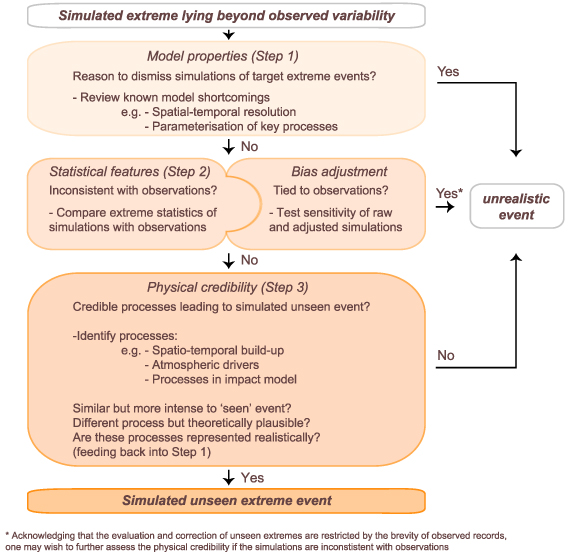
In this paper, we demonstrate a framework to check that the conclusions about unseen events obtained from large ensemble analyses are sound. Our three steps for assessing the realism of simulated events outside the range of observed variability (figure 1) are inspired by the protocol for event attribution to climate change (Philip et al 2020). Step 1 is to review model properties and assess whether the system representation has the capability to represent relevant processes leading to extreme events. Step 2 is to evaluate the statistical features of the large ensemble of simulations (whether from global climate models or regional climate models) by evaluating the consistency of simulated distributions with observations. Bias correction is an integral part of assessing statistical features because it is common practice (e.g. Warszawski et al 2014) but may influence the simulated distribution of extreme events and impacts. We, therefore, evaluate the statistical features for both raw and bias corrected values. Step 3 is to assess the physical credibility of the model simulations. Although some studies check the physical processes leading to extreme events—such as teleconnections and land–atmosphere interactions (Van der Wiel et al 2017, Thompson et al 2019, Vautard et al 2019, Kay et al 2020)—establishing physical credibility is not straightforward (Philip et al 2020), especially for unseen events.
We demonstrate our framework using a case study of Amazon floods. In 2009 and 2012, floods in the Amazon led to the spread of disease, food, and water insecurity (Davidson et al 2012, Hofmeijer et al 2013, Marengo and Espinoza 2016, Bauer et al 2018). At that time, the 2009 flood was the most extreme in 107 years of records, yet three years later it became the second highest in 110 years, drastically altering likelihood estimates. Despite the Amazon stage record being one of the longest in the world, the ∼100 year series is still too short for estimating credible, worst-case events.
To sample more flood events than those available from the historical record, we use EC-Earth large ensemble global climate model simulations coupled with the PCR-GLOBWB global hydrological (water balance) model from an earlier study (Van der Wiel et al 2019b). EC-Earth and PCR-GLOBWB are state-of-the-art global models that have been applied in numerous multi-model intercomparison studies, such as within the Coupled Model Intercomparison Project (e.g. Taylor et al 2012, Samaniego et al 2019, Wanders et al 2019), and have been validated globally (Hazeleger et al 2012, Sutanudjaja et al 2018), including for Amazon streamflow (van Schaik et al 2018). Here, we extend previous studies by evaluating whether simulated extremes that exceed the historical record are likely to be unseen events or simply unrealistic. We do this by: reviewing the ability of EC-Earth and PCR-GLOBWB to simulate extreme Amazon floods (Step 1); assessing the statistical consistency of these large ensemble simulations with observations using raw data or bias corrected simulations (Step 2) then; exploring the physical drivers behind the largest simulated floods (Step 3).
via Watts Up With That?
April 13, 2022 at 12:08AM
 Iowa Climate Science Education

