Month: April 2022

Critical Gender Theory Wrecking Havoc

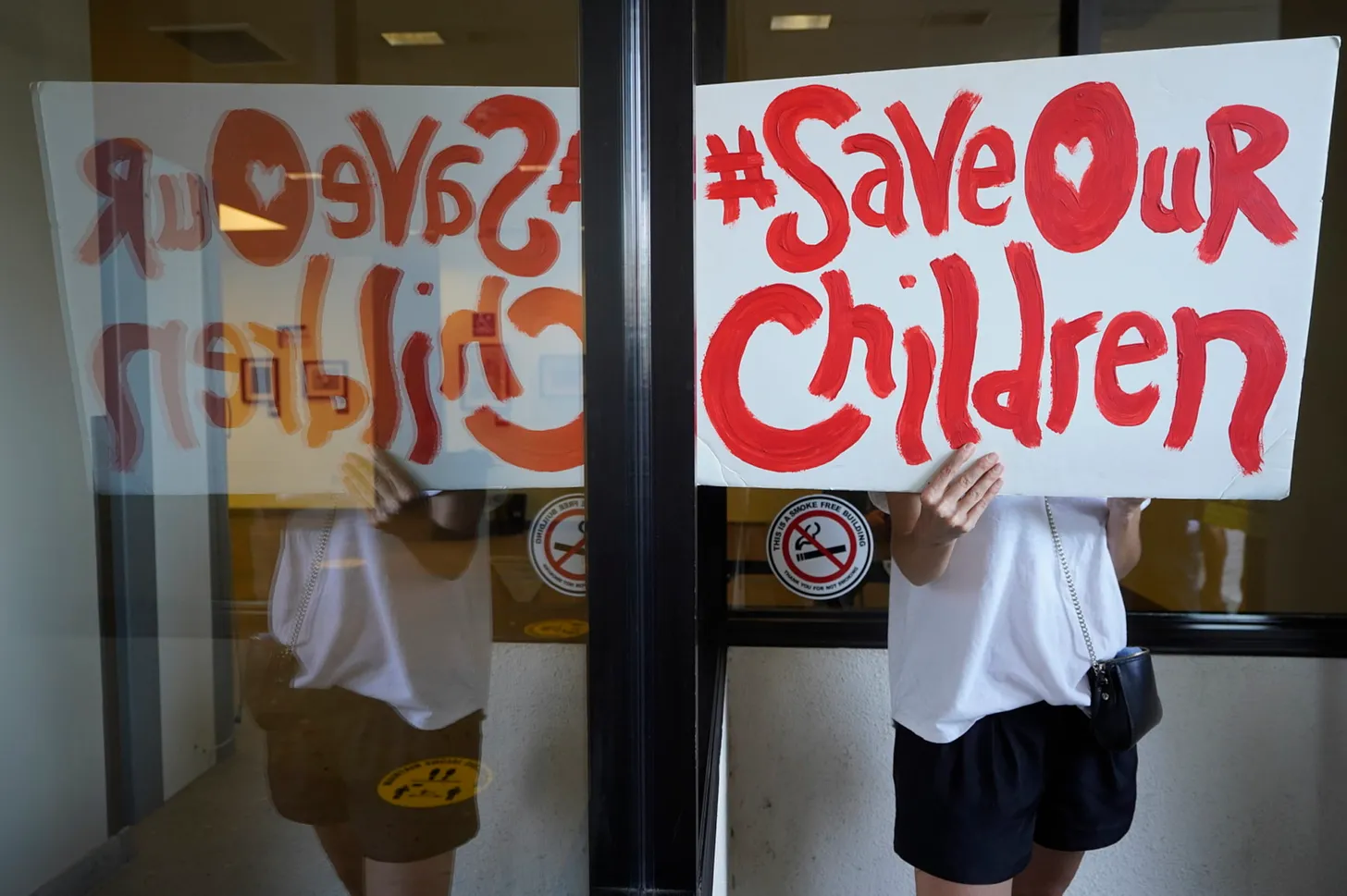
This is an update adding to a previous post reprinted below Ruckus Over Classroom Genderism.  C. Bradley Thompson provides a detailed and disturbing accounting of the gender transition  movement operating inside the US school system. His substack article is Sex and the Schools, or, An Essay You Don’t Want to Read.  A few excerpts are in italics with my bolds.

In this new series of essays, I’d like to show you what is being taught in America’s twenty-first-century government schools and the philosophy behind it. The portrait that I will present here is not a pretty one, but it is the reality. The simple truth of the matter is that America’s government schools are intellectually bankrupt and morally corrupt. To suggest otherwise is either disingenuous or a form of head-in-the-sand-ism.

Officially, America’s schools claim to teach no moral values per se. But that claim is contradicted by the fact that they constantly push moral values such as “diversity,” “equity,” “inclusion,” “tolerance,” moral relativism, and egalitarianism. Such “values” are intended to strip children of any standards or principles they may have previously embraced, so that the teachers can replace the sometimes conservative cultural values of the kids’ parents with the political values of today’s postmodern, cultural Left—namely, egalitarianism, multiculturalism, feminism, environmentalism, transgenderism, “social justice,” socialism, etc.

The curricula in America’s K-12 government schools (and in many of the most elite private schools) is now dominated by two offshoots of Critical Theory known as Critical Gender Theory (CGT) and Critical Race Theory (CRT). Developed in America’s “ed” schools and law schools, CGT and CRT seek to deconstruct and reinvent all traditional gender categories and racial relationships. The primary delivery mechanism for inciting this social revolution is America’s government school system.

The ultimate aim of Critical Gender Theory is to deconstruct the family and replace it with the State as the primary vehicle for educating children.

The specific political goal is to create a new class of the “oppressed.” From this new class of victims will come the new revolutionaries who will keep the revolution alive and move it to the next stage of development. This is the ultimate means by which capitalism is to be dismantled and the State is to become the final arbiter of the principle, “From each according to his ability, to each according to his need.”

The battlefront comes down to two core questions: first, who shall determine the sexual mores taught to America’s young children—parents or government teachers, and, second, what sex- and gender-related values should be taught to children in America’s government schools?

And yet these fundamental questions still don’t quite capture what’s at stake in this conflict. There’s an even deeper, metaphysical question that represents the new battleground between parents and America’s Education Establishment: What is the sex-gender “identity” of each and every child? To put the issue in even simpler terms, the question is: what is a boy and what is a girl?

For tens of thousands of years, the answers to these two questions were self-evidently obvious the moment a child was born. Today, however, the answers are uncertain until the child answers them with the assistance of government schoolteachers and administrators. The question is no longer settled by nature and science and nurtured by parents.

To put a sharper edge on the matter, the question might be: how is it that 9-year-old girls can be encouraged by school officials to take puberty blockers and 15-year-old girls can be encouraged to begin a course of testosterone treatments and 17-year-old girls can be encouraged to ready themselves for double mastectomies without their parents’ knowledge and permission?

We have entered a Brave New World. This is penultimate stage of western nihilism.

.Ruckus Over Classroom Genderism.

The best overview I’ve seen comes from a veteran teacher in California. Peter Laffin writes in American Thinker The Truly Remarkable Thing about Florida’s Anti-Grooming Law.  Excerpts in italics with my bolds and added images.

It is difficult to remain objective over the Florida education fracas. So much of the episode fires up the amygdala. The innocence of children. The rights of parents. The sovereignty of individual identity. The never-ending scandal of humans and sex. To feign “neutrality” in this conflict is a sort of moral suicide. If none of this matters, what possibly could?

As someone who taught school in progressive enclaves for 14 years, I can attest that there are many good people who oppose this law for fear that it will diminish the humanity of loved ones and reverse the tide of social progress. Although I do not believe that this law will have that effect, I respect the sincerity of those who do.

Nonetheless, it remains urgent to speak the truth plainly and oppose the ever-intensifying spread of radical social theory being taught to ever-younger students.

Instances of ideological excess in American classrooms are well chronicled and widespread. We have seen enough to know that the time to act has long since passed. The Florida anti-grooming law is a necessary tool to blunt this advance, even though it seems conspicuously tame upon closer inspection. Its most controversial aspect, from which the clever but disingenuous “don’t say gay” moniker was derived, would have been uncontroversial in any other era:

“Classroom instruction by school personnel or third parties on sexual orientation or gender identity may not occur in kindergarten through grade 3 or in a manner that is not age appropriate or developmentally appropriate for students in accordance with state standards.”

The key term for those still attempting to comprehend this law is “instruction.” The target is not the casual reference, but rather the systematic instruction of academic gender theory to prepubescent children. For instance, it has become common for teachers to utilize resources like “The Genderbread Person” in SEL (social-emotional learning) curricula, as well as other ideologically tinged materials that do not reflect settled science, let alone objective reality.

Further, such instruction materials necessarily force teachers to operate beyond their professional depth and predetermined range of responsibility. Teachers are not psychologists. This was pointedly demonstrated by a mother who spoke at a PTA meeting in Spreckles, California after her daughter’s teacher admitted to stalking her online in order to recruit her into an LGBTQA+ club. “Do you have a doctorate in psychiatry that I don’t know about?” she asked. Also, teachers are not paid by taxpayers to be activists involved in recruiting 5- to 8-year-olds into political causes. Too many teachers have departed the realm of education and entered into the realm of indoctrination, and often with a creepy, messianic air. As such, they must be reined in.

The Florida law prohibits teachers from formally instructing students on these matters before the 4th grade. Until then, the situation will remain in the hands of the students’ families and their doctors.

It would be difficult to contrive a more sensible demand in reaction to the current climate. This is perhaps the most stunning aspect of the entire controversy. Beneath the wailing and screeching is an utterly reasonable request.

And as such, it is no surprise that the vast majority of Floridians support the new law, along with the vast majority of the U.S. voting population. Nor is it a surprise that voters who have read the actual text of the law support it in even greater numbers. Even a majority of Democrats back the legislation. And yet, outlets like NPR and CNN, and subsequently their audiences, have reacted to its passage as though it were an edict from the pope. The cultural left’s blind spot here is profound. At this point, the DNC and its media allies should be charging Ron DeSantis consulting fees. No one is working harder to elect him president.

“The fundamental cause of trouble in the modern world,” philosopher Bertrand Russell once said, “is that the stupid are full of certainty, while the intelligent are full of doubt.” For years, the cultural left has taken the Democrat party hostage and forced it to abandon any pretense of intellectual humility, let alone electoral realism. Both parties have undergone bouts of dangerous self-certainty in recent times. The Republican Party was guilty of this during the Iraq war. But it is obvious that today’s Democratic Party has claimed pathological self-certainty as its banner. While even the most egalitarian countries in the West retreat from pushing gender ideology on prepubescent children, American liberals appear bent on doubling down.

Because of the emotional component, it is understandably difficult to zoom out and gain perspective. But the current environment beggars belief. Can the cultural left really be so certain of an academic theory — so certain that sex is “assigned” at birth as opposed to “observed” in the same manner as eye and hair color, weight, and length — that they will continue to demand its presence in early childhood curriculum? Even at the cost of looming political catastrophe?

It’s still possible that it will relent. But it will require a good dose of humility.

Peter Laffin is a teacher and writer in Laguna Niguel, California. His work has appeared in the American Spectator.

For more on SEL, see Why the Classroom Activists Never Give Up

Social-Emotional Learning supposedly arose out of the COVID-19 pandemic and a need to attend to the emotional psyches of fragile youth. It is a shift in the role of a teacher from an educator to a therapist and places a high value on a child’s emotional competency over academic performance. After locking kids in their homes, isolating them from their peers, muzzling them with ineffective face diapers, and pounding them with fear and doom for 2 years, activists have swooped in to provide emotional support in the classroom once they were permitted to return. In typical government fashion, it seems like a solution looking for a problem. They didn’t create SEL to mend the fragile psyches of youth, they damaged the fragile psyches of youth to push SEL.”

“In a recent Twitter thread by podcaster Josh Daws of the Great Awokening Podcast, Daws lays out in 23 tweets how CRT and gender ideology have been deployed sequentially and their effect on the minds of America’s youth. Based on the work of postmodern critic James Lindsey, Daws suggests that the opening salvo of CRT was to tear down approved identity in the youth. It imparts guilt, shame, and social rejection of majority identities like whiteness, maleness, a binary gender paradigm, or even heterosexuality. Once a person has been made to reject their own race, gender, or sexuality, it is followed up with an approved list of identities from which they can choose in order to be socially accepted.”

via Science Matters

https://ift.tt/H1Brjsu

April 13, 2022 at 08:44AM

NZ helped scrub ‘plant-based’ diets from IPCC climate report

News Brief by Kip Hansen – 12 April 2022

According to Marc Daalder reports at  newsroom., a New Zealand based news website:

 “New Zealand diplomats helped remove references to the need for “plant-based” diets from the latest IPCC report’s influential summary”. 

“Coverage of the negotiations by the Earth Negotiations Bulletin – the only media outlet permitted to attend the event – makes clear that New Zealand argued against the use of the term “plant-based” in favour of “sustainable healthy diets” in at least two sections of the report’s summary.”

Daalder refers to this section of the approved SPM:

Summary for Policymakers IPCC AR6 WG III  C.9.1

“Demand-side and material substitution measures, such as shifting to balanced, sustainable healthy diets [See Footnote 62], reducing food loss and waste, and using bio-materials, can contribute 2.1 GtCO2-eq yr-1 reduction.”

FOOTNOTE 62: ‘Sustainable healthy diets’ promote all dimensions of individuals’ health and wellbeing; have low environmental pressure and impact; are accessible, affordable, safe and equitable; and are culturally acceptable, as described in FAO and WHO. The related concept of balanced diets refers to diets that feature plant-based foods, such as those based on coarse grains, legumes, fruits and  vegetables, nuts and seeds, and animal-sourced food produced in resilient, sustainable and low-GHG emission systems, as described in SRCCL.”

[SRCCL = Special Report Climate Change and Land (2019)]

The Kiwis did us a good turn with that.  A demand that the world must shift to “plant-based” diets is nothing more than another attempt of the UN and IPCC to force society to make changes that UN bureaucrats and the Davos crowd demand – not changes for themselves, but only changes to be forced on every other common man and woman

The most interesting thing about this report is that it shows how clearly the wording that appears in IPCC Summaries for Policy Makers are based on politics and not on any underlying science at all.  The brave Kiwis, supported by India and Kenya, forced the IPCC to stick to science and call for “balanced, sustainable healthy diets”, which except for the  vague but important quality of ‘balanced’ and the undefined amorphous quality ‘sustainable’, is at least firmly supported by medical science. 

# # # # #

Author’s Comment:

Next time you meet a New Zealander, a Kiwi, shake his hand and thank him . . .

Maybe they have delayed the nutty demand that  “everyone must be vegan” nonsense from the IPCC.

Thanks for reading.

# # # # #

via Watts Up With That?

https://ift.tt/YFneMPi

April 13, 2022 at 08:08AM

Can Computer Models Predict Climate?

Guest post by Christopher Essex, Emeritus Professor of Mathematics and Physics, University of Western Ontario.

Christopher Essex

By Dr Christopher Essex

It is well known that daytime winter temperatures on Earth can fall well below -4°F (-20℃ ) in some places, even in midlatitudes, despite warming worries. Sometimes the surface can even drop below -40°F (-40℃ ), which is comparable to the surface of Mars. What is not so well known is that such cold winter days are colder than they would be with no atmosphere at all!

How can that be if the atmosphere is like a blanket, according to the standard greenhouse analogy? If the greenhouse analogy fails, what is climate?

Climate computer models in the 1960s could not account for this non-greenhouse-like picture. However modern computer models are better than those old models, but the climate implications of an atmosphere that cools as well as warms has not been embraced. Will computer models be able to predict climate after it is? The meteorological program for climate has been underway for more than 40 years. How did it do?

Feynman, Experiment and Climate Models
“Model” is used in a peculiar manner in the climate field. In other fields, models are usually formulated so that they can be found false in the face of evidence. From fundamental physics (the Standard Model) to star formation, a model is meant to be put to the test, no matter how meritorious.

Climate models do not have this character. No observation from Nature can cause them to be replaced by some new form of model. Instead, climate models are seen by some as the implementation of perfect established classical physics expressed on oracular computers, and as such must be regarded as fully understood and beyond falsification. In terms of normal science, this is fantasy.

Modern critics of climate models cite a famous remark of the physicist Richard Feynman: “It doesn’t matter how beautiful your theory is, it doesn’t matter how smart you are. If it doesn’t agree with experiment, it’s wrong.” Those critics imagine models as theory, and observations as experiment. No knowledgeable model builder believes that climate models capture all features of the system well. As such they disagree with observations. However, they do not violate Feynman’s edict because climate models are no theory for climate, and observations of an uncontrolled system are no experiment. Feynman was speaking in the context of controlled physical experiments, which cannot be done for climate.

If a climate model disagrees with data, in principle the sub-grid-scale (more below) of ad hoc climate models can be adjusted to make it agree. Fortunately, good model builders resist the temptation to overdo such tuning. However, they may do things inadvertently like tune models to be more like each other than like the atmosphere and oceans. [reference 1]

Extreme Computing in Search of Climate
Extreme conditions can compromise any computer calculation, despite popular faith otherwise. Sharp transitions on boundaries, extreme gradients, and extremes in density are examples. There are also extremes that are often overlooked, e.g., an extreme of time. Direct computation of the meteorological physics for long timescales is an extreme in time. Integrations of classical physics on computers for climatological timescales are unique and unprecedented. Like other forms of extreme computation, there are consequences.

Numerical analysis on computers contends with the finite representation (i.e., a finite number of numbers) of all computers. There are three types of errors that result,

  1. Round off error: the computer must chop off (truncate) numbers because of space limitations.
  2. Truncation error: To put an equation onto a computer you must usually chop off (truncate) parts of the physical equations you aim to compute.
  3. Symmetry Error: How you chop up the equations affects the symmetry (Lie symmetry) of the equations you plan to integrate. This is realized in the violation of conservation laws, which are uniquely important for extreme climate timescales. [reference 2]

The first two on this list are routine numerical analysis that all must face with computer calculations. Mostly they are not a problem, but in serious computing they come up much more frequently than one might like, and measures must be taken. The third type of error tells us that the actual computer model equations that take us into the future will usually conserve different things than the original equations. The conservation laws from the original mathematics are broken and replaced with something artifactual. For example, consider a simple numerical treatment of a pendulum. Typically, such numerical treatments do not conserve energy, even though the original equations do. For long times the amplitude of the pendulum can grow (unphysically) with time, because the energy grows instead of being constant in the numerical system. Note that there are conservation laws, due to symmetries, in dissipative systems too. [reference 2]

The significance for long term forecasting is clear. The only tie the present has to the future, through fundamental equations, is in terms of change relative to those properties that are preserved over time. Change those properties; change the prescribed future. Such change can accrue over long timescales.

Computation for climate regimes has another claim to extremity. The range of space scales is extraordinary. There are few other scientific problems that compare. The finite representation enters here too, inducing something like pixels on a computer screen. Between pixels nothing is captured. For proper computing, grid spacings must be smaller than anything you hope to capture. All the wiggles in the equation’s solution must be larger than the grid spacing. Everything else is lost.

But the enormous scales and complexity in climate mean that the wiggles are much smaller than grid spacings. Not even thunderstorms show up given resolutions of 100s of kilometers! If you put together a grid that could capture all turbulence, say, you’d need a spacing of about 1mm – air’s Kolmogorov cutoff (the smallest turbulent eddy size). Considering the scale of the Earth, on modern computers, a proper computation of a ten-year forecast for the atmosphere and oceans, can be estimated as taking in excess of the age of the Universe, squared.

The climate problem is much too big, and computers remain far too small and slow to do proper computation for this problem. We can proceed no further unless one compromises to improper computation. Important processes between the grid points must be treated, but with timesaving, empirically-based replacements for proper physics. These are the sub-grid-scale “parameterizations.” All climate models are improper in this sense, employing mathematical cartoons instead of the advertised physics. The basis for any unalloyed faith in climate models is thus dispensed with. Thus, released from the strictures of specific mathematics and physics, models can always be tuned to approximate any observations one wants. If we have future data, we can tune the models to that too. But we cannot adjust for conditions we haven’t encountered yet. That is a key property of real climate change: conditions that we haven’t encountered yet. So, for climate change, empiricism fails. Only extrapolation remains, making the exercise fundamentally not predictive.

There is yet another issue. Nonlinear equations, distorted into discrete representations on grid points, fed faux physics, integrated for extreme long times, are notoriously computationally unstable. There has been a long struggle to get these algorithms to settle down and stop wandering off into fantasyland – gradual loss of system mass, negative densities and other wonders. To get these problems under control, models had non-physical energy flows injected into them to keep them stable. These were called flux adjustments in the AR4.They were like reigns for a bronco. [reference 3 – see bottom of this page]

In contrast, modern versions are so stable that nothing happens unless pushed from the outside. Models exhibit no natural variability over long times (white spectra). But instability is also a real-world property. Are computational stabilization schemes too aggressive, throwing the baby out with the bath water? Have they encountered computational over-stabilization? [reference 4] Is their long-term stability a bug or a feature? Some modelers believe the latter. They believe that models have discovered what climate is. Thus, they contend that climate is a “boundary value problem,” as startup conditions no longer matter in the long term. If true, an observer living on climate timescales would experience no variability – nothing analogous to weather. Every moment would be like the last. Change would strictly be a matter of external causes. However, there is no known way to deduce it from first principles, and long-term internal variability is evident. [reference 5 & 5a]

Closure and the Climate Snipe Hunt
Barry Saltzman worked on finding climate from first principles (directly from the fundamental equations), seeking a natural separation between the meteorology and climate regimes. [reference 6] One seeks averaged (climate) equations that are physically consistent with the meteorological regime while also being able to “ignore” it. Fortunately, Nature separates itself in such regimes. For example, we can ignore quantum mechanics on our trips to the grocery store. Climate would find a coherent definition and meaning in a theory that could “ignore” in this way. This property is called “closure.” It would give otherwise unmoored computer models something to aim for.

But Saltzman and his contemporaries chose a tough path. The closure problem of turbulence was known to be and remains one of the fundamental unsolved problems in science, and climate contains turbulence. One of Saltzman’s efforts along this line led directly to Lorenz’s work, which revolutionized modern science. While that is quite an accomplishment, he gave up on his agenda in the end, ultimately deferring to a version of the aforesaid meteorological model program for discovering what climate is. [reference 3 – see bottom of this page]

Meanwhile, ironically extending from Lorenz in part, a small revolution in other fields of science emerged. Ideas like sensitivity to initial conditions, bifurcation, fractals, and complex system dynamics rose in importance. Such ideas have come late to thinking about climate and models, although sensitivity, known as “natural variability,” was already in play. Few know that climate models cope with this by something called “ensemble averaging.” A single computation of the future can’t address such sensitivity, so the alternative offered is to do the integration repeatedly with a collection (or ensemble) of slightly different initial values. The average over these is presented as the future. It seems technical, but in terms of the future it is something like the difference between, “You will meet a tall handsome stranger,” and “you may or may not meet an average person.” Forecasts like that are difficult to falsify.

The depth of difficulty of the scientific problem is obscured by the machinery inherited from the radiative-convective-model picture originating in the 60s [reference 7 and 7a], which is peculiarly imposed on modern models. We imagine in accordance with radiative-convective-model thinking that an integral over a temperature field (temperature index) is proportional to an integral over the radiation field (changes in infrared gas amounts). The constant of proportionality is known as the “climate sensitivity.” Much effort has gone into determining its “correct” value in the context of climate models. But such a relationship implies that these integrals can be related to each other in a function, which can ignore the underlying meteorology. That is, it is a claim of closure, and tantamount to a definition of climate. There is no reason to support this claim in Nature. If this function does not exist, neither does climate sensitivity, and the models that conform to this picture are falsified. [reference 8]

A completely different modern approach to climate and climate change is through bifurcation. Bifurcation is a rich subject, existing prior to rudimentary thoughts about “tipping points.” Complex systems can change qualitatively with very small changes of a control parameter for some family of differential equations. For climate change, one sort of chaos inflected flow pattern would change to a different one in this picture. Persistent new weather patterns result. This different approach has little to do with temperature. There is practical climate change possible without any “warming” in this picture!

Bifurcation was put directly into the climate context through fluid dynamics on a rotating sphere. [reference 9] Lewis and Langford generated something close to the famous threecell Hadley circulation spontaneously from first principles! Moreover, this circulation emerged as a result of a bifurcation process in terms of the equator-pole surface temperature gradient (not temperature!). The bifurcation turned out to be a hysteresis bifurcation (cubic normal form). The familiar Hadley circulation changed into a different circulation (different “climate”) but did not change back when the control parameter was reversed! Irreversible climate change?

Conclusions
A physical definition for climate remains scientifically elusive because it represents a deep problem that neither elegant theories nor brute force computations have succeeded in getting a foothold on. Without that definition, the question posed by the title cannot be answered.

There are many paths yet to explore, but they are buried by the greenhouse mindset inherited from the models of the 1960s. It makes this deep problem seem trivial and it invites the vision of one temperature controlled solely by infrared active gases. That is the basis of climate sensitivity, which amounts to a dubious claim of closure for the climate problem. However, this function need not exist in Nature.

This questionable closure invites the vision of climate as a control problem. But it would be control over something that is not actually climate through a function that exists only in the radiative-convective models. This vision is itself unfalsifiable. Following it ensures that we only fool ourselves, because as Feynman also said, “Nature can’t be fooled.”

.

For Further Information
Essex, C., and R. McKitrick (2008): Taken by Storm: The Troubled Science, Policy, and Politics of Global Warming, Bolen Books: Victoria, BC.

Essex, C., M. Davison, and C. Schulzky (2000): Numerical Monsters, SIGSAM Bulletin (ACM Press), 134, 16-32.

.

Reference 1: Essex, C., and A.A. Tsonis (2018): Model falsifiability and climate slow modes. Physica A, 502, 554-562.

Reference 2: Essex, C., S. Ilie, and R.M. Corless (2007): Broken symmetry and long-term forecasting. Journal of Geophysical Research, 112, D24S17.

Reference 3: Intergovernmental Panel on Climate Change [IPCC] (2006): Climate Change 2007 – The Physical Science Basis (Second Order Draft). Contribution of Working Group I to the Fourth Assessment Report of the IPCC.

Reference 4: Corless, R.M., C. Essex, and M.A.H. Nerenberg (1991): Numerical methods can suppress chaos, Physics Letters A, 157, 27-36.

Reference 5: Tsonis, A.A., K.L.Swanson, and S.Kravtsov (2007): A new dynamical mechanism for major climate shifts, Geophysical Research Letters, 34 L13705.

Reference 5a: Tsonis, A.A., and K.L. Swanson (2011): Climate mode covariability and climateshifts, International Journal of Bifurcation and Chaos 21, 3549–3556.

Reference 6: Maasch, K.A., R.J. Oglesby, and A. Fournier (2005): Barry Saltzman and the theory of climate, Journal of Climate. 18, 2141–2150.

Reference 7: Manabe, S., and R.F. Strickler (1964): Thermal Equilibrium of the Atmosphere with a Convective Adjustment. Journal of the Atmospheric Sciences. 21, 361-385.

Reference 7a: Manabe, S., and R.T. Wetherald (1967): Thermal Equilibrium of the Atmosphere with a Given Distribution of Relative Humidity. Journal of the Atmospheric Sciences, 24, 241-259.

Reference 8: Essex, C. (2011): Climate theory versus a theory for climate. International Journal of Bifurcation and Chaos, 21, 3477–3487.

Reference 9: Lewis, G., and W.F. Langford (2008): Hysteresis in a differentially heated spherical shell of Boussinesq fluid. SIAM J. Applied Dynamical Systems, 7, 1421-1444.

.

.

\

This blog isn’t cluttered with intrusive ads –
which means no income is earned in that manner.
If what you’ve just read is useful or helpful,
please consider making a donation

please support this blog

.


via Big Picture News, Informed Analysis

https://ift.tt/x0WMlbm

April 13, 2022 at 06:21AM

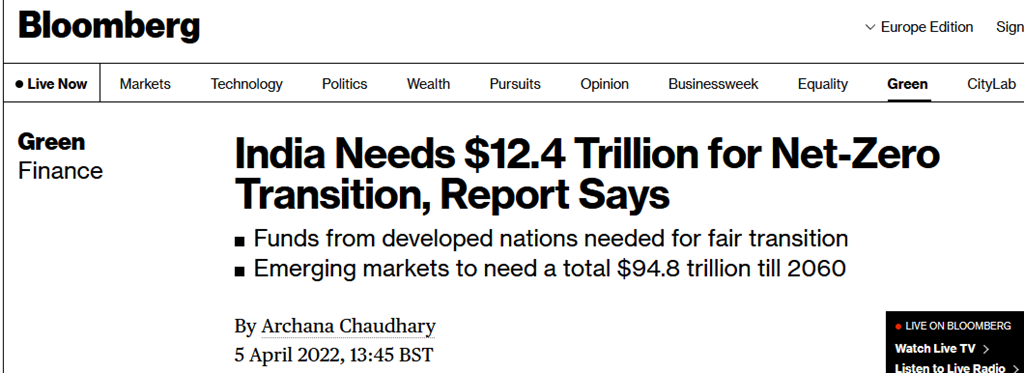
China & India need $50 trillion for Net-Zero transition, report says

From NOT A LOT OF PEOPLE KNOW THAT

APRIL 11, 2022

By Paul Homewood

Get your wallets out!

imageimage

Eight emerging markets — India, China, Indonesia, Kenya, South Africa, UAE, Nigeria and South Africa — will together need $94.8 trillion in transition finance from developed markets if they are to meet climate goals
India will need investments worth $12.4 trillion, nearly half of U.S. GDP, from developed nations and investors to help its economy transition to net-zero carbon emissions by 2060, according to a report.
Without capital inflows and grants from the developed world, emerging economies including India’s will see household consumption fall by 5% on average each year, according to a study by 
Standard Chartered Plc.
Eight emerging markets — India, China, Indonesia, Kenya, South Africa, UAE, Nigeria and South Africa — will together need $94.8 trillion in transition finance from developed markets if they are to meet climate goals without affecting their citizens’ cost of living, the report said. China alone will need $35.1 trillion, the calculations show.
Developing economies have raised concerns about richer nations not meeting their climate finance commitment of $100 billion, made in Paris in 2015. India sought 
$1 trillion in funding from the developed world to help meet its net-zero goal by 2070, during the global climate talks in November.   
If India’s financial needs are provided by developed markets, household spending in its economy could increase by $7.9 trillion. Instead, if India were to self-finance its transition costs, the average Indian household spending could fall by as much as $5.8 trillion, according to the report.
The study suggests a mix of blended finance or joint spending by the public and private sectors to subsidize the cost of capital to cut investments risks, coupled with issuing sovereign green bonds by emerging markets as possible solutions to bridge the funding gap for climate change.
“If developed markets fail to channel net-zero investment into emerging markets while working on their own transition, there will be devastating implications for the planet,” the report said.

https://www.bloomberg.com/news/articles/2022-04-05/india-needs-12-4-trillion-for-net-zero-transition-report-says?mc_cid=9acd144434&mc_eid=4961da7cb1

via Watts Up With That?

https://ift.tt/z2hTmu8

April 13, 2022 at 04:14AM