Month: April 2022

Part 3 Of IPCC’s 6th Climate Report Gets Mixed Reaction From The European Media, Not All Pessimistic

By Die kalte Sonne

The third part of the IPCC’s 6th Assessment Report has been published and the response to it varies widely. The BBC speaks of a “now or never moment.” The problem with such terms is that they unfortunately wear out very quickly because they are again more or less deadlines. The BBC assumes that mankind has a maximum of 3 years left to turn the tide..

“But keeping temperatures down will require massive changes to energy production, industry, transport, our consumption patterns and the way we treat nature.

To stay under 1.5C, according to the IPCC, means that carbon emissions from everything that we do, buy, use or eat must peak by 2025, and tumble rapidly after that, reaching net-zero by the middle of this century.

To put it in context, the amount of CO2 that the world has emitted in the last decade is the same amount that’s left to us to stay under this key temperature threshold.

„I think the report tells us that we’ve reached the now-or-never point of limiting warming to 1.5C,“ said IPCC lead author Heleen De Coninck, who’s Professor of Socio-Technical Innovation and Climate Change at Eindhoven University of Technology.

Speaking to BBC News she said: „We have to peak our greenhouse gas emissions before 2025 and after that, reduce them very rapidly.

„And we will have to do negative emissions or carbon dioxide removal in the second half of the century, shortly after 2050, in order to limit warming to 1.5C.“”

Meanwhile Germany weekly Zeit also covers the report, but with somewhat less drama than the BBC. After all, Zeit also discusses measures that are either hardly used or even banned in Germany, such as carbon capture.

Because it can’t be completely implemented that way, all future unavoidable greenhouse gas emissions must be offset by pulling them back out of the atmosphere. How can that be done? Through reforestation and other natural approaches, for example, but their effectiveness is shrinking as climate change progresses. Or mankind is turning to technologies such as carbon capture and storage (CCS) – the injection and storage of carbon in reservoirs. However, these methods are controversial and so far do not work adequately.”

Axel Bojanowski of Die Welt seems far less pessimistic. He also addresses the issue of carbon capture in a factual article.

Negative emissions could capture up to 12 complete annual rations of global greenhouse gas emissions by 2100, the climate report says. Dumping CO2 underground (CCS, carbon capture and storage) could make it possible to use fossil energy sources ‘for longer,’ the IPCC writes. However, the process is met with massive resistance, especially in Germany, and was therefore stopped, which the IPCC indirectly criticizes: The use of CCS worldwide is ‘far below the pathway for the two-degree target.’ Policy instruments could reduce the barriers, the IPCC writes.

In an opinion piece (paywall article), Bojanowski writes about conflicting goals, among other things.

At the same time, the UN has set 16 other human goals in addition to limiting warming, such as overcoming hunger and poverty, improving education and health, and ensuring the availability of cheap energy. Above all, the IPCC recognizes opportunities for synergies with the other human goals. But why is the push for fossil fuels still so strong, especially in poor countries, when, according to the IPCC, there are almost only benefits to turning away from coal, oil and gas?”

Donate – choose an amount

via NoTricksZone

https://ift.tt/18cwoAm

April 9, 2022 at 10:43AM

IPCC World’s Last Chance (Again)

Getty Images

James Macpherson reports on the latest deadline in his Australian Spectator article The IPCC say the world is ending! (Again?) .H/T John Ray.  Excerpts in italics with my bolds.

In the latest ‘now or never!’ since the ‘last now or never!’ the United Nations has warned the world that it is once again ‘now or never!’ to avoid disastrous Climate Change.

Forget Prince Charles’ warning back in July 2009 that we had just 96 months to save the planet.

Ignore former British PM Gordon Brown’s prediction, just three months later, that we had fewer than 50 days to avoid disaster.

And never mind French Foreign Minister Laurent Fabius who, standing beside then American Secretary of State John Kerry, told the world on May 13, 2014, that ‘we have 500 days to avoid climate chaos’.

The irony of that particular Chicken Little routine was that Fabius was scheduled to host the 21st Conference of the Parties on Climate Change on November 30 the following year – 65 days after the world, by his reckoning, would have ended.

I was going to quip that you couldn’t make this stuff up, but it seems like they do.

Anyway, enough joking around. This is it. Seriously. They’re not even kidding this time. Honestly. Like, for real guys. ‘It’s now or never!’

Yes, I know that’s what American defence chiefs were warning back in 2004 when they predicted European cities would sink beneath rising seas, and that Britain would be plunged into ‘a Siberian climate’ by 2020.

But it wasn’t like they got everything wrong.

Their predictions of widespread rioting across the world by 2020 did come to pass. And if you overlook the fact that the rioting was caused by the death of George Floyd and the imposition of compulsory injections – rather than the complete collapse of the ecosystem – you’ll see just how prescient the defence chiefs were.

You can’t expect climate catastrophists to get it right all the time. Or any of the time. It’s not like they’re astrologers.

Doomsday was predicted but failed to happen at midnight.

The important thing to worry about is that things are now a lot more worrying than the last time we were warned to worry, and so there is now good reason to be worried.

We have this week reached a tipping point that is even pointier than every other tipping point so far reached; which is to say we will soon be at a point of no return that is well past the point of no return that we were last warned there was no returning from.

The latest UN climate panic comes in the form of what media outlets called ‘a massive 3,000-page document’ published Monday.

It’s unlikely anyone will read all 3,000 pages, but no one should need to. The sheer size of the document – let me remind you, it’s ‘massive’ – tells you everything you need to know.  Things are bad.

And if the thickness of the report does not convince you that things are dire, environmentalists at the UN can make their next dossier of doom and gloom run twice that length. It’s only trees, after all.

Let me remind you just how massively bad things are.

Back in 1972, the then UN Under General Secretary Maurice Strong warned we had ‘only 10 years to stop the catastrophe’.

In 1982, which was the deadline for stopping the catastrophe, the head of the UN Environment Program Mostafa Tolba told us we had just 18 more years before we would face an environmental catastrophe ‘as irreversible as any nuclear holocaust’.

Just eight years later, he was insisting we needed to fix global warming by 1995 or we would ‘lose the struggle’.

The great climate doomsday of 1995 failed to materialise, as did the climate Armageddon of 2000. But the flurry of final warnings, last chances, and tipping points continued; every prediction more hysterical than the last.

UN Climate Panel chief Rajendra Pachauir, who was no doubt surprised to still be here in 2007, warned that ‘if there is no action before 2012, that’s too late’. He further insisted that ‘what we do in the next two to three years will determine our future’.

Our betters spent the next two or three years jetting around the globe, holding lots of conferences and summits, which must have saved our bacon since not only did we survive the predicted 2012 apocalypse, but we hung on grimly until 2019 at which point the UN informed us we had just 11 years to prevent irreversible damage from climate change.

To emphasise just how serious things were, they invited a Swedish school girl to berate them for robbing her of her dreams, or something. These days she’s performing Rick Astley covers for adoring fans.

Now, just three years into that 11-year do-or-die period,
we are being told that it’s ‘now or never’.

One could be forgiven for thinking that when the world doesn’t end as these activists predict, they simply change the date and call it science.

The UN report, the most comprehensive report since the last most comprehensive report, says emissions must be curbed by 2030 or things will be even worse than the last time we were told they couldn’t possibly be any worse.

The report says that people must change their diets and their lifestyles which, as we already know, means eating bugs and walking.

And if we fail to heed the latest hysterical shrieks from those who warn of rising sea levels while purchasing beachside mansions, we can be sure there will be even shriekier histrionics in the future.

This is it. Our final, cataclysmic warning. Until the next one. And probably the one after that.

When the UN insist that it is ‘now or never’ for climate action, what they really mean is that they want now and never-ending emergencies as a pretext for herding us around the room. First here and then there, but never to an exit.

via Science Matters

https://ift.tt/6vaJWbA

April 9, 2022 at 10:24AM

More than half of all new UK cars to be electric by 2028 in bid to ditch petrol and diesel

From NOT A LOT OF PEOPLE KNOW THAT

By Paul Homewood

Sheer madness!

MORE than half of all UK cars should be electric by 2028, according to the Government, as it looks to solidify plans for a Zero Emission Vehicle (ZEV) mandate.

Grant Shapps is looking to set legally binding targets to speed up the shift away from petrol and diesel, and towards the mass adoption of electric vehicles. In its new report, the Department for Transport proposed legally binding annual targets that car manufacturers will be forced to meet before 2035.

In less than eight years, the Government will ban the sales of new petrol and diesel vehicles in the UK.

Just five years later, a similar ban will be introduced to restrict sales of hybrid vehicles.

The proposed scheme would start in 2024, when manufacturers would have to sell all-electric cars, which account for 22 percent of their total sales.

The Government document added: “There is a level of uncertainty based on the form of wider policy measures and future demand, but this modelling assumes that by 2030 a minimum of 80 percent of all new UK car sales are zero emission.

“It assumes a 22 percent mandate in 2024 and 52 percent in 2028.

“Alongside ZEV uptake, it also assumes further efficiency improvements to non ZEVs.”

In 2030, the European Union expects approximately 46 percent of all new car sales to be ZEV across the EU.

The document stated that the UK is a leading ZEV market in Europe, so would expect to be above this average value.

The Society of Motor Manufacturers and Traders said that new rules “must encourage consumers to purchase, not just compel manufacturers to produce”.

SMMT chief executive Mike Hawes said: “The danger is that consumers will lack the incentive to purchase these new vehicles in the quantities needed, keeping their older, more polluting vehicles for even longer thereby undermining the carbon savings this regulation seeks to deliver.”

https://www.express.co.uk/life-style/cars/1593104/electric-car-sales-uk-zero-emission-vehicle-mandate-consultation-dft

If this is not an admission that for most drivers EVs are absolutely useless, I don’t know what is!

It also raises the question of how these quotas will be enforced. After all, car manufacturers cannot force people to buy EVs. And we already know that huge discounts don’t make any difference, because the government has already tried them.

I have read rumours that manufacturers will be fined if they don’t hit the targets, which simply means that these will be added to the price of conventional cars, to the detriment of drivers. If that is the case, people will simply tend to buy imported cars instead, who presumably won’t be affected by the quota.

This whole business is an example of how we are all gradually losing our freedom of choice.

via Watts Up With That?

https://ift.tt/DoyMWpC

April 9, 2022 at 08:05AM

Melting ice caps may not shut down ocean current, say researchers 

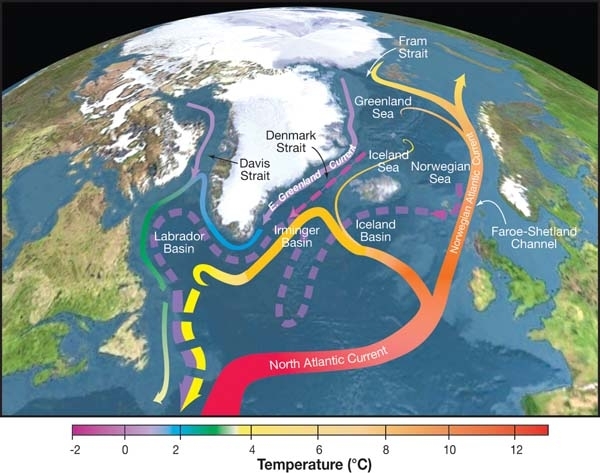
A portion of the Atlantic meridional overturning circulation [image credit: R. Curry, Woods Hole Oceanographic Institution @ Wikipedia]

Another supposed climate tipping point, popular with the alarm-loving media, floats away? A feature that’s “built into many models” was found not to work as advertised.
– – –
Most simulations of our climate’s future may be overly sensitive to Arctic ice melt as a cause of abrupt changes in ocean circulation, according to new research led by scientists at the University of Wisconsin–Madison.

Climate scientists count the Atlantic Meridional Overturning Circulation (or AMOC) among the biggest tipping points on the way to a planetary climate disaster, says Phys.org.

The Atlantic Ocean current acts like a conveyor belt carrying warm tropical surface water north and cooler, heavier deeper water south.

“We’ve been taught to picture it like a conveyor belt—even in middle school and high school now, it’s taught this way—that shuts down when freshwater comes in from ice melt,” says Feng He, an associate scientist at UW–Madison’s Center for Climatic Research.

However, building upon previous work, He says researchers are revising their understanding of the relationship between AMOC and freshwater from melting polar ice.

In the past, a stalled AMOC has accompanied abrupt climate events like the Bølling-Allerød warming, a 14,500-year-old, sharp global temperature hike. He successfully reproduced that event using a climate model he conducted in 2009 while a UW–Madison graduate student.

“That was a success, reproducing the abrupt warming about 14,700 years ago that is seen in the paleoclimate record,” says He, now. “But our accuracy didn’t continue past that abrupt change period.”

Instead, while Earth’s temperatures cooled after this abrupt warming before rising again to plateau at new highs for the last 10,000 years, the 2009 model couldn’t keep pace. The simulated warming over the northern regions of the planet didn’t match the increase in temperatures seen in geological archives of climate, like ice cores.

In a study published this week in the journal Nature Climate Change, He and Oregon State University paleoclimatologist Peter Clark describe a new model simulation that matches the warmth of the last 10,000 years.

And they did it by doing away with the trigger most scientists believe stalls or shuts down the AMOC.

Continued here.

via Tallbloke’s Talkshop

https://ift.tt/eaj62yp

April 9, 2022 at 04:40AM