Month: April 2022

Solar Cycle Update: The Gap is Growing

.
.
Trend or blip? The former looks more likely at the moment, but the sun can cause surprises.

Spaceweather.com

April 5, 2022: New sunspot counts from NOAA confirm that Solar Cycle 25 is racing ahead of the official forecast–and the gap is growing:

See the complete labeled plot or play with an interactive version from NOAA

Sunspot counts have now exceeded predictions for 18 straight months. The monthly value at the end of March was more than twice the forecast, and the highest in nearly 7 years.

The “official forecast” comes from the Solar Cycle Prediction Panel, a group of scientists representing NOAA, NASA and International Space Environmental Services (ISES). The Panel predicted that Solar Cycle 25 would peak in July 2025 as a relatively weak cycle, similar in magnitude to its predecessor Solar Cycle 24. Instead, Solar Cycle 25 is shaping up to be stronger.

In March 2022, the sun produced 146 solar flares, including one X-flare and 13 M-flares. Auroras were sighted as far south…

View original post 38 more words

via Tallbloke’s Talkshop

https://ift.tt/hOvgwTu

April 6, 2022 at 02:34AM

How Big Banks Conspire to Wreck Reliable & Affordable Energy Supplies

That the big end of town is keen to profit from the greatest economic and environmental fraud of all time, is no secret.

Banks have been attempting to wreck reliable and affordable power supplies, for the best part of 20 years, dressing it up as “corporate social responsibility”.

There’s nothing moral about it; it’s all about ensuring the massive subsidies to wind and solar continue to roll until kingdom come.

So, it should come as no surprise that the suits that run the finance sector are doing everything in their power to stack the odds in favour of hopelessly unreliable wind and solar, where the massive mandated subsidies guarantee over-the-market returns to rent-seeking investors.

As NSW’s Premier during the 1920s, Jack Lang quipped “Always back the horse named self-interest, son. It’ll be the only one trying.”

If this country were better governed, these characters would all be charged with treason. Alan Moran details the depth of the disaster being engineered by those who profit most.

Will war end the climate alarmist zeal of the central banks?
Spectator Australia
Alan Moran
21 March 2022

Faced with implacable opposition from the Senate, Sarah Bloom Raskin, President Biden’s pick for supervising banks within the Federal Reserve (Fed), has withdrawn her candidature. During the Obama administration, she was one of the Fed’s seven governors and a Treasury deputy secretary.

Her rejection by the Senate was a result of her expressed intent ‘to incentivise a rapid, orderly, and just transition from fossil fuels and other high-emission investments’.

Not so long ago, that opinion would have not been a barrier to the job – indeed her appointments under Obama faced little opposition. But such views became more controversial with Biden’s re-installation of Obama’s anti-oil and gas regulations and the consequent return of the US to becoming a net importer. The Ukrainian war brought home the serious strategic implications of impeding fossil fuel production and last week the swing Senators, Democrat Joe Manchin and Republicans Susan Collins and Lisa Murkowski, pulled the plug on Raskin.

There have been few central bankers as woke as climate activist Mark Carney, the former Governor of the Bank of England, who is now with investment conglomerate Brookfield. At Brookfield, Carney joined fellow activist Mike Cannon-Brookes of Atlassian in bidding for AGL with a view to expediting the firm’s departure from fossil fuels.

Though Carney may have been a stand-out, most banking bureaucrats are infected with alarmist zeal and central banks are coordinating internationally to press their philosophy through the Network for Greening the Financial System (NGFS) and the Task Force on Climate-related Financial Disclosures (TCFD).

In this respect, Australia may have dodged a bullet with the departure from the Reserve Bank of Guy Debelle, who had been the heir-presumptive Governor. He was described as a ‘green energy crusader’ even by fellow hydrocarbon haters at the AFR. Debelle will now help Twiggy Forrest’s Fortesque tilt at windmills, postulate about hydrogen as a future fuel and trumpet pie-in-the-sky $210 billion schemes, like that linking Singapore with an Australian desert paved with solar panels.

Perhaps Debelle was pushed out of contention for the Reserve Bank’s top job or maybe he recognised a growing unease within governments about climate fanatics occupying high places.

The USA and EU between them have spent an estimated $5 trillion on renewable energy over the past 20 years (Australia has spent relatively more). Almost all of renewable energy installations have relied on the support of subsidies, and while the subsidies have savaged the economics of fossil fuel, its share of total energy use has fallen by just two per cent to 84 per cent.

The world has certainly changed since Russia’s invasion of Ukraine. Among other lessons, this has shown many politicians that calls for decarbonisation were luxuries that cannot be indulged in the dangerous world which Putin’s actions have revealed we inhabit.

In the UK, Prime Minister Boris Johnson, under pressure, is reneging on his 2021 green exhortations and walking, crab-like, towards permitting new oil and gas fields – even to allowing fracking for gas – and re-opening coal generators.

In this context, it is doubtful that the Bank of England Governor, Andrew Bailey, would today deliver a speech like that he gave in 20 November last year.  In that speech Bailey outlined a range of further actions necessary to meet the net zero emissions goals of the Bank of England, goals that are broadly shared by all other democratic nations’ central banks. The Bank’s measures included ensuring that the 1,500 financial intermediaries that it regulates ‘hold capital against material climate-related financial risks’. The Governor foreshadowed a ‘wider supervisory toolkit’ to incentivise firms to take meaningful actions in support of climate transition, adding, ‘Where progress is insufficient and assurance or remediation is needed, the (Bank’s Prudential Regulatory Authority) will request clear plans and, where appropriate, exercise its powers,’ to ensure this is rectified.

Even if such thunderous admonitions will now be diluted, repairing the damage will be slow.

It will be slower still for Australia where, almost daily, Energy Minister Angus Taylor issues press releases that pontificate about how government action is securing the future of steel through renewable energy, increasing (subsidised) rooftop energy, causing firms to raise ‘the bar for corporate emissions accountability’, as well as providing additional handouts for hydrogen and emissions reductions. As if this were not bad enough, Taylor would correctly warn us that, if in May we have an ALP Government, the damaging policies would worsen.

Changing course for Australia is proving a more laborious process than in the rest of the world. But everywhere, the accumulation of central bank regulations, procedures, recruitments and policy directives leave a powerful residue that will continue to hamper the redirection of capital towards commercial energy. In doing so, central bank directives, alongside other similar policies, will leave western democracies less able to confront the dangerous world that recent events have revealed.
Spectator Australia

One event they didn’t bank on.

via STOP THESE THINGS

https://ift.tt/tHpeFl5

April 6, 2022 at 02:34AM

The Many Benefits of Rising Atmospheric CO2 — An Introduction

Dr. Craig Idso, Chairman of the Center for the Study of Carbon Dioxide and Global Change, and a new principal at MasterResource. invites readers to join him in a new series of articles discussing the many ways in which rising atmospheric carbon dioxide benefits humanity and nature.

Atmospheric carbon dioxide: you can’t see, hear, smell or taste it. But it’s there—all around us—and it’s crucial for life. Composed of one carbon and two oxygen atoms, this simple molecule serves as the primary raw material out of which plants construct their tissues, which in turn provide the materials out of which animals construct theirs. Knowledge of the key life giving and life sustaining role played by carbon dioxide, or CO2, is so well established, in fact, that humans—and all the rest of the biosphere—are described in the most basic of terms as carbon-based lifeforms. We simply could not and would not exist without it.

Ironically, far too many demonize and falsely label this important atmospheric trace gas a pollutant. Nothing could be further from the truth. Instead of being shunned like the plague, the ongoing rise in CO2 should be welcomed with open arms.

How do I know this?

During the past three decades of my professional career I have performed countless hours of research, conducted multiple experiments, published a series of professional journal articles, written several books, created videos and feature-length documentaries, and authored thousands of commentary articles exploring the effects of CO2 on the biosphere (much of that work can be found at my CO2 Science website, www.co2science.org). In all those activities I have come to know that, far from being a pollutant, this colorless, odorless, tasteless and invisible gas benefits the biosphere in a multitude of ways. And I want to share that knowledge with you!

To accomplish this objective, over the next several months I will be publishing a series of articles describing several key benefits atmospheric CO2 enrichment provides to both humanity and nature. The articles will explore topics such as the effects of CO2 on plant growth and water use efficiency, a CO2-induced greening of the planet, the monetary benefits of rising CO2 on crop yields, and much, much more. Look for the postings at a rate of about two per month.

Sadly, most of the population remains woefully unaware of the many positive impacts of CO2 on the biosphere. This is no surprise, considering the constant and steady stream of misinformation our society endures from sources dedicated to demeaning and defaming CO2. What is more, world governments, non-governmental organizations, international agencies, societal think tanks, and even respectable scientific organizations attempting to assess the potential consequences of increasing atmospheric CO2 concentrations have spent hundreds of millions of dollars writing and promoting large reports about it.

Yet, these endeavors have failed miserably because they have neglected to evaluate or even acknowledge the manifold real and measurable benefits of the ongoing rise in the air’s CO2 content.  As a result, many important and positive impacts of atmospheric CO2 enrichment remain underappreciated and largely ignored in the debate over what to do, or not do, about anthropogenic CO2 emissions. And that omission does not bode well for policy decisions.

I hope you will join me on this informative journey as we explore the many benefits of CO2 and I hope you will share what you read and learn with others. Societal change occurs as individuals become informed one by one. Together we can help make that happen!

-Dr. Craig Idso

—————————————————————————————————————-

CRAIG D. IDSO is the founder, former president, and currently chairman of the Center for the Study of Carbon Dioxide and Global Change. The Center was founded in 1998 as a non-profit public charity dedicated to discovering and disseminating scientific information pertaining to the effects of atmospheric carbon dioxide enrichment on climate and the biosphere. The Center produces the online newsletter, CO2 Science, and maintains a massive online collection of editorials on and reviews of peer-reviewed scientific journal articles relating to global climate change.

Dr. Idso’s research has appeared many times in peer-reviewed journals, including Geophysical Research LettersEnvironmental and Experimental BotanyForest Ecology and ManagementJournal of ClimatePhysical GeographyAtmospheric EnvironmentTechnologyThe Quarterly Review of BiologyEnergy & Environment, and the Journal of the Arizona-Nevada Academy of Science.

Dr. Idso is the author or coauthor of several books, including The Many Benefits of Atmospheric CO2 Enrichment (Vales Lake Publishing, LLC, 2011), CO2, Global Warming and Species Extinctions (Vales Lake Publishing, LLC, 2009), CO2, Global Warming and Coral Reefs (Vales Lake Publishing, LLC, 2009); Enhanced or Impaired? Human Health in a CO2-Enriched Warmer World (Center for the Study of Carbon Dioxide and Global Change, 2003); and The Specter of Species Extinction: Will Global Warming Decimate Earth’s Biosphere? (George C. Marshall Institute, 2003). He contributed chapters to McKittrick, R. (Ed.), Critical Topics in Global Warming (Fraser Institute, 2009) and Encyclopedia of Soil Science (Marcel Dekker, 2002). Dr. Idso has also produced several short video works and three feature-length documentariesCarbon Dioxide and the Climate Crisis: Reality or Illusion? (2008), Carbon Dioxide and the Climate Crisis: Avoiding Plant and Animal Extinctions (2008), and Carbon Dioxide and the Climate Crisis: Doing the Right Thing (2008).

In 2009, Dr. Idso became the lead author and editor for the Nongovernmental International Panel on Climate Change (NIPCC), overseeing a team of internationally renowned scientists in the production of several major reports on climate change. Those reports include Climate Change Reconsidered: The 2009 Report of the Nongovernmental International Panel on Climate Change (NIPCC)Climate Change Reconsidered: 2011 Interim ReportClimate Change Reconsidered II: Physical Science, and Climate Change Reconsidered II: Biological Impacts. His most recent work with NIPCC is encapsulated in its 2019 report, Climate Change Reconsidered II: Fossil Fuels, where he contributed as a lead or contributing author on several chapters.

Dr. Idso received a B.S. in Geography from Arizona State University, an M.S. in Agronomy from the University of Nebraska – Lincoln, and a Ph.D. in Geography from Arizona State University, where he also studied as one of a small group of University Graduate Scholars. Prior work positions have included Director of Environmental Science at Peabody Energy in St. Louis, Missouri, faculty researcher in the Office of Climatology at Arizona State University, and lecturer in Meteorology at Arizona State University.

Dr. Idso’s professional associations have included membership in the American Association for the Advancement of Science, American Geophysical Union, American Meteorological Society, Arizona-Nevada Academy of Sciences, Association of American Geographers, Ecological Society of America, Geological Society of America, and The Honor Society of Phi Kappa Phi. Dr. Idso has also served as an adjunct scholar for the Cato Institute and he is presently a policy advisor for the CO2 Coalition, the Heartland Institute and the Committee For A Constructive Tomorrow.

The post The Many Benefits of Rising Atmospheric CO2 — An Introduction appeared first on Master Resource.

via Master Resource

https://ift.tt/uC3H8BU

April 6, 2022 at 01:07AM

Population Bombing

News Brief by Kip Hansen – 6 April 2022

NATURE magazine published a Book Review of a new book out from Jennifer D. Sciubba titled:  “8 Billion and Counting: How Sex, Death, and Migration Shape Our World”.    

Quoting the Nature review:

“Japan is ageing so rapidly that if current trends continue, the nation could eventually disappear altogether”, writes Jennifer Sciubba in her data-packed book 8 Billion and Counting.

Almost eight billion people live on Earth; their futures are highly divergent, argues Sciubba, a senior associate at Washington DC think tank the Center for Strategic and International Studies. The twenty-first century “is less a story about exponential population growth than it is a story about differential growth — marked by a stark divide between the world’s richest and poorest countries”, she writes.”

In Latin America and the Caribbean, eastern and southeast Asia, Europe and North America, Australia and New Zealand, the total fertility rate (TFR), or average number of children a woman is likely to have in her lifetime, was below replacement level (around 2.1 children per woman) in 2020. By contrast, sub-Saharan Africa’s population is set to increase sixfold this century; its TFR is 4.72, down from 5.88 two decades ago. In Nigeria, children and adolescents are half of the population. In rural towns in South Korea, primary schools are closing for lack of pupils, whereas urban areas of Lagos ring “with the sounds of children playing”….

The book is fascinating, but no real surprises are to be found for those who actually follow population trends.   [ I certainly hope that the book reviewer is misquoting the book author about Japan “eventually disappearing.” ]

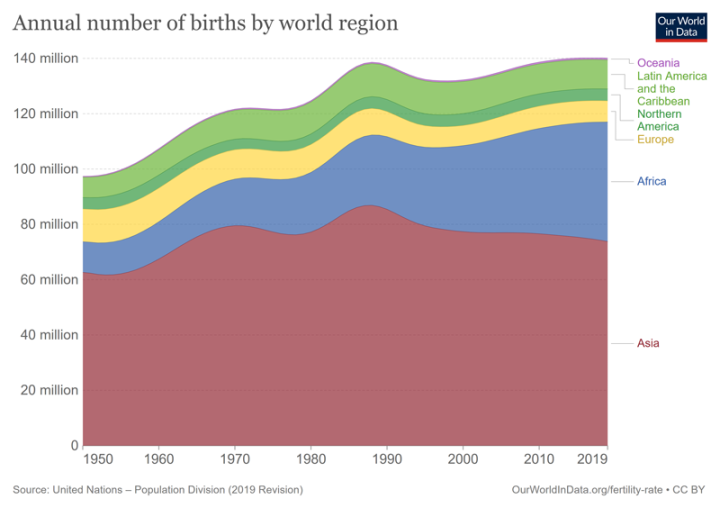
You might be interested in seeing some of the actual data:

Two things of interest stand out:  1) This is the actual number of births.  Focus on the right -hand side of the graphic and on the width of colored area.  Asia we see is responsible for the largest number of total birth but the width of the bar is narrowing – there are fewer births each year.  The opposite is true for Africa, the blue band is getting wider and eider, more and more births.  It is harder to see, but Europe is narrowing with fewer births, with North America remaining more or less stable.  Latin America and the Caribbean births are increasing.

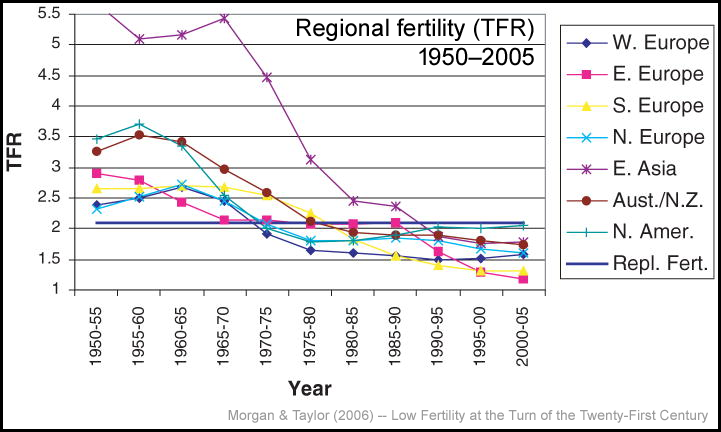
The second interesting thing is that births dipped sharply in the 1970 and in the 1990s.  One might speculate that the spreading use of the birth control pill after 1965 caused the first dip. The 1990s dip is best explained by this chart of regional fertility:

In this study, we see plummeting fertility rate in East Asia dropping below the replacement level through the 1990s.  Note that Africa is not on this chart.  China’s “one child policy” was not implemented until 1980.

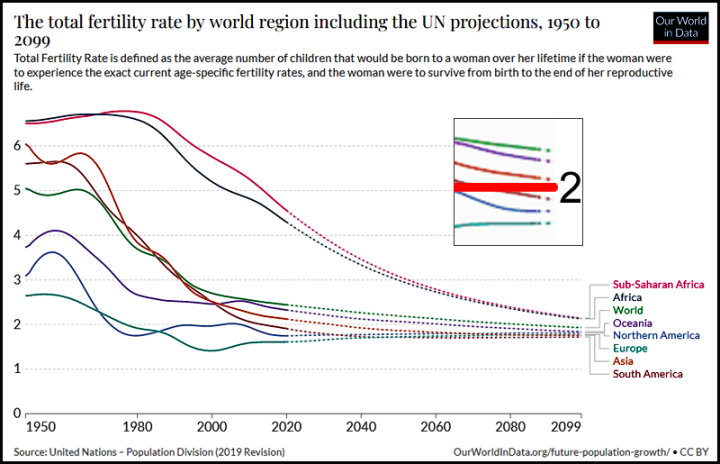
Our World in Data offers this speculative version:

The top two traces are Africa which is the obvious outlier with TFR above 4 while the rest of the world is 2.5 and below.  The breakout box shows the number of regions that are already below the replacement level which include both North and South America and Europe. 

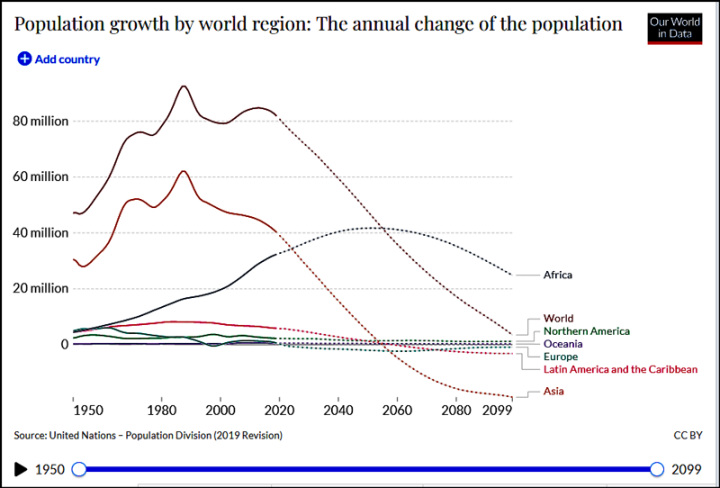
One more then readers can discuss the news:

Here we see that world population growth (the upper-most trace) mirrors Asia growth (the dark red, second trace down).  However, the sharp decline in Asian growth is being clearly offset by rising growth in Africa, which is the only region shown to be rising substantially.

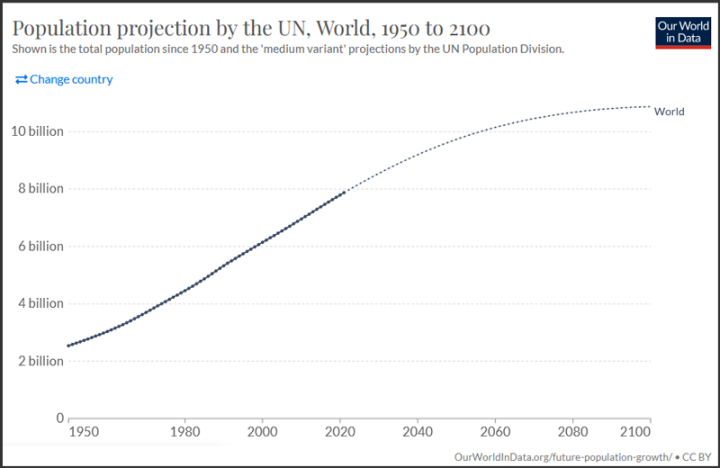
And for World Total Population?  The numbers are rising and will continue to as human life spans increase and reproduction does not stop.  The United Nations predicts it will peak out at about 11 billion around 2100.

What are the reasons for this pattern?  What are the causes for the rises and falls in population? 

# # # # #

Author’s Comment:

Don’t ask me – I don’t know.  I do know that birth rates fall as standard of living increases, at least historically. 

Worldwide, births have leveled off.  Regionally, births are falling except in Africa.  Many advanced nations have birth rates that fall below replacement and these nations can be shown to be importing workers from other less fortunate nations.  The agricultural sector of the U.S. economy has been doing so for decades and is now doing so for the lower skills of the building trades. 

I haven’t the slightest idea what this all means for human society over the next 50 years – but it is as obvious as noonday sunshine that there is no Ehrlich-ian Population Bomb going off. 

Include the name the person to whom you speaking in your comment – if not just a general statement.

Thanks for reading.

# # # # #

via Watts Up With That?

https://ift.tt/J68FaSC

April 6, 2022 at 12:42AM