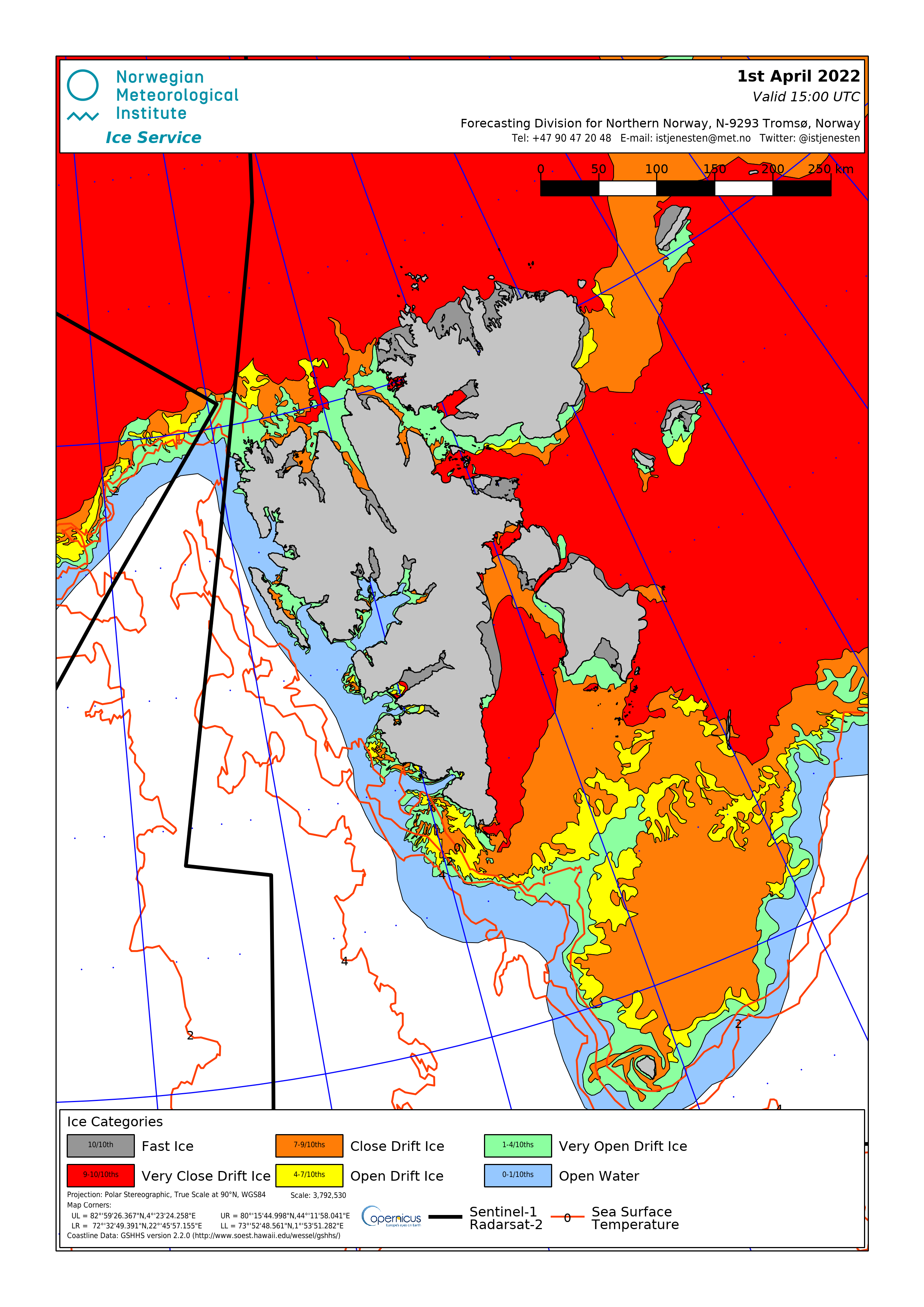
The average sea ice cover at the end of March is the metric used to compare ‘winter’ ice to previous years or decades, not the single-day date of ‘most’ ice. This year, March ended with 14.6 mkm2 of sea ice, most of which (but not all) is critical polar bear habitat. Ice charts showing this are below.
But note that ice over Hudson Bay, which is an almost-enclosed sea used by thousands of polar bears at this time of year, tends to continue to thicken from March into May: these two charts for 2020 show medium green becoming dark green, indicating ice >1.2 m thick, even as some areas of open water appear.
To keep the above graph in perspective (which because of the scale looks like a huge decline), see the graph below showing extent for March vs. September to 2021
Southern Greenland/Davis Strait closeup, via NSIDC
Overall, nothing spectacular in terms of change compared to last few years: still lots of ice for polar bears to hunt upon for newborn seals, which they will be doing now in almost all regions.
IMAGE: TAKEN IN 1993, THIS PHOTO SHOWS THE MORTALITY OF HISTORICAL FORESTS OF ATLAS CEDAR IN MOROCCO.view more CREDIT: CSABA MÁTYÁS, PROFESSOR EMERITUS, UNIVERSITY OF SOPRON, HUNGARY
How hot is too hot, and how dry is too dry, for the Earth’s forests? A new study from an international team of researchers found the answers – by looking at decades of dying trees.
Just published in the journal Nature Communications, the study compiles the first global database of precisely georeferenced forest die-off events, at 675 locations dating back to 1970. The study, which encompasses all forested continents, then compares that information to existing climate data to determine the heat and drought climatic conditions that caused these documented tree mortality episodes.
“In this study, we’re letting the Earth’s forests do the talking,” said William Hammond, a University of Florida plant ecophysiologist who led the study. “We collected data from previous studies documenting where and when trees died, and then analyzed what the climate was during mortality events, compared to long-term conditions.”
After performing the climate analysis on the observed forest mortality data, Hammond noted, a pattern emerged.
“What we found was that at the global scale, there was this consistently hotter, drier pattern – what we call a ‘hotter-drought fingerprint’ – that can show us how unusually hot or dry it has to get for forests to be at risk of death,” said Hammond, an assistant professor in the UF/IFAS agronomy department.
The fingerprint, he says, shows that forest mortality events consistently occurred when the typically hottest and driest months of the year got even warmer and drier.
“Our hotter-drought fingerprint revealed that global forest mortality is linked to intensified climate extremes,” Hammond said. “Using climate model data, we estimated how frequent these previously lethal climate conditions would become under further warming, compared to pre-industrial era climate – 22% more frequent at plus 2 degrees Celsius (plus 3.6 degrees Fahrenheit), to 140% more frequently at plus 4 degrees Celsius (plus 7.2 degrees Fahrenheit).”
Those higher temperatures would more than double how often forests around the world see tree-killing droughts, he adds.
“Plants do a phenomenal job of capturing and sequestering carbon,” Hammond said. “But death of the plants not only prevents their performing this critical carbon-capturing role, plants also start releasing carbon as they decay.”
Hammond says that relying, in part, upon trees and other plants to capture and sequester carbon, as some proposed climate solutions suggest, makes it is critical to understand how hot is ‘too hot,’ and how dry is ‘too dry.’ “Otherwise mortality events, like those included in our database, may wipe out planned carbon gains.”
One of the study’s co-authors, Cuauhtémoc Sáenz-Romero of Universidad Michoacana de San Nicolás de Hidalgo in Mexico, offered an example of how recent climate patterns affected a Mexican temperate forest.
“In recent years, the dry and warm March to May season is even more dry than usual, but also warmer than ever,” he said. “This combination is inducing a lot of stress on the trees before the arrival of the next June-to-October rainy season. For example, in 2021, more than 8,000 mature trees were killed by bark beetles in the Monarch Butterfly Biosphere Reserve in Central Mexico. The effect of the La Niña Pacific Ocean stream resulted in drier, warmer conditions; a deadly combination that favored pest outbreaks.”
Hammond has also developed an interactive application on the website of the International Tree Mortality Network to host the database online and to allow others to submit additional observations of forest mortality to the database.
EXPLAINERS
‘Georeferenced’
Using maps or aerial images, scientists assign to them real-world coordinates.
‘Ground-truthed’
Information confirmed or validated by direct observation and measurement. In the case of machine learning, it refers to checking results for accuracy.
The organization, founded and coordinated by co-author Henrik Hartmann from the Max Planck Institute in Germany, among others, is a collaborative effort between scientists on every forested continent and aims to coordinate international research efforts on forest die-off events. Hammond is the network’s data management group leader.
“We’re hoping that this paper will create a bit of urgency around the need to understand the role of warming on forest mortality,” Hammond said. “Also, we expect that our open-access database will enable additional studies, including other climate fingerprints from local to regional scales. Current climate modeling and remote-sensing research communities need ground-truthed datasets to validate their predictions of important processes like forest mortality. One of the really important elements to this study was bringing all this data together for the first time, so that we can ask a question like this at the planetary scale.”
The paper, “Global field observations of tree die-off reveal hotter-drought fingerprint for Earth’s forests,” will be available at nature.com/articles/s41467-022-29289-2 . In addition to Hammond, Sáenz-Romero and Hartmann, it is also co-authored by A. Park Williams, University of California, Los Angeles; John Abatzoglou, University of California, Merced; Henry D. Adams, Washington State University; Tamir Klein, Weizmann Institute of Science; Rosana López, Universidad Politécnica de Madrid, Spain; David D. Breshears, University of Arizona; and Craig D. Allen, University of New Mexico.
-30-
The mission of the University of Florida Institute of Food and Agricultural Sciences (UF/IFAS) is to develop knowledge relevant to agricultural, human and natural resources and to make that knowledge available to sustain and enhance the quality of human life. With more than a dozen research facilities, 67 county Extension offices, and award-winning students and faculty in the UF College of Agricultural and Life Sciences, UF/IFAS brings science-based solutions to the state’s agricultural and natural resources industries, and all Florida residents. ifas.ufl.edu| @UF_IFAS
Benny is a former member of the German Greens and holds a PhD in Cultural Studies for a thesis examining the problems of ancient Greece. He will be talking about renewable energy, the UK experience in Brisbane and extend this to also discuss the war in the Ukraine when in Melbourne.
The GWPF was founded by Nigel Lawson, Margaret Thatcher’s Chancellor of the Exchequer – and father of cooking goddess Nigella Lawson.
I did once get to have lunch with Nigel Lawson; that was in Sydney many years ago. We had a view of the Opera House and he confirmed for me that the theory of catastrophic human-caused global warming really was the brainchild of Margaret Thatcher. She detested coal miners and wanted that industry closed. She succeeded in the UK, and the idea was since gone global.
A little before that lunch with Nigel Lawson, I had dinner in New York with Vladimir Putin’s Environment advisor Andrei Illarionov. We were at a conference in New York. Andrei was puzzled as to why The West was so enamoured with the idea of catastrophic human-caused global warming and pondered Margaret Thatcher’s involvement. We discussed Nigel Lawson and both admitted to being big fans of Nigella. Andrei’s own theory went that the Kyoto Protocol gave Germany and Britain an economic advantage because of the timing of their transition away from coal. He thought Thatcher a clever politician, who had outsmarted the Russians of her vintage.
As far as I know Andrei Illarionov is still advising Vladimir Putin on energy and environment issues. I wouldn’t be surprised if Russia one day cut the gas to the UK and Germany.
If that happened much of Europe might be left freezing in the dark and wishing for some coal.
I’m not sure if these are topics that will be discussed at the lunches in Melbourne, Sydney, or Brisbane? But they might be.




 Iowa Climate Science Education